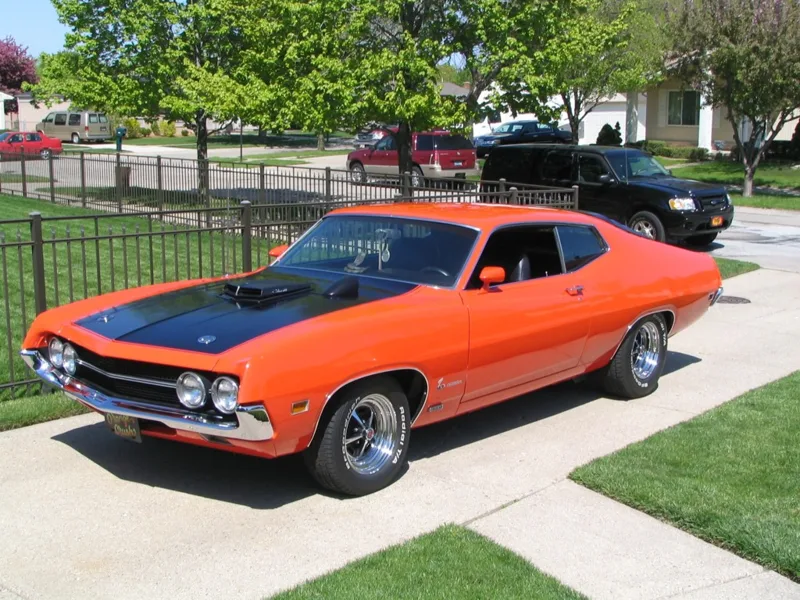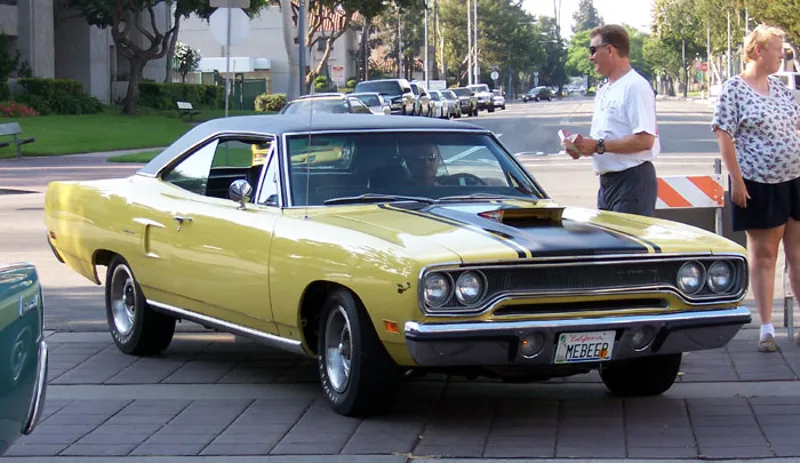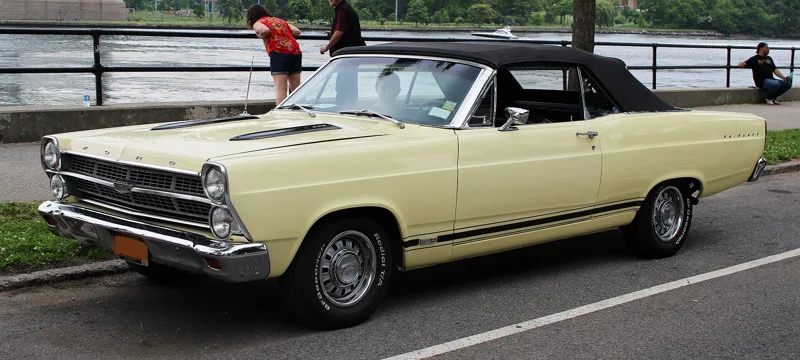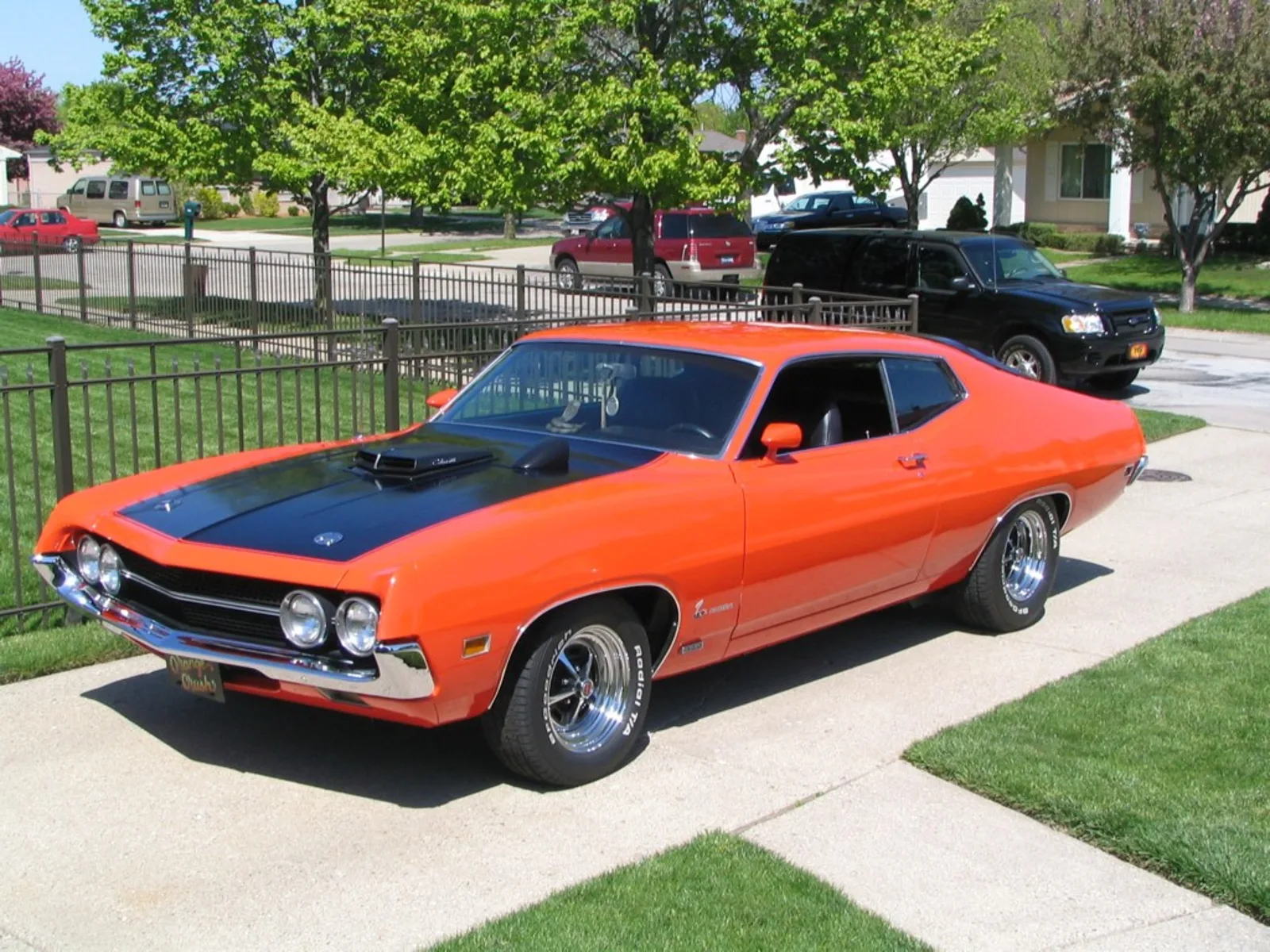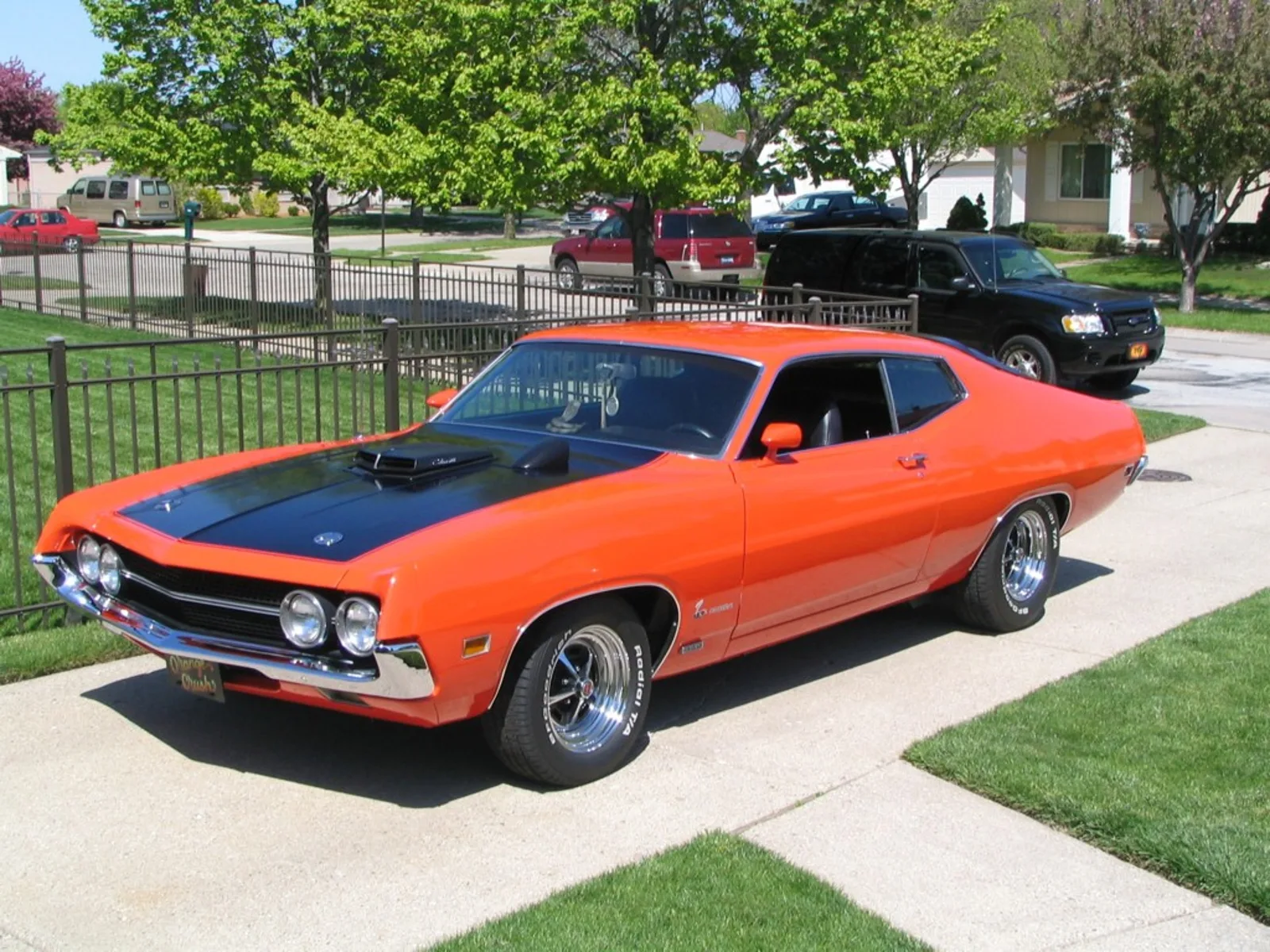
Two intermediate-size performance cars that competed for the same buyers, each with a lightweight-feeling engine option and a racing story on the side.
The Ford Torino and Plymouth Road Runner were rivals in the late-1960s muscle market, where the Torino offered the 428 Cobra-Jet and the Road Runner the 383 V8 and a $714 Hemi option. Both cars also took part in NASCAR, with the Superbird built for the 1970 season.
The Ford Torino and the Plymouth Road Runner met in the same showrooms in the late 1960s, when American muscle was at its loudest. The Torino was an intermediate built on Ford's Fairlane, while the Road Runner was a stripped-down mid-size car from Chrysler's B platform with a powerful engine and a price that undercut its rivals.
Both cars were sold in large numbers and both were tied to racing, but they took different routes to the street. One leaned on Ford's Cobra-Jet programme and a sports roof, and the other on a bare-bones trim level and the 383 V8 that the Road Runner made its own.
Were the Torino and Road Runner really rivals?
They competed for the same buyers in the same segment of the market. The Torino was a competitor in the intermediate class, while the Road Runner was built to undercut the more expensive muscle cars of its day, such as the Pontiac GTO and Plymouth's own GTX.
The two cars ran in the same era, with the Torino producing from 1968 to 1976 and the Road Runner's first generation covering 1968 to 1970. Their paths crossed most visibly in motorsport, where both brands fought for NASCAR success at the end of the decade.
Two muscle cars from the same era, each built to win on the street and, when it counted, on the speedway.
How did the Torino's engine range compare with the Road Runner's?
The Torino's standard engine was a 200 cu in (3.3 L) six, while the Torino GT came with a 302 cu in (4.9 L) V8. The most potent option was the 428 Cobra-Jet, introduced on 1 April 1968 and rated at 335 hp (250 kW).
The Road Runner had a different starting point. Its standard engine was an exclusive 383 cu in (6.3 L) V8 rated at 335 bhp (340 PS; 250 kW) at 5200 rpm, with 425 lb ft (576 N m) of torque at 3400 rpm.
Specifications side by side
| Specification | Ford Torino (1968) | Plymouth Road Runner (1968) |
|---|---|---|
| Production | 1968 to 1976 | 1968 to 1980; first generation 1968 to 1970 |
| Base engine | 200 cu in (3.3 L) six; 302 cu in (4.9 L) V8 in the GT | 383 cu in (6.3 L) V8, 335 bhp (340 PS; 250 kW) |
| Top engine option | 428 Cobra-Jet, 335 hp (250 kW), from April 1968 | 426 Hemi, 425 bhp (431 PS; 317 kW) |
| Torque | No figure given | 425 lb ft (576 N m) at 3400 rpm; Hemi 490 lb ft (664 N m) at 4000 rpm |
| Air conditioning engine | No figure given | 330 hp (246 kW) version, because the 335 bhp cam did not allow vacuum for air conditioning |
| Transmission | Three-speed manual standard; four-speed and Cruise-O-Matic optional | Four-speed manual standard; TorqueFlite automatic optional |
| Quarter mile | 15.8 seconds at 90 mph (140 km/h), GT with 390-4V (Car Life) | 14.3 seconds at 104 mph, Hemi Superbird (Road Test) |
| 0-60 mph | 7.7 seconds, GT SportsRoof with 390-4V (Car Life) | 5.5 seconds, Superbird with the Hemi (Road Test) |
| Option price | $306 for the Cobra-Jet | $714 for the Hemi |
| Output | 172,083 in 1968; 371,787 with Fairlane | 81,125 domestic in 1969, plus 3,295 in Canada and elsewhere |
| Racing | NASCAR base; 1968 Indianapolis 500 pace car in convertible form | 1970 Superbird built for NASCAR homologation |
What made the Cobra-Jet special?
The 428 Cobra-Jet arrived in April 1968, and its late introduction means these engines are now rare. It was the most potent engine available in the Torino range that year, and it is generally believed to be under-rated at 335 hp (250 kW).
Cars with the 428 carried emblems borrowed from the full-size Fords, a red-and-chrome badge reading 428 on the fenders behind the parking lamps. The Cobra-Jet option cost $306, and a Car and Driver test of a 428 CJ with Ram Air induction and C-6 automatic ran the quarter mile in 14.2 seconds, reaching 159.2 km/h (98.9 mph).
How fast was a 1968 Torino GT?
Car Life tested a 1968 Torino GT SportsRoof with a 390-4V engine, a C-6 automatic and a 3.25:1 axle. It recorded 0 to 60 mph (97 km/h) in 7.7 seconds, and its quarter mile took 15.8 seconds, with the car reaching 140 km/h (90 mph), a respectable figure for a car in this class.
Motor Trend wrote that tackling quick or tight corners in a Torino GT was more a matter of instinct than practised skill. That verdict sat alongside the magazine's praise for the GT's combination of power and handling.
Which Torino was the Cobra?
The 1969 Cobra was a sub-series with the same body code as a Fairlane 500, offered as a two-door SportsRoof and two-door hardtop. Ford marketed it as the Cobra without Torino or Fairlane attached, although the 1969 NASCAR entrants were labelled Torino Cobras.
The Cobra came with the 428 Cobra-Jet as standard. With Ram Air the car had a 3.50:1 open differential and a functional hood scoop, and it used a 735 cfm Holley four-barrel carburettor.
How did the Road Runner begin?
The Road Runner was a muscle car that Chrysler introduced in the United States for the 1968 model year under its Plymouth brand. It was based on the Belvedere, Plymouth's basic mid-size model, and paired a strong engine with stripped trim and a price below the more upscale muscle cars.
Plymouth paid $50,000 to Warner Bros.-Seven Arts for the use of the name and the cartoon likeness, and a further $10,000 to develop the beep-beep horn. The result was a back-to-basics mid-size performance car on the Chrysler B platform, shared with the Belvedere and Satellite.
What was inside the 1968 Road Runner?
The interior was spartan, with a basic vinyl bench seat and few options. Early cars lacked even carpet, and the floor-mounted shifter for the four-speed had a rubber boot and no console, so that a bench seat could be fitted.
Buyers could add power steering, front disc brakes, an AM radio, air conditioning (not with the Hemi) or an automatic. The Hemi was a $714 option, fed by 2X4 Carter AFB carburettors and making 317 kW (425 bhp; 431 PS) at 5000 rpm.
How did the Road Runner sell?
Plymouth expected to sell about 20,000 Road Runners in 1968, but actual sales came to around 45,000, more than double the forecast. That placed the Road Runner third among muscle cars, behind only the Pontiac GTO and the Chevy SS-396 Chevelle.
Dodge saw the success and debuted the Super Bee, a cousin of the Road Runner, in mid-1968. The Road Runner's convertible added 2,128 cars for 1969, though all but ten of those had the 383 engine.
What did the 1969 Road Runner add?
The 1969 model kept the same basic look, with changes to the taillights, grille and side marker lights, plus optional bucket seats and new Road Runner decals. The Air Grabber option, code N96, added a fibreglass air duct under the hood that connected to twin vents, with a lever under the dash to open and close them.
A 440 Six BBL, with three two-barrel Holley carburettors, arrived in mid-1969. Its 390 hp (395 PS; 291 kW) peaked at 4,700 rpm, while the 490 lb ft (664 N m) of torque arrived at 3200 rpm, matching the Hemi at a lower engine speed. About 1,432 of the 440 Six BBL cars were built.
How did the 1969 Torino change?
The number of intermediate models rose from 14 to 16, and the grille received a more prominent centre divider. The 250 cu in (4.1 L) six became the standard engine, with a new 351 cu in (5.8 L) Windsor V8 among the options.
The 428 Cobra-Jet was no longer the top engine. It was superseded by the 428 Super Cobra Jet, a drag-racing engine included with the Drag Pack option, which could be ordered with either the Q-code 428 or the R-code Ram Air 428.
Did the Road Runner win Car of the Year?
Motor Trend named the Plymouth Road Runner its Car of the Year for 1969, a rare honour for a car built on a budget. The award came in a year when the Road Runner's domestic production reached 81,125 cars for the three body styles.
The 1970 model year brought a new grille, bench seat, hood and front fenders, plus single-piston Kelsey-Hayes disc brakes in place of the earlier Bendix calipers. High Impact colours, including In-Violet, Moulin Rouge and Vitamin C, were available that year.
What happened to Road Runner sales in 1970?
Sales dropped by more than 50 percent to about 41,000 units, as the muscle car market itself weakened. Insurance companies added surcharges for muscle car policies, which made high-performance cars expensive to insure, and the convertible ended with 834 built.
Plymouth also introduced the compact Duster 340 for 1970, with a 275 hp (205 kW) 340 V8. It was priced below the Road Runner, and its smaller engine made insurance far cheaper than for the Road Runner.
How did the Superbird come about?
During the 1969 NASCAR aero wars, Chrysler fielded the Dodge Charger 500, a Charger with aerodynamic improvements, and later the Charger Daytona. Ford's Torino Talladega and Mercury Cyclone Spoiler II were quick fastbacks that the Chrysler cars struggled to match in 1969.
To meet NASCAR homologation rules, Plymouth got its own version of the winged Dodge for the 1970 season, the Superbird. After Chrysler's managers called the Pettys a Plymouth team, Petty Engineering had signed with Ford within days. Its nose and wing were built on the Road Runner, and NASCAR required one unit per dealer that year. Production for the US market was 1,935 cars.
How did the Superbird perform?
Superbirds were available with three engines. The most popular was the Super Commando 440 V8 with one four-barrel carburettor, rated at 375 bhp (280 kW). The 440 Six Barrel was rated at 390 bhp (291 kW), and only 135 buyers ordered the 426 Hemi, rated at 425 bhp (317 kW).
Road Test magazine clocked a Hemi car at 5.5 seconds to 97 km/h (60 mph) and 14.3 seconds for the quarter mile, at 104 mph. The nose stretched the car's length by 19 inches (483 mm), and the spoiler stood two feet high.
Which buyer suits each car?
The Torino suits a buyer who wants a Ford intermediate with a choice of six, V8 and the 428 Cobra-Jet, and who values the sports roof or the GT's handling. The Road Runner suits a buyer who wants a stripped mid-size car with the 383 V8, the Hemi option and a lower price than its rivals.
Practicality is only partly covered here. The Torino wagons carried six people, or eight with the rear-facing third seat, but no comparable Road Runner space figures are given, and running costs for either car are not covered.
What were the Torino's racing and record highlights?
A 1968 Torino GT convertible was chosen as the Indianapolis 500 pace car, which gave the car a place in that race's history, and the Torino became the base for Ford's NASCAR entrants. Its heritage in motorsport is one of the two strongest threads running through this comparison.
The Road Runner's motorsport story is the Superbird, which was built for the 1970 NASCAR season. The Superbird sold in small numbers, and the car was built for only one model year.