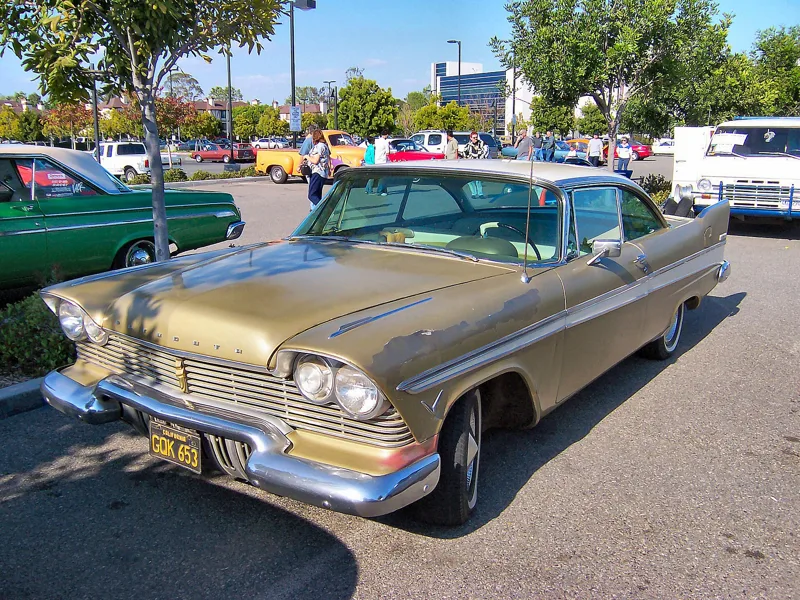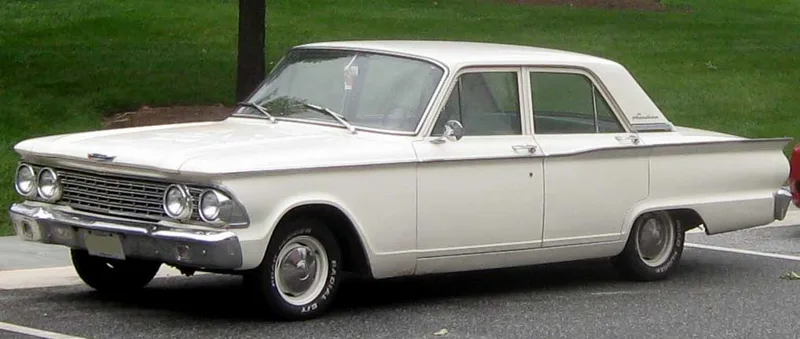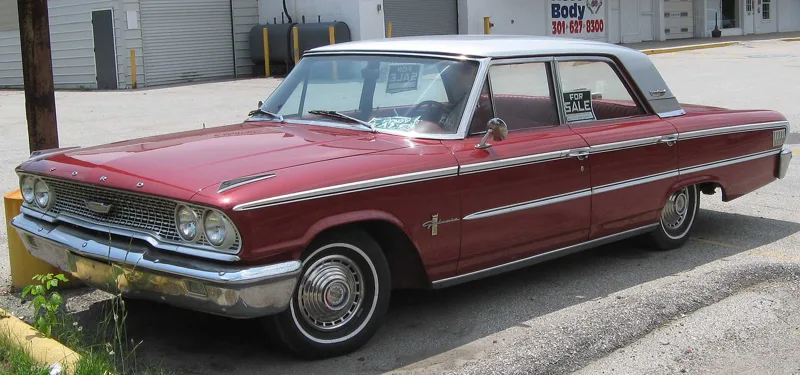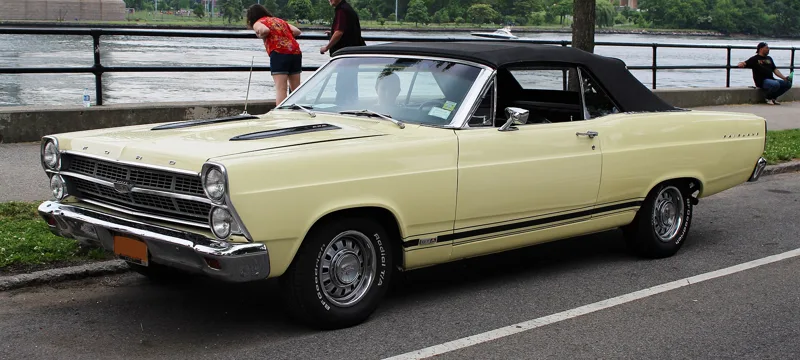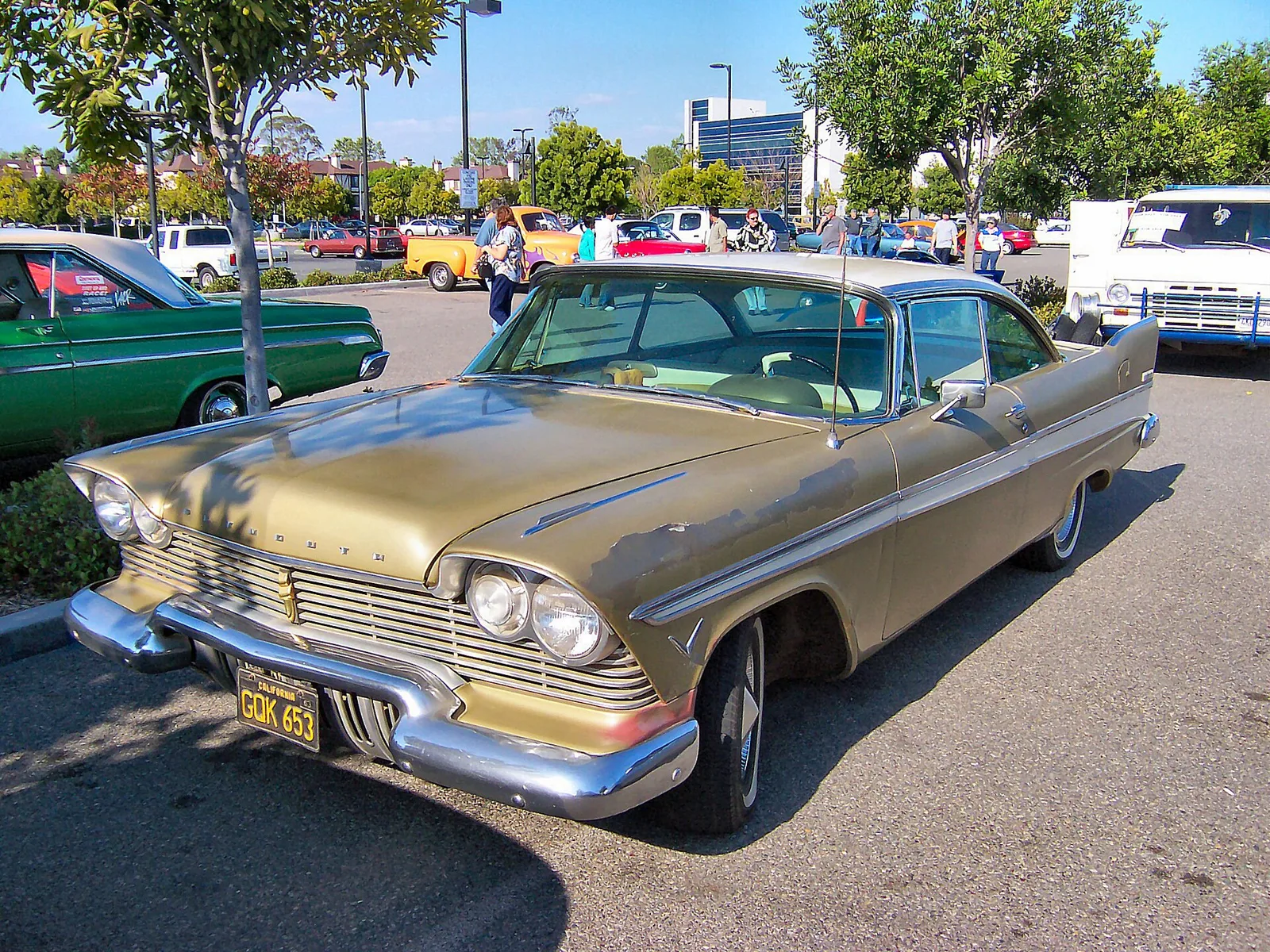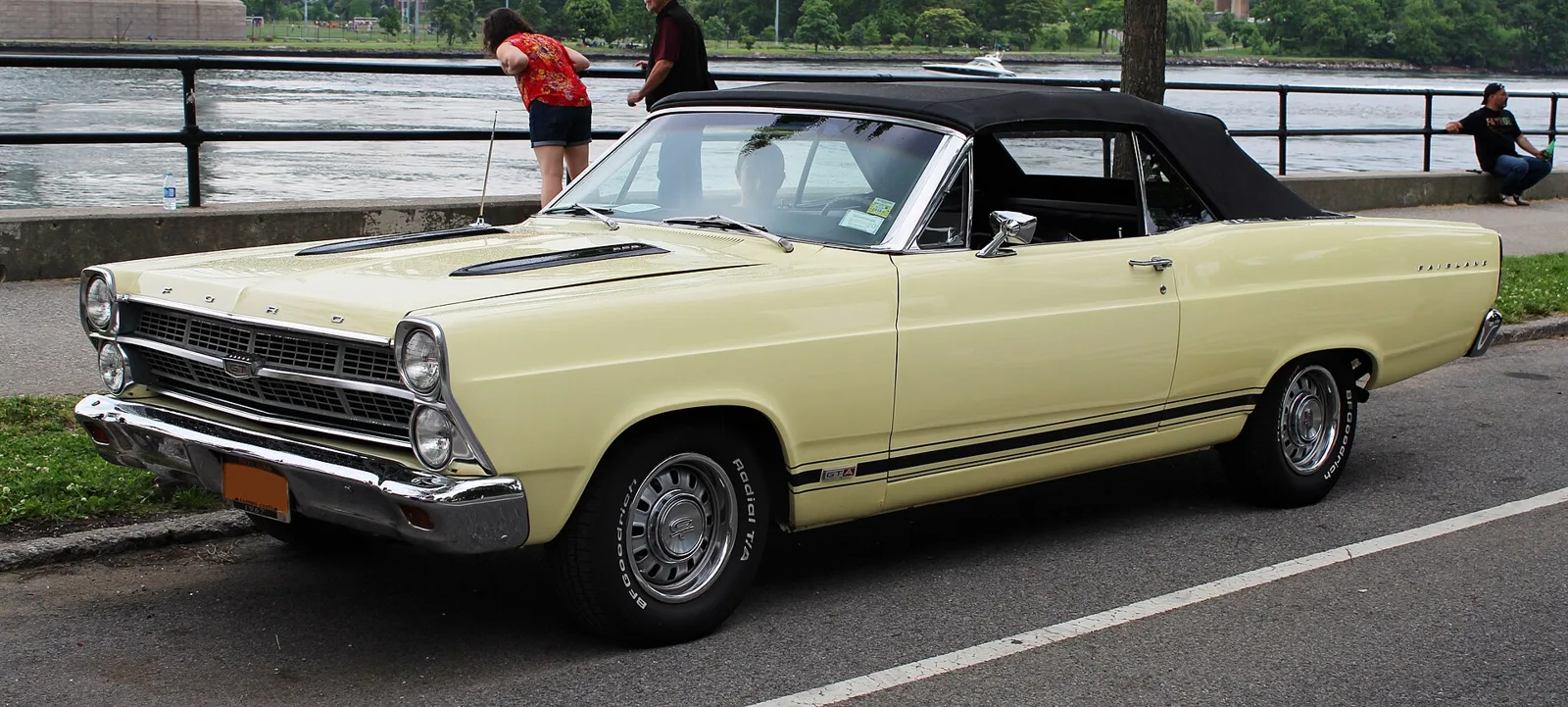
Ford's Fairlane and Chrysler's Plymouth Belvedere were both full-size flagships that were downsized into the intermediate class, and they met head-on in the early 1960s.
Ford's Fairlane and Plymouth's Belvedere were both mid-century flagships that were reshaped into intermediates in the early 1960s, and they were named as direct rivals in the 1962 model year. The Fairlane leaned on its unibody and Windsor V8, while the Belvedere offered the Slant Six and, from 1964, the 426 Hemi that won at Daytona.
The Ford Fairlane and the Plymouth Belvedere were both flagship models before they became intermediates. The Fairlane started in 1955 as Ford's premier full-size car, while the Belvedere began as a Plymouth hardtop in 1951 and became a full model line in 1954. When both were downsized for the early 1960s, they met head-on as rival mid-size cars.
Where did the Fairlane and the Belvedere come from?
The Fairlane took its name from the Dearborn, Michigan estate of Henry Ford, and it was used for seven generations between 1955 and 1970. It replaced the Crestline as Ford's premier full-size offering for 1955, and it marked the start of the Crown Victoria and 500 names, which later became standalone full-size lines.
The Belvedere's name came first on a two-door pillarless hardtop, the Cranbrook Belvedere, introduced on March 31, 1951. It was Plymouth's first pillarless hardtop, and it was a reaction to Chevrolet's Bel Air and to Ford's Victoria, which had pioneered the two-door hardtop in the cheaper end of the market. In 1954 the Belvedere replaced the Cranbrook as Plymouth's top trim and became a full model line.
In March 1954 Plymouth offered its first fully automatic transmission, the PowerFlite two-speed, which was a notable step for the line.
The word belvedere is Italian for beautiful sight or fair view. Plymouth's line ran until 1970, and the Belvedere name was dropped at the end of that model year, replaced by the Satellite name that had first been used on top-end Belvederes.
Two Detroit flagships that became intermediates, and two engine stories that ended in very different racing legends.
How did the two cars become rivals?
The Fairlane moved into the intermediate class for 1962, when it was designed to bridge the gap between the compact Falcon and the full-size Galaxie. It was aimed at GM's A-body senior compacts, and the Plymouth Belvedere and AMC Rambler were the cars it had to beat in that class.
The Belvedere was downsized for 1962 as well, with more compact outside dimensions. Buyers in that era still favoured bigger cars, and sales of the downsized Plymouths suffered, but the smaller car gave owners greater approval in actual use.
In an economy test, Popular Mechanics lined up a six-cylinder automatic Belvedere against the Fairlane and the Chevy II, a compact. The magazine concluded that the Belvedere was a very pleasant transportation package, which put it in the same comparison as the Fairlane.
How were the two cars built and designed?
The 1962 Fairlane had a unibody frame, with four boxed torque boxes in its lower body to absorb road shock. Its front suspension used short and long arms, and the rear used Hotchkiss drive. It measured 197 in (5004 mm) long on a 115.5 in (2934 mm) wheelbase, and it was 16 in (406 mm) longer than the Falcon.
The Belvedere used the same unibody platform for its 1962 to 1964 models, and it was restyled to look longer and wider in the middle years. The 1964 Belvedere gained a slant-back roofline that proved popular, and sales improved significantly over the previous design.
Chrysler's styling had earlier been shaped by Virgil Exner, whose Forward Look gave the 1955 Plymouths a major overhaul. The 1956 models added the first push-button automatic transmission in an American car, and the 1960 Belvederes were the unit-body cars that spread the design across the line.
In 1956 Chrysler's chief engineer George Huebner took a Belvedere on a publicity drive across the United States with a turbine engine fitted in place of the standard gasoline unit.
For 1957 the Fairlane line added the Country Sedan, and Ford's Ranchero coupe utility arrived the same year.
Which engines did the Fairlane offer?
The 1955 Fairlane used a 223 cu in (3.7 L) straight-six and a 272 cu in (4.5 L) V8, and the 292 cu in (4.8 L) Y-block was sold as the Thunderbird V-8. By 1962 the standard Fairlane engine was a 170 cu in (2.8 L) six, and an optional Windsor V8 appeared at 221 cu in (3.6 L) with 145 hp (108 kW).
Later Fairlane engines included a 260 cu in (4.2 L) Challenger V8 rated at 164 hp (122 kW), and a 289 cu in Challenger that reached 271 hp (202 kW). The 289 was coded K in the vehicle identification number, and it was marked on the fenders with V badges that read 289 High Performance.
Belvedere engines went in a different direction. The 1951 Cranbrook Belvedere used a Chrysler flathead straight-six of 217.8 cu in (3.6 L) rated at 97 hp (72 kW), and the 1954 model moved to a 230.2 cu in six rated at 110 hp (82 kW) and a PowerFlite automatic.
In 1965 Plymouth made the Fury a full-size car again, and the Belvedere became the intermediate offering in three subseries: Belvedere I, Belvedere II and Satellite. The Satellite came with a 273 cu in LA-block V8 as standard equipment.
The 1964 and 1965 Fairlane range used a 289 V8 with a two-barrel carburettor and hydraulic lifters rated at 195 horsepower (145 kW), and the Cruise-O-Matic became the only automatic available by 1965.
What was the Slant Six, and how did it compare?
From 1960 the Belvedere got a new standard inline six known as the Slant Six. It displaced 225 cu in (3.7 L), used overhead valves, and had a block inclined 30 degrees to the right to allow a lower hood line. Its single-barrel Holley carburettor and rugged build made it one of the most durable engines of its day.
The Slant Six's reliability was its selling point, while the Fairlane's six was a 170 cu in unit in 1962. The Belvedere's V8 options were 318 cu in (5.2 L) and 361 cu in (5.9 L), which gave it a bigger engine range than the Fairlane offered at the time.
The Belvedere's most famous engine was the 426 cu in Chrysler Hemi, which debuted in the 1964 model and used a canted large-valve arrangement that was a significant breathing improvement at high revs. The Fairlane's Thunderbolt used a 427 cu in V8 of its own, so both lines had a serious performance engine in their range.
How did the Thunderbolt and the Hemi Belvedere race?
The Fairlane Thunderbolt was a small number of two-door Fairlane sedans prepared for drag racing. It used Ford's 427 cu in (7.0 L) race V8 with two four-barrel carburettors, a high-riser manifold and fibreglass panels, and it was rated at 425 hp (317 kW) at 7,500 rpm. Between 111 and 127 were built.
Racing in NHRA Super Stock, the Thunderbolt set elapsed time and top speed records in 1964 of 11.6 seconds and 124 mph (200 km/h). Delivered without a full tank, the car came in under the 3200 lb (1451 kg) minimum, so it needed fuel aboard to qualify, and production stopped once NHRA required 500 vehicles to be built.
The Hemi Belvederes won first, second and third at NASCAR's 1964 Daytona race, and Richard Petty was one of the winning drivers. Petty later won the Grand National championship in a Belvedere in 1968.
The Belvedere's 1968 Road Runner was a low-price, high-performance alternative to the GTX, which came standard with a 440 engine. Its performance credentials were built on those V8 options.
About 50 similar Mercury Cyclones were produced in 1964 for Ford's A/FX competition, which they dominated. Of the Thunderbolts, the first 11 were painted Vintage Burgundy and the rest were white, with 99 fitted with manual transmissions.
What sales did the two lines achieve?
The Fairlane's most popular sedan in 1955 was the four-door Town Sedan, with 254,437 built at a list price of US$1,960. Ford outsold Chevrolet in 1957 for the first time since 1935, which was a sign of how well its restyled cars were received.
The Cranbrook Belvedere sold 51,266 units across 1951 and 1952, and 35,185 Belvederes were sold in 1953. The 1954 Belvedere managed 32,492 units for the year, a figure that shows how small the early Belvedere line was compared with the Fairlane.
The Belvedere's sales suffered in 1961, when the Plymouth yielded third place in US sales to the 1960 Ramblers. The 1964 slant-back design improved sales significantly.
What did each line leave behind?
The Belvedere has a stronger popular-culture presence. A 1957 to 1958 Belvedere hardtop became a central character in the 1983 film Christine, based on the novel by Stephen King, and a 1967 Belvedere served as the standard police cruiser in the pilot of the television show Adam-12. Belvederes also served police forces, including the LAPD and New York Police Department.
The Fairlane's legacy is more tied to Ford's own family. The Torino name replaced it in North America in 1971, and in Australia a long-wheelbase Falcon was sold as the Fairlane through 2007. In South America the sixth-generation Fairlane was sold through 1981.
The Belvedere name ended with the 1970 model year, and the Satellite and later the Fury carried on the Plymouth full-size story. Both nameplates ended with the 1970 model year, so their head-to-head period was brief.
Side-by-side comparison
| Point | Ford Fairlane | Plymouth Belvedere |
|---|---|---|
| Years | 1955 to 1970 | 1954 to 1970 as a model line |
| Early role | Premier full-size Ford from 1955 | Top trim from 1954, Cranbrook hardtop from 1951 |
| Intermediate from | 1962 | 1965, when it became an intermediate |
| Standard six | 170 cu in (2.8 L) from 1962 | Slant Six 225 cu in (3.7 L) from 1960 |
| Larger V8 | 289 cu in Challenger, 271 hp (202 kW) | 318 and 361 cu in V8s from 1960 |
| Performance engine | Thunderbolt 427 cu in, 425 hp (317 kW) | 426 Chrysler Hemi from 1964 |
| Racing record | Super Stock records at 11.6 seconds | Hemi cars won first, second and third at Daytona in 1964 |
| Sales milestone | 254,437 Town Sedans in 1955 | 51,266 Cranbrook Belvederes in 1951 and 1952 |
| Successor | Torino name from 1971 | Satellite name after 1970 |