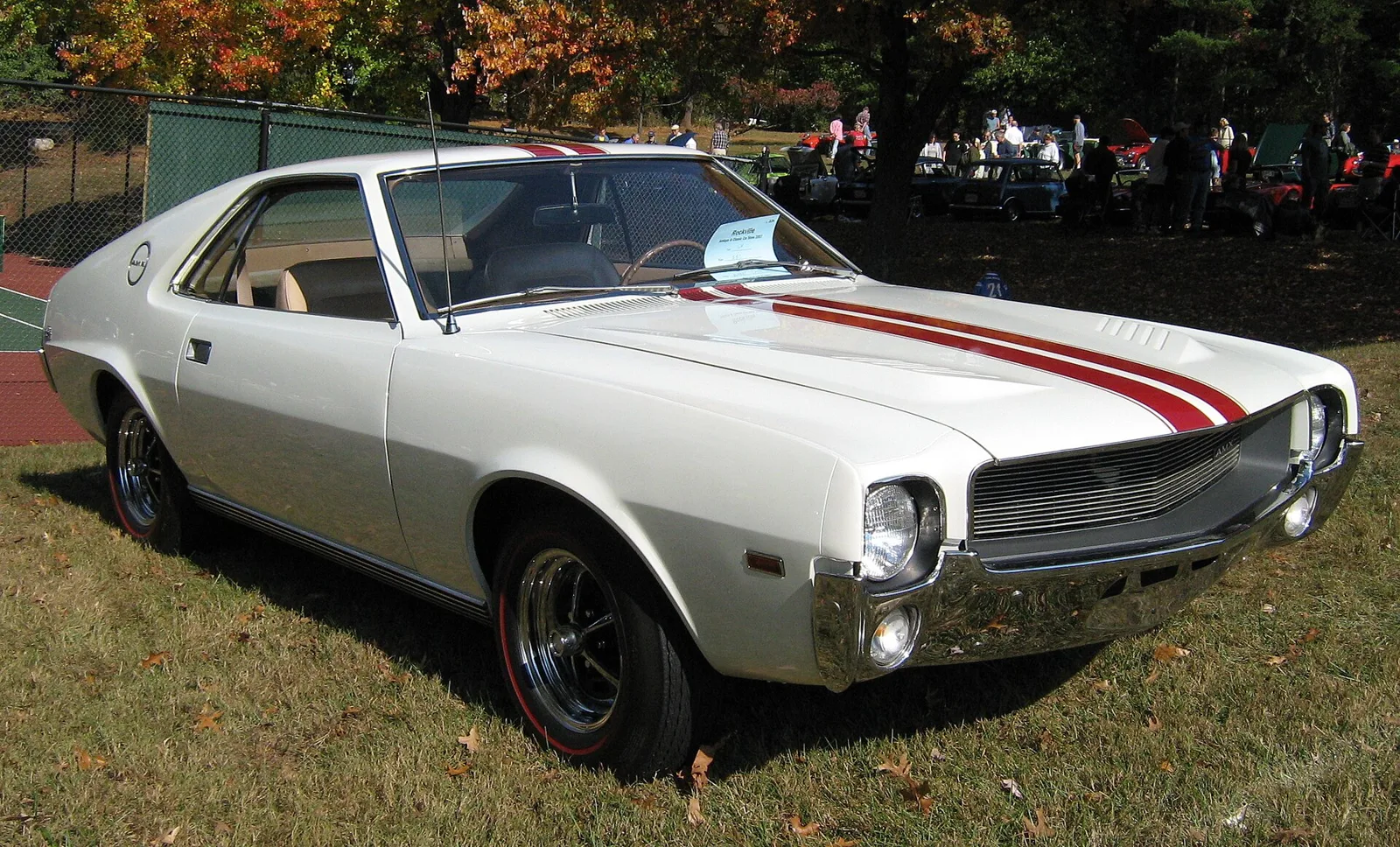
American Motors' 1968 to 1970 two-seater: a Javelin-based coupe with a record-setting launch, a short production run and a long collector afterlife.
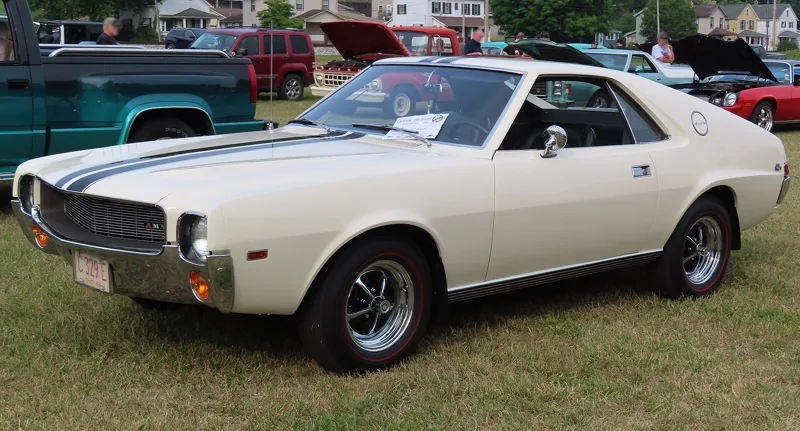
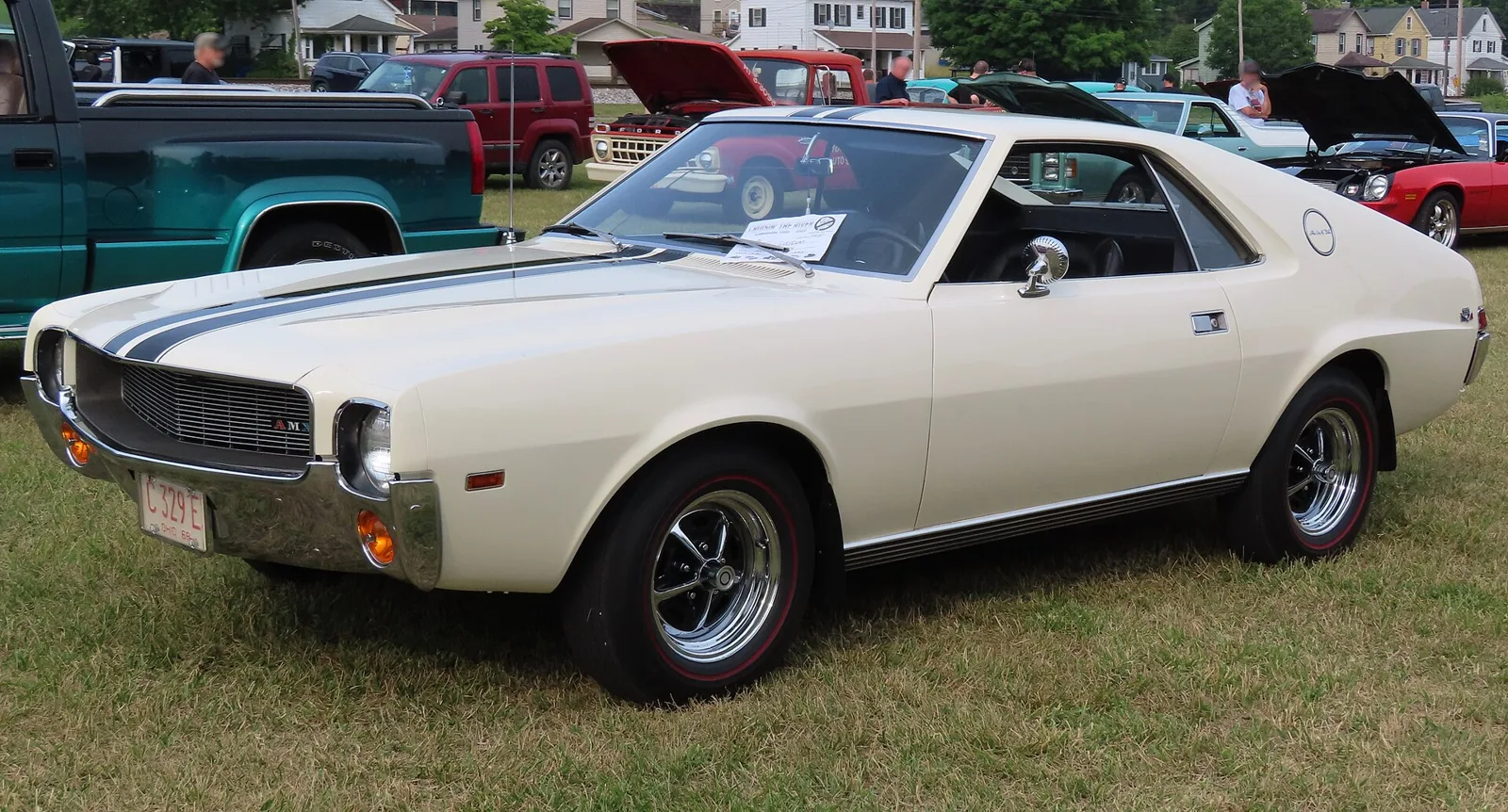
The AMC AMX was a two-seat muscle car built by American Motors from 1968 to 1970 on a shortened Javelin platform. It offered V8 engines up to 390 cu in and sold at about a quarter less than the Chevrolet Corvette, with 19,134 cars built.
The AMC AMX was a two-seat GT-style muscle car that American Motors built from 1968 to 1970. It rivalled the Chevrolet Corvette at a much lower price, and it was a Javelin derivative without the rear seat. Sales never thrived, but it helped AMC move its image away from economy cars and drew younger buyers into its showrooms.
Where did the AMC AMX come from?
The AMX began as an American Motors experimental concept, shown on the company's Project IV tour in 1966. It became a production two-seater for 1968, based on the new-for-1968 Javelin with a shorter wheelbase and no rear seat. Its rear quarter windows stayed fixed, which made it a coupe rather than a hardtop.
The original full-scale AMX models were developed in 1965 by AMC's advanced styling studios under Charles Mashigan. The two-seat concept was a hit on the auto show circuit in 1966, and it featured a rumble seat that opened from the rear decklid, which was called the Ramble seat.
AMC executives saw the chance to change the public's view of the company, which had been seen as an economy-car maker. Robert B. Evans asked for a car like the AMX to be put into production quickly. Two development programmes were started, one a modified Javelin and the other a completely new fiberglass car.
The modified Javelin was chosen. It let AMC use its existing unibody technology and steel manufacturing, because the company could turn out steel bodies in large numbers and had no interest in fiberglass bodies, which suited only low-volume models. Vic Raviolo, who had worked on Lincoln racers, was involved in engineering the new coupe.
A two-seat American coupe that cost less than a Corvette, set world records before it went on sale and still turns up in collectors' garages.
Why was the AMX seen as a rival to the Corvette?
The AMX was one of just two American-built two-seaters, and it competed directly with the Chevrolet Corvette. Its 1968 MSRP of US$3,245 was nearly 25% below the Corvette, and its 97 in (2,464 mm) wheelbase was one inch shorter than the Corvette's.
It was the first steel-bodied two-seat American performance car since the 1955 to 1957 Thunderbird. Ford's original two-seater had evolved into a four-seat personal luxury car from 1958, which left the Corvette with few domestic rivals.
The AMX was introduced to the press at Daytona International Speedway on 15 February 1968, a little over four months after the Javelin went on sale. On the track the new cars ran at speeds up to 130 mph (209 km/h), and the company's group vice president described the AMX as a car that could satisfy both muscle car and sports car buyers.
The public launch followed on 24 February 1968, when the AMX was promoted as the only American sports car that cost less than $3,500. Its acceleration was so sharp that some commentators felt it confused buyers, because it handled like a sports car but accelerated like a muscle car.
What records did the AMX set before it went on sale?
In January 1968, two specially prepared AMX cars claimed 106 world speed and endurance marks on Goodyear's Texas circuit. The drivers were Craig Breedlove, his wife Lee and Ron Dykes. AMC had asked the land speed record holder to put the car through its paces before it was even on sale.
Carl Chakmakian, AMC's manager for performance activities, arranged the programme. Breedlove's team and Traco Engineering were given six weeks to get the cars ready for the Chicago show in February.
One car's 290 cu in engine was bored out to 304 cu in, and the other's 390 cu in engine was bored to 397 cu in. The shop fitted exhaust headers, oil coolers, racing camshafts with solid lifters and larger carburettors, plus 37 US gal (140 L; 31 imp gal) safety fuel cells.
The chassis received heavy-duty springs, traction control arms, heavy-duty shocks and a panhard-type track bar. Wide magnesium racing wheels and racing tyres replaced the road equipment, and roll cages protected the driver. Breedlove later took the car to Bonneville, reaching 189 mph (304 km/h) in a United States Auto Club sanctioned run.
What engines did the AMX offer?
The AMX came with a 290 cu in (4.8 L) V8 as standard, and the 343 cu in (5.6 L) and 390 cu in (6.4 L) engines were options. The 390 made 315 hp (235 kW) and 425 lbf ft (576 N m) of torque in 1968, and it was raised to 325 hp (330 PS; 242 kW) by 1970.
| Year | Engine | Power | Torque | Code |
|---|---|---|---|---|
| 1968 | 290 cu in (4.8 L) V8 | 225 hp (168 kW) | Unlisted | N |
| 1968 | 343 cu in (5.6 L) V8 | 290 hp (220 kW) | Unlisted | T |
| 1968 | 390 cu in (6.4 L) V8 | 315 hp (235 kW) | 425 lbf ft (576 N m) | X |
| 1970 | 360 cu in (5.9 L) V8 | 290 hp (220 kW) | Unlisted | P |
| 1970 | 390 cu in (6.4 L) V8 | 325 hp (330 PS; 242 kW) | 430 lbf ft (583 N m) | X |
A BorgWarner T-10 four-speed manual was standard, along with traction bars, a dual exhaust and wider tyres. A Shift-Command three-speed automatic that could be shifted manually was optional, with a floor-mounted shifter.
The Go Package was the popular performance option for the 343 and 390 engines. It added power-assisted front disc brakes, a Twin-Grip differential, E70x14 red-stripe tyres on 6-inch steel wheels and heavy-duty suspension and cooling. In 1970 the 360 engine was offered with the Go Package for $298.85, or $383.90 with the 390.
How did the AMX drive and how was it reviewed?
Road tests described the AMX as a handsome two-seater with American-style acceleration and European-style handling. Car and Driver measured 0 to 60 mph in 6.6 seconds on its 1968 test of the 390 car, and a top speed of 122 mph (196 km/h).
The same test recorded a 14.8-second quarter-mile at 95 mph, and the 0 to 100 mph time was 16.3 seconds. Motor Trend recorded 6.56 seconds to 60 mph in December 1969, with a quarter-mile of 14.68 seconds at 92 mph.
The Society of Automotive Engineers named the AMX best-engineered car of the year in 1969 and again in 1970. Its one-piece injection-moulded dashboard was cited as an industry first for safety, and the 1970 cars were the first production cars with thinner, lighter and safer windscreens.
How did the AMX change across its model years?
The AMX changed mainly in trim and paint in 1969, and it received a new front end, new engines and redesigned interiors in 1970. The 1969 base price rose by $52, and the 'Big Bad' paint option arrived in mid-year for $34.
From January 1969 every manual AMX came with a Hurst floor shifter. The three-speed Shift-Command automatic stayed optional, and the driver could also shift it manually through its three gears. The 'Big Bad' colours were neon blue, orange and green, and 195 cars were built in blue, 285 in orange and 283 in green.
The 1970 facelift brought a longer hood with a power blister, a flush full-width grille and full-width taillamps. The car grew about 2 in (50.8 mm) to 179 in (4,547 mm) in overall length, while keeping the 97 in (2,464 mm) wheelbase. Front double wishbones and new 'Magnum 500' wheels were fitted, and the interior gained a broad wood-grained dashboard and clamshell bucket seats.
The base 1970 model was priced at US$3,395 (US$28,146 in 2025 dollars). AMC promoted it as a sports car for the price of a sporty car. The shadow mask finish, which added a satin black hood, cost $52, and a C-stripe cost $32.
Was there a Super Stock AMX?
Yes. The Super Stock AMX was a drag-racing car built on the 390 engine with twin Holley carburettors, 12.3:1 compression heads, aftermarket headers and drag slicks. American Motors rated it at 340 hp (250 kW), but the National Hot Rod Association rated it at 420 horsepower (310 kW).
Most were prepared and custom-painted by AMC dealers and campaigned at major racing events, where they ran in the low 11s. Its fastest recorded pass covered the quarter-mile in 10.73 seconds at 128 mph (206 km/h). The Super Stock car lacked comfort equipment, and it came with no factory warranty.
The base price was $5,994, about $1,900 more than a fully loaded 1969 AMX. Buyers could order the car in all white or in vertical bands of red, white and blue, which set it apart from other AMC competition cars of the day.
What special editions were built?
The best-known editions are the California 500 Special, sold by Southern California dealers in Big Bad Green in 1969, and the Playmate Pink car made for Playboy's 1968 Playmate of the Year. The number of California 500 Specials is unknown, with an estimate of 32 cars.
The California 500 Special was a pace car replica, finished in Big Bad Green with black stripes and a 390 Go-Pac. It had side exhaust pipes in place of the rocker moulding strips and brass plaques on the hood blisters with crossed racing flags. A total of 283 AMXs were built in Big Bad Green for 1969.
Angela Dorian's car was painted Playmate Pink and powered by the base 290 V8 with an automatic. Its dashboard number plate carried her measurements of 36-24-35, and the car was later featured on a Jay Leno programme. A 1969 Playmate Pink special-order car with a 390 and the GO Package was also sold through a dealership in Potosi, Missouri.
Thoroughbred Motors in Denver modified an estimated 22 new AMXs as Von Piranha racers, with extra air scoops, cut hood bulges and a 950 CFM Holley three-barrel carburettor on the original build. Breedlove replicas were also offered, with an estimated 50 AMXs in red, white and blue.
How did the AMX fare in racing?
AMXs ran on drag strips across the United States, and in 1969 an AMX placed second in the SCCA national championship. Dwight Knupp drove one to sixth overall at Daytona, finishing just 1 minute and 14 seconds behind the winning Corvette average in the B production class.
A single 1969 AMX, driven by the Bruerton brothers, took part in the Cannonball Baker coast-to-coast run in 1971 and 1972. In 1971 the car finished fifth, covering 2,897 miles (4,662 km) in 37 hours and 48 minutes, and in 1972 it finished eighth in 39 hours and 42 minutes.
The car had 90,000 miles (144,841 km) on the odometer by the first run, and the brothers had taken it on many endurance trips, including a rough ride the length of the Baja California peninsula. The two-seat AMX was never eligible for SCCA Trans-Am competition, but it was a regular performer in drag racing.
How did the AMX reach Australia?
A total of 24 right-hand drive 1969 AMXs were hand-assembled under licence in Australia by Australian Motor Industries between August 1969 and July 1970. They were called Rambler AMX because AMI already built the Rambler range.
The Australian cars were built from complete knock-down kits shipped from Kenosha, Wisconsin, to AMI's Port Melbourne facility. Only three colours were offered: white, Safety Wattle Yellow and Signal Red, and the cars came with a 343 cu in engine, automatic transmission and power steering.
Because the cars were right-hand drive, the power brake booster and heater were moved, while the windscreen wipers kept their left-hand pattern. All Australian interiors were finished in black, and they were promoted as personal supercars.
What concept cars came before and after the AMX?
The 1966 AMX concept gave the production car its Ramble seat idea, and it was the first car to carry the AMX name. It was shown at the 1966 Society of Automotive Engineers convention in Detroit, and it had no interior, engine or suspension, so it was essentially a fiberglass show piece.
American Motors' president, Roy Abernethy, sanctioned the Turin coachbuilder Vignale to build an operational steel car. Built on a modified 1966 Rambler American chassis with a 98 in (2,489 mm) wheelbase and a 290 cu in V8, the Vignale car was finished in 78 days and shown at the 1966 New York International Auto Show.
The AMX II was a less radical four-seat hardtop for the Project IV show with an overall length of 187 in (4,750 mm). The AMX GT of 1968 was a shortened, chopped Javelin with a Kammback rear end, and it gave clues to future production options.
The AMX/3 was the most ambitious follow-up. Built by Giotto Bizzarrini, it was a mid-engined steel car on a 105.3 in (2,675 mm) wheelbase, with an AMC 390 V8. BMW tested it and found its chassis 50% stiffer than a benchmark Mercedes-Benz, and one car was timed at 170 mph (274 km/h) at Monza.
Only five completed cars were produced before the US$2,000,000 development programme was cancelled. The planned output of 5,000 cars a year was never reached, because the price kept rising and new bumper regulations added cost.
Why did the two-seat AMX end after 1970?
The two-seat AMX ended after the 1970 model year because sales were below AMC's targets and high-powered cars became more expensive to insure. The AMX name moved to a high-performance version of the four-seat Javelin from 1971.
Overall economic conditions shifted, with inflation pushing buyers towards smaller cars and insurers penalising high-powered models. AMC had planned a European-engineered alternative, the AMX/3, for 1971, but it was never produced in the planned numbers.
Even so, nearly every one of the 19,134 two-seat cars built has remained in circulation, according to Hemmings. That survival rate, rather than the sales figures, is what made the car's reputation.
How are AMX values and collectables viewed today?
Collectors have pushed AMX values up since the mid-2000s. A California 500 AMX changed hands for $54,000 at a 2006 Barrett-Jackson sale in Scottsdale, and a regular AMX went for over $55,000 at a Mecum auction in Belvidere, Illinois.
Hemmings listed the 1968 to 1970 AMXs among the 21 hottest cars enthusiasts wanted in 2007, and it put the two-seaters on its 2010 list of 32 best cars to restore for economic sense. The car's parts were largely shared with other AMC models, so the fundamentals were easy to find.
Scale models are also popular. Jo-Han made a 1/25-scale promotional model under licence, Hot Wheels produced a 1969 AMX custom in 1:64 scale, and the Playboy Pink car has appeared as a 1:18 diecast model in a 'Best of the Best' series.