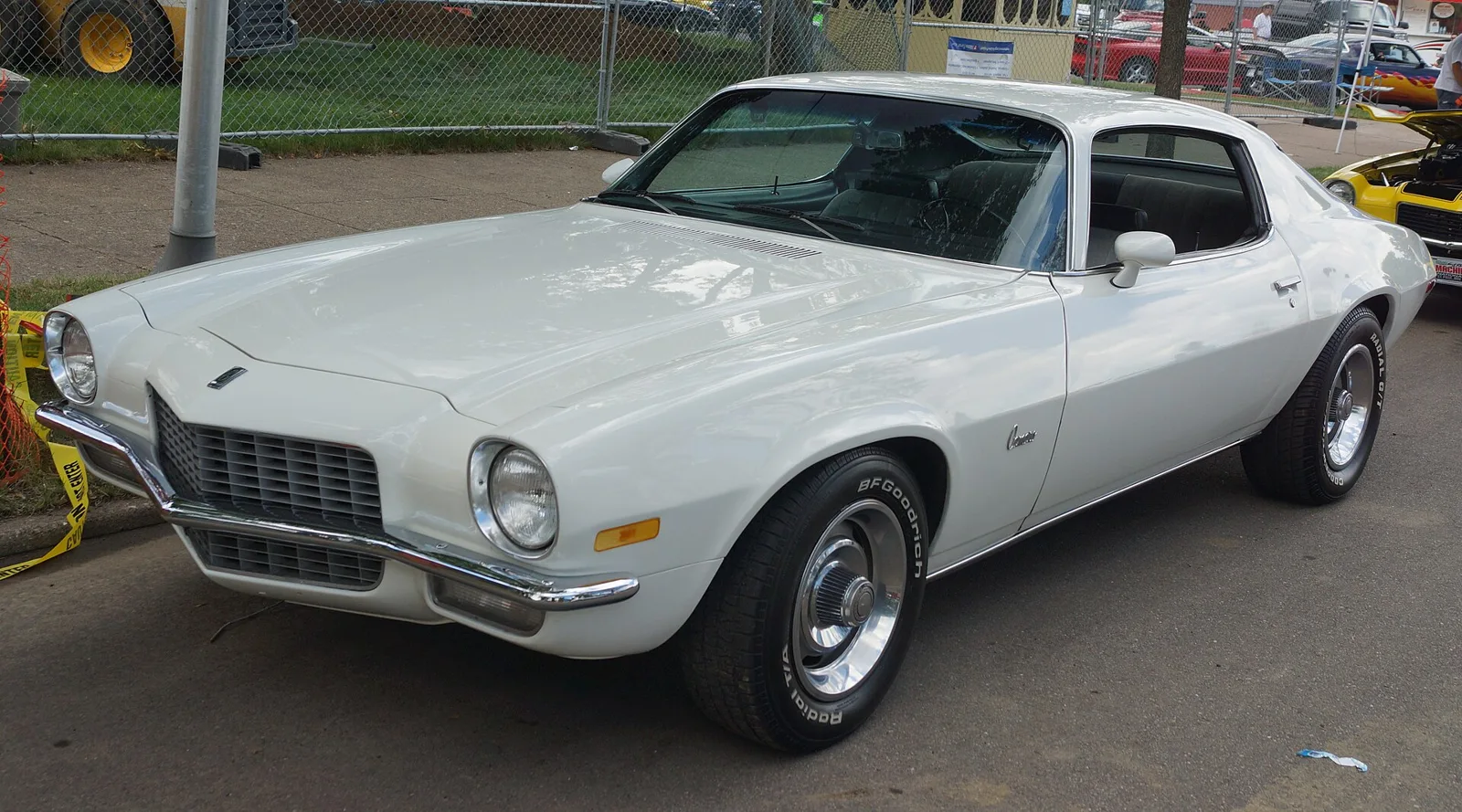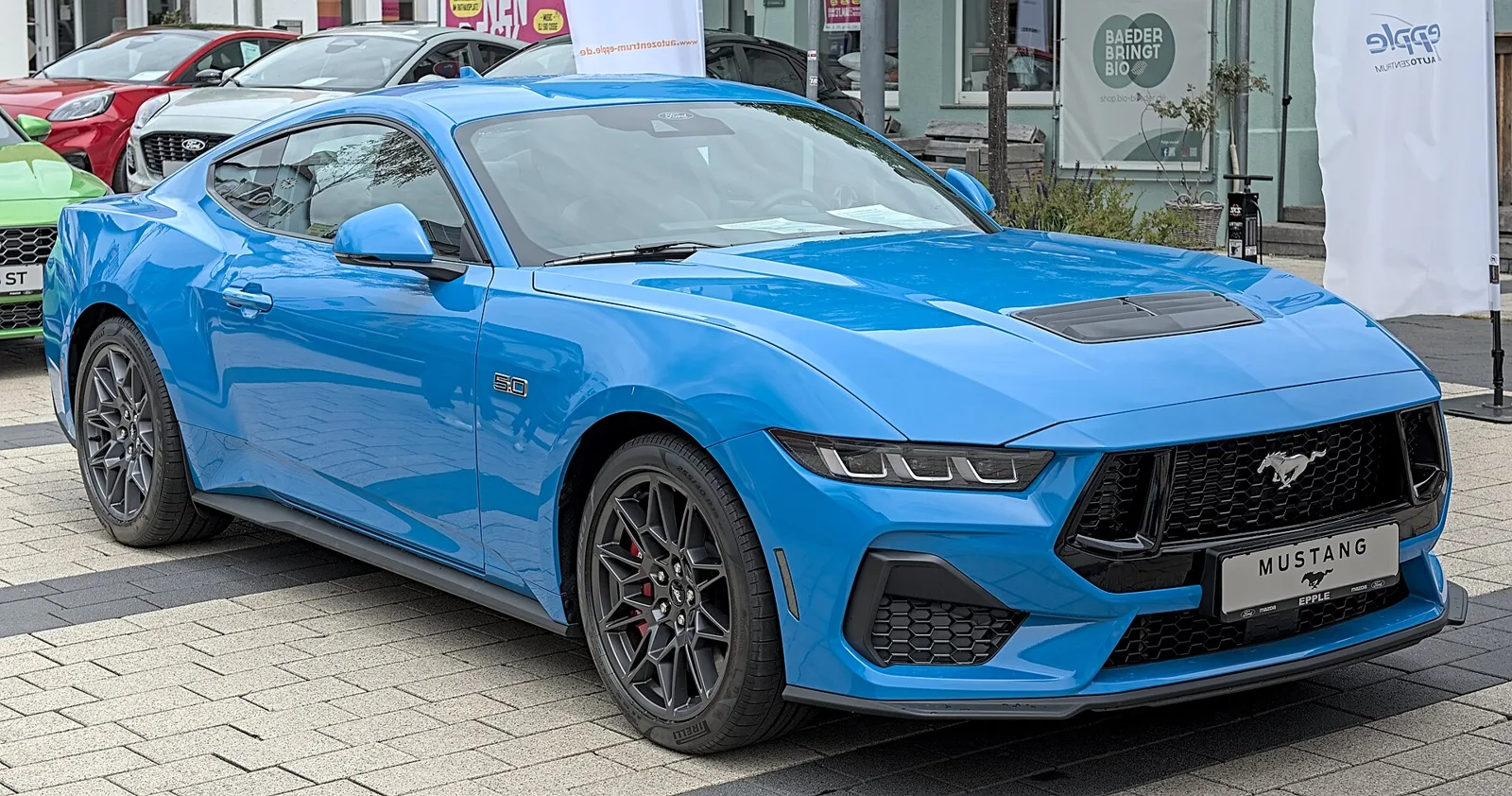
Forecast to sell 100,000 a year, the 1964 Mustang topped 400,000 in twelve months.
The Ford Mustang went on sale on 17 April 1964, created the pony car class and sold over 400,000 units in its first year. After growth in the early 1970s, the smaller Mustang II arrived for 1974. The seventh generation, the S650, began production on 1 May 2023.
Ford expected to sell fewer than 100,000 Mustangs in the first year, and it passed that figure in three months. By the end of the model year the car had become the most successful launch since the 1927 Model A.
Where did the Mustang name and the idea come from?
The credit is shared. Ford credits executive stylist John Najjar, a fan of the Second World War P-51 Mustang fighter, with suggesting the name. He co-designed the first prototype, the mid-engined Mustang I of 1961, with fellow stylist Philip T. Clark, and test driver and Formula One racer Dan Gurney demonstrated it at the United States Grand Prix at Watkins Glen on 7 October 1962.
Robert J. Eggert, Ford Division's market research manager and a breeder of quarterhorses, added the name to the list tested by focus groups. A book called The Mustangs, given to him by his wife in 1960, had put the idea in his head. The designer preferred Cougar or Torino, and Henry Ford II wanted T-bird II, but Mustang came out on top by a wide margin.
The name did not travel to Germany. Krupp owned it, having built trucks as Mustangs between 1951 and 1964, and Ford refused to pay about US$10,000 for it. A moped maker, Kreidler, also used the name, so German buyers got the T-5 until December 1978.
The one-millionth Mustang was sold within two years of the launch.
How was the first Mustang developed and launched?
With extraordinary speed and a tight brief. Lee Iacocca drove the project as general manager of Ford Division, while his chief engineer Donald N. Frey oversaw a development run of just 18 months, from September 1962 to April 1964, which was a record. The cars reached the public through an unusual route, with the first sale on 14 April 1964 at a dealership in St John's, Newfoundland, three days before the official introduction.
The design teams had five goals. The car had to seat four, with bucket seats and a shifter on the floor. Weight was capped at 2,500 lb (1,100 kg), length at 180 in (5 m) and price at US$2,500, and the range had to offer plenty of power, comfort and luxury extras. Three studios competed. The Ford studio won, under project design chief Joe Oros with a team that included Gale Halderman and L. David Ash. Oros wanted a car that appealed to women yet made men desire it, with a Ferrari-like front end and air intakes in the sides to cool the rear brakes.
Ash, often credited with the styling, said later that the car was the work of a group, not one person. Halderman recalled that sketches he made at home became the basis for the clay model, and that the fastback was developed in secret, cast in red fibreglass and revealed to Iacocca only when finished. Iacocca's reaction, as Halderman remembered it, was that they had to build it.
Cost was the other pillar. The Mustang borrowed heavily from the Falcon and Fairlane, which let Ford quote a list price of US$2,368, shortened the learning curve for workers and allowed dealers to stock it without a big spares investment. A unitised platform came from the 1964 Falcon with welded box-section rails. Durability problems with the new frame meant a convertible was engineered first to ensure stiffness, and an industry-first torque box helped handling.
What happened when the Mustang went on sale in 1964?
Production began on 9 March 1964 in Dearborn, Michigan, and the official unveiling came on 17 April, at the World's Fair in New York, 16 days behind the Plymouth Barracuda. Over 400,000 were sold in the first year, and the one-millionth Mustang followed within two years of launch. The next morning 2,600 newspapers carried favourable coverage.
The forecast of fewer than 100,000 was beaten within three months. A further 318,000 followed in the rest of the model year, which set a record, and inside eighteen months of the launch the factory had built over a million. Twelve-month sales reached 418,812, a figure the Mustang II would later be measured against.
The film business joined in. A Wimbledon White convertible with a red interior appeared at the London premiere of Goldfinger on 17 September 1964, and a Tropical Turquoise coupe followed in Thunderball at its Tokyo premiere on 9 December 1965.
The 1964 and a half cars
Production began five months ahead of the customary start of the 1965 model year, which is why enthusiasts call the earliest cars 1964 and a half models. Ford itself advertised, coded and titled every one of them as a 1965 model. When the normal year began in August 1964 the lineup changed: alternators replaced generators, the six-cylinder engine grew from 170 to 200 cu in (2.8 to 3.3 L) and the V8 from 260 to 289 cu in (4.3 to 4.7 L). The 121,538 earlier cars carry the distinction.
How did the first-generation cars perform?
Modestly at first, then convincingly. The cheapest model used a 2.8 L (170 cu in) straight-six from the Falcon with a three-speed manual gearbox. After August 1964 the 3.3 L (200 cu in) six made 120 hp (89 kW), while the V8 range started with a two-barrel 4.7 L (289 cu in) at 200 hp (150 kW), then a four-barrel at 225 hp (168 kW), and topped out with the HiPo, which delivered 271 hp (202 kW) at 6000 rpm along with 312 lb.ft (423 N.m) at 3400 rpm.
A 1965 Mustang fitted with the HiPo and a 4.11 rear axle took 5.2 seconds to reach 60 mph (97 km/h), and 14.0 seconds to cover a quarter mile, crossing the line at 100 mph (161 km/h). The GT Equipment Group added a V8, fog lamps, rocker-panel stripes, disc brakes and a five-dial instrument panel, and Ford built 15,079 GTs in 1965 and 25,517 in 1966. The Shelby Mustang debuted in 1965 as a fastback only.
Not everything was perfect. A Popular Mechanics survey of owners turned up many complaints about legroom, though the magazine measured 20.93 mpg-US (11.24 L/100 km) from the optional 260 cu in V8 with automatic at a steady 60 mph (97 km/h), good for the period. Options included the Pony Interior with embossed running ponies on the seats and the Rally-Pac, a steering-column clock and tachometer that cost US$69.30 from the factory.
How did the Mustang grow, and what went wrong?
It got bigger and heavier, and then buyers drifted away. A redesign for 1967 made the car larger and allowed a big-block engine for the first time. Iacocca later complained about the growth even though he oversaw that redesign. New federal safety rules brought an energy-absorbing steering column, four-way flashers and dual-circuit brakes in 1967, and a 4.9 L (302 cu in) V8 arrived in 1968.
The 1969 restyle added width and length again, with quad headlamps that gave an aggressive stance. Some felt it was too extreme, so 1970 returned to standard headlamps, although 1969 output was higher than 1970's. Performance packages arrived in 1969: the Mach 1, the Boss 302 and the Boss 429, the last two built to homologate engines for racing. The GT option was dropped that year until it returned in 1982. A hardtop-only Grande offered a soft ride, simulated wood and 55 lb (25 kg) of extra sound deadening.
The 1971 to 1973 cars went further in the wrong direction. Under S. "Bunkie" Knudsen, the Mustang shifted from speed and power towards larger, heavier luxury. They grew in all directions but height, and put on about 800 lb (360 kg). The 1971 model was nearly 3 in (75 mm) wider than the 1970, with a flat rear roofline and poor visibility. Sales kept sliding as buyers moved to the smaller Pinto and Maverick, and Iacocca summed it up later by saying the Mustang market had never left Ford, but Ford had left it.
What was the Mustang II and why did it arrive?
It was Ford's answer to its own excess. Iacocca, who became company president in 1970, asked for a Mustang that was smaller and thriftier for 1974. It was planned on the Maverick and ended up on the Pinto subcompact. It went on sale on 21 September 1973, just two months ahead of the first oil crisis, and shared no components with earlier Mustangs.
The smaller size let it take on imported sports coupes such as the Datsun 240Z, the Toyota Celica and the Ford Capri, and later the Chevrolet Monza and its GM cousins from Pontiac, Oldsmobile and Buick. First-year sales were 385,993, against the original Mustang's twelve-month record of 418,812. Iacocca wanted it finished to a high standard, a little jewel, and the car came out heavier than the original thanks to the equipment needed to meet new regulations. It is regarded as an early example of the downsizing that Detroit's Big Three went through in the malaise era.
What platforms has the Mustang used?
Four, in sequence, with rear-wheel drive throughout. From 1965 until 2004 the Mustang shared its chassis with other Ford lines, and only since 2005 has it had a platform to itself.
| Years | Platform base |
|---|---|
| 1965 to 1973 | 1960 Ford Falcon compact |
| 1974 to 1978 | Longer-wheelbase Ford Pinto (Mustang II) |
| 1979 to 2004 | Fox platform, shared with 14 other Ford vehicles |
| 2005 onwards | D2C, unique to the Mustang |
The Fox-based car was the last Ford to use that architecture. Along the way a succession of names was attached to the model, including GT, Mach 1, Boss 302 and 429, Cobra (separate from the Shelby Cobra) and Bullitt, plus the 5.0 fender badge for 4.9 L overhead-valve and 5.0 L double-overhead-cam V8 engines.
Which rivals did the Mustang create?
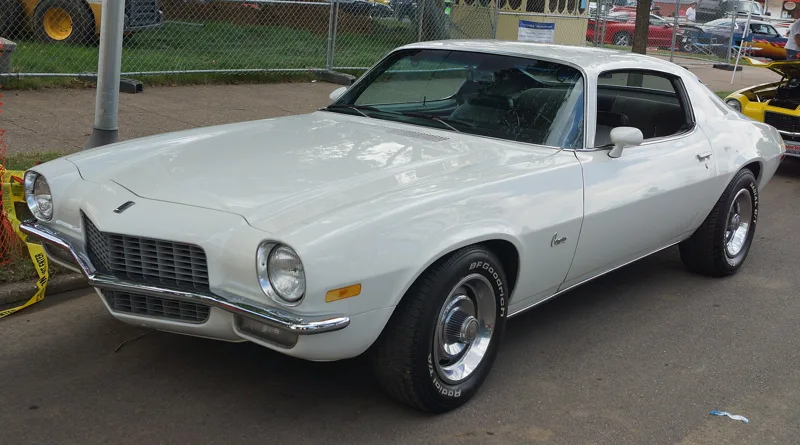
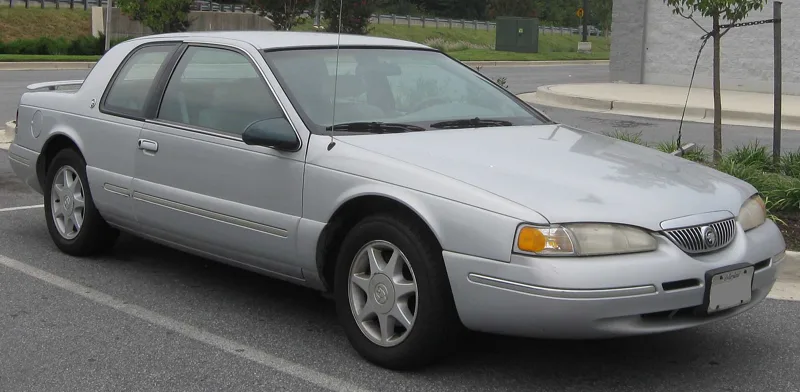
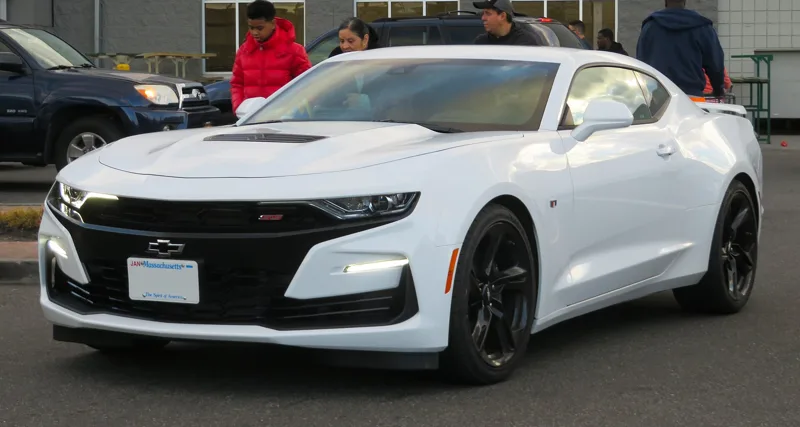
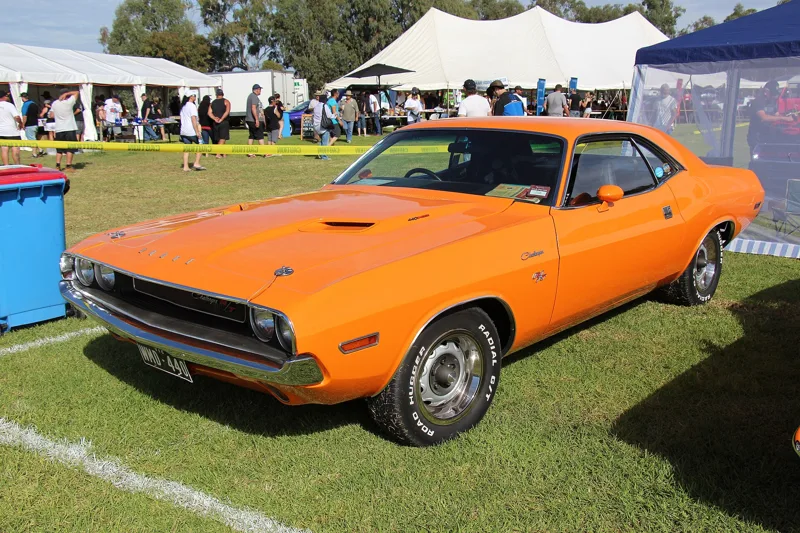
Almost every American maker built a response. The Chevrolet Camaro and Pontiac Firebird followed in 1967, the AMC Javelin in 1968 and the Dodge Challenger in 1970, while the Plymouth Barracuda had been launched around the same time as the Mustang. The Mercury Cougar of 1967 was a unique-bodied, higher-trim alternative, and by the 1970s it was marketed as a personal luxury car.
The influence reached beyond America. Coupe design around the world felt the effect, and it prompted the Toyota Celica to be sold in the United States, along with the Ford Capri, which Lincoln-Mercury handled.
What is the seventh-generation Mustang like?
It is the S650, introduced on 14 September 2022 at the North American International Auto Show in an event called The Stampede, built at Ford's Flat Rock Assembly Plant and in production from 1 May 2023. Two engines launched with it: a redesigned 2.3 L turbocharged EcoBoost four-cylinder with 315 HP, and the fourth-generation 5.0 L Coyote V8 rated at 480 to 486 HP in the GT and 500 HP in the Dark Horse.
The EcoBoost has a new twin-scroll turbocharger, an electronic wastegate and both direct and port fuel injection, while the Coyote gains twin air intakes and twin throttle bodies. The Dark Horse series was created to slot in above the Mach 1 where the discontinued Shelby GT350 used to sit. Its V8 is modified, with a crankshaft of its own and forged rods taken from the sixth-generation Shelby GT500, and takes a similar role to the 2012 and 2013 Boss 302 as a road car with extra track ability.
A Getrag 6-speed manual is offered on the GT, a Tremec 6-speed manual on the Dark Horse, and a 10-speed automatic across the range. Inside, a fighter-jet-inspired digital display replaces the dual-cowl dashboard, with a 12.4 inch instrument cluster and a 13.4 inch infotainment screen running on Unreal Engine, aimed at a younger buyer used to high-end technology.
Reviewers have not been uniformly kind. Criticisms include interior materials that feel less premium than the price suggests, limited rear-seat space, an automatic with too many ratios, climate controls buried in the touchscreen with small icons, a slow start-up and the lack of a spare tyre, with a repair kit supplied instead. Police interest has been strong nonetheless: with Ford, GM and Dodge having dropped sports cars and sedans, the Mustang now serves with state agencies in Georgia, Idaho, the Carolinas, Tennessee and Virginia, upgraded in house because Ford offers no factory police package.
How fast are the Mustang GTD and the Dark Horse SC?
They are the headline models of the generation. The GTD, unveiled on 17 August 2023 for the 2025 model year, is a street version of Ford's FIA Group GT3 racer, with the supercharged 5.2 L Predator V8 of the last Shelby GT500 and a transaxle at the back and 815 hp (608 kW) and 664 lb.ft (900 N.m). Top speed is 202 mph (325 km/h).
Dirk Muller drove one round the Nurburgring in December 2024 in under seven minutes, the first American production car to do so at that point, and it improved to 6:52.072 in May 2025. Two 2026 Chevrolet Corvettes then beat it in July 2025: the ZR1 with 6:50.763 and the ZR1X with 6:49.275, which also edged the Porsche 911 GT3 RS record of 6:49.328. Ford chief executive Jim Farley responded on Instagram with "Game on!".
The Dark Horse SC, unveiled on 15 January 2026, is the track-focused answer. Ford treats it as the spiritual heir to the previous Shelby GT500, and it uses the same supercharged 5.2 L Predator V8 for 795 hp (593 kW) and 660 lb.ft (895 N.m). A convertible Dark Horse SC was revealed at the Woodward Dream Cruise on 15 August 2026, lowered from a crane.
Where is the Mustang racing today?
Everywhere from endurance racing to stock cars. The Mustang GT3, built by Ford and Multimatic on the Dark Horse, races in the IMSA SportsCar Championship and the FIA WEC, which brought the Mustang back to Le Mans for the first time since 1997, a gap of 27 years. A GT4 version with the road car's 5.0 L Coyote followed for 2024, and the Dark Horse bodywork replaced the sixth-generation Mustang GT in the 2024 NASCAR Cup Series.
In the Supercars Championship, Ford revealed the Mustang GT Supercar at the 2022 Bathurst 1000, initially built with Dick Johnson Racing to the Gen3 regulations. The track-only Dark Horse R, unveiled in July 2023, was built for the Ford Mustang Challenge, a one-make series supporting the IMSA SportsCar Championship in 2024.
Where does the Mustang go next?
Several projects are already announced. The GTD Competition was unveiled on 17 April 2026 alongside a Nordschleife lap of 6:40.835, but it remains a pre-production model. Details include magnesium wheels, more aerodynamic devices such as dive planes and a modified wing.
In Australia, Ford announced the Dark Horse T8-Spec Pack in April 2026, a run of 250 units developed with Triple Eight Race Engineering. Conversion from a regular Dark Horse takes place at the Broadmeadows Assembly Plant, and the standard Dark Horse is due back in the fourth quarter of 2026 with 500 units.