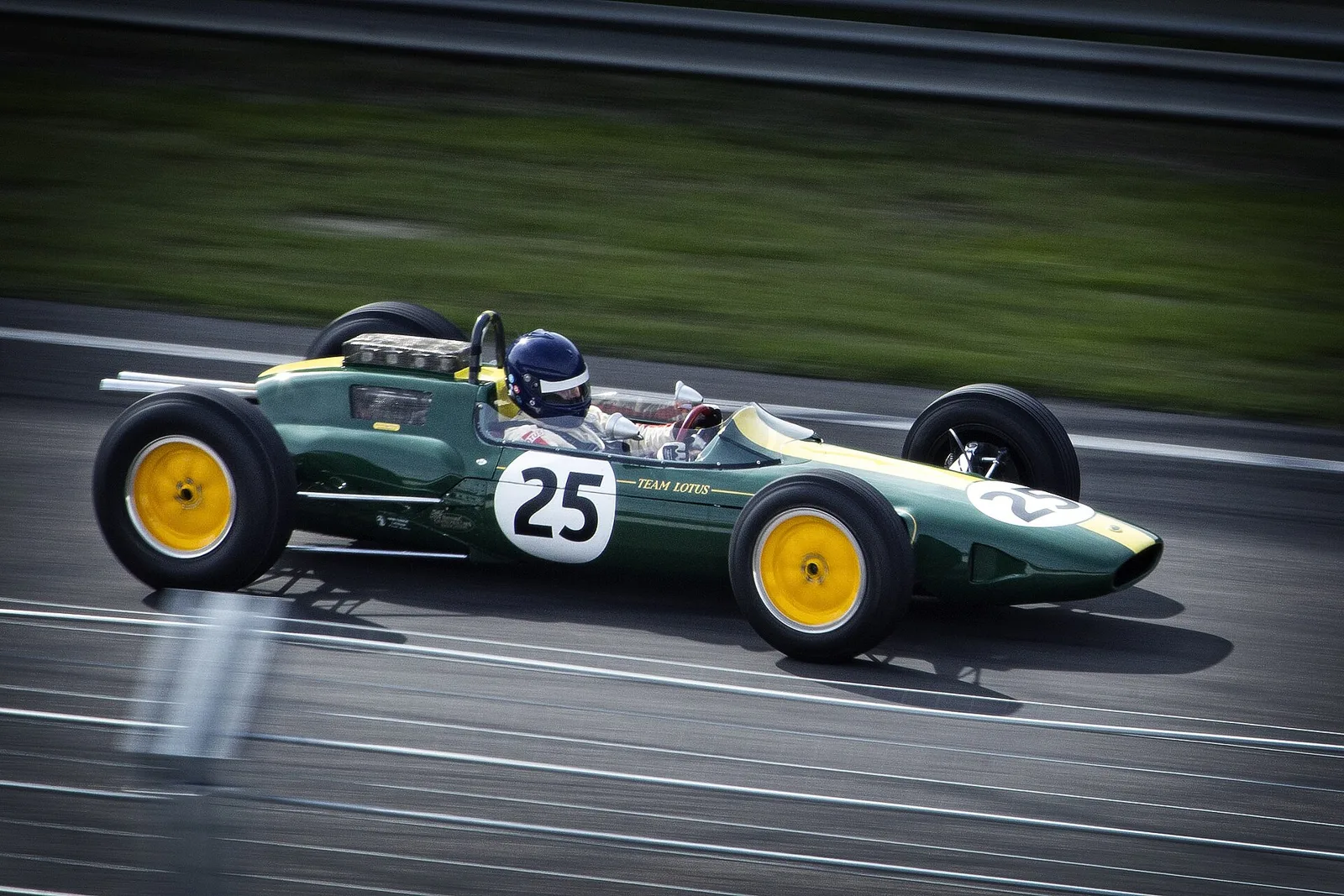
From a monocoque sketched on napkins to a ground-effect car nicknamed Black Beauty, Colin Chapman's 25, 49, 72 and 79 changed how a Grand Prix car is built.
Colin Chapman's Lotus cars changed Formula One in turn: the 25 was a fully stressed monocoque in 1962, the 49 of 1967 carried the Cosworth DFV as a structural member, the 72 of 1970 added a wedge shape and side radiators, and the 79 of 1978 was first to exploit ground effect fully.
When the Lotus 25 first appeared at the Dutch Grand Prix in 1962, John Cooper inspected the car and asked Colin Chapman where he had put the frame tubes. The answer was that the car was a monocoque, and its skin was its structure.
That was the first of four ideas that Chapman and his engineers put into Formula One between 1962 and 1978, in the Lotus 25, 49, 72 and 79: the monocoque, the engine as part of the chassis, the wedge with side radiators and, last, an underbody that pulled the car to the road.
What did the Lotus 25, 49, 72 and 79 each change in Formula One?
The Lotus 25 introduced the fully stressed monocoque chassis in 1962. The Lotus 49 built the car around the Cosworth DFV as a load-bearing part of the structure in 1967. The Lotus 72 of 1970 added a wedge shape, side radiators and inboard brakes, and the Lotus 79 of 1978 was the first car to exploit ground effect fully.
| Car | Year | The idea | Engine | Record |
|---|---|---|---|---|
| Lotus 25 | 1962 | Fully stressed monocoque | Coventry Climax FWMV V8 | 14 World Championship wins, Clark's 1963 title |
| Lotus 49 | 1967 | Engine as a stressed member | Ford Cosworth DFV | Twelve wins, contributed to two drivers' and constructors' titles |
| Lotus 72 | 1970 | Wedge shape, side radiators, inboard brakes | Cosworth V8 | 20 wins, two drivers' and three constructors' titles |
| Lotus 79 | 1978 | Full ground effect | Ford Cosworth DFV | 7 wins, 10 poles, Andretti's 1978 title |
Lotus 25 was a fully stressed monocoque, and John Cooper asked where Chapman had put the frame tubes.
Lotus 25: the car without a frame
The Lotus 25 was designed by Colin Chapman for the 1962 season and was the first fully stressed monocoque chassis in Formula One. The original sketches were made on napkins while Chapman discussed the idea over dinner with Frank Costin, the designer of the Vanwall bodywork. In Jim Clark's hands it took 14 World Championship wins and carried him to the 1963 title.
The monocoque made the car more rigid and stronger than typical Formula One cars of the time. It was three times stiffer than the interim Lotus 24, while its chassis weighed half as much. It was also tiny, with a frontal area of 0.74 square metres against 0.88 for a normal car. The driver sat reclined sharply behind the wheel, an idea seen in the Lotus 18 and pioneered over a decade earlier by Gustav Baumm at NSU, which earned the car the nickname The Bathtub. The front coil and damper units were moved inboard, as on a 1948 Maserati.
A shock to the paddock
The 25 appeared at Zandvoort in 1962, and its arrival was a shock to rivals, particularly Brabham and UDT/Laystall, who had recently bought Lotus 24s on the understanding that they were mechanically identical to the works cars. Chapman had reserved the right to alter the bodywork. Privateers such as Rob Walker Racing, who had been buying Lotus chassis, were refused 25s and given 24s, while the works team had the 25 to itself for Clark and Trevor Taylor.
Power came from versions of the Coventry Climax FWMV V8 from the Mk.II at 1496cc through to the Mk.5 at 1499cc. Reg Parnell Racing later fitted BRM P56 engines of similar specification to its second-hand cars in 1964.
The 25 on track
Seven cars were built, numbered R1 to R7. Four were written off in accidents between 1962 and 1966, three of them by Trevor Taylor. The best was R4, in which Clark took all seven of his 1963 World Championship wins. Clark's first Grand Prix win came in it at Spa in 1962, followed by wins in Britain and the United States. He led the final race in South Africa when an engine seizure cost him the title to Graham Hill.
In 1963 he got his revenge with seven wins, in Belgium, France, Holland, Britain, Italy, South Africa and Mexico, and Lotus won its first constructors' championship. After the United States Grand Prix, a 25 went to Indianapolis for evaluation, where an ignition system was trialled for Ford. The results encouraged Chapman to launch his Indianapolis 500 challenge.
The 25 won three more races in 1964, and again an oil leak left Clark coasting to a halt with a lap to run in the final race in Mexico, handing the title to John Surtees. Clark took the car's last win at the 1965 French Grand Prix. Parnell's 25/33 hybrid finished seventh at the 1967 Dutch Grand Prix, five years after the model's debut.
Lotus 49: the engine becomes the chassis
The Lotus 49 was designed by Colin Chapman and Maurice Philippe for 1967. After a difficult first year in the three-litre formula with the heavy, unreliable BRM H16 engine, they went back to the drawing board. The 49 was the first Formula One car powered by the Ford Cosworth DFV, an engine that existed because Chapman convinced Ford to finance Keith Duckworth's design.
The key idea was to make the engine a stress-bearing structural member, bolted to the monocoque at one end and to the suspension and gearbox at the other. BRM had done this first, and the front-engined Lancia D50 of 1954 had anticipated it, but the 49 made it standard. Virtually all Formula One cars have been built that way since.
The 49 in 1967 and 1968
Graham Hill found the 49 responsive but the engine's sudden surges of power hard to manage, saying after his first run that it had some poke and was not a bad old tool. Jim Clark won easily on its debut at Zandvoort in 1967 and took three more wins that season, though early DFV unreliability ended his title hopes. At Spa a spark plug problem struck, and at the French Grand Prix reliability problems hit both Clark and Hill, handing the win to Jack Brabham. Clark then ran out of fuel at Monza.
Clark opened 1968 by winning the South African Grand Prix and the Tasman Series, but he was killed in a Formula Two race at Hockenheim. Hill became team leader and won his second world title with three wins, including Monaco, the fourth of his five victories there. In the British Grand Prix at Brands Hatch, Jo Siffert won in a 49B owned by Rob Walker, the last victory by a genuinely private entry in a championship Formula One race.
Wings, the 49B and the end of the line
The 49B arrived for the 1968 Monaco Grand Prix and followed Ferrari's strutted wings by becoming the first Formula One car with wings mounted directly to the wheel hubs, after their success on Jim Hall's Chaparral 2E. The wings stood several feet above the chassis in clean air, but after several breakages that caused dangerous accidents the high wings were banned and Lotus had to mount them on the bodywork.
Jochen Rindt won his first race in a 49B at Watkins Glen in 1969 and its last at Monaco in 1970. The Lotus 63, due to take over, proved a failure, so an improved 49C kept racing. In total the 49 took twelve wins and contributed to two drivers' and two constructors' titles before the Lotus 72 took over in 1970. Twelve were built and seven survive, with chassis R3 the only original 1967 car, at the National Motor Museum in Hampshire.
The Tasman 49T
Lotus also ran the car in the Tasman Series with a 2.5-litre DFW engine, which made about 268 kW (360 bhp) against the DFV's 313 kW (420 bhp). Clark won four of the eight races in 1968 including the Australian Grand Prix, where he beat Chris Amon's Ferrari by 0.1 seconds, the closest finish in that race's history.
Lotus 72: a wedge on wheels
The Lotus 72 was designed by Chapman and Philippe for 1970. It had inboard brakes, radiators in the sidepods instead of in the nose, as had been normal since before the Second World War, and wings producing downforce. Its shape, a wedge on wheels, was inspired by the Lotus 56 gas turbine car, and in a back-to-back test with the 49 and the same Cosworth engine the 72 was 12 mph faster.
It combined the stressed engine of the 49 with advanced aerodynamics, and produced a car years ahead of its rivals. The handling needed work first, because the anti-dive front suspension geometry and the anti-squat set-up at the rear took away the driver's feel. Once the suspension was modified the major problem left was front inboard brake shafts failing. Nine chassis were built.
From Spain to Rindt's title
The 72 debuted at the Spanish Grand Prix in April 1970 in the red, cream and gold of Gold Leaf, but was withdrawn after that race for suspension changes. It returned for the Dutch Grand Prix, and Jochen Rindt won the Dutch, French, British and German races in quick succession. Rindt died after a qualifying crash at Monza in a 72 running without its wings, caused by the failure of a front brake shaft. Emerson Fittipaldi took his seat and won the United States race, and Rindt became Formula One's only posthumous world champion.
Fittipaldi, Peterson and the long afterlife
Tony Rudd developed the car during 1971, redesigning the rear suspension and modifying the rear wing for more downforce. In 1972 Fittipaldi became the youngest world champion in Formula One history, winning five races, and Lotus took the constructors' title in new black and gold John Player Special colours.
For 1973 mandatory deformable side structures meant integrated sidepods. Ronnie Peterson joined and won four races to Fittipaldi's three, but retirements let Jackie Stewart take the drivers' title, though Lotus kept the constructors' crown. Fittipaldi left for McLaren, whose M23 was closely based on the 72.
The Lotus 76 that was meant to replace it flopped, so the 72 raced on in 1974, and Peterson won another three races, with Lotus fourth among constructors. By 1975 it was no match for the Ferrari 312T and the Brabham BT44, and Lotus finished sixth. With 20 wins and a haul of two drivers' and three constructors' titles behind it, the 72 gave way to the Lotus 77 for 1976. It won the 1996 Historic Formula One Championship.
Lotus 79 ground effect: the Black Beauty
The Lotus 79 was designed in late 1977 by Chapman with Geoff Aldridge, Martin Ogilvie, Tony Rudd, Tony Southgate and Peter Wright. It was the first Formula One car to take full advantage of ground effect aerodynamics, an idea pioneered in its predecessor, the Lotus 78. Where the 78 had undercar pressure problems, the 79 spread the low-pressure area evenly along the whole underside by extending the bodywork back inside the rear suspension, so the air left the rear cleanly, and a smaller rear wing could be used to cut drag.
The car was built from sheet aluminium honeycomb around a Ford Cosworth DFV, with a single fuel cell behind the driver, which improved fire protection and put the centre of gravity back in the middle. It was the first Formula One car designed with computer aids, and the first to be analysed by computers in the pits.
Testing and a shock for the designers
Ronnie Peterson tested the car in secret in late 1977 and found it extremely fast, but the chassis suffered early fatigue from the suction and g-forces. It made about 30 percent more downforce than the 78, which Ogilvie and Rudd had not foreseen. They strengthened the monocoque and load points, and the car became faster still.
Press and fans called it Black Beauty, for its clean lines and black and gold John Player Special livery. It was instantly competitive on its debut at the 1978 Belgian Grand Prix at Zolder, where Mario Andretti took pole by more than a second and won comfortably. After driving it, Andretti said the 78 was like driving a London bus. It was not flawless: its brakes faded over a race distance, its exhaust tended to overheat and the monocoque was less stiff than the team wanted.
1978 and the end of the era
The 79 produced an unprecedented level of domination in 1978. Andretti and Peterson finished one-two in Belgium, Spain, France and the Netherlands, the last Lotus one-two in the team's history. Brabham's fan car won in Sweden and was then withdrawn, and the Ferrari 312T3 on Michelin tyres was the only other threat. Ferraris won mainly when the Lotus failed to finish.
Peterson won in Austria, but at the Italian Grand Prix he was injured in a start-line collision and died the following day. Andretti was comfortably world champion, Peterson finished runner-up posthumously, and Lotus won the constructors' title with 86 points. They were the last drivers' and constructors' world championships for Lotus.
In 1979 Carlos Reutemann replaced Peterson and the car appeared in the green of Martini sponsorship. The Lotus 80, meant to succeed it, was a failure, so the 79 returned. It was now outclassed by the Ligier JS11, the Ferrari 312T4 and the Williams FW07, a car heavily based on the 79. Lotus slipped to fourth in the constructors' standings and the 79 was retired without another win. It still gave Nigel Mansell his first Formula One test, at Paul Ricard in December 1979.
How these ideas show up in modern Grand Prix cars
Several of these ideas are still visible in modern Formula One. Virtually all cars since the 49 have been built with the engine as a structural member, the 72 paired that layout with advanced aerodynamics, and the 79 is credited with pushing the sport into the modern aerodynamics era. Rubens Barrichello's verdict after driving a 79 in 2000 was that it felt like a modern Grand Prix car.
Where this goes next
Each of these cars was replaced by something. The Lotus 33 arrived in 1964, though the 25 raced on into 1965. The 72 took over from the 49 in 1970 and the Lotus 77 followed the 72 in 1976, while the Lotus 80 failed to replace the 79 in 1979, signalling the end of the team's glorious era. The second-generation Lotus Elise has Type 72 and 72D editions that commemorate the 72, and the 49 and 79 appear in racing games.