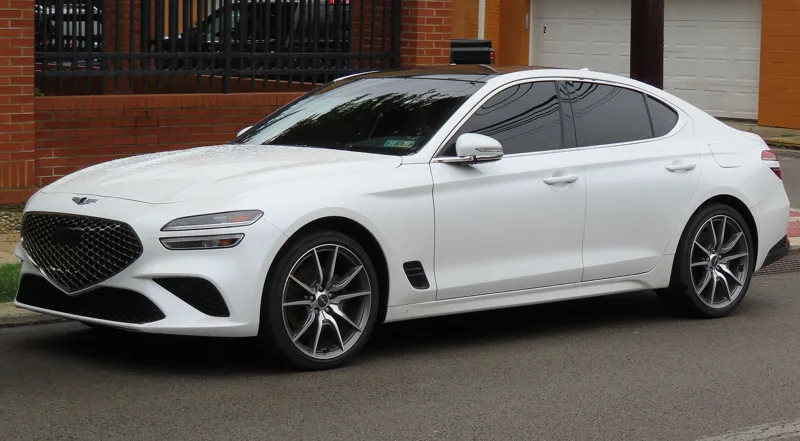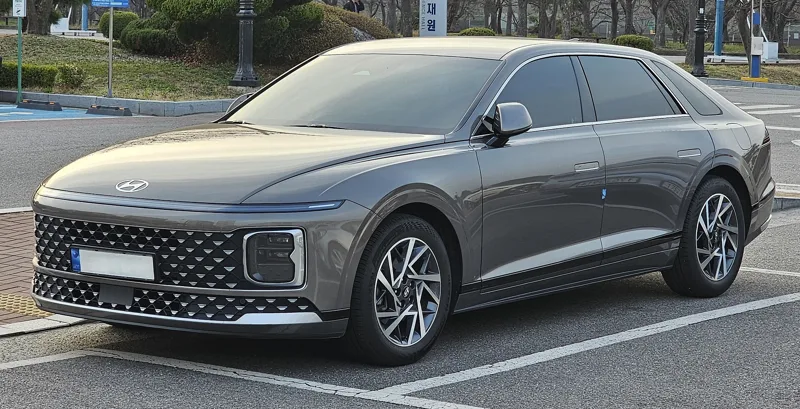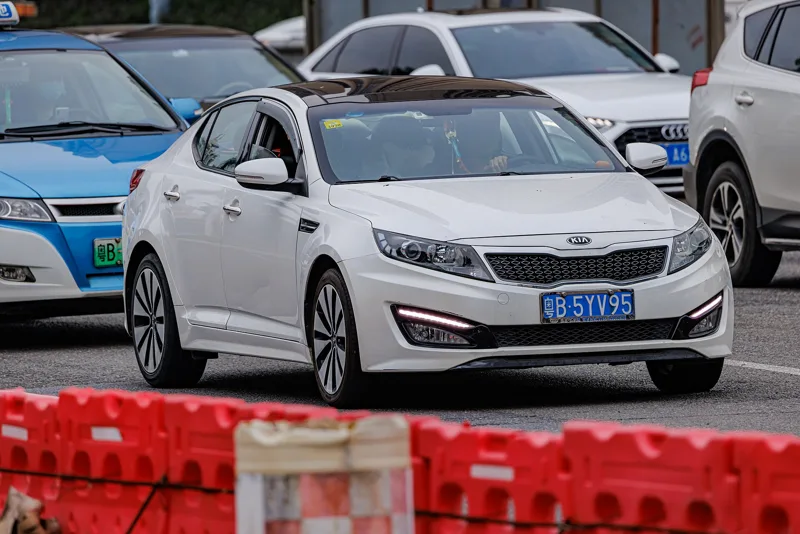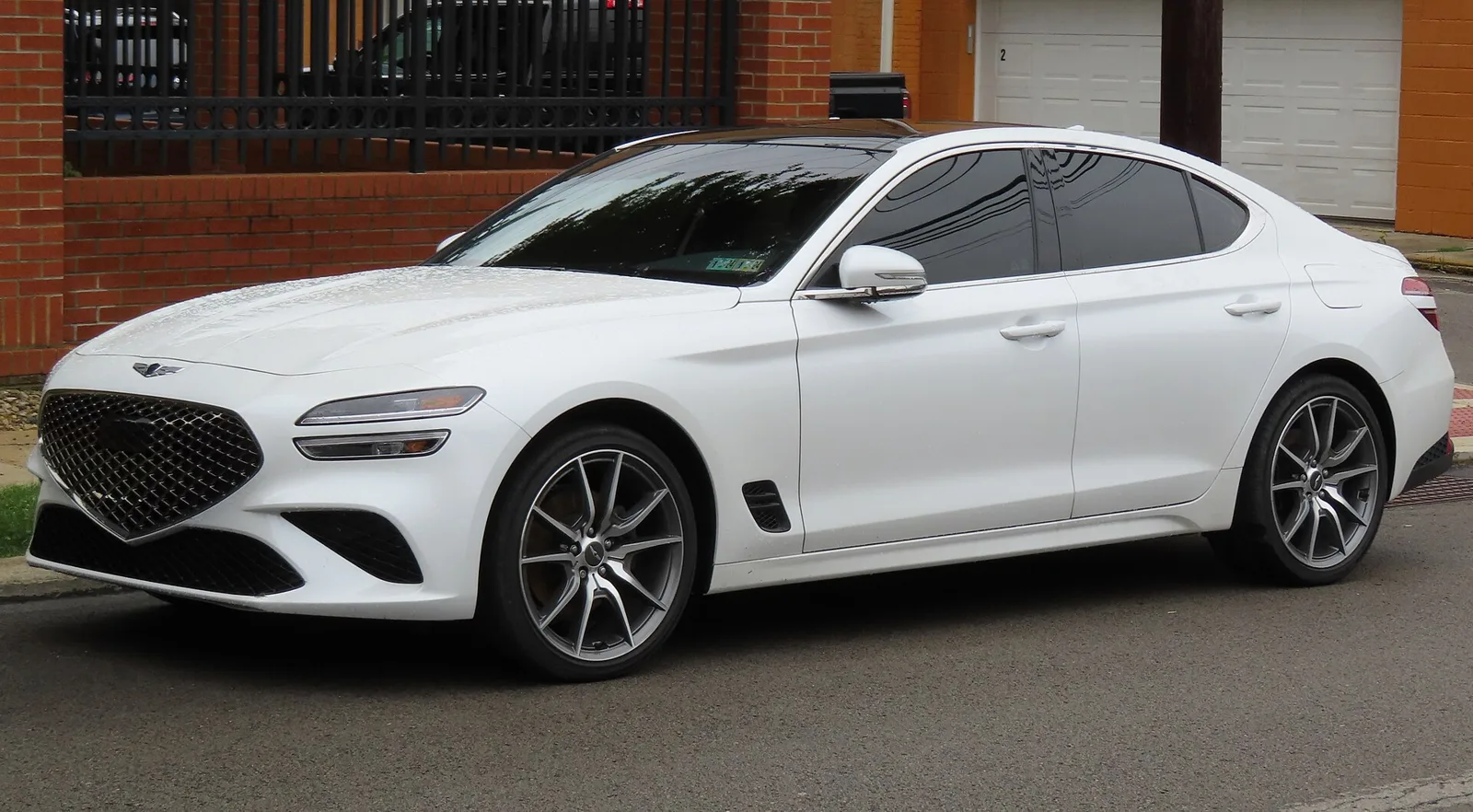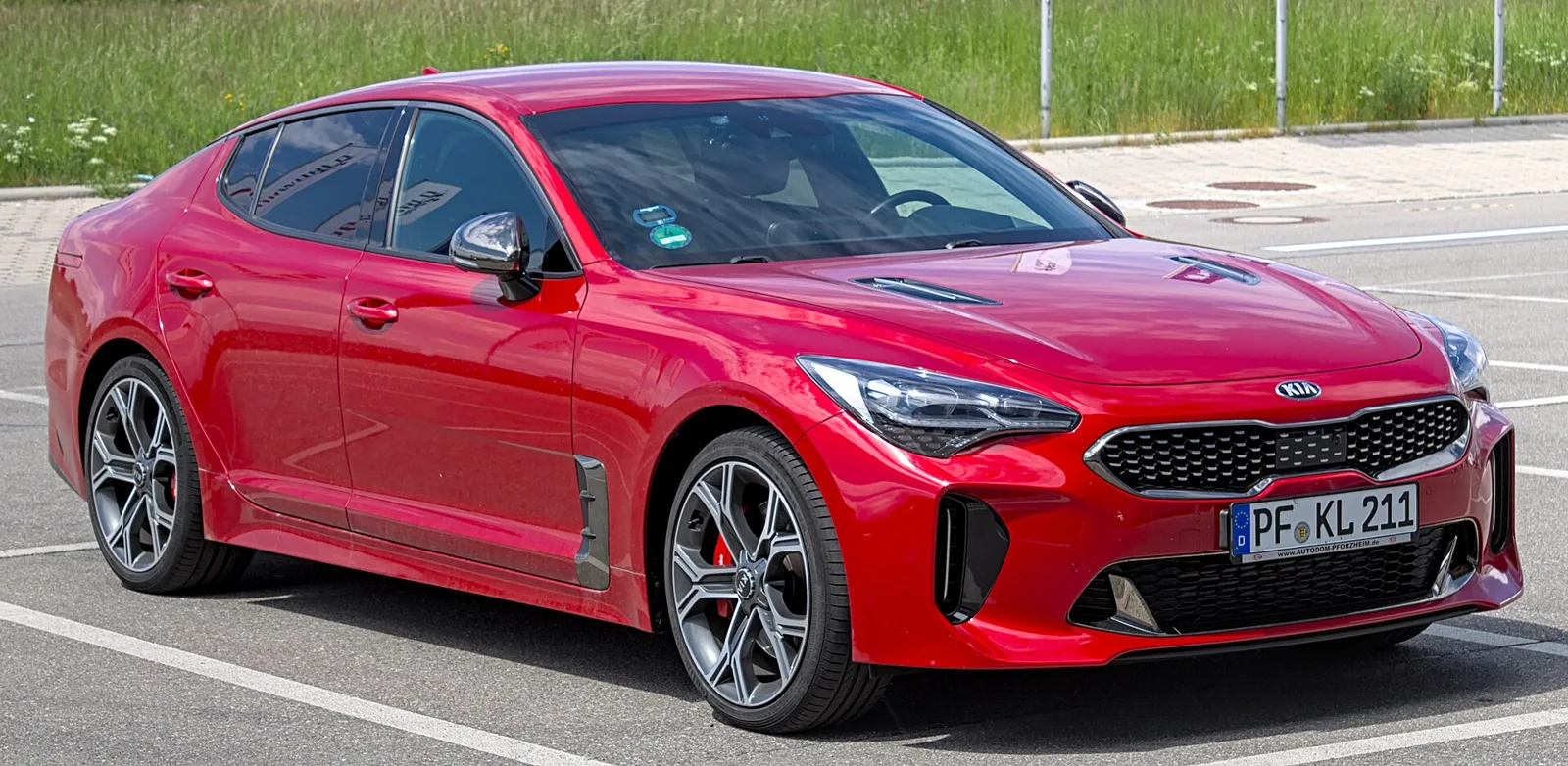
Kia's four big saloons ran from the front-drive Opirus to a rear-drive Stinger that sold only 1,499 cars at home before it was dropped.
Kia's top-end saloons were the Opirus (2003-2012), the Cadenza (2009-2021), the K9 or K900 (2012-2026) and the Stinger (2017-2023). The first three were luxury and executive cars; the Stinger was a rear-drive V6 fastback that ended as Kia's lowest seller.
By the time Kia stopped building the Stinger in April 2023, its award-winning sports saloon was also the lowest-selling model the company had. Kia put the end down to falling worldwide demand, a home-market tally of only 1,499 cars and a company turning towards electric vehicles. It was the latest chapter in a long attempt by Kia to sell big, expensive cars to buyers who expected the badge to be something else.
That attempt runs through four names: the Opirus, the Cadenza, the K9 and the Stinger. Three were luxury and executive saloons, aimed at comfort and size. The fourth was a rear-drive fastback with a twin-turbo V6, engineered by Albert Biermann, a former BMW M vice president of engineering.
What was the Kia Opirus and why was it built?
The Opirus was an executive saloon that Kia sold over a single generation, from 2003 to 2012 globally and from 2004 to 2009 in North America under the Amanti name. It was Kia's first premium car, built to give the company a way into richer markets.
It debuted at the 2003 Geneva Motor Show as a four-door, five-seat, front-drive sedan, and went to North America at the New York International Auto Show. Development took 22 months and cost US$167 million, with 18% of that spent on research and 41% on the technologies needed to build the car. In South Korea it replaced the Mazda 929-derived Enterprise. It was also the first Kia to share a platform with Hyundai, using a variation of the Grandeur and XG Y4 architecture, stretched by 1.9 inches, with 4.1 inches added to overall length. Every car was made at Hwaseong, near Incheon.
The name came with a story. Opirus pointed to Ophir, the ancient city famed for its riches, and an online survey picked it from a shortlist that included Regent and Conzern. In North America the car became the Amanti, a name the New York Times described in 2004 as an untranslatable latinate construction meant to suggest luxury.
Kia built four big saloons to reach the premium end, and the fastest of them became its lowest-selling model.
How was the Kia Opirus equipped, and did it work?
It was well equipped and aimed at comfort rather than agility. In North America Kia pitched it to value-sensitive professionals aged between 40 and 60, with a power moonroof, an eight-way driver seat, 16-inch alloy wheels and eight airbags. It had 105.6 cubic feet of passenger volume and 15.5 cubic feet of boot space.
Reviewers had views on the styling, which they variously called conservative, restrained, unoriginal and derivative. The cues were easy to spot, with the Lancia Thesis, Chrysler 300C, Lexus GS, Jaguar S-Type, Lincoln Town Car and Mercedes-Benz E-class all getting a mention. Korean-market cars added rear seats that heated and reclined, discharge-type headlights, navigation, parking sensors and electronically adjustable suspension.
Under the bonnet were the 3.5-litre Sigma and 3.8-litre Lambda V6 engines. The North American 3.5 produced 200 bhp at 5500 rpm and 220 lb-ft at 3500 rpm, through a five-speed automatic with a manual sequential mode. Electronic stability control was a first for Kia, developed with Continental Teves of Germany, and an electronically controlled suspension offered automatic and sport settings. J.D. Power rated the Amanti the most appealing premium mid-size car in its 2005 study.
A facelift for 2007, shown at the 2006 Paris show, cut 250 pounds of weight, retuned the suspension and introduced a 3.8-litre V6 in North America. It made 32 per cent more power than the engine it replaced. Sales ended in North America after 2009 and elsewhere in 2012.
What was the Kia Cadenza?
The Cadenza, called the K7 in South Korea, was a full-size executive car produced from 2009 to 2021. It was launched to replace the Opirus and Amanti, and by January 2014 it was on sale in South Korea, China, Brazil, Colombia, Chile, the Middle East, Canada and the United States.
The first generation moved to the new front-drive Type-N platform with MacPherson struts at the front and a multilink rear. Petrol engines ranged from 165 to 290 horsepower, including a 2.4-litre direct-injection four with 201 horsepower and the 3.5-litre Lambda at the top. Korea also got a hybrid, the K7 700h, which paired a 159 hp four-cylinder with a 35 kW electric motor. Peter Schreyer, who had been chief designer at Audi, led the styling and gave the car the Tiger Nose grille of the Kia family.
In January 2013 Kia confirmed that the Cadenza was heading to the United States, where it was the company's take on the Hyundai Azera. It was one of five Korean luxury sedans in the American market then, alongside the Azera, Genesis, Equus and Kia's own K900. The car offered Nappa leather in black, beige or white, a heated and ventilated driver seat and an available dual sunroof, and its most powerful engine was a 294 horsepower 3.3-litre V6.
The second generation, released in the autumn of 2016 and again redesigned by Schreyer, carried a revised 3.3-litre V6 of 290 horsepower and added a new eight-speed automatic developed in-house, with drive mode select. A facelift in June 2019 brought a 2.5-litre SmartStream engine in place of the 2.4, a 3.5-litre in place of the 3.3 in some regions, a new grille and hood and a 12.3-inch touchscreen. The Insurance Institute for Highway Safety gave it a Top Safety Pick+ rating.
Kia cited the market's move from large cars to crossovers and SUVs when it dropped the Cadenza from Canada after the 2019 model year and from the US after 2020. Production stopped in early 2021, a dozen years after it began, so that the K8 could take over.
What was the Kia K9 (K900)?
The K9 is Kia's full-size luxury saloon, known as the K900 to buyers in the United States and Canada and as the Quoris in other export markets. Production started in 2012 and, according to Kia, ends in 2026. Kia had never before sold a rear-drive saloon in the United States.
It first appeared in South Korea in May 2012, with exports from late that year, and by June 2013 buyers in Russia, the United Arab Emirates, the United States, Canada and four Latin American countries (Colombia, Chile, Guatemala and Peru) could buy it. The first generation, code KH, was a relative of the Hyundai Equus and Genesis and shared the BH-L platform. It had Kia's Tiger nose grille, blind spot detection, a head-up display and adaptive front lighting.
Launch engines in Korea were a 3.3-litre V6 of 300 PS (221 kW) and a 3.8-litre direct-injection V6 of 334 PS (246 kW), both with an eight-speed automatic. Russia received a 294 PS 3.8. The American K900 used a 5.0-litre V8 of 426 PS (313 kW), while Canada offered the V8 or a 315 PS 3.8-litre V6.
The second generation, code RJ, was shown at the New York show in March 2018. It was longer and wider, with the wheelbase stretched by about 2.3 inches (60 mm), and kept the same eight-speed transmission and three engines. Inside were better leather and wood, an analogue clock developed by Maurice Lacroix, and in Korea an all-wheel-drive version. The 2021 facelift, with images released on 17 May, brought a broader grille bearing chrome V motifs, a rear lamp spanning the full width, a 14.5-inch display and fingerprint authentication.
Marketing for the K900 was ambitious. A Super Bowl XLVIII commercial featured Laurence Fishburne returning as Morpheus, the character he played in the Matrix films, and in October 2014 the basketball player LeBron James became Kia's K900 luxury ambassador. The car sold more than 200 units a month in the US from April to June in its launch year, then dropped to roughly 100 to 130 in July and August, 56 in September and 62 in October.
Canada lost the K900 in 2018 and the United States in 2021, with Kia blaming the market's drift towards crossovers and SUVs. Only 305 were sold in the US in 2020. On 6 July 2026 Kia confirmed that the K9 would stop at the end of 2026, 14 years after launch, because of declining sales, with the K8 to become the company's largest car.
How did the Kia Stinger get from concept to showroom?
The Stinger started as a 2011 concept at the Frankfurt Motor Show and a 2014 show car, the Kia GT4 Stinger, at the North American International Auto Show. The production car was shown to the public at the 2017 North American International Auto Show, with Peter Schreyer and Gregory Guillaume leading the design and Albert Biermann, formerly of BMW M, running engineering.
Design work took place at Kia's European studio in Frankfurt. Biermann later rose to a senior executive role at the Hyundai Motor Group, running performance development and high performance vehicles. The testing programme included more than 1,000 kilometres at the Korea International Circuit and 10,000 kilometres at the Nurburgring Nordschleife. The car used a shortened version of the rear-drive Hyundai Genesis platform with extra steel reinforcement.
How fast was the Kia Stinger?
The Stinger GT with the 3.3-litre twin-turbo V6 reached 100 km/h in 4.9 seconds, according to Kia. The V6 made 272 kW (370 PS) at 6,000 rpm, the 2.0-litre turbo four 188 kW (255 PS), and Europe and Korea also had a 2.2-litre diesel of 149 kW (202 PS).
Every Stinger used an eight-speed automatic with five driving modes and paddle shifters. The 3,342 cc V6 delivered 510 N-m of torque from 1,300 to 4,500 rpm, and Kia claimed 0-100 km/h in 7.7 seconds for the diesel, 6 seconds for the 2.0-litre petrol and 4.9 seconds for the V6. Car and Driver timed an all-wheel-drive GT 3.3T at 4.6 seconds to 60 mph, recorded 0.91 g on the skidpad and stopped from 70 mph in 164 feet (50 m). Motor Trend's rear-drive 2.0 took 6.6 seconds to 60 mph and covered the quarter mile in 15 seconds.
The most quoted speed story involves Schreyer. He is said to have taken a pre-production Stinger GT to 269 km/h (167 mph) on the Autobahn, only to be passed, allegedly, by a Volkswagen Arteon. The US car's top speed was governed at the same 167 mph.
An August 2020 refresh gave the Stinger revised lamps, a 10.25-inch infotainment screen and a new wheel design. A 2.5-litre turbo petrol engine of 304 PS (224 kW) joined the range, and the V6 gained 3 PS from a variable exhaust. The updated car reached the UK on 6 January 2021, North America on 16 March 2021 and Mexico on 3 May 2021, among the first Kias to wear the company's new logo.
The four Kia saloons side by side
| Model | Years | Drive and platform | Top engine mentioned |
|---|---|---|---|
| Opirus (Amanti) | 2003 to 2012; North America 2004 to 2009 | Front-drive, Hyundai Grandeur/XG-based | 3.8 L V6 |
| Cadenza (K7) | 2009 to 2021 | Front-drive, Type-N | 3.5 L Lambda V6 |
| K9 (K900, Quoris) | 2012 to 2026 | Rear-drive, BH-L shared with Equus and Genesis | 5.0 L V8, 426 PS |
| Stinger | 2017 to 2023 | Rear-drive, shortened Genesis platform | 3.3 L twin-turbo V6, 370 PS |
Who noticed the Kia Stinger, and why did it end?
The Stinger won attention from the start. It took the iF Product Design Award and the Red Dot award for Best of the Best Car Design in 2018, and a MotorWeek Drivers' Choice Award as Best of the Year. Kia promoted it with GQ magazine as a street style icon and put it in two commercials during Super Bowl LII on 4 February 2018, one with racing driver Emerson Fittipaldi and another with Aerosmith singer Steven Tyler.
In The Grand Tour, James May pitted a Stinger GT against a pair of longboard skateboarders on a Majorcan mountain road, the car going uphill and the riders down. In January 2019 Kia became title sponsor of Blackpink's In Your Area World Tour, and June 2021 saw the America's Got Talent judges turn up in two Stinger GT2 models.
Police forces took to it as well. In 2018 police in the Australian states of Queensland and Tasmania chose the Stinger 330S for road policing duties, after production of the Ford Falcon and Holden Commodore police cars stopped. Polish SPEED units have used the V6 versions since 2019, and Merseyside Police began using the Stinger in 2021.
In October 2022 Kia decided to stop production in April 2023, pointing to declining worldwide demand, the model's position as its lowest seller and an electrification strategy with a coupe-like electric model in it. A Tribute Edition followed in December 2022: a GT 3.3-litre turbo limited to 1,000 units worldwide, with 200 for Korea, painted Moonscape Gray matte with black 19-inch wheels, Terracotta brown leather, numbered door sills and wasp icons on the headrests.
What takes over from the Cadenza, K9 and Stinger?
Kia has named the K8 as the heir to two of them. Production of the Cadenza ended to make way for the K8, and when the K9 stops at the end of 2026 the company says the K8 will serve as its largest car. Kia tied the Stinger's end to its electric push, which counts a coupe-like model among its plans.