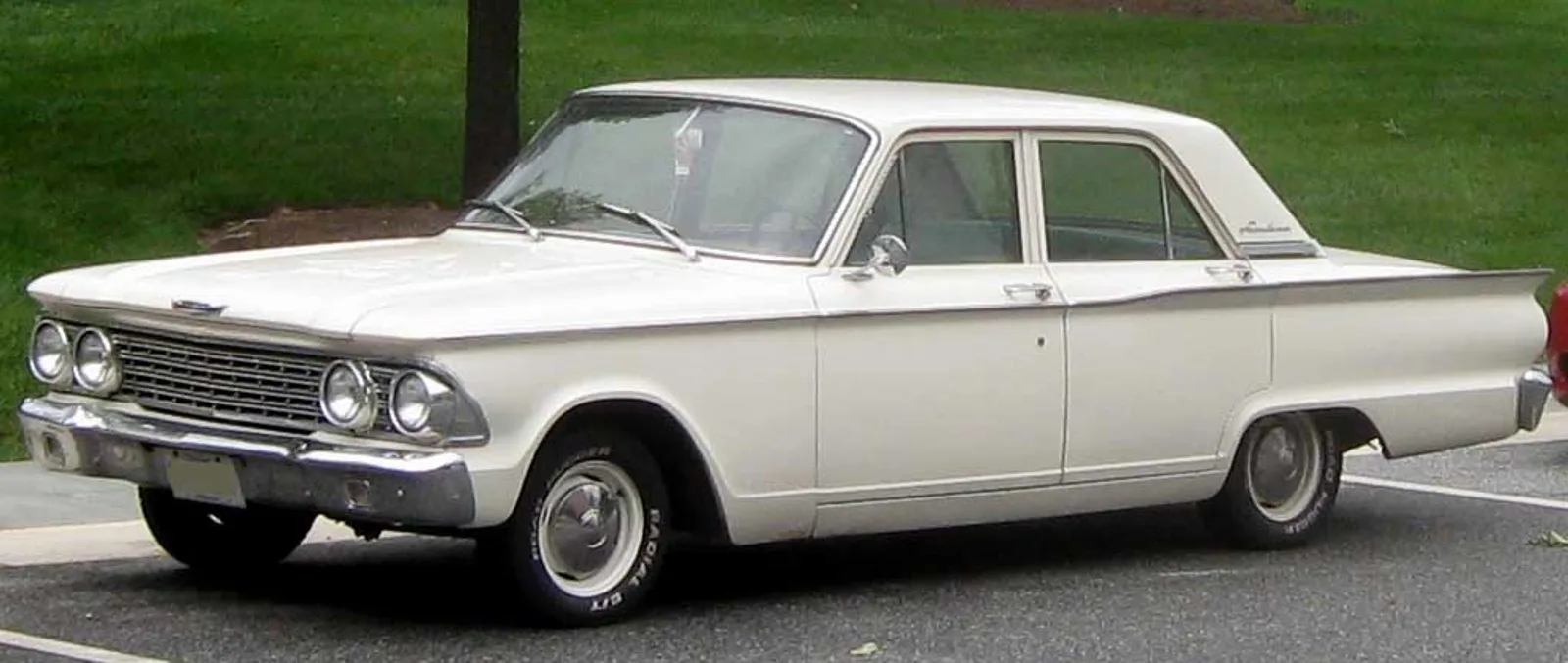
Ford's first postwar car beat Chevrolet and Plymouth to market, and the 1955 Fairlane added seat belts and factory air conditioning.
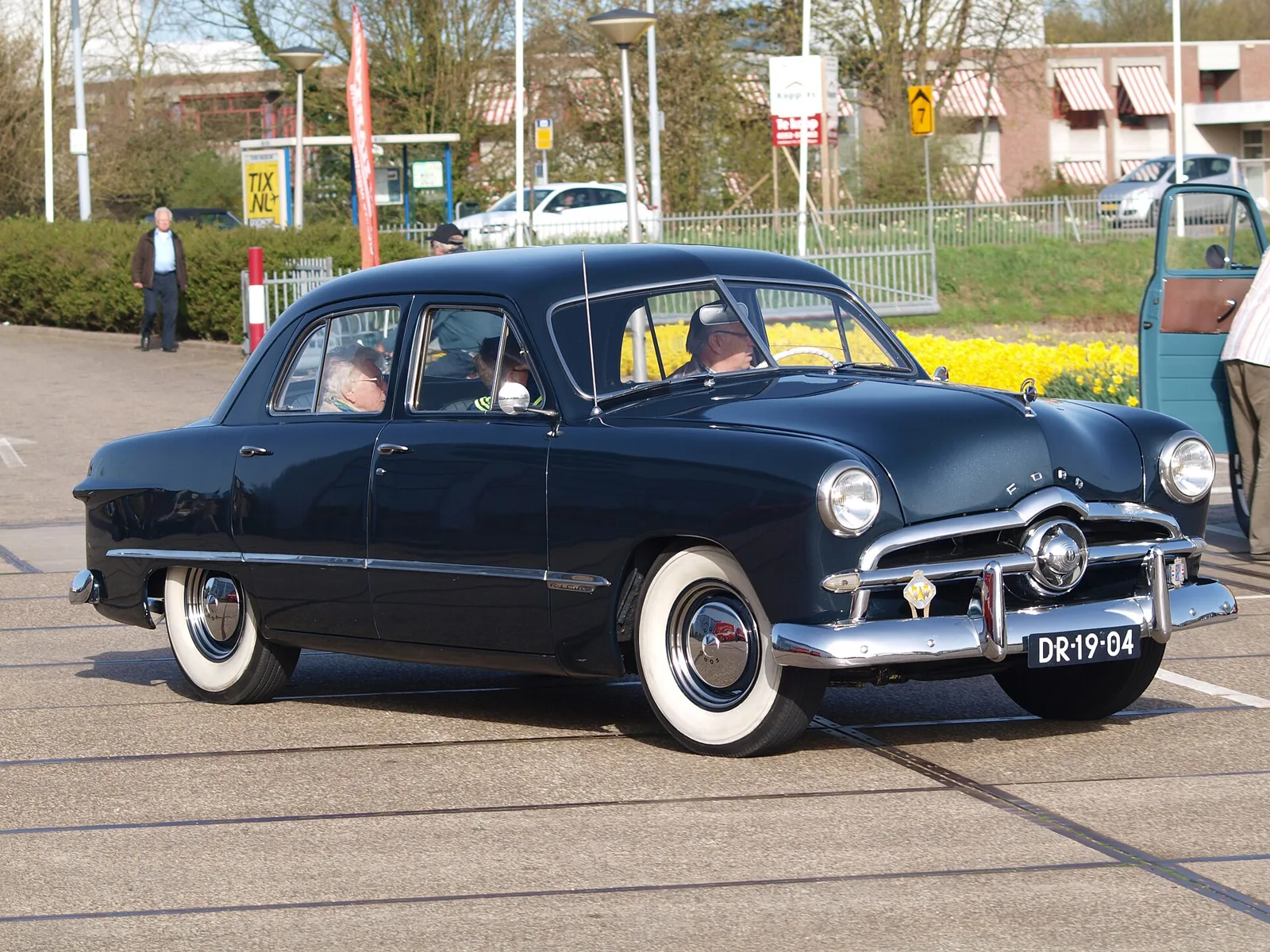
The 1949 Ford was the first full-size postwar Ford, released in June 1948 and nicknamed the Shoebox for its slab sides, with 1,118,740 sold in 1949. The 1955 Ford, led by the Fairlane, added panoramic glass, V8 options up to 193 hp, and Ford's first factory air conditioning.
Ford got its first postwar car into showrooms in June 1948, six months ahead of Chevrolet and nine ahead of Plymouth. The 1949 Ford was the first all-new line from any of the American Big Three after the war, and it was the first Ford line released after the deaths of Edsel Ford and Henry Ford. In 1955 it gave its cars another new body to keep pace with surging rivals, and the Fairlane took over as the top trim.
Together, the two lines run from the slab-sided Shoebox Ford to a car with panoramic glass, a factory air conditioner and the first seat belts Ford offered.
The 1949 Ford and the Shoebox shape
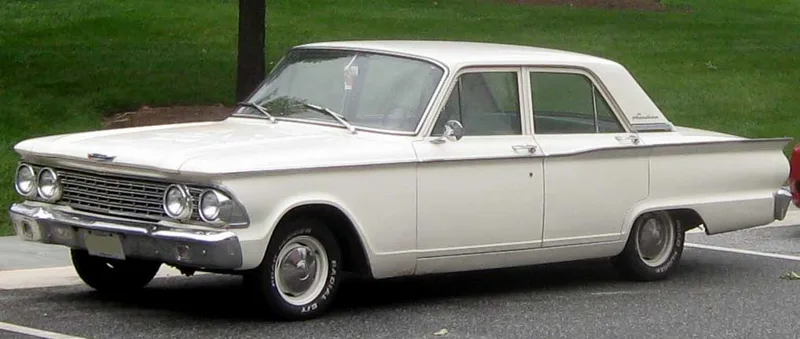
The 1949 Ford replaced the prewar 1941 Ford and was the first full-size Ford designed after World War II. The line ran for the 1949 to 1951 model years, and, with the F-Series launched alongside in 1948, it was sold purely as a car. In 1946 to 1948 the American industry was busy getting production going again, so most makers simply re-released updated versions of their 1941 and 1942 cars. Ford skipped that step.
The new shape earned the nickname Shoebox Ford. It used ponton styling, in which the sides are a flat slab rather than a series of bulges. The theme had been used to streamline cars since the late 1920s, but the 1949 Ford took it further than anyone had. Running boards disappeared, and the front and rear wings were merged into one smooth body. In the 1950s the slab-sided look went on to influence European makers including Mercedes-Benz, Borgward, Austin and Volvo.
The car also brought several firsts to Ford. For 1950 it introduced stand-alone model nameplates, and in the same year the Ford crest first appeared. Designed by artist Frank L. Engle, it stayed on Fords in various forms until the 1991 model year. Ford built the 1949 car at its River Rouge complex in Dearborn, Michigan, and at 14 other branch plants across the United States.
Ford beat Chevrolet to market by six months and Plymouth by nine.
How the 1949 Ford was built
Ford redesigned the car from the ground up for 1949, keeping only the powertrain and the 114-inch wheelbase from the 1941 to 1948 cars. The frame was a drop-center ladder, and the old transverse leaf springs, which had been in use since the Model T, were retired. In their place went independent front suspension on coil springs and longitudinal leaf springs at the rear. The torque tube driveshaft, a rigid housing wrapped around the shaft, gave way to the more widely used open Hotchkiss design.
Power was carried over: a 226 cubic-inch L-head inline-six as standard, with a 239 cubic-inch flathead V8 as an option.
The car debuted at a gala at the Waldorf-Astoria Hotel in New York in June 1948, with a carousel of the new range and a revolving display of the chassis. Ford advertised the integrated steel structure as a "lifeguard body". The woody station wagon still used wood for its outer panels, but it gained a steel inner structure. The convertible frame got an X member for extra rigidity.
1949 Ford Custom, coupe and trim levels
Richard Caleal is credited with shaping the design, and he presented it to the Ford Executive Committee. The names Custom, De Luxe and Super De Luxe made way for Standard and Custom trims. Body styles included the Tudor (two-door) and Fordor (four-door) sedans, a fastback Club Coupe, a Business Coupe with no rear seat, a Convertible Club Coupe and a two-door station wagon.
The centre of the "Bullet-nose" grille carried a red circle embossed with a 6 or an 8 to show which engine was fitted. Ford Motor Company used ponton styling across all three divisions for 1949, and the Ford looked much like the Mercury Eight and the Lincoln even though the bodies were different. Studebaker later adopted the bullet-nose idea for its 1950 Starlight facelift.
The result was a hit. Ford returned to first place among American manufacturers in 1949 with sales of 1,118,740 cars, helped by a model year stretched to 16 months.
1950 and 1951: Crestliner, Victoria and Ford-O-Matic
Changes for 1950 were mostly on the outside. The "FORD" lettering gave way to the new crest badge, and trims were renamed Deluxe and Custom Deluxe. A Deluxe Business Coupe was the cheapest Ford. After complaints, the door latch was upgraded several times for safety.
To take on the Chevrolet Bel Air hardtop, Ford launched the Crestliner "sport sedan". It was the first stand-alone Ford nameplate in America and was a premium Tudor with two-tone paint and a vinyl roof. The two-door wagon became the Ford Country Squire and gained flat-folding rear seats.
For 1951 the grille turned "dual-bullet". The Victoria name, last used in 1934, returned on a two-door hardtop meant to rival Chevrolet and Plymouth's equivalents, and it outsold the Bel Air by nearly 10 percent. The Crestliner came back too, and Custom Deluxe became Custom. The three-speed Ford-O-Matic, introduced in November 1950 as an option, was the first automatic transmission in a Ford. In 1951 a keyed ignition replaced the starter button.
Meteor, Australia and the Ford Forty-Nine
For 1949 Ford of Canada created the Meteor brand as an entry-level line sold through Lincoln-Mercury dealers, though in smaller towns the two brands did not share a network. A Meteor used a Ford body, chassis and V8 with a Mercury grille and its own trim, giving Lincoln-Mercury a cheaper car to compete with Pontiac and Dodge. From 1949 to 1951 Meteor shared model names with Ford, including a Custom Deluxe Victoria coupe.
Ford Australia also built the 1949 V8 generation from 1949 to 1951, with a right-hand-drive Fordor sedan and a two-door coupe utility developed specifically for Australia. By 1950, its local models had reached 80 percent Australian-sourced content.
The shape returned in 2001, when Ford showed the Ford Forty-Nine concept at the North American International Auto Show. J Mays and Chip Foose, who also designed the Plymouth Prowler, drew it as a modern take on the 1949 Club Coupe. It used a Lincoln LS chassis and V8, shared with the Thunderbird, and swapped the bullet nose for an all-glass roof. Like the Volkswagen New Beetle, Audi TT and Chrysler PT Cruiser, it was meant to preview a possible production car. Ford also built a non-running convertible. After the disappointing launch of the revived Thunderbird, Ford ended development of a production Forty-Nine.
The 1955 Ford Fairlane
The 1955 Ford was built for the 1955 model year and, in revised form, for 1956, and a new design followed in 1957. Ford gave the car a new body to keep up with surging Chevrolet and Plymouth, but underneath it was still much like the 1952 Ford.
1955 Ford engines
The Mileage Maker inline-six grew to 223 cubic inches, and the Y-block V8, new for 1954, was offered in two sizes.
| Engine | Capacity | Setup | Output |
|---|---|---|---|
| Mileage Maker inline-six | 223 CID (3.7 L) | Standard | 120 hp (89 kW) |
| Y-block V8 | 272 CID (4.5 L) | 2-barrel carburettor, single exhaust | 162 hp (121 kW) |
| Y-block V8 | 272 CID (4.5 L) | 4-barrel carburettor, dual exhaust | 182 hp |
| Y-block V8 | 292 CID (4.8 L) | From the Thunderbird | 193 hp (144 kW) |
Fairlane, Crown Victoria and panoramic glass
The most obvious novelty was the Fairlane, which replaced the Crestline as the top trim. Alongside it came the Crown Victoria, with a chrome "basket handle" arching over the familiar Victoria hardtop roof. The handle first appeared on the Mercury XM-800 concept car. Later Fords reused the trick of a trim piece dividing the cabin front from rear: the 1977 to 1979 Thunderbird, the LTD Crown Victoria, and the Fairmont Futura and Zephyr Z-7 coupes.
The two-door range now came in three rooflines: the tall two-pillar Mainline, Customline and Fairlane sedans, the pillarless Fairlane Victoria hardtop, and the chrome-pillar Fairlane Crown Victoria, which could also have a transparent skylighted top. Brakes were new 11-inch (280 mm) drums. The frame was new, though it still had five cross members.
The cars also borrowed the panoramic windshield that Oldsmobile, Buick and Cadillac had used the year before. With vertical A-pillars the driver gets a wider view. Ford offered seat belts for the first time, as a dealer option, installed from a Service Bulletin rather than at the factory. Its first factory-fitted air conditioner, Select Aire, packed a heater core and evaporator into the dash, with cold air vents on top of the dash beside the radio speaker. The condenser sat in front of the radiator.
Models were sold under three names, Mainline, Customline and Fairlane. Station wagons became a separate series for the first time. The Ranch Wagon and Custom Ranch Wagon had two doors, and the Country Sedan and Country Squire had four, the Country Squire with wooden applique side mouldings. The sedan delivery was marketed as the Ford Courier.
1956 Ford: 12 volts and the Lifeguard package
For 1956 the eggcrate grille was widened into rows of rectangles, but the biggest change was electrical. Ford adopted a 12-volt system, with six volts optional. The Crown Victoria Skyliner was selling badly, with just 603 made, and a convertible replaced it the next year. A mid-year Town Victoria four-door hardtop and a new Customline Victoria two-door hardtop were aimed at the Chevrolet Bel Air and Plymouth Belvedere. The Parklane, a two-door wagon in Fairlane trim, was the answer to the Chevrolet Nomad.
New options included a new heater and a nine-tube signal-seeking radio. Standard warning lights for oil pressure and the ammeter replaced gauges. Victoria hardtops took on the lower, sleeker roofline used on both Crown Victorias, without the wide chrome band.
The Lifeguard safety package arrived, made up of seat belts, a padded dash, safety door locks, a deep-dish steering wheel and a mirror designed to break away. It was a slow seller. So was the air conditioner, which stayed expensive despite a full revamp that moved the compressor under the bonnet and the cooling vents to the top of the dashboard. It could not be ordered on the Thunderbird.
The 1955 Ford in Australia
Ford Australia built the 1955 Ford too, as a V8 Customline four-door sedan and a V8 Mainline two-door coupe utility. The utility body was developed in Australia on an imported convertible chassis strengthened for loads, and a limited number of Customline wagons followed. It was the first Australian Ford with the new overhead-valve Y-block V8, and it went on sale at the end of July 1955.
The cars took the 1956 US facelift and were revised again in 1957 and 1958, the last with the grille from the 1955 Canadian Meteor. The 1957 models, introduced in September, could have the Fordomatic automatic, and local parts content had risen to 80 percent. By 1958 the Customline with automatic was sold as the Ford V8 Fordomatic, and the larger 292 cubic-inch (4.79 L) V8 arrived. Australian production ended in 1959 when the 1959 US Ford took over, built locally as the Custom 300, Fairlane 500 and Ranch Wagon.