A look at how safety cars bunch the field, how Formula One and NASCAR run them, and how the virtual safety car took over from the real thing.
A safety car is a slower lead car that controls the field during a caution period, so that hazards can be cleared under safer conditions. Formula One introduced its own from 1993, and the virtual safety car has since handled many incidents without a real car on track.
Few sights in racing are as recognisable as a slow car leading the field under yellow flags. Its presence changes how drivers race, how teams plan their strategy and how the rule book is written.
What does a safety car do?
During a caution period the safety car holds the field to a slower pace, set to suit each series and circuit. Its job is to let marshals clear hazards in safer conditions, or to wait out bad weather until the track improves.
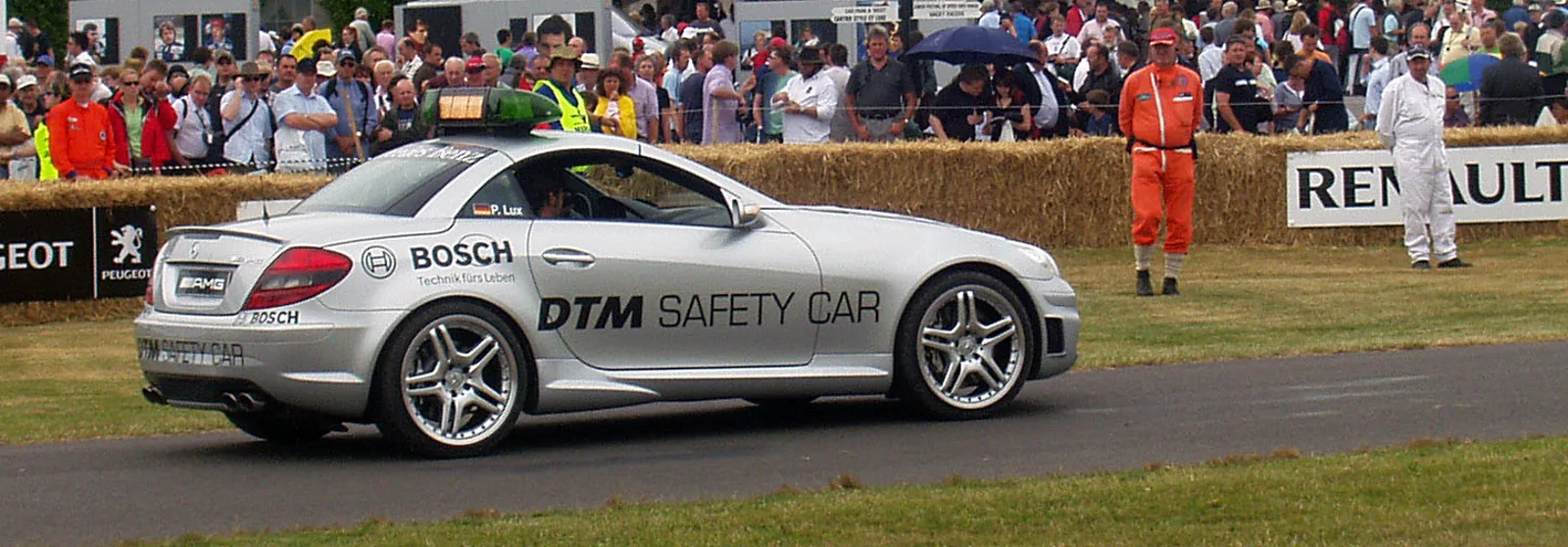
During a caution period the car, which is typically a modified high-performance production car, enters the track ahead of the leader. Competitors are normally not allowed to pass it or one another, and the safety car leads the field at a predetermined safe speed that varies by series and circuit.
Following the car keeps tyres near their working temperature and stops engines overheating. A safety car is also preferred over a red flag and a restart, because a red flag takes longer to resolve.
The safety car slows the field to clear a hazard, then steps aside so that racing can resume on equal terms.
How did safety cars begin?
The first reliance on this safety measure came with the deployment of a pace car during the inaugural Indianapolis 500 in 1911. The first pace car was a Stoddard-Dayton driven by Carl G. Fisher, and the Speedway has selected a pace car and its driver for the race every year since.
Formula One's first safety car appeared at the 1973 Canadian Grand Prix, when a yellow Porsche 914 was called out in treacherous weather. The result took several hours to confirm, because the safety car driver had placed his car in front of the wrong competitor, leaving part of the field a lap down incorrectly.
Formula One officially introduced safety cars in 1993, after trials at the French and British Grands Prix during the 1992 season. Early choices were varied, including a Lamborghini Countach at Monaco in the 1980s, a Fiat Tempra at the rain-affected 1993 Brazilian Grand Prix and an Opel Vectra at the 1994 San Marino Grand Prix.
How does a safety car change a race?
A safety car bunches competitors together, eliminating any time and distance advantage that a leading driver had over the field. That makes racing more competitive when the race resumes, but it penalises leaders by erasing the gains they made before the caution.
Pit stops are often allowed during these periods. A driver can refuel, change tyres or carry out maintenance while the others run at lower speed, then rejoin a queue of cars all running together. In normal racing that stop would cost significant ground.
Racing cars also consume less fuel while the safety car is out, which can let competitors run farther on a tank or reduce the number of pit stops needed for the rest of the race.
How does Formula One run its safety car?
In Formula One, if an accident or heavy rain prevents normal racing from continuing safely, the Race Director calls a safety car period. Marshals wave yellow flags and hold SC boards while the car enters the track. Since 2007 cars have shown the state through LEDs or displays.
A yellow LED lights when the safety car is out, so the driver knows which flags are being waved.
The car is driven by a professional, Bernd Maylander since 2000, with a co-driver to help with operations and communications. Orange and green lights on a roof light bar signal the drivers. Green lights mean overtaking the safety car is allowed, which happens only once the race leader is immediately behind it.
When the safety car is ready to leave, it turns off its orange lights to show that it will enter the pit lane at the end of the lap. Drivers keep formation until they pass the first safety car line, where green lights and flags tell them they are free to race again.
For incidents in the first three laps, the safety car has an advantage over the red flag. A red flag would take at least fifteen minutes to restart, and the two-hour clock would not begin until the cars were lined up for a second formation lap. Under a safety car the race is still scored and the clock keeps running.
What were the early Formula One safety cars?
| Car | Event | Note |
|---|---|---|
| Porsche 914 | 1973 Canadian Grand Prix | First Formula One safety car use |
| Porsche 911 | 1976 Monaco Grand Prix | Early use of a Porsche sports car |
| Lamborghini Countach | 1981, 1982 and 1983 Monaco Grand Prix | An exotic choice for the Monaco circuit |
| Fiat Tempra 16V | 1993 Brazilian Grand Prix | Used in rain-affected conditions |
| Ford Escort RS Cosworth | 1993 British Grand Prix | Early official season use |
| Opel Vectra | 1994 San Marino Grand Prix | Criticised for a low top speed that kept tyres cold |
| Lamborghini Diablo | 1995 Canadian Grand Prix | High-performance choice for a fast circuit |
| Mercedes-Benz models | From 1996 onward | Mercedes-Benz became the main supplier from 1996 |
Since 1996 Mercedes-Benz has been the main supplier of safety cars, with Aston Martin sharing the duties from 2021 until it exited service as 2025 concluded. Formula One has used a Mercedes-AMG GT Black Series variant since 2022.
How did the 2007 pit lane procedure work?
From 2007 new procedures applied for the first time at the Bahrain Grand Prix. The pit lane closed as soon as the safety car was deployed, and no car could enter the pits until the field had formed up behind the safety car and passed the pit entrance, and the pit lane open signal was then shown.
A ten-second stop/go penalty applied to any driver who entered before that message. The rule was exploited at the 2008 Singapore Grand Prix, when Nelson Piquet, Jr. crashed his Renault shortly after Fernando Alonso had left the pits, in what was later discovered to be an intentional crash to trigger a safety car.
From 2009 this procedure was dropped and replaced by software that calculates where each car is on the track and the minimum lap time needed to reach the pits. Cars that enter the pits before that time has expired are penalised.
Drivers who pass the red light at the pit lane exit are penalised too. Disqualification was once the penalty, but it is no longer standard, and the Formula One penalty guidelines as of 2025 recommend a 10-second stop/go penalty for running the red light.
What is the virtual safety car?
After the 2014 Japanese Grand Prix, where driver Jules Bianchi suffered a serious head injury and later died, the FIA set up an accident panel. It recommended a virtual safety car based on the slow zone system used at Le Mans, for incidents that did not warrant a real car but could not simply be managed with yellow flags.
The virtual version does not appear on the track. A VSC icon shows trackside and on the drivers' steering displays, and drivers must stay under the posted speed limit, which amounts to a 35% speed reduction. Each driver sees a delta time on the dashboard and must keep it positive, meaning slower than the reference time. Engine control units enforce the limit.
The system was tested during the final three races of 2014 and introduced for the 2015 season after ratification by the World Motor Sport Council. It was first used briefly before a safety car deployment at the 2015 Monaco Grand Prix after a 30G crash involving Max Verstappen, and it saw its first extended deployment at the 2015 British Grand Prix.
How do other series manage caution periods?
Formula E uses a Full Course Yellow condition as its equivalent of the virtual safety car. Marshals wave yellow flags with an FCY sign, drivers activate a limiter similar to a pit speed limiter, and overtaking is not allowed. Each minute spent under FCY subtracts 1kWh of reserve energy, which gives teams more energy-saving tactics.
In IndyCar the pace car is selected two months before the 500 and chosen each year by the Speedway. Since 1993, pit road closes under yellow until the pace car passes the pit entrance, and since 2000 the pace car has pulled off in turn one, with the leader pacing the field back to green. A wave-around rule added in 2002 lets lapped cars rejoin behind the leader.
NASCAR runs a different model. Each track usually provides its own safety car, typically from a manufacturer or a local dealer, so Toyota tracks use the Camry Hybrid and Ford tracks use the Mustang. Because NASCAR does not allow speedometers or electronic speed limiting, the pace car circles at pit road speed during warm-up laps, so drivers can note the speed they must hold.
Which incidents have affected safety cars?
In 2012 the Daytona 500 saw Juan Pablo Montoya's car lose control on lap 160 after a suspension part failed, hitting a safety truck and a jet dryer trailer. Montoya was treated at the infield care center and released, and the clean-up took about two hours.
At the 2018 Detroit Grand Prix IndyCar race, a Chevrolet Corvette ZR1 pace car driven by General Motors executive Mark Reuss crashed head-on into a retaining wall. Neither Reuss nor the IndyCar official in the car was injured, and a backup pace car was brought out after about 20 minutes.
The 1971 Indianapolis 500 pace car, an orange Dodge Challenger, crashed at the start of the race when it lost control while heading into the pit lane. In 1986 a drunken fan stole the pace car at Talladega and drove a lap before local police caught him at a roadblock.