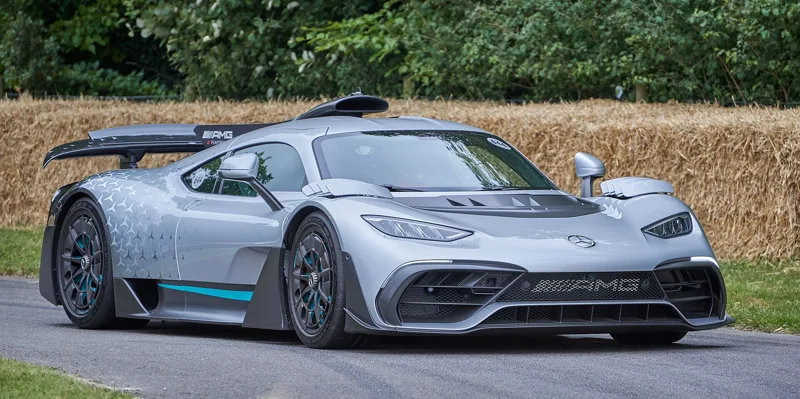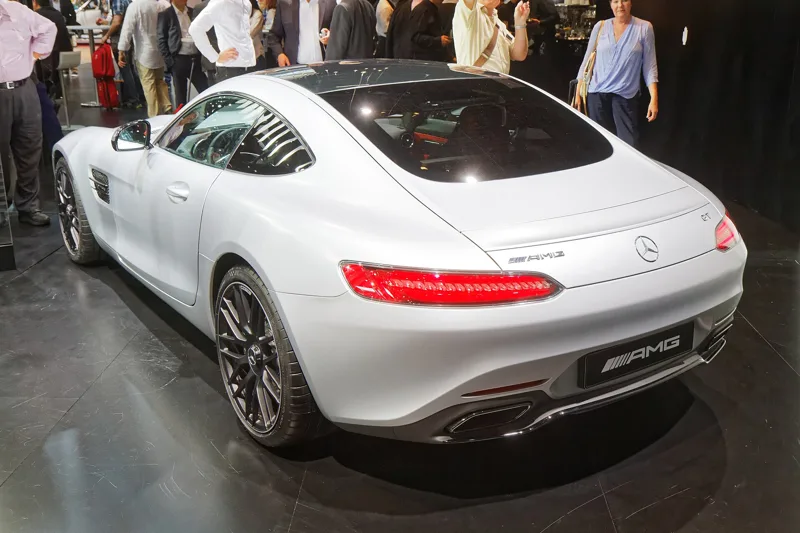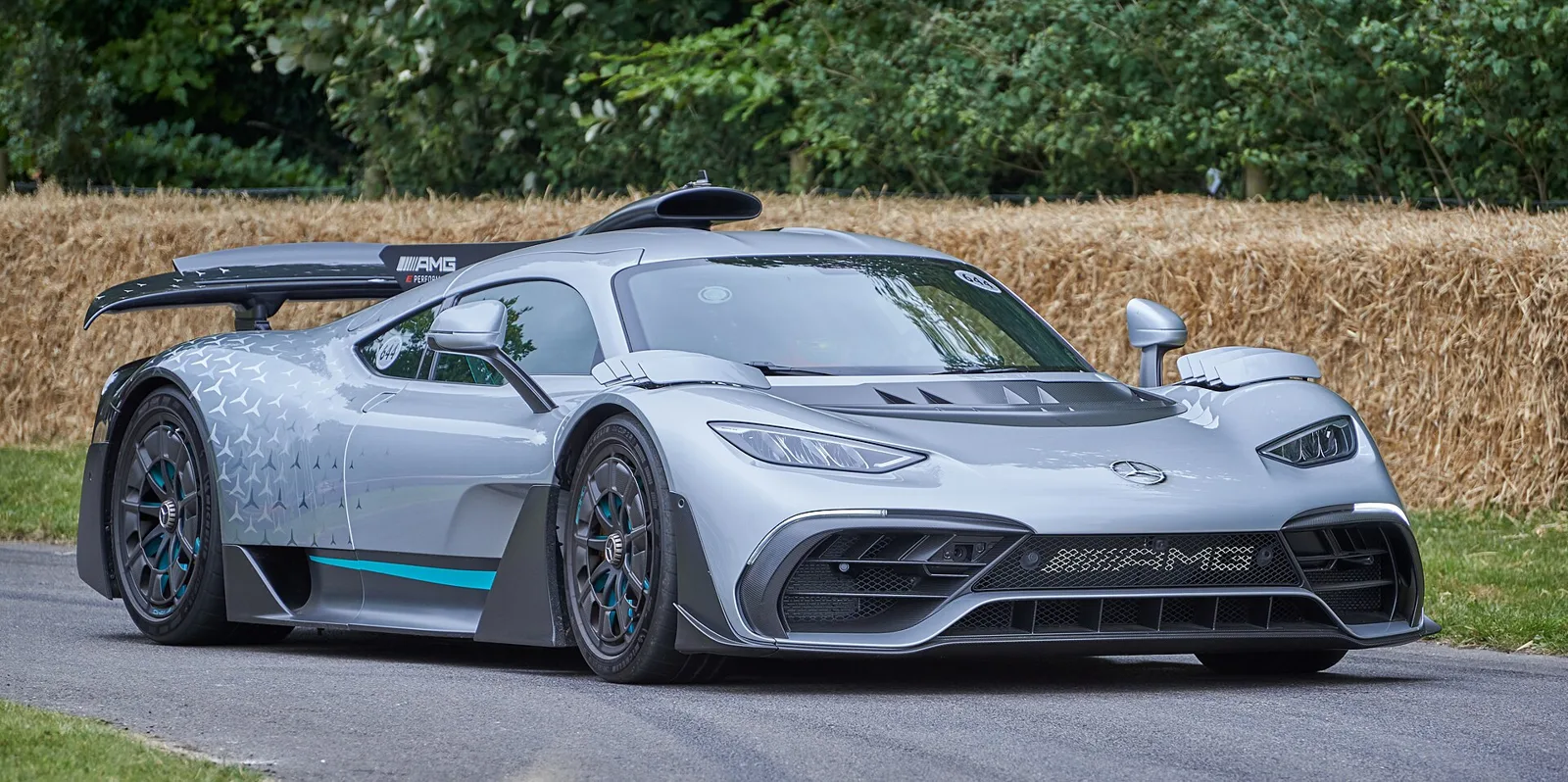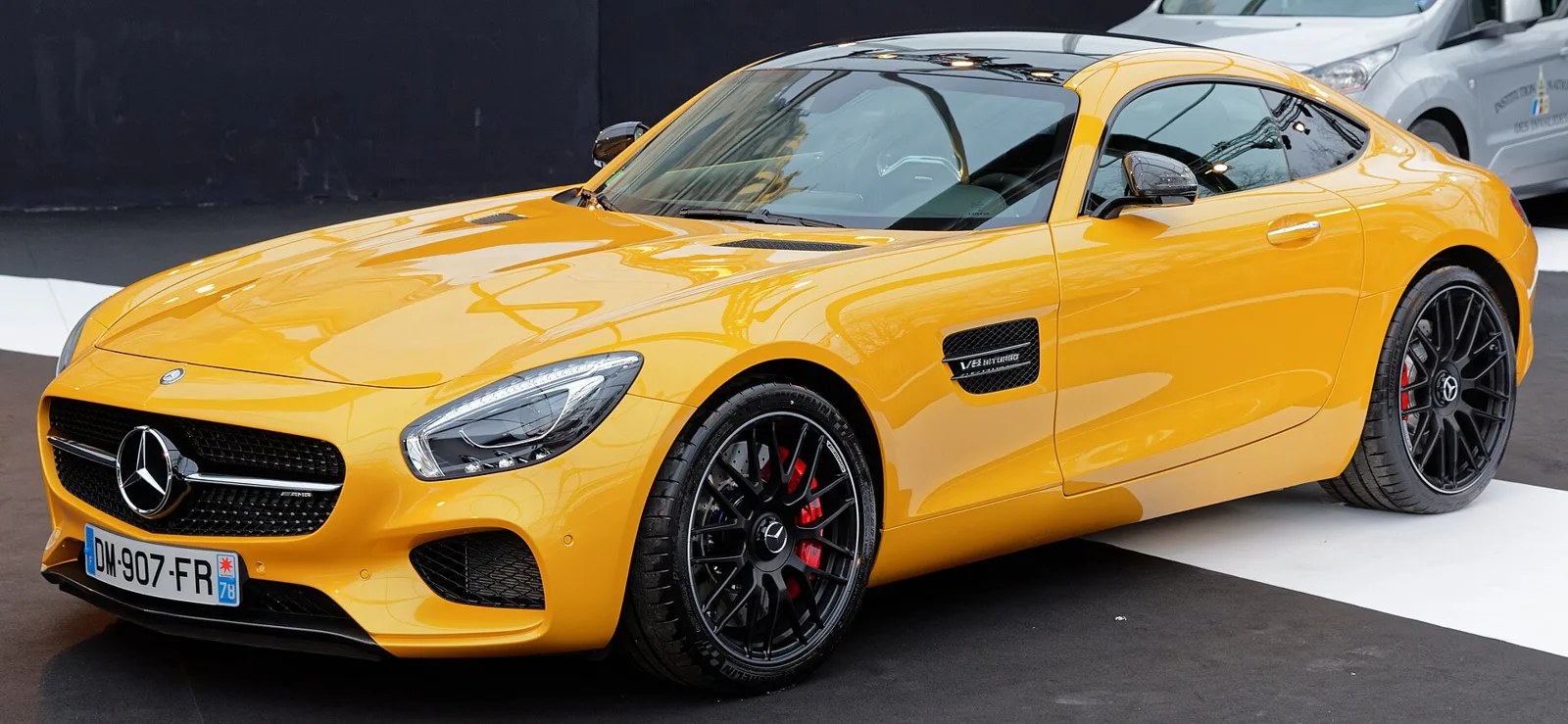
A two-door sports car built entirely in-house by Mercedes-AMG, which spawned the GT R, a Formula One safety car role and a 2023 second generation.
The Mercedes-AMG GT is a two-door sports car family from Mercedes-AMG, introduced in September 2014. It runs from the GT and GT S to the GT R and the 730 PS Black Series, and it has a second generation from 2023 with V8 and mild-hybrid power.
The Mercedes-AMG GT is a family of two-door sports cars that Mercedes-AMG has built since its introduction in September 2014. It was the second sports car that the company developed entirely in-house, and it spawned a road-car range that runs from the GT to the Black Series. Its race versions, the GT3 and GT4, took the GT's name to customer racing, while its Black Series set a fastest-lap benchmark for a road-legal production car around the Nurburgring.
What is the Mercedes-AMG GT?
The GT is a two-door sports car made by Mercedes-AMG, the performance arm of Mercedes-Benz. It was introduced on 9 September 2014 and officially unveiled that October at the Paris Motor Show. All of the first-generation variants were assembled at the Mercedes-Benz plant in Sindelfingen, Germany.
The car was not a direct replacement for the SLS AMG, because it competed in a different segment. It was, however, the second sports car to be developed entirely in-house by Mercedes-AMG, following the SLS. The first-generation GT went on sale in March 2015 in GT and GT S forms.
Mercedes-AMG built its second in-house sports car around a racing mindset, and the Black Series took that idea to the Nurburgring record books.
How was the first GT designed?
The exterior kept the wide wheel arches, the lower bodywork and the fastback roofline of the SLS AMG. Mark Fetherston was the exterior lead designer, whose previous work included the W176 A-Class, the CLA-Class and the SLS AMG. The car used conventional forward-opening doors rather than the gullwing doors that the 300 SL pioneered in the 1950s.
The car was built on a shortened and upgraded version of the Transaxle Spaceframe platform that the SLS used. The structure is 93 percent aluminium, with a magnesium front module base. The interior, designed by Jan Kaul, has a large centre console with leather and carbon polymer trim, and the trunk has room for a medium-sized suitcase.
What engines did the GT and GT S use?
The GT used a 4.0-litre M178 twin-turbo V8 tuned to 340 kW (462 PS; 456 hp) and 600 Nm (443 lb ft) of torque. The GT S raised that to 375 kW (510 PS; 503 hp) and 650 Nm (479 lb ft). Both used a seven-speed AMG SPEEDSHIFT dual-clutch gearbox that sent power to the rear wheels.
Its "hot inside V" design places the exhaust manifolds and turbochargers between the cylinder banks, which cuts turbo lag, and the sump is dry. Car and Driver tested the GT S to 60 mph (97 km/h) in 3.0 seconds, with a quarter-mile time of 11.2 seconds and a top speed of 311 km/h (193 mph).
The GT S had an electronically controlled mechanical limited-slip differential, Race Mode and Race Start settings, and AMG Ride Control adaptive suspension. Its AMG Performance Exhaust had dynamic flaps, and it used a lithium-ion battery where the GT had an absorbent glass mat battery.
What did the GT C and the 2017 facelift add?
The 2017 facelift brought a higher power output from the M178 engine, 10 kW more for the GT and 9 kW more for the GT S, and the Panamericana grille from the GT3, GT4 and GT R became standard on every variant. The facelift also introduced the GT C roadster and a limited Edition 50 model.
The GT C produced 410 kW (557 PS; 550 hp) and 681 Nm (502 lb ft). It was wider than the GT S at 2,007 mm (79 in), and it had active rear steering that the GT S did not offer. The Edition 50 was limited to 500 units worldwide, which is why the steering wheel carried the marking "1 of 500".
Why did the GT R matter?
Goodwood saw the GT R's debut on 24 June 2016. The M178 in this car made 585 PS (430 kW; 577 hp) at 6,250 rpm and 700 Nm (516 lb ft) at 5,500 rpm. It reached 100 km/h in 3.6 seconds and had a stated top speed of 319 km/h (198 mph). It was the car that gave the range its most overtly track-focused identity.
The GT R had manually adjustable coilover springs, an active underbody fairing, a manually adjustable rear wing and a nine-mode AMG Traction Control system. In exchange it lost Keyless-Go and several comfort features, which could still be ordered as options.
In a test conducted by the German magazine Sport Auto, the GT R completed a lap of the Nurburgring Nordschleife in 7:10.92. On the Nordschleife that put it ahead of every rear-drive road car at the time, and it ranked fifth overall among road-legal lap times.
What is the GT R Pro?
The GT R Pro came out at the Los Angeles show in 2018. It was a more track-focused variant of the GT R, limited to 750 units worldwide with a starting price of US$200,645. It kept the GT R's engine, with 430 kW (585 PS; 577 hp) and the same 3.6-second 0-100 km/h time and 319 km/h top speed.
The Pro added a manually adjustable coilover suspension, lightweight anti-roll bars, carbon ceramic brakes as standard, carbon-fibre bucket seats and forged 19-inch front and 20-inch rear wheels. A track package added a full steel roll cage, four-point harnesses and a fire extinguisher, and the curb weight was reduced by 25 kg (55 lb), or 40 kg (88 lb) with the track package fitted, compared with the GT R.
In November 2018 the GT R Pro lapped the Nurburgring in 7:04.632, driven by Maro Engel. That was the eighth fastest lap for a road-legal production vehicle at the time.
What makes the GT Black Series special?
The Black Series first appeared through Mercedes-AMG's YouTube channel on 9 July 2020. Its M178 was tuned to 537 kW (730 PS; 720 hp) at 6,700 to 6,900 rpm and 800 Nm (590 lb ft) of torque from 2,000 to 6,000 rpm. The engine, referred to as the M178 LS2, has a redline of 7,200 rpm against the GT R's 7,000 rpm, and it uses a flat-plane crankshaft.
The Black Series accelerated from 0 to 100 km/h in 3.2 seconds and had a claimed top speed of 325 km/h (202 mph). Boost was raised from 135 to 170 kPa with a smaller compressor wheel. The suspension was unique, with carbon-fibre anti-roll bars at the front and iron bars at the rear, and camber was manually adjustable at both axles.
The aerodynamic package gave the car more than 400 kg (882 lb) of total maximum downforce at 249 km/h (155 mph). It had carbon-ceramic brake rotors, an enlarged grille based on the AMG GT3 race car, and a Michelin Pilot Sport Cup 2 R tyre developed for the car. On 4 November 2020 the Black Series recorded a lap of 6:43.616 at the Nurburgring with Maro Engel, the fastest lap ever recorded for a road-legal production vehicle at that time.
Which roadsters and special editions came with the GT?
The GT and GT C roadsters debuted at the 2016 Paris Motor Show. They used the active air management system from the GT R, and they had a three-layer fabric roof that opened and closed in 11 seconds up to 50 km/h (31 mph). A roadster version of the GT R was introduced in March 2019, limited to 750 units, and it was discontinued in 2021 when the Black Series was released.
The GT S Edition 1 was built in a limited run of 375 examples sold worldwide. It included a gloss black aerodynamic set, a fixed rear wing, a carbon fibre roof, red interior accents and red brake calipers. The GT3 Edition 55, a track car, was sold in five units at 625,000 euros each.
How did the GT race in Formula One and sports car racing?
Formula 1 used the GT S as its safety car over three seasons, beginning at the 2015 Australian Grand Prix. The GT R took over from 2018 to 2021, and during the 2020 Tuscan Grand Prix it ran in red to mark Scuderia Ferrari's 1,000th Grand Prix start. The Black Series was the safety car from 2022 to 2026, and the GT 63 Pro is the safety car from the 2026 season.
The AMG GT3 was presented at the Geneva Motor Show in March 2015, using the 6.2-litre naturally aspirated V8 from the SLS AMG GT3. It was built largely from carbon-fibre-reinforced polymer to keep its weight under 1,300 kg (2,866 lb). As of June 2019 a total of 130 GT3 cars had been sold. Craig Baird gave the car its first race win, in the Australian GT Championship in March 2016.
The GT4 racing variant was presented at the 2017 24 Hours of Spa and based on the GT R. The GT3 Evo followed in 2019 with a new data logger, a new brake and traction control system, and an updated design. Its eligibility for the FIA World Endurance Championship's LM GT3 class from 2025 marked a return to the 24 Hours of Le Mans.
What is the second-generation AMG GT?
The second generation first appeared at Pebble Beach on 19 August 2023, roughly eleven months after the first car was discontinued. Production followed the next month. It uses the same platform as the new SL roadster and is longer than its predecessor, which allows a 2+2 cabin.
The V8 arrived first in two forms, the GT 55 with 469 hp (350 kW) and the GT 63 with 577 hp (430 kW), each with four-wheel drive. A plug-in hybrid V8 for the GT 63 S E Performance followed in 2024, along with a 2.0-litre four-cylinder mild hybrid that drives the GT 43 and the China-only GT 50. Every powertrain uses a nine-speed automatic.
The GT 63 Pro was unveiled on 22 July 2024 as a more track-focused GT 63, with extra radiators, standard carbon-ceramic brakes and more downforce. Its power rose from 577 hp (430 kW) to 612 hp (450 kW).
What is the GT2 Edition W16?
The Mercedes-AMG GT2 is a customer race car with a 520 kW (697 hp; 707 PS) four-litre biturbo V8, which made its debut at Monza in 2023 and won its first race at the Red Bull Ring that year. The GT2 Pro is a non-homologated track-day version with a base output of 551 kW (749 PS; 739 bhp).
The GT2 Edition W16 was unveiled in September 2025, inspired by the W16 Formula One car. Push2Pass can lift output to 830 PS (610 kW; 819 hp), with 1,000 Nm (738 lb ft) on tap. The run is limited to 30 units. It weighs 1,430 kg (3,153 lb) in total.
Specifications
| Variant | Power | Torque | 0-100 km/h |
|---|---|---|---|
| GT (2015-2021) | 340 kW (462 PS; 456 hp) | 600 Nm (443 lb ft) | Not given |
| GT S (2015-2020) | 375 kW (510 PS; 503 hp) | 650 Nm (479 lb ft) | Not given |
| GT R (2017-2021) | 430 kW (585 PS; 577 hp) | 700 Nm (516 lb ft) | 3.6 seconds |
| GT Black Series (2021-2023) | 537 kW (730 PS; 720 hp) | 800 Nm (590 lb ft) | 3.2 seconds |