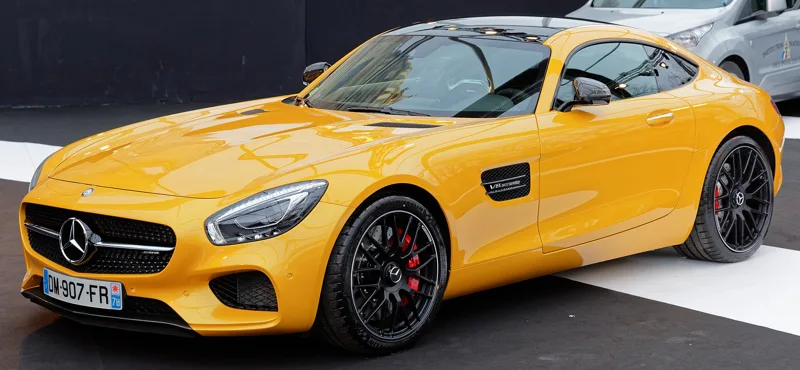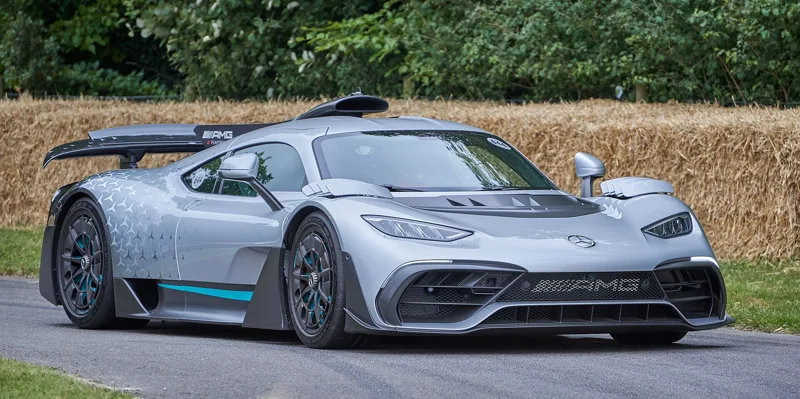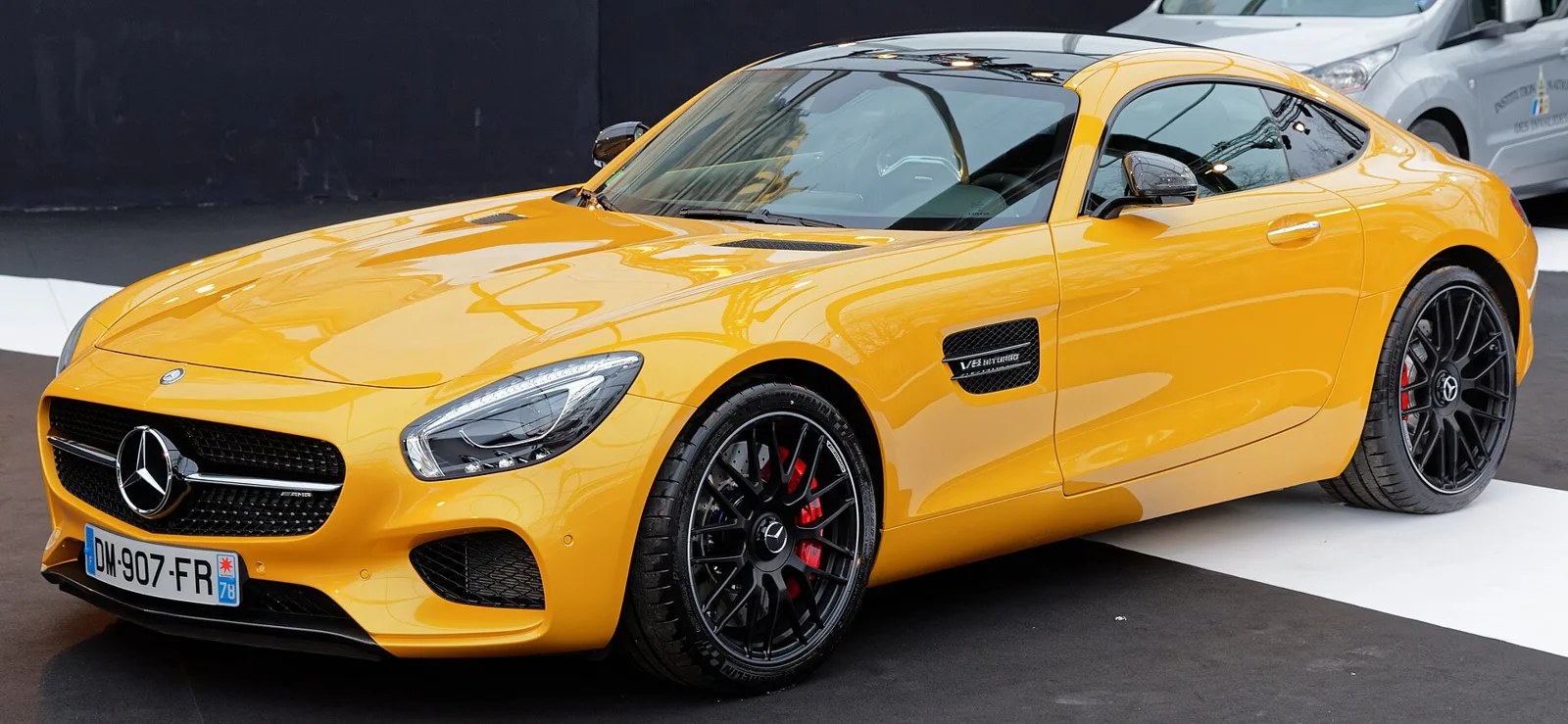
The 2014 compact coupe, its GT R, GT C and GT R PRO variants, and the flatplane-crank Black Series.
The Mercedes-AMG GT C190 was a two-seat sports coupe built from 2014 to 2022 by Mercedes-AMG. It used a 3,982 cc twin-turbo V8 with 462 to 510 PS, and it spawned roadster, GT R, GT C and Black Series variants.
Mercedes-AMG's C190 was meant to give Stuttgart a compact sports coupe that could take on the Porsche 911. Built from 2014 to 2022 by the Mercedes-AMG division, it grew into a family of coupes, roadsters and track specials that included the flatplane-crank Black Series.
Why was the AMG GT built?
The GT was the successor to the SLS AMG, but it was not planned as a direct replacement. The SLS AMG left production shortly before the new car arrived, which left the GT as the only choice among Mercedes cars for anyone wanting a sports car in its own right, not derived from other models.
In early 2012 the project had not yet been signed off, but it was approved soon afterwards under the internal code C190, and by the end of 2012 development was in full swing. As with the SLS AMG, the whole design and development job went to the Mercedes-AMG sports division.
The production car made its debut on 9 September 2014 at the company's Affalterbach base, and it appeared at the Paris Motor Show in early October. Two versions launched first, the basic GT and the GT S, with orders open from November and deliveries planned for early 2015.
A compact Mercedes sports car that grew into a flatplane-crank track weapon.
How did the GT look?
The GT was more compact than the SLS AMG, 94 mm shorter in length with a wheelbase 5 cm shorter. Its styling was much more rounded, and its proportions recalled certain legendary berlinettas built in Europe between the '50s and '60s.
The front followed the look of contemporary Mercedes-Benz cars, with a wide, horizontal grille split by a chrome moustache with a prominent three-pointed star. Trapezoidal light units sat on top of the wings and enclosed a bonnet grooved lengthways by two ridges. The bumper apron had two large side air intakes, while the centre intake was more discreet and partly hidden by the number plate.
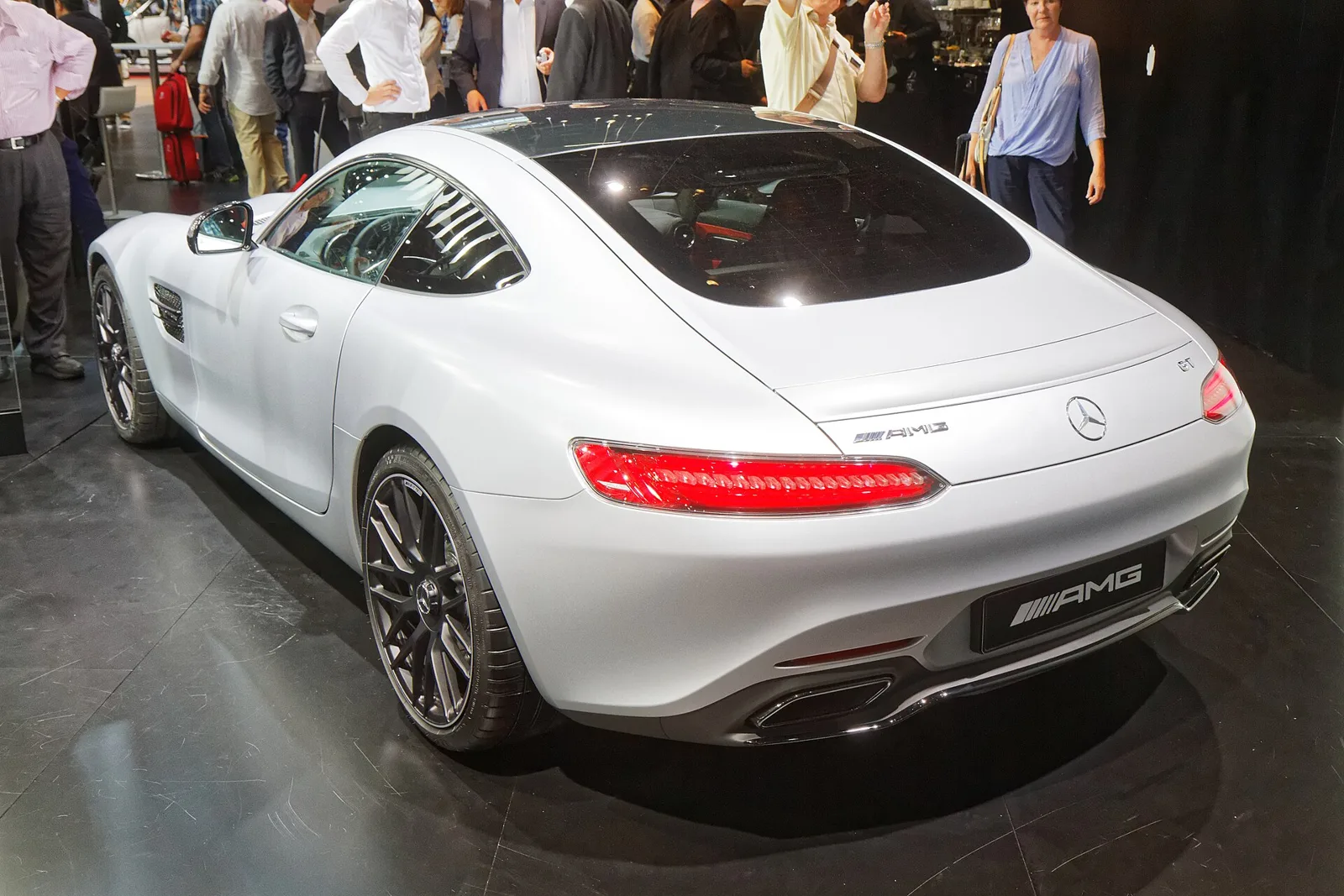
The doors gave up the spectacular gullwing opening in favour of conventional hinges on the front edge. The short tail was dominated by horizontal LED lights and a small, retro-flavoured rear window, and the rear apron housed two diamond-shaped exhaust tailpipes.
Inside, the two-seat cabin had sports seats with integrated head restraints and leather trim with aluminium inserts. The driving position was sporty but far from spartan. A three-spoke steering wheel carried the gear-change paddles, and the instruments were a traditional speedometer and rev counter rather than a display. The boot was small, reaching 350 litres at most.
What was under the bonnet?
The GT was built around a space frame of aluminium alloy, with riveted and bonded panels borrowed from aeronautical practice to save weight. The engine sat well back, in a front-longitudinal, transaxle layout with rear-wheel drive, so the weight was spread 47% on the front axle and 53% on the rear.
The engine was a 3,982 cc (243.0 cu in) V8 of the M178 family, with dry-sump lubrication that lowered the centre of gravity. Mercedes-AMG designed it in full, using the M177 as a base, and it had two overhead camshafts, direct injection and two turbochargers mounted in the centre of the V.
Two outputs were offered at launch. The basic GT made 462 PS (456 hp) at 6,000 rpm and 600 Nm (443 lb ft) from 1,600 to 5,000 rpm, while the GT S made 510 PS (503 hp) at 6,250 rpm and 650 Nm (479 lb ft) from 1,750 to 4,750 rpm. Drive went through a seven-speed dual-clutch gearbox with four selectable programmes.
The GT S came with an electronically controlled limited-slip rear differential, while the basic car used a simpler mechanical self-locking unit. Its double wishbones were forged aluminium at both ends, and Ride Control, which adjusts the dampers, was standard on the GT S and optional on the GT.
| Specification | Detail |
|---|---|
| Engine | 3,982 cc (243.0 cu in) twin-turbo V8, M178 family, dry sump |
| Output, basic GT | 462 PS (456 hp) at 6,000 rpm |
| Output, GT S | 510 PS (503 hp) at 6,250 rpm |
| Torque | 600 Nm (443 lb ft) basic GT; 650 Nm (479 lb ft) GT S |
| Kerb weight | 1,540 kg (3,395 lb) basic; 1,570 kg (3,461 lb) GT S |
| Top speed | 304 km/h (189 mph) basic GT; 310 km/h (193 mph) GT S |
| Acceleration | 0 to 100 km/h in 4 seconds (GT); 3.8 seconds (GT S) |
| Consumption | 9.3 l/100 km (30.4 mpg-imp; 25.3 mpg-US), 216 g/km CO2 (GT) |
| Brakes | 360 mm ventilated discs; GT S 390 mm front; carbon-ceramic option 402 mm front |
| Gearbox | Seven-speed dual-clutch, four programmes |
The basic GT ran 19-inch wheels at both axles, and the GT S had 20-inch rear wheels. AMG Dynamic Select offered driving modes including Controlled Efficiency, Sport, Sport Plus and Individual, with Race mode on the GT S alone.
What did the GT R change?
The GT R was unveiled on 24 June 2016 at the Goodwood Festival of Speed. It was the higher-performance version from the first look, with a bigger grille of vertical chrome slats, a redesigned front apron that looked like a wide mouth, a visible extractor and a conspicuous rear spoiler to press the rear axle down.
The wheel arches were opened out, adding 4.6 cm at the front and 5.7 cm at the rear, and new movable, electronically managed aerodynamic elements joined the front end. Airflow leaving through the rear extractor was managed by an active underbody fairing system.
The car was 15 kg lighter than the GT S, thanks to a carbon-fibre roof, a titanium exhaust and a carbon-fibre propshaft. Much of the sound-absorbing material was also removed from the cabin. The 4-litre twin-turbo V8 was retuned for boost pressure and combustion, giving 585 PS (577 hp) at 6,250 rpm.
The gearbox changed its first and seventh ratios, shorter and longer respectively. The GT R reached a top speed of 320 km/h (199 mph). It also became the new Formula 1 safety car in early 2018.
Was there a roadster?
The roadster was shown at the 2016 Paris Motor Show as the GT Roadster, which borrowed the vertical-slat grille from the GT R. Its bodyshell had to be reinforced to keep the torsional stiffness that a car of this performance needs, yet its kerb weight rose only slightly thanks to more light alloy.
The soft top has three layers of fabric and is available in black, red or beige. It is electrically operated and takes 11 seconds to open or close at speeds up to 50 km/h. The roadster also had two engine versions with power levels not previously offered on the coupe, rated at 476 PS (469 hp) for the base car and 557 PS (549 hp) for the GT C Roadster.
What did the GT C add?
The GT C was presented at the Paris Motor Show, with first deliveries at the start of 2017, and for both bodies it sat halfway between the extreme GT R and the calmer GT S. It took the wider tracks and the steering rear axle of the GT R, but its look was less aggressive than the GT R, closer to the GT S.
The engine was the familiar 4-litre V8 with double supercharging, giving 557 PS (549 hp) and 680 Nm (502 lb ft) from 1,900 rpm. The limited-slip differential was electronically controlled, and the dual-clutch gearbox gained a fifth driving programme.
At the Detroit Motor Show in January 2017 a limited edition, the Edition 50, was presented. It had a dedicated interior and was built in 50 coupes and 50 roadsters.
How did the range change in 2017?
In March 2017 the range was updated. The vertical-slat grille was extended to the basic GT and the GT S, but the big changes were in the engines. The basic GT's output rose from 462 to 476 PS, in coupe form too, while the GT S went from 510 to 522 PS.
All-wheel steering became an option on the GT S, and a year later the GT S was offered as a roadster as well.
What did the GT R PRO and Black Series bring?
The GT R PRO was shown at the Los Angeles show in 2018 as a track-focused version of the GT R. Its differences from the normal GT R were mostly in lightening and strengthening the bodyshell and in the chassis hardware.
Its kit covered adjustable springs, lighter anti-roll bars, active engine mounts, carbon-ceramic discs and a carbon roof, plus carbon bucket seats, specific wheels with semi-slick tyres and a carbon front spoiler. Although it was homologated for road use, it could be fitted with further track kit, such as a fire extinguisher. It was built in a limited series of 750 examples.
Maro Engel took a GT R PRO round the Nurburgring in November 2018 in 7'04"632, which put it eighth among the quickest road cars on that circuit.
The Black Series came next. It premiered online on 9 July 2020 through Mercedes-AMG's YouTube channel, since the COVID-19 emergency ruled out a live event. The company intended it to end production of the C190 and R190 range, and it was far more advanced than even the GT R PRO.
Its bodywork closely recalled the GT3 and GT4 race cars. The grille was wider, the bumper had a lower lip adjustable in two positions, and a carbon bonnet had new air intakes for the engine. The tail was dominated by a huge rear wing, adjustable and tiltable up to 20 degrees, and by an extractor that, with the flat floor, produced a downforce of 400 kg at 250 km/h.
The engine was rebuilt in depth, and its crankshaft is the most racing-like feature. Instead of the cross-plane arrangement of most road models, the crankpins are set at 180 degrees, making it a flat-plane crankshaft. The firing order changes accordingly, and performance climbs sharply: 730 PS (720 hp) and 800 Nm (590 lb ft), 0 to 100 km/h in 3.1 seconds, 0 to 200 km/h in 8.8 seconds, and a top speed of 325 km/h (202 mph).
On the Nurburgring the Black Series posted the quickest lap ever set by a road-legal sports car, 6'43"616, ahead of the Lamborghini Aventador SVJ and the Porsche 911 GT2 RS.
What was the Track Series?
The Track Series was revealed in late March 2022 and shown to the public at Goodwood. Only 55 were made, created to celebrate 55 years of AMG. Built for track use only, it had major changes, above all a V8 boosted to 734 PS (724 hp).
How did production end?
After the Black Series was unveiled in July 2020, the range began to thin out. The GT S was removed from the price list, and the basic GT's output rose to 530 PS (523 hp).
Production of the standard Mercedes-AMG GT ended at the end of 2021. The roadster was replaced by the Mercedes-AMG SL.
How did the GT3 race in motorsport?
The GT3 version was shown at the Geneva Motor Show in March 2015. It was built for the FIA-GT racing championships, and it was technically very different from the road cars, with a body rebuilt in carbon-fibre reinforced plastic to stay within a 1,300 kg (2,866 lb) limit.
The GT3 did not use the twin-turbo V8 of the road car. It used the naturally aspirated M159 V8 of 6,208 cc (378.8 cu in), which had been used for years in several road applications, including the SLS AMG itself.
The most notable result was the 2016 24 Hours of the Nurburgring, where four cars took the first four places. Two of them belonged to the AMG-Black Falcon team, which took first and fourth, while AMG-Team HTP Motorsport was second and Haribo Racing Team-AMG third. The Zakspeed team's car came sixth. In 2017 a GT3 from Riley Technologies finished third in its class at the 24 Hours of Daytona.
Some 130 cars were sold and prepared for GT3 racing in the FIA-GT series. A few others were prepared for the GT4 category, but they achieved less significant results.