A joint Volkswagen and Porsche project from 1969 to 1976, sold as a Porsche in North America and remembered for its flat-four and flat-six engines.
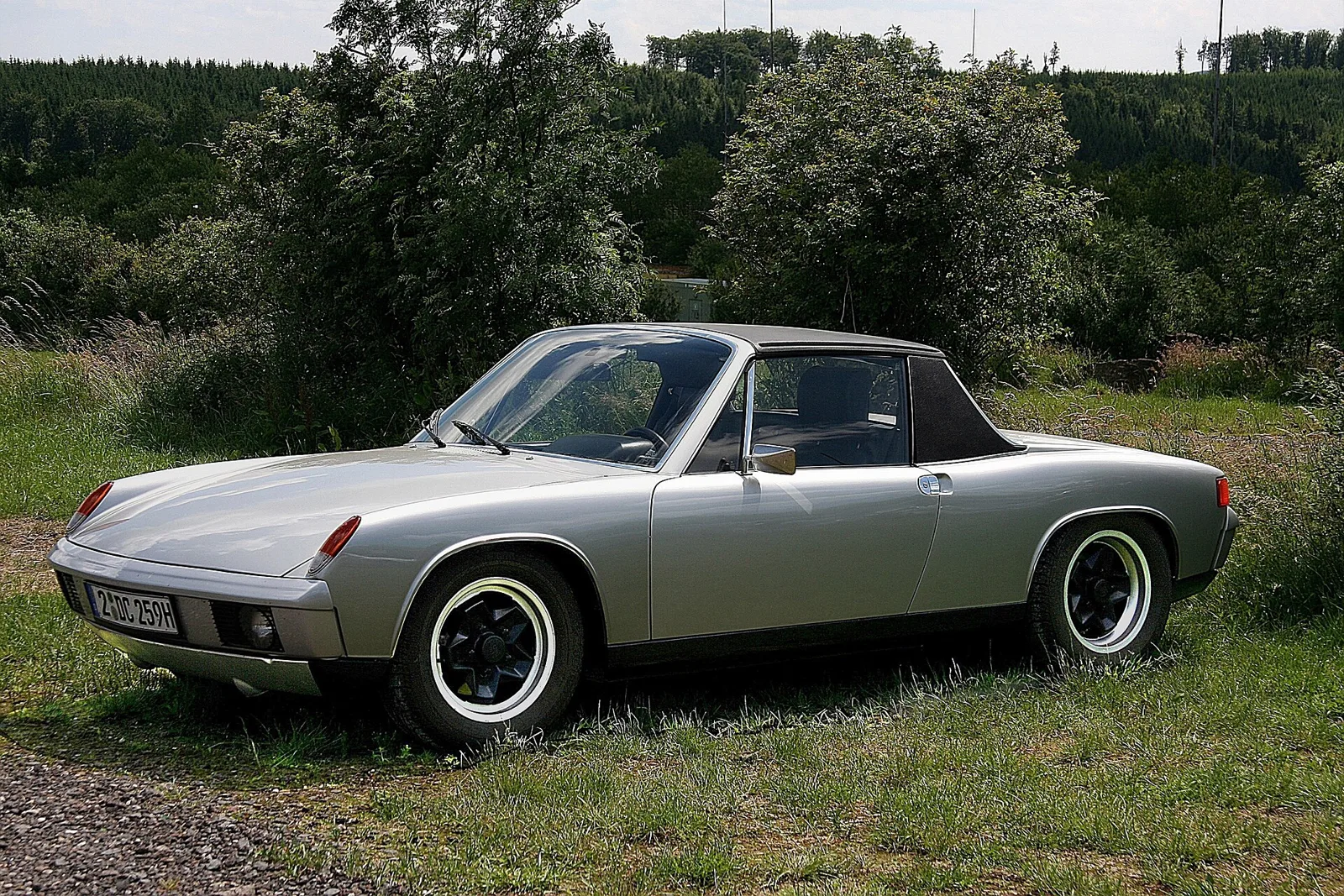
The Porsche 914 was a mid-engined targa roadster that Volkswagen and Porsche built together from 1969 to 1976. Flat-four and flat-six engines were offered, both sat amidships, and more than 118,000 four-cylinder cars were sold worldwide. Porsche sold the cars as Porsches in North America.
The Porsche 914 was a mid-engined targa-topped two-seat roadster that Volkswagen and Porsche developed and sold together from 1969 to 1976. It came with either a flat-four or a flat-six engine, and in North America both versions were badged and sold as Porsches. More than 118,000 914/4 cars were sold worldwide, which made the four-cylinder model the company's best seller of its time.
Why did Volkswagen and Porsche build the 914?
By the late 1960s both companies needed new models. Porsche was looking for a replacement for its entry-level 912, while Volkswagen wanted a range-topping sports coupe to succeed the Karmann Ghia. Most of Volkswagen's development work was handled by Porsche under an arrangement that dated back to Porsche's founding.
Volkswagen therefore asked Porsche to take on one more project to complete that contract, and the 914 was chosen for it. Ferdinand Piech, who led research and development at Porsche, was put in charge of the car. The project brought two sets of needs together in a single body.
The body was intended to suit both companies without looking too much like either partner's existing products. That goal guided the sleek targa shape, which kept the roof removable while the rear of the car housed the engine.
A Volkswagen-Porsche collaboration that sold a mid-engined targa to America as a Porsche and then became a safety car.
Where did the 914's design come from?
Between 1966 and 1967 the German firm Gugelot Design pitched a sports coupe concept to a number of carmakers, among them Volkswagen and Porsche. A number of accounts link that proposal, reworked to suit the partners, to the 914's design.
Later accounts reject that idea. They acknowledge that Porsche knew of the Gugelot design, but they state that the 914 was designed in-house at Porsche. Body engineer Heinrich Klie is credited as the main designer of the production car, which is why the design is treated as a Porsche product.
The debate matters because it shows how the two firms worked. Porsche handled most of the engineering, while Volkswagen controlled key decisions on sharing tooling costs and marketing, and those arrangements shaped the car long before it reached showrooms.
Why did the joint venture break down?
Originally the plan was to sell a Volkswagen with a flat-four and a Porsche with a flat-six. Porsche then decided that two versions sharing one body would be risky in the American market, and it persuaded Volkswagen to let both be sold as Porsches in North America. The first 914 prototype was presented on March 1, 1968.
Development became complicated after Heinrich Nordhoff, Volkswagen's chairman, died on April 12, 1968. His successor, Kurt Lotz, had no connection with the Porsche family, and the verbal agreement between the two firms fell apart. Lotz believed Volkswagen owned the model outright and had no reason to share it unless Porsche paid part of the tooling costs.
That decision wrecked the original price and marketing plan. The chassis became much more expensive, and the 914/6 ended up costing only a little less than the 911T, which was Porsche's next lowest priced car. Sales and the rising costs eventually made the flat-six model unsustainable.
Which engines did the 914 use?
Volkswagen versions used a fuel-injected 1.7-litre Type 4 flat-four producing 80 bhp (60 kW; 81 PS). Porsche's 914/6 used a 2.0-litre air-cooled flat-six, the Type 901/3 from the 1967 to 1969 911T. It was the least powerful flat-six in the Porsche range at the time.
The flat-six had revised pistons that lowered the compression ratio to 8.6:1, with iron cylinder barrels and smaller venturis in its Weber 40IDT3C carburettors. Its output was 110 bhp (82 kW; 112 PS). When the 911T gained a 2.2-litre engine in 1970, the 914/6 kept its 2.0-litre unit.
All of the 914's engines sat amidships in front of a version of the 901 gearbox that had been adapted for a mid-engined car. Karmann built the rolling chassis at its plant, and the body and final assembly were completed by Volkswagen or Porsche depending on the model.
How did the 914 change through its production run?
In 1973 the 914/6 was replaced by a 100 bhp (75 kW; 101 PS) 2.0-litre fuel-injected version of the Volkswagen Type 4 engine. In 1974 the 1.7-litre unit gave way to an 85 bhp (63 kW; 86 PS) 1.8-litre engine, and Bosch L-Jetronic injection was added to American cars to help with emissions control.
Bumper changes followed the safety and emissions rules of the period. From 1970 to 1972 the cars had chrome or painted bumpers without guards, guards were added at the front in 1973 and at the rear in 1974, and in 1975 and 1976 rubber-covered units replaced them. Headlight surrounds turned from white to black during 1973.
The most significant handling upgrade came when anti-roll bars were added. A change from the tail-shifter gearbox to the side-shifter from 1973 to 1976 also made the gearchange more precise. Cars built before early 1972 had a fixed passenger seat, while later cars gained a movable one.
What was the 914/6 GT?
Porsche homologated the 914/6 with the FIA as a Group 4 Special Grand Touring car on March 1, 1970. Two cars were sent to the Targa Florio that month for testing rather than racing. They received squared fender flares of the maximum 2 in (51 mm) depth, reinforced chassis plates and stone guards for rally use.
The GT's bodywork used fibreglass for the bumpers, deck lids and rocker panels, and its nose held an extra oil cooler. A 100 L (26.4 US gal) fuel tank filled much of the nose, and race-ready, the car came in at 1,980 lb (898.1 kg). Its engine had larger valves and dual ignition, and output reached 210 PS (154.5 kW; 207.1 hp) at 8000 rpm.
Rallying was a factory campaign for the car, but it did better on road circuits. In the United States Porsche and Audi's distributor called it the 914/6R. The SCCA required 500 copies for homologation, and dealers were also supplied with appearance kits.
How many 914/6 GTs were built?
Porsche built fewer than 40 GTs with the full race engine. Another 11 cars received the Competition Option Group M471 package, which added the GT's steel fender flares, rocker panels and nose piece, along with wheel spacers and 6-inch Fuchs wheels. About 400 appearance-only kits were also sold to dealers.
The SCCA placed the car in the more competitive B Production class instead of C Production.
What were the 914/8 and other concept 914s?
Two 914/8 prototypes were built in 1969, with the first using a Type 908 flat-eight racing engine rated at 350 hp (261 kW; 355 PS). That car was built on a spare prototype shell and included quad headlamps and other differences from the production model. Neither prototype raced beyond testing.
The second 914/8 was a silver road car with a detuned 908 engine producing 300 hp (224 kW; 304 PS). It was prepared as a gift to Ferry Porsche for his 60th birthday, and it is now in the Porsche Museum. Ferry reportedly did not care for the car very much.
Outside prototypes also appeared. Giorgetto Giugiaro's Italdesign studio built the Porsche Tapiro on a 914/6 platform, with gullwing doors and a debut at the 1970 Turin Auto Show. The Heuliez Murene, designed by Jacques Cooper, appeared at the 1970 Paris Auto Show, and it sold at auction in 2012 for EUR 42,889.
Other one-offs include the Gerber and Sbarro rotary car, which fitted a two-rotor Wankel from the NSU Ro 80 and produced 115 hp (85.8 kW). The Gerber car returned 21 mpg-US (11.2 L/100 km) and reached 190 km/h (118.1 mph). General Motors also used a 914/6 for its XP-897GT, a rotary-engined concept shortened by 6.5 in (165 mm).
Did the 914 sell well?
Yes. The 914/4 became Porsche's top seller during its run, outselling the 911 by a wide margin with more than 118,000 units sold worldwide. Volkswagen of America handled exports to the United States, where both versions were sold as Porsches.
The 914/6 was less successful. Slow sales and rising costs led Porsche to discontinue the model in 1972, after 3,351 cars had been built. The four-cylinder cars remained in production until 1976, when the 912E took over as the entry-level Porsche.
What was the 914 Limited Edition?
In 1974 Porsche produced Limited Edition cars for North America to celebrate its victories in the Can-Am racing series. They came with individual colour schemes and had optional equipment fitted as standard. The factory is said to have produced about 1,000 of them, roughly half in Bumblebee and half in Creamsicle.
The Creamsicle wore a cream exterior with Phoenix red trim, while the Bumblebee had a black exterior with Sunflower yellow trim. The Limited Edition cars all used the 2.0-litre flat-four, which made 91 hp in US trim. The Appearance Group cost $300 and the LE package added another $320.
How did the 914 end up as a Formula One safety car?
The 914 is remembered as Formula One's first safety car. It was deployed at the 1973 Canadian Grand Prix to help manage a race that had seen various incidents in treacherous weather. That role gave the car a place in motorsport history beyond its sales record.
On the track, two French drivers, Claude Ballot-Lena and Guy Chasseuil, took a 914/6 GT to a GTS class win and sixth place overall at the 1970 24 Hours of Le Mans. Brian Redman had also used a 914/6 to scout the course before the 1970 Targa Florio.
What are the Porsche 914 specifications?
| Specification | Detail |
|---|---|
| Built | 1969 to 1976 |
| Layout | Mid-engined targa two-seater |
| Four-cylinder engine | 1.7 L flat-four, 80 bhp (60 kW; 81 PS) |
| Flat-six engine | 2.0 L Type 901/3, 110 bhp (82 kW; 112 PS), 8.6:1 |
| Later four-cylinder | 1974: 1.8 L, 85 bhp (63 kW; 86 PS) |
| 914/6 GT engine | 210 PS (154.5 kW; 207.1 hp) at 8000 rpm |
| 914/6 GT weight | 1,980 lb (898.1 kg), ready to race |
| 914/6 GT fuel tank | 100 L (26.4 US gal) |
| 914/4 sales | More than 118,000 units |
| 914/6 production | 3,351 cars before discontinuation in 1972 |