How the bumper moved from ornament to crash-energy absorber, why US rules swung between five-mile and two-and-a-half-mile tests, and why truck underride guards matter.
A bumper is the structure at the front and rear of a car that absorbs the energy of minor impacts and limits repair costs. Early versions were rigid metal bars, while modern bumpers use a plastic skin over a foam core. US federal rules from 1972 set crash-test limits.
A bumper is a structure fitted to, or built into, the front and rear of a motor vehicle to absorb the impact of a minor collision and keep repair costs down. Stiff metal bumpers appeared as early as 1904, when they were mainly decoration. Since then materials, engineering and regulation have shifted the job towards protecting the car's components, improving crash safety and sparing pedestrians serious injury.
When did bumpers first appear?
The first bumpers were simply rigid metal bars. George Albert Lyon is credited with the earliest car bumper, and the first one actually fitted to a vehicle went on the Austrian carmaker Nesselsdorfer's machine in 1897. Those bumpers were unreliable and had only a cosmetic purpose. Owners often swapped the front spring hanger bolt for a longer one, so that a metal bar could be attached. G.D. Fisher later patented a bracket to simplify the job.
The first bumper designed to absorb impacts arrived in 1901, and it was made of rubber. Frederick Simms gained a patent for it in 1905. Automakers began adding steel strip bumpers across the front and rear in the mid-1910s. Often treated as an optional accessory, bumpers became more common in the 1920s as designers made them more complex and substantial.
A bumper that protects a car's parts too well may leave the people inside and outside it worse off.
How did bumpers turn to plastic?
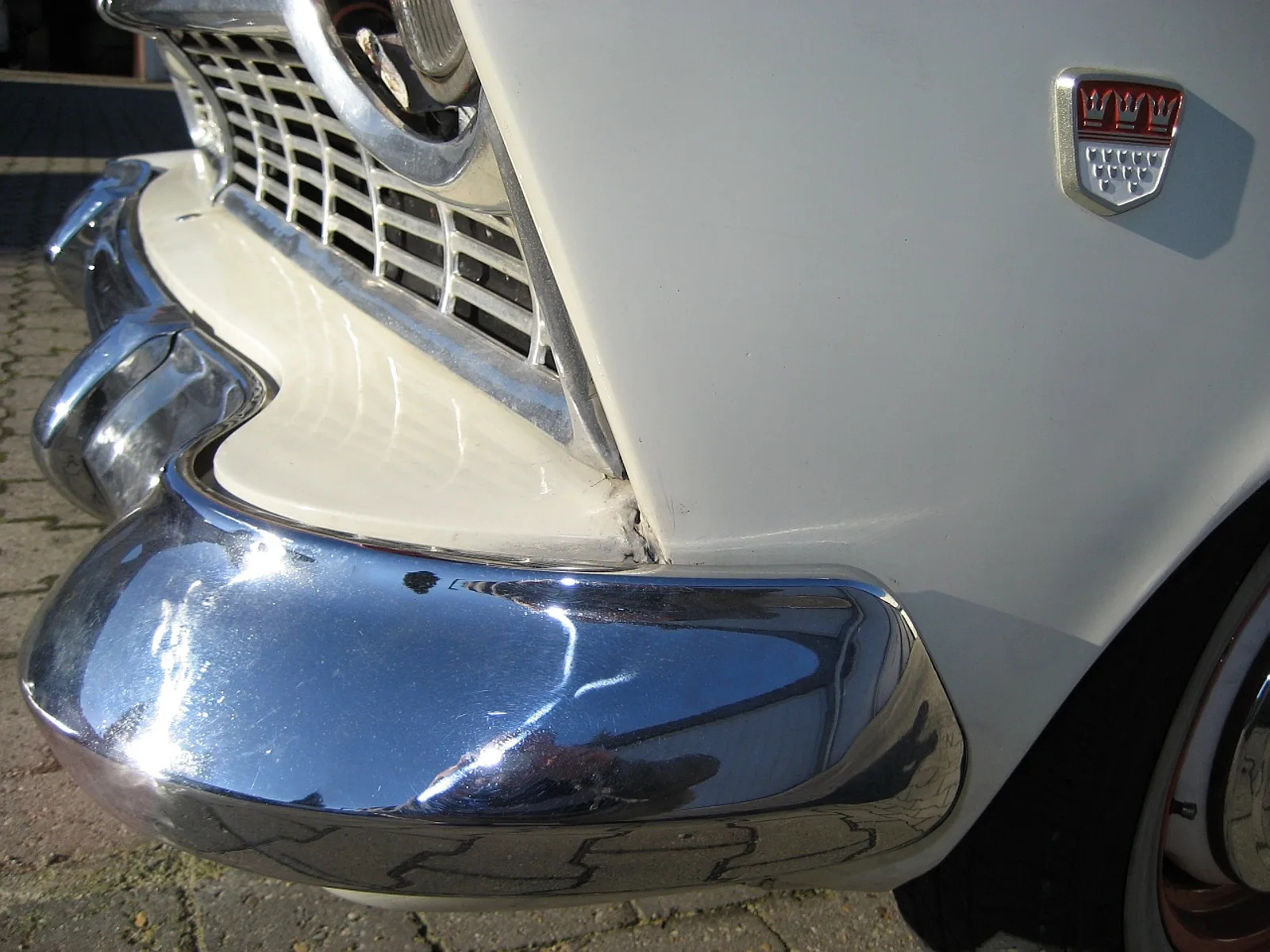
Chrome-plated bumpers grew heavier and more ornate until the late 1950s, when American makers began setting new trends and brand-specific designs. The 1960s brought lighter blade-like chrome bars with a painted metal valance below. Multi-piece construction took hold as grilles, lights and even exhaust outlets were built into the bumper.
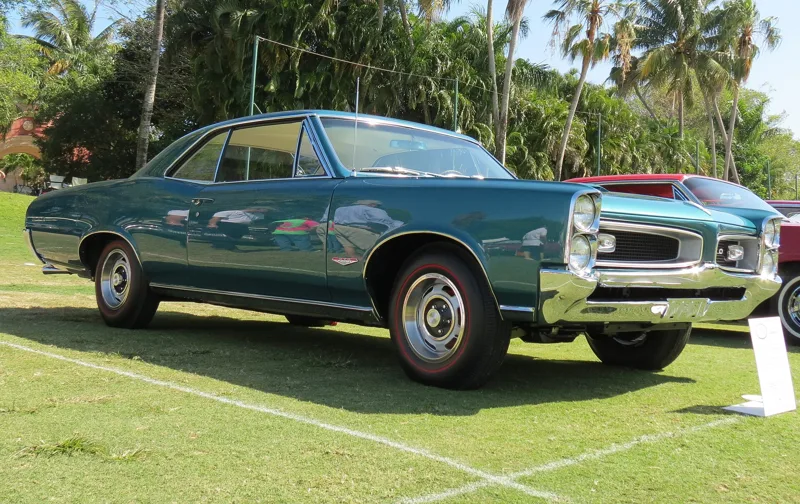
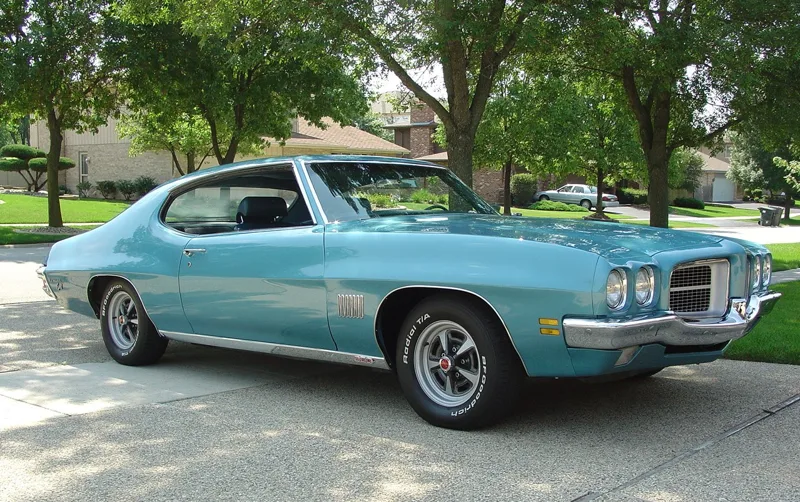
The turning point came with the 1968 Pontiac GTO, which carried General Motors' Endura front bumper in body-coloured plastic. It was designed to shrug off low-speed impacts without permanent deformation, and an advert of the day showed John DeLorean swinging a sledgehammer at it with no damage to show. Similar elastomeric bumpers went on the front and rear of the 1970-71 Plymouth Barracuda. In 1971 Renault fitted a moulded sheet-compound plastic bumper to the Renault 5.
Modern practice is a plastic cover over a reinforcement bar of steel, aluminium, fibreglass composite or plastic. Many bumpers now combine polycarbonate and ABS, known as PC/ABS, and the plastic outer skin sits over a lightweight, energy-absorbing foam core rather than the steel and rubber of earlier decades.
Why does impact energy matter so much?
A bumper protects other parts of the vehicle by dissipating the kinetic energy of an impact. That energy is half the mass multiplied by the square of the speed. Because speed is squared, force and energy loads climb far faster than the speed itself. A bumper meant to protect components at 5 mph (8 km/h) must be four times as tough as one designed for 2.5 mph (4 km/h), and small gains in protection add weight and cost fuel economy.
For a long time engineers believed rigidity helped occupants, and this view held until 1959. Modern crash theory points the other way, towards bodies that crumple progressively. A completely rigid car might have excellent bumper protection for its parts, yet it would offer poor protection to the people inside.
Do bumpers protect pedestrians?
Bumpers are increasingly designed to reduce injury to pedestrians struck by cars. Flexible bumper covers help, and front bumpers in particular have been lowered and built from softer materials such as foams and crushable plastics to reduce the severity of leg injuries. European countries have adopted rules aimed at the roughly 270,000 pedestrian and car deaths recorded worldwide each year.
The pedestrian question is tied to a basic conflict. Bumpers that withstand impacts well and keep repair costs down tend to injure pedestrians more, while bumpers that are kind to pedestrians usually cost more to repair. Most bumpers are designed to meet only the minimum regulatory standard.
Why do bumper heights cause problems?
In passenger cars the height and placement of bumpers are set by law in both the United States and the European Union. Bumpers still fail to protect in moderate-speed crashes, because under emergency braking the suspension pitches each car forward, allowing bumpers to slide past one another. Very tall bumper surfaces can prevent override and underride, and active suspension is another way to keep the vehicle level.
Height also matters for airbags. Their sensors often do not trigger until contact with an obstruction, so the front bumper needs to meet the other vehicle first to leave time for the cushions to inflate. Crush zones are useless if they are bypassed, as when the raised platform of a tractor-trailer misses a car's bumper and strikes its windscreen.
Lift kits are legal in most of the United States, but many places restrict front and rear bumper heights to protect pedestrians. New Hampshire sets limits for non-private vehicles, and Georgia, North Carolina, South Carolina and Tennessee have banned the practice of raising the front of a vehicle while leaving the rear low. Virginia makes a front bumper four or more inches higher than the rear illegal.
How do underride guards work?
Underride collisions, in which a smaller car slides beneath a larger vehicle, often cause severe injuries or death. The platform bed of a typical tractor-trailer sits at the head height of seated adults in a passenger car. Around 500 people are killed this way in the United States each year.
After the actress Jayne Mansfield died in a car and truck crash in June 1967, the National Highway Traffic Safety Administration recommended a rear underride guard, known as a Mansfield bar, an ICC bar or a DOT bumper. These must sit no more than 22 in (56 cm) from the road. The trucking industry was slow to upgrade them, and there is no requirement to repair damaged guards. NHTSA tightened the rules in 1996, and Transport Canada went further with energy-absorbing rear guards. In July 2015 NHTSA proposed stronger performance requirements.
UN Regulation 58 sets the rules for rear underrun protective devices in Europe, requiring them to sit no higher than 45 cm (17.7 in), 50 cm (19.7 in) or 55 cm (21.7 in) depending on the vehicle type. Many European nations also require side underride guards, which Japan, the United States and Canada use in some form.
What did the US bumper standard require?
In 1971 the National Highway Traffic Safety Administration issued the first US regulation for passenger car bumpers. Federal Motor Vehicle Safety Standard 215, Exterior Protection, took effect on 1 September 1972. It forbade functional damage to safety parts such as headlamps and fuel system components in barrier tests at 5 mph (8 km/h) front and 2.5 mph (4 km/h) rear. The rule effectively ended bumper designs with integral tail lamps.
| Year | US bumper requirement |
|---|---|
| 1972 | FMVSS 215 takes effect, with barrier tests at 5 mph (8 km/h) front and 2.5 mph (4 km/h) rear |
| 1974 | Standardised front and rear bumper heights, with angled impacts at 5 mph (8 km/h) |
| 1976 | Consolidated standard codified at 49 CFR 581; Phase I for 1979 cars |
| 1980 | Phase II zero-damage requirement for 1980 and newer cars |
| 1983 | Test speeds halved to 2.5 mph (4 km/h) and Phase I damage allowances restored |
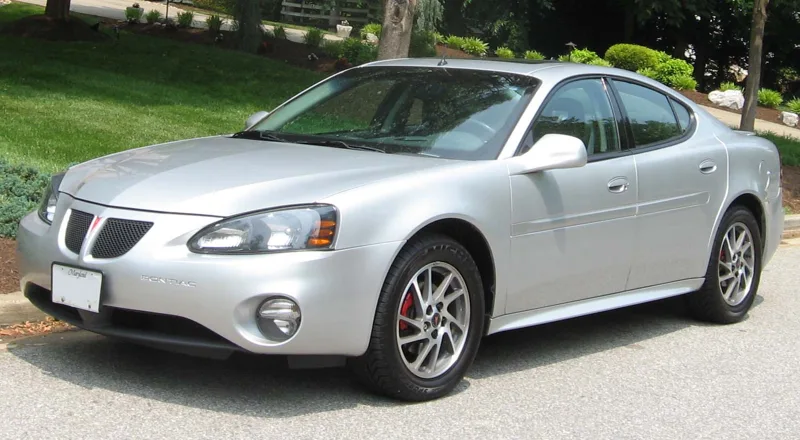
The October 1972 Motor Vehicle Information and Cost Saving Act told NHTSA to aim for the maximum feasible reduction of cost to the public and consumers. The 1973 model year produced a wide range of solutions, from solid rubber guards to recoverable designs with telescoping shock absorbers. Many cars were fitted with bulky bumpers, and some grew longer, adding weight at the extremes. The 1973 AMC Matador coupe used free-standing bumpers with rubber gaiters, while Pontiac's Endura design on the 1973 Grand Am and Chevrolet's Monte Carlo of 1978 integrated tightly with the body.
Foreign makers responded in their own way. Apart from exceptions such as the Volvo 240, Porsche 911 and Rolls-Royce Silver Shadow, compliant bumpers were fitted mainly to cars sold in North America, so models often looked different from their home-market versions. The height rules also ruled out the Citroen SM, which could not be imported because of its hydropneumatic suspension.
Did the 1982 rollback make sense?
The bumper rules were consolidated in March 1976 and codified at 49 CFR 581, separate from the vehicle safety standards. A zero-damage Phase II requirement applied to 1980 and newer cars, allowing only a 3/8 in (10 mm) dent and 3/4 in (19 mm) displacement at 5 mph (8 km/h) in the most rigorous tests. In May 1982 NHTSA halved the front and rear test speeds to 2.5 mph (4 km/h), cut the corner tests from 3 mph (5 km/h) to 1.5 mph (2 km/h), and restored the Phase I damage allowances.
Owners and insurers saw the trade-off differently. Stronger bumpers meant fewer and smaller repair bills, and insurers cut collision rates by 20 per cent for cars with robust bumpers. NHTSA estimated the net saving to consumers at between $11 and $39 over the life of a car. Consumer groups argued that the 1982 change raised overall costs with no benefit beyond the automakers, and the Consumers Union asked for the Phase II standard to return in 1986. NHTSA refused in 1990.
The Insurance Institute for Highway Safety ran low-speed barrier tests at 6 mph (9.7 km/h) and published repair costs. In 1990 it tested three years of the Plymouth Horizon. A 1983 model with Phase II 5 mph bumpers cost $287 to repair, a 1983 model with Phase I 2.5 mph bumpers cost $918, and the 1990 car cost $1,476, all in 1990 dollars.
How do bumper rules differ around the world?
Most countries outside North America follow international rules devised under the United Nations. These require a car's safety systems to keep working after a straight-on pendulum or moving-barrier impact of 4 km/h (2.5 mph) front and rear, with corner impacts at 2.5 km/h (1.6 mph) at a height of 45.5 cm (18 in). Canada first matched the 5 mph American rules, did not follow the 1982 cut to 2.5 mph, and in early 2009 moved to harmonise with US federal and UN rules.
Are bull bars and off-road bumpers safe for the street?
Bull bars and roo bars protect rural vehicles from large animals, but they carry a serious risk in towns. A rigid bar transmits the full force of a collision to a pedestrian, while a standard bumper absorbs some energy by crumpling. The European Union has banned the sale of rigid metal bull bars that do not meet pedestrian-protection standards.
Off-road bumpers of heavy-gauge metal add ground clearance, improve departure angles and protect the vehicle. Like bull bars they do not absorb energy by deforming, which makes them more dangerous to pedestrians than factory plastic bumpers. Their legality varies by jurisdiction. The United States federal bumper standard sets its impact and height limits only for passenger cars, which leaves light trucks, SUVs and multipurpose vehicles outside those constraints, though some cities have their own rules.