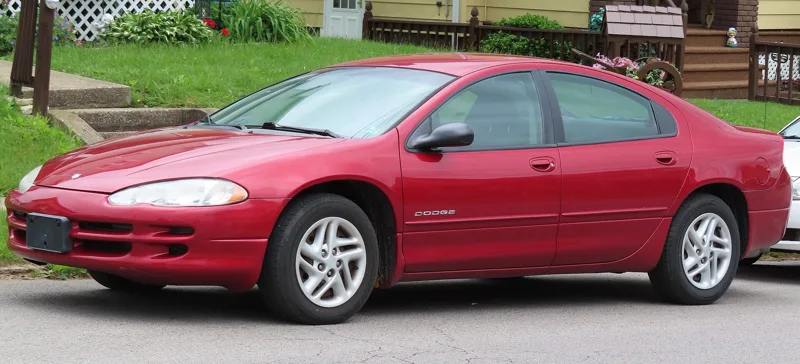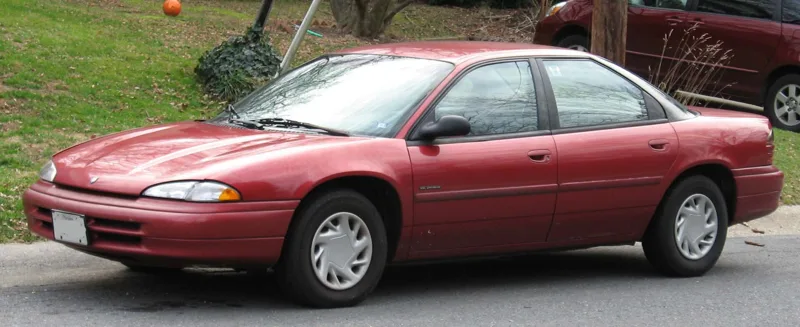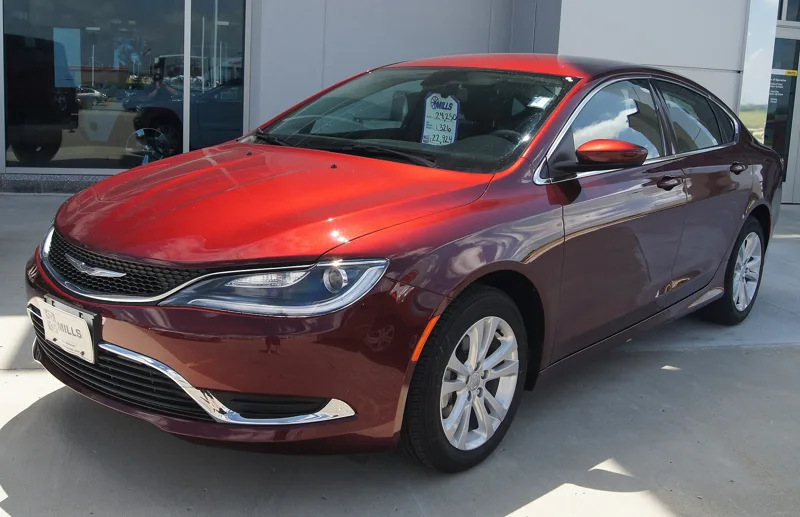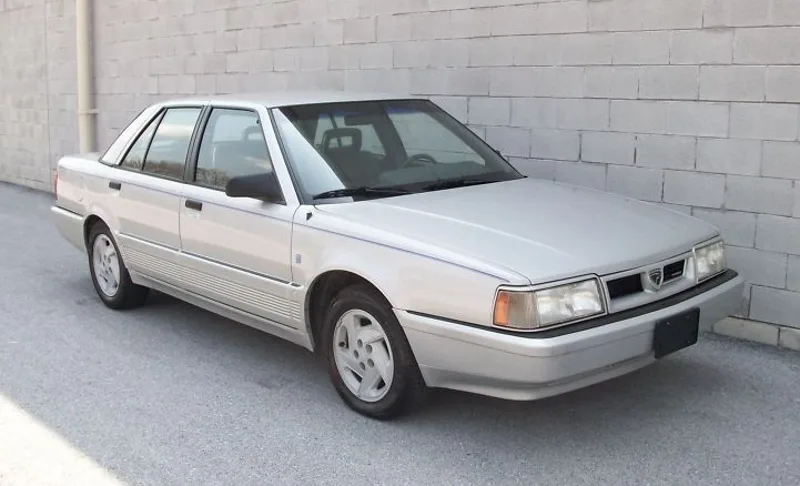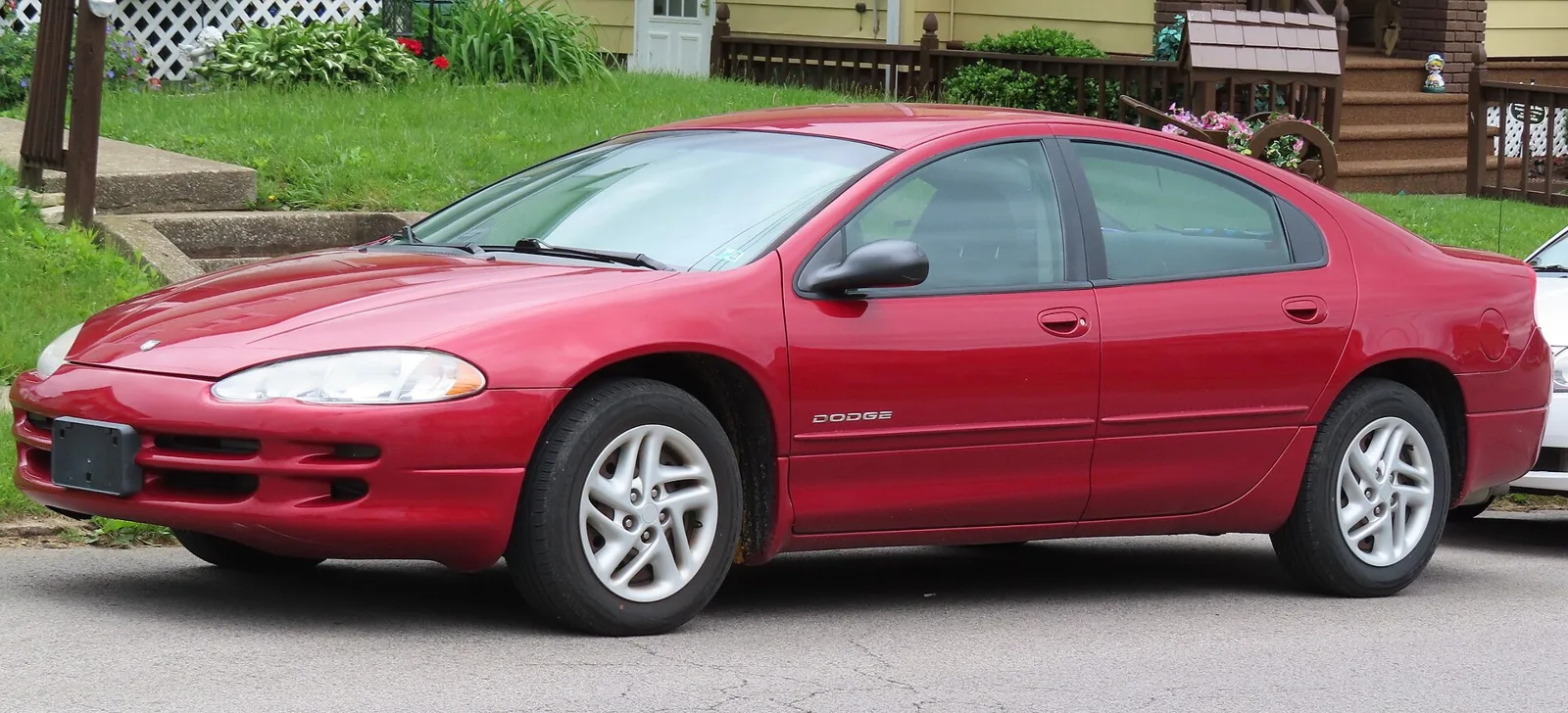
Chrysler's cab-forward Intrepid and Ford's controversial oval Taurus arrived in the same mid-1990s market, and their fates diverged from the first year.
The first-generation Dodge Intrepid went on sale for 1993 as a cab-forward front-drive sedan, with airbags on every car. The Ford Taurus third generation arrived in 1995 with oval styling and was the best-selling US car in 1996, although most of its sales went to fleets.
The Dodge Intrepid and the third-generation Ford Taurus were both mid-size or full-size family sedans in the mid-1990s, and both took bold styling steps. The Intrepid carried Chrysler's cab-forward design, with the wheels pushed to the corners. The Taurus used an oval design language that its own chief designer called the new global theme for Ford. Their reception split almost immediately.
Where did the two designs come from?
The Intrepid's design traces back to 1986, when Kevin Verduyn completed the first exterior of a concept sedan called Navajo. It never passed the clay stage, but the Navajo was reworked into the Lamborghini Portofino, which Chrysler showed at the 1987 Frankfurt Auto Show. That car set the cab-forward design that Chrysler then built into production.
The Taurus had a different origin. Ford began work on the third generation in 1991, and final approval for the oval design came in April 1992. Chief designer Jack Telnack said the oval was becoming the new global design theme for Ford, and that the Taurus was drawn to stand out in the market.
A cab-forward Chrysler sedan against a Ford whose oval styling was both its signature and its biggest problem.
How did the Intrepid's chassis come about?
Chrysler bought American Motors in 1987, and the Intrepid's chassis work began in the late 1980s. Initial proposals looked like the Dodge Dynasty, but that approach was scrapped in 1988 by Francois Castaing, a former AMC vice president who ran vehicle engineering at the new company.
Castaing's new chassis began with the Eagle Premier platform, and its longitudinal engine mounting was inherited from the Premier. The LH platform could carry front-wheel drive, and the LX version carried rear-wheel drive. The transmission was based on Chrysler's A604 (41TE) Ultradrive unit, which became the A606 or 42LE.
The first LH cars appeared in 1992 at Detroit, as three models for 1993. Chrysler's Concorde, the Dodge Intrepid and the Eagle Vision all shared the platform, and the Intrepid was the Dodge badge in the family.
Why did the Taurus styling prove controversial?
The oval styling was Ford's gamble. Development teams had considered designs that resembled the second-generation car and more radical ones, and the oval scheme was chosen in April 1992. It became the Taurus's weak point in the marketplace, because buyers reacted to its shape more than its substance.
Telnack compared the shape to a pair of slippers, and the body used a rounded profile like that of the Chrysler Concorde. Its heavily contoured sides owed something to the Lincoln Mark VIII. Critics dubbed the car the Bubble or Submarine Taurus, and the window shape and broad front curves were the main targets.
The LX came with chrome alloy wheels, chrome dual exhaust tips and a script Taurus badge, which signalled the car's upscale aim. The wagons shared their sheet metal with the Sable from the firewall back.
Ford softened the look for 1998. The front bumper gained a full-length opening, the Ford logo moved down onto a chrome bar in the grille, and the rear turn signal lenses changed from amber to red.
Which engines did each car offer?
The Intrepid's standard engine was a 3.3-litre pushrod V6, and a 3.5-litre SOHC V6 with four valves per cylinder was added in 1990. The 3.5 was the optional engine in the first-generation car, rated at 214 hp.
Rival buyers weighed the Intrepid against the Chevrolet Lumina and the Taurus first, then against the Camry, Maxima and Accord.
The Intrepid's engine line was the clearer story of its early years. The second generation later replaced both engines with all-aluminium units, a 2.7-litre DOHC V6 at 200 hp and a 3.2-litre SOHC V6 at 225 hp, and the 3.5 became the R/T's engine.
For the Taurus, the more useful comparison is its tuning. Ford engineers designed the suspension to emulate the ride and handling of the Toyota Camry and Honda Accord, which were the most closely studied rivals in its development.
What did the first Intrepid offer as standard?
The first Intrepid came in base and ES trims. Every car received driver and front passenger airbags, a rarity at the time, along with air conditioning and a four-speed automatic transmission.
The ES added four-wheel disc brakes, 16-inch wheels and touring suspension damping. Anti-lock brakes and traction control were optional, and a 3.5-litre SOHC rated at 214 hp was available for those who wanted more power.
Changes over the first five years were modest. A variable-assist power steering rack arrived in 1994, the touring suspension became standard on the base car, and anti-lock brakes became standard on the ES in 1995. In 1996 Autostick, a manual shift function, arrived on the automatic.
Specifications side by side
| Specification | Dodge Intrepid (first generation) | Ford Taurus (third generation) |
|---|---|---|
| Model years | 1993 to 1997 for the first generation | 1996 to 1999 |
| Production start | Shown at the January 1992 Detroit show for 1993 | June 1995; first car built on July 12, 1995 |
| Layout | Front-wheel drive, LH cab-forward platform | Mid-size; chassis largely carried over from the second generation |
| Body styles | Four-door sedan | Four-door sedan and five-door wagon, with the Mercury Sable |
| Standard engine | 3.3-litre OHV V6 | Not given in these figures |
| Optional engine | 3.5-litre SOHC V6, 214 hp | Not given in these figures |
| Transmission | Four-speed automatic; Autostick from 1996 | Not given in these figures |
| Airbags | Driver and front passenger on every car | Not given in these figures |
| Trims | Base and ES | GL and LX at launch |
| Build location | Brampton, Ontario, and Newark, Delaware | Atlanta, Georgia, and Chicago, Illinois |
| Styling | Cab forward, from the Lamborghini Portofino concept | Oval-based design elements |
| US sales | Not given | Best-selling US car in 1996; number three in 1997 |
| Awards | Car and Driver Ten Best, 1993 and 1994 | Lost Motor Trend Car of the Year to the 1996 Dodge Caravan |
How did the Taurus interior work?
Ford's engineers tuned every panel so that the sounds of the car, from doors closing to the engine running, were pleasing, and its trim designers chose every interior surface for its feel. The Taurus's interior was completely redesigned for 1996. The gauges sat in an oval pod, and the dashboard wrapped slightly around the driver. The main controls were placed within easy reach and designed to be recognised by touch.
The radio and climate controls were combined in an oval-shaped Integrated Control Panel in the centre of the dash. Ford designed it in response to owner complaints that the earlier controls had been cluttered with small, similar buttons that forced drivers to look away from the road.
The Flip-Fold centre console was an innovation, turning a seat between the front buckets into a console with a lockable bin and cupholders. The GL and GL models used a column shifter, a cloth bench and the Flip-Fold, while the LX came with bucket seats and a floor shifter. In 1999 the car offered three configurations again, as the first Taurus had.
Seating ran from five to eight. Sedans and wagons with the floor shifter seated five, and a wagon with its third-row bench could seat seven. Flip-Fold cars could seat six or eight, depending on the body and third row.
How did the two cars sell?
The Taurus remained the best-selling car in the United States for 1996, but only 49 per cent of its sales went to retail buyers. Rental fleets took 51 per cent, and Ford added a low-priced G model mid-year to lift a slow start.
Ford had predicted the new Taurus would sell over 400,000 units a year, the level the old model had reached. Ford also offered a six-month lease to Camry and Accord owners, a $250 cash allowance on lease renewals and a $50 voucher for a restaurant meal after a test drive.
In 1997 the redesigned Camry overtook the Taurus, which slipped to third behind the Camry and the Honda Accord. The Camry's sales came mainly through retail outlets, which made the gap in quality of volume plain.
The Intrepid's sales record in its first generation is not given here. Its later problems came with the second generation, when cost-cutting and a fading cab-forward design hurt sales.
How did reviewers receive the two cars?
Road and Track gave the Taurus a good review and found its handling and refinement impressive. Motor Trend was positive, although it found the oval styling awkward at first. The magazine's Car of the Year went instead to the redesigned 1996 Dodge Caravan.
The Intrepid and the Concorde were on Car and Driver's Ten Best list for 1993 and 1994. Both Intrepid generations won Consumer Guide's Best Buy award, and the second generation made the Ten Best list again for 1998 and 1999.
What happened to the Intrepid after 1997?
The second-generation Intrepid arrived for the 1998 model year, with stronger and stiffer body shells and integrated side impact protection. Its 3.5-litre V6 reached 242 hp in the R/T, and the ES was rated at 234 hp.
Cost-cutting began in 2002, when illuminated switches, courtesy lights and a trunk liner were removed. The R/T was discontinued in 2003, and a new SXT kept the 3.5-litre engine at 250 hp. The Intrepid was cancelled in 2004 and replaced by the rear-wheel drive Dodge Magnum and Charger.
The second-generation 2.7-litre V6 had its own problem. Some engines suffered failures from oil sludge, which clogged the fine oil passages and often destroyed the engine. Five class actions were consolidated in the District of New Jersey in February 2009, and the fixes ranged from synthetic oil to a new engine.
The Intrepid also appeared in police and fleet packages from 2002 to 2004, and it made its NASCAR debut in 2001. Sterling Marlin gave Dodge its first win in an Intrepid, and the car raced until 2005.
What did the hybrid research cars show?
In the late 1990s Chrysler used the Intrepid as a research platform for a diesel-electric hybrid. The ESX, ESX II and ESX III were built between 1997 and 1998, with the first in a series hybrid layout and the next two as mild hybrids.
The ESX set a target of 80 mpg-US but reached an estimated 55 mpg-US. It used exotic materials and lead-acid batteries, which pushed its cost to an estimated $80,000. The ESX II used an aluminium frame and carbon fibre, and the ESX III used injection-moulded thermoplastic, lowering the cost to about $30,000.
Which buyer suits each car?
A buyer who wanted a family sedan with airbags on every car, a choice of V6 power and a more conventional shape would have looked at the Intrepid. Its first-generation cars were fitted with safety equipment that was rare at the time.
A buyer who wanted a wagon or sedan with a configurable interior and a large, distinctive shape would have looked at the Taurus. Its controls were the biggest focus of the redesign, and its fleet-heavy sales show how popular it was with businesses.
Neither car won every comparison. The Intrepid had the stronger early safety story, while the Taurus had the bigger sales year and the wider body choice. The oval styling that held the Taurus back was also the feature that most set it apart.