A 1970 to 1977 sports tourer with a Triumph V8, a rocky start in the United States and a long afterlife on British screens.
The Triumph Stag was a 2+2 convertible built by the British Triumph Motor Company from 1970 to 1977. Styled by Giovanni Michelotti, it used a 3.0-litre V8 that was enlarged in development, sold 25,877 cars and gained a reputation for overheating in the United States.
The Triumph Stag was a 2+2 sports tourer that the British Triumph Motor Company sold from 1970 to 1977. Giovanni Michelotti, an Italian designer, gave it its shape, and it was built around a V8 that Triumph developed in-house. It had a difficult start in the United States, but it went on to a long life on British screens and in enthusiast garages.
Where did the Triumph Stag come from?
The Triumph Stag was a 2+2 sports tourer built from 1970 to 1977 by the British Triumph Motor Company. Italian designer Giovanni Michelotti styled it, and it began as a styling experiment cut from a pre-production 2000 saloon, which Triumph later turned into a convertible.
Michelotti had styled the 2000 saloon in 1963-64 as well. Under his arrangement, Triumph could take the prototype as the foundation for a new model if Harry Webster, its Director of Engineering, approved. Webster did approve, and the prototype went back to England.
The result was a two-door drophead that had little in common with its 2000 progenitor in styling. It kept the 2000's suspension and driveline, however. Triumph liked the Michelotti look so much that it carried the Stag's styling lines into the T2000 and T2500 Mark II saloon and estate of the 1970s.
Triumph normally gave new projects four-letter development code names, such as Bomb for the Spitfire. The Stag was the only Triumph to take its code name into production. Its launch came nearly two years behind schedule, in June 1970, and the reception at the international shows was warm.
A four-seat convertible with a V8 that never quite stopped overheating, and a film career that outlasted its reputation.
How was the Stag designed?
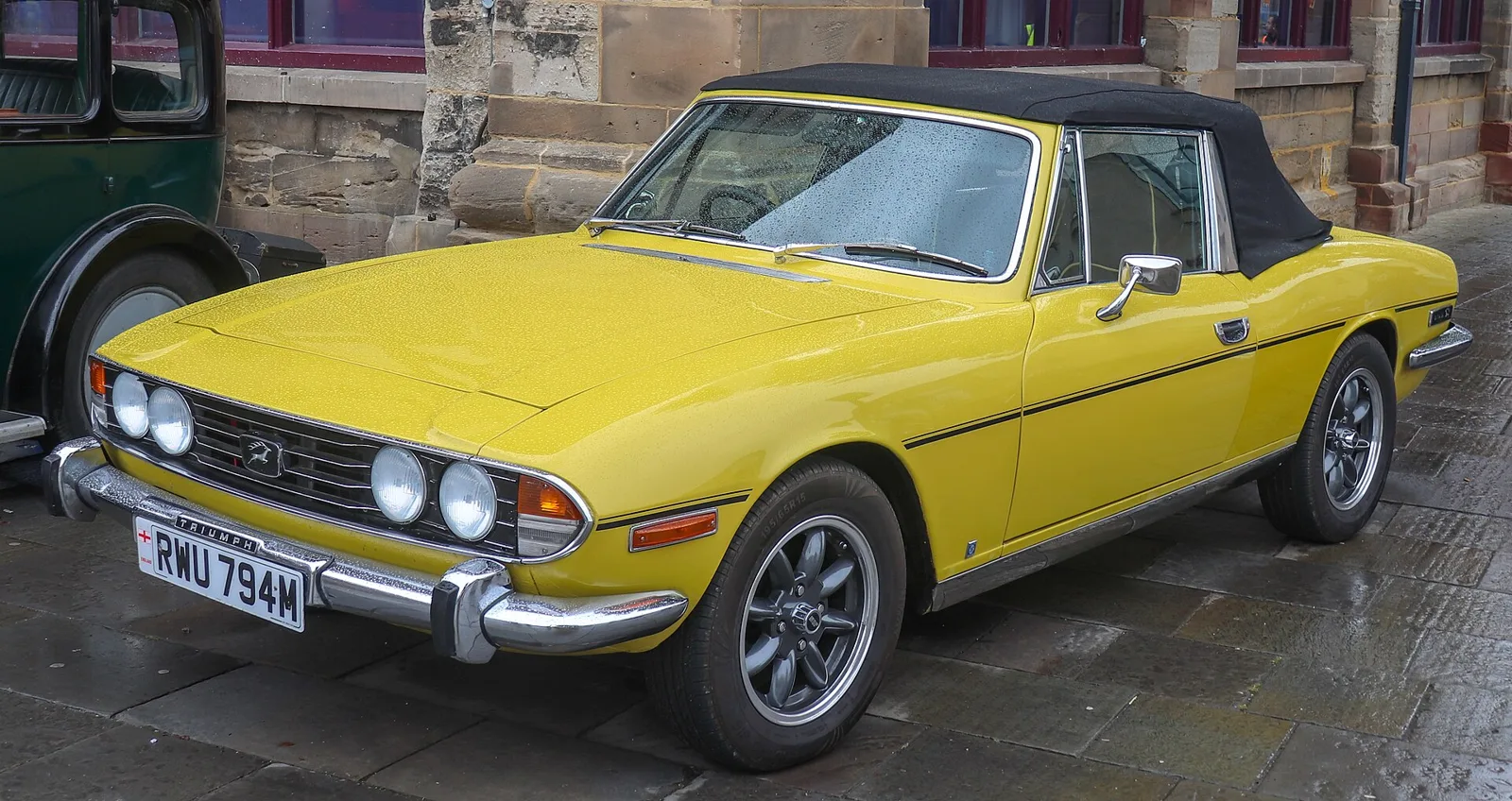
The Stag was a four-seater convertible coupe with a B-pillar roll bar hoop, tied to the windscreen frame by a T-bar. The hoop was needed for structural rigidity and to meet proposed American rollover standards of that era.
A body-colour removable hard top, with defrost wires on the rear window, a full headliner and lever-operated quarter windows, was a popular factory option.
Michelotti converted his 1966 styling concept into a coupe in 1968, and the second car took clear cues from the GT6 coupe, including its rear windows, roofline and the air vent gills in the C-pillar. Triumph then built a one-off production-style Fastback in 1970/71, with minor detail changes to match the production Stag more closely.
What engine did the Stag use?
The Stag used a Triumph-designed overhead-cam V8 that was enlarged to 2,997 cc (3.0-litre, 183 cu in) in 1968. It reached production in 1970 with dual carburettors.
The first design used the 2000 saloon's 2.0-litre six, which was to be uprated to 2.5 litres. Harry Webster and his successor as chief engineer, Spen King, pushed for a new overhead-cam 2.5-litre fuel-injected V8 instead. That unit was then enlarged to 2,997 cc to add power.
Mechanical fuel injection was dropped in favour of dual Zenith-Stromberg 175 CDSE carburettors, because the car had to meet US emissions standards and the United States was a key market. The fuel-injected version had been troublesome in any case.
Triumph aimed for a family of in-line and V engines around a common crankshaft, from four cylinders to eight, with capacities of 1.5 to 4 litres. A 2.0-litre slant four went into the Dolomite and TR7, and a version built by StanPart first appeared in the Saab 99 in 1968. The Stag V8 followed in 1970.
Rover's all-aluminium V8, originally designed by Buick, was tested for the Stag in May and June 1967. Installation tests found it too tall, and front structure changes would have been needed. Triumph chose its own unit rather than hold up the project, and the Stag's chassis was unitary, with MacPherson struts at the front and semi-trailing arms at the rear.
What were the Triumph Stag's main specifications?
The Stag had a 3.0-litre V8 in later cars, a four-speed manual or three-speed automatic gearbox, independent suspension and power-assisted rack and pinion steering. Production totalled 25,877 cars between 1970 and 1977.
| Feature | Detail |
|---|---|
| Production years | 1970 to 1977 |
| Body | 2+2 convertible coupe, with an optional removable hard top |
| Engine | 2,997 cc (3.0-litre) overhead-cam V8 |
| Transmission | Borg-Warner Type 35 3-speed automatic, or 4-speed manual with Laycock overdrive |
| Front suspension | MacPherson struts |
| Rear suspension | Semi-trailing arms |
| Brakes | Front discs, rear drums |
| Steering | Power-assisted rack and pinion |
| Total built | 25,877 cars |
| Export cars | 6,780, of which 2,871 went to the United States |
Why did the Stag overheat in the United States?
Overheating came from several linked faults: a water pump layout carried over from the Saab slant four, coolant that lacked enough corrosion inhibitor, timing chains that stretched and failed, and cylinder head studs that warped the block. US cars suffered most, because low compression pistons and advanced ignition timing added heat.
The Saab 99 mounted its engine back to front, so its water pump could not sit on the front face. The pump went into the top of the block instead, and that position was copied onto the V8 through a shared machining line. When coolant escaped through the expansion bottle and the level fell below the pump, overheating followed, often with pump failure.
The block was iron and the heads were aluminium, which meant the car needed corrosion-inhibiting antifreeze all year round. Owners and dealers did not appreciate this, so electrolytic corrosion produced sludge that clogged the radiators. Cylinder head heat distortion then caused head gasket failure, an expensive repair that often left the radiator clogged again.
Long simplex roller timing chains stretched and often failed within 25,000 miles (40,200 km). A stretched chain could skip links, so valves struck pistons. The head studs were set at mixed angles, and as they heated and cooled they pulled the block out of shape, a problem made worse by overheating.
Quality also slipped once production began. Pre-production engines were built meticulously, but cars built later were not checked as carefully, and casting sand and core wire were still found blocking coolant passages. Time magazine rated the Stag one of the 50 worst cars ever made.
How many Stags were built, and how rare were they?
About 25,877 Stags were built between 1970 and 1977, and 6,780 of them were export models, including 2,871 for the United States. British Leyland had around 2,500 UK dealers, so the average dealer sold only seven or eight Stags, roughly one a year.
Triumph had expected large sales in the United States, and the engine's reputation there made that difficult. Because the cars were so rare, few dealers saw the same fault often enough to diagnose it. British Leyland never fully re-engineered the V8, adding only a domed piston and a higher-pressure cooling system that boiled over at a higher temperature.
In the UK the Stag was an immediate success. Buyers faced a 12-month waiting list, and cars changed hands well above list price. Around 19,000 were sold in the UK over seven years, and the car's popularity at home stood in sharp contrast to the trouble it caused abroad.
What separated the Mk 1 and Mk 2 Stags?
Enthusiasts call cars built before the 1973 model year Mk 1 and later cars Mk 2. The dividing line is chassis number 20001, and the main visual change was twin coachlines added in 1973. Triumph itself treated the Stag as a single model.
Triumph changed the specification by model year, with cosmetic updates each time. The Mk 1 and Mk 2 labels are an enthusiast's invention, because the chassis numbering changed at 20001 and the sequence marked the start of the later batch.
Mk 2 cars had a slightly different warning light cluster, instrument needles that pointed up, a single courtesy light in the T-bar and a smaller steering wheel. The seats were upholstered so that a simple head restraint could be fitted, first as an option and then as standard.
The three-quarter window in the early soft top was dropped in the 1972 model year because it tended to split when stowed. For 1976 the sills and tail panel returned to body colour, although a stainless steel sill cover was fitted to all 1976 and 1977 cars.
What options did buyers get on the Stag?
Buyers could choose between a Borg-Warner Type 35 three-speed automatic, fitted to about half of cars, and a four-speed manual with Laycock overdrive. Electric windows, power steering and power brakes were standard, and Delaney Gallay air conditioning was a factory option.
The manual gearbox was a derivative of the TR2 unit, improved for the TR4, TR5 and 250 models with a raised first gear and needle roller bearings on the layshaft. Overdrive became standard on all manual cars from 1973, because it lowered engine speed in third and top gears.
Early cars could be ordered with the soft-top, the hard-top or both. Later cars came as a soft-top model or as a hard and soft top model, and few other factory options were offered.
Wheels changed over time. Non-US cars from 1970 to 1975 had Rostyle steel wheels with tin-plate trims, US cars in 1971 and 1972 had 72-spoke wire wheels, five-spoke alloys became the US standard in 1973, and alloys were standard on all markets from 1976.
Was the Stag ever replaced?
The Stag was never directly replaced. British Leyland planned a TR7-based fastback called the Lynx, with a 3.5-litre Rover V8, for a 1978 launch. The closure of the Speke factory and new policies from chief executive Michael Edwardes ended the project.
The Lynx used the TR7 platform with a longer wheelbase to fit a rear seat, and it had fastback coupe bodywork. Its gearbox and rear axle came from the Rover SD1, and the car was very close to production when it was cancelled.
Many owners replaced the troublesome engine with units from other cars, including the Rover V8, the Triumph 2.5-litre engine the car was first designed around, or Ford Essex units. As of September 2024, fewer than 6% of surviving Stags known to the DVLA had a 3.5-litre engine or larger, and 92% had a 3-litre engine.
What unmade Stag variants were planned?
Triumph planned a coupe to sit beside the open Stag, as the GT6 coupe did with the Spitfire. Several one-off variants were built, including a Fastback coupe and two four-wheel-drive Stags, and the Fastback and the 4WD cars both survive.
British Leyland did not continue with the Fastback, reportedly because it feared the car would take sales from other models in the BL range. The design was considered successful and more useful than an ordinary Stag, but the project went no further.
Four-wheel drive used the Ferguson Formula, pioneered on the Jensen FF. Two more 4WD Stags were built in 1972 by FF Developments for GKN testing, with automatic locking differentials and Dunlop Maxaret anti-lock braking. Both cars survive. They had a broad bulge in the centre of the bonnet, because the engine sat slightly higher to clear the front drive.
A lightweight test Stag with most of the sound-deadening removed did not proceed. A 32-valve V8 was considered, but no trace of an engine built to that specification has come to light.
How did the Stag become a classic?
The Stag has sizeable club and owner support and a number of specialist suppliers. The main UK enthusiast club estimates that about 8,500 survive in the UK, while DVLA data for Q4 2022 shows 8,409 UK cars either taxed or under SORN.
The last production Stag, BOL88V, is kept at the Heritage Motor Centre in Warwickshire. Because owners swapped engines so widely, the number of converted cars is not known.
Where did the Triumph Stag appear on screen?
The Stag appeared in films and television from the early 1970s, most famously as a Bond car in Diamonds Are Forever. It also featured in Straw Dogs, Bergerac, A Very English Scandal and the 2024 Grand Tour special.
- 1971: an early pre-production Stag was Dustin Hoffman's main transport in Straw Dogs.
- Diamonds Are Forever: Bond commandeers a Saffron Yellow 1970 Stag from a diamond smuggler.
- Hazell (1978-1979): a 1975 Mk2 Stag, originally green and later repainted red.
- My Beautiful Laundrette (1985): a 1973 Stag was driven by several characters.
- Bergerac (1981-1991): a yellow Stag was used by the ex-wife of the lead character.
- Second Sight (2000-2001): DCI Ross Tanner, played by Clive Owen, drove a Sapphire Blue Stag.
- A Very English Scandal (2018): Jeremy Thorpe, played by Hugh Grant, drove a white Stag.
- Modern Love (2021): the Stag played the main role in the first episode of series 2.
- The Grand Tour (13 September 2024): James May drove a Stag across Zimbabwe and parts of Botswana, and it was the only car in the special with no mechanical issues.