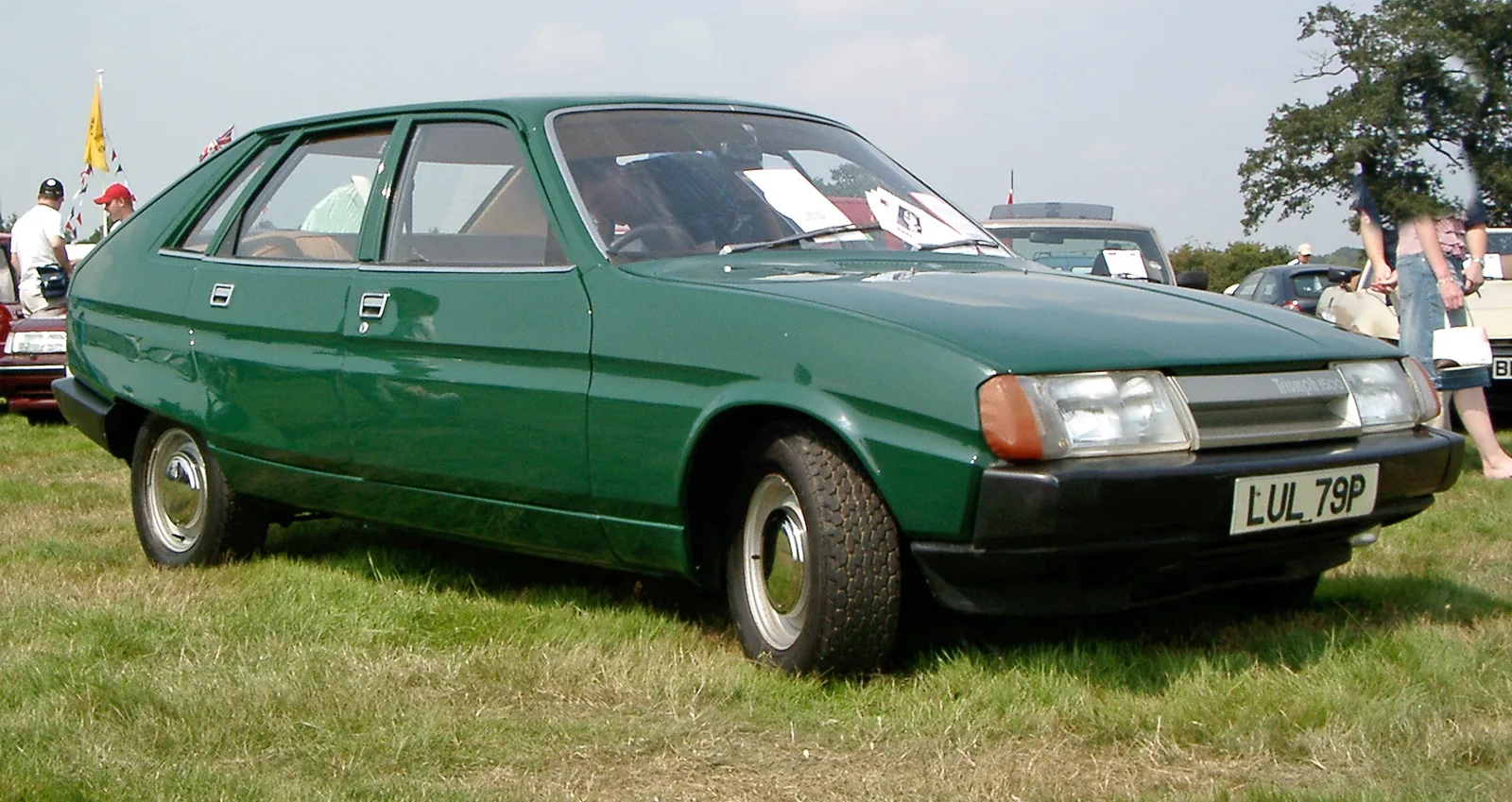
A fastback mid-size saloon that British Leyland meant to replace the Dolomite, developed from 1970 and dropped in 1975 before series production began.
British Leyland's 1970 to 1975 project, the SD2, was meant to be a fastback Dolomite successor. It never reached showrooms: profit doubts and the Ryder Report led to its cancellation in spring 1975, before series production began.
The Triumph SD2 was a fastback mid-size saloon that British Leyland developed from 1970 and abandoned before a single car went on sale. It was meant to succeed the Triumph Dolomite, and its planners expected to sell about 83,000 of them a year.
Why did British Leyland need a Dolomite successor?
The Dolomite had come about because management decided that front-wheel drive would be kept for Austin and Morris, while other marques switched to rear-wheel drive. Triumph therefore converted its front-drive 1300 and 1500 saloons to rear-wheel drive. The Dolomite was priced above the Austin and Morris cars but below the Rover and Jaguar models.
Work on the successor started almost as soon as the Dolomite was launched. The new model was to sit in the mid-size market as a higher-quality complement to the Morris Marina and the Austin Allegro, and to close the distance between them and the Rover range above.
The SD2 never went into series production, and development stopped in the spring of 1975.
How did Triumph end up in British Leyland?
The Triumph Cycle Company was founded in 1886 as a maker of bicycles and motorcycles, and it began producing cars in 1923. The Triumph models developed by Donald Healey won a name for sportiness in the 1930s, but the car division still made losses almost continuously. Triumph was insolvent by 1939.
After its production facilities were destroyed in the Second World War, the Standard Motor Company bought the Triumph name in 1944 and restarted car production under the brand. Leyland took over the Standard group in 1960. From 1967 Rover joined the Leyland group, and in 1968 Leyland merged with British Motor Holdings, which owned Austin, Morris and Jaguar, to create British Leyland Motor Corporation (BLMC). Triumph then sat under one roof with several of its former rivals. Repositioning the brand was something BLMC management achieved only partly.
Who designed and engineered the SD2?
The SD2 was the work of the in-house Specialist Division, which was designing the fastback Rover SD1 at the same time. The potential successor to the Dolomite received the development code SD2. Malcolm Harbour led the project, Charles Spencer 'Spen' King was technical director, and David Bache was responsible for the design. Development began in 1970, and by spring 1974 BLMC had built several prototypes, although no production car followed.
What did the SD2 look like?
Two body designs were tried. Pininfarina of Italy was asked to propose an alternative, and its notchback saloon with straight lines was judged the more elegant of the pair. In September 1973, however, management chose the in-house design for corporate and cost reasons. Bache's car was a four-door fastback with a large tailgate, and it followed the thinking behind the SD1, whose body he had also shaped.
Like the larger Rover, the SD2 had a striking crease that ran the full length of the flanks, dropping towards the front bumper and rising at the rear. A third side window was planned in the C-pillar, to be left uncovered on the basic versions and given a plastic cover on the higher-grade one. Wide-band headlights with an inclined surface were fitted at the front, and the rear wheels were partly hidden by the wings.
Why did the in-house design beat Pininfarina?
The in-house design won on corporate and cost grounds, even though Pininfarina's notchback was the design management found more elegant. Both proposals were built as prototypes, so BLMC had real cars to compare before it made the decision in September 1973.
Bache's fastback followed the concept of the Rover SD1, so the two cars shared a design approach. Pininfarina's straight lines disappeared from the programme, and the SD2 went on with Bache's body shape until development was stopped.
What engines and running gear were planned?
To keep costs down, the SD2 was meant to borrow as many parts as it could from other cars in the group, with the new TR7 the main partner. At times management also thought the SD2 floor pan could later underpin other group models, such as a replacement for the Morris Marina.
Engineers first considered new four-cylinder engines derived from the six-cylinder units of the Rover SD1, but that idea was dropped early for cost reasons. Instead, only existing engines from the Leyland programme came into question, and the engine plan changed as the project's economics worsened.
| Stage | Engines | Note |
|---|---|---|
| Original plan | 1.5, 1.7 and 2.0 litre fours | Designs already used in the Dolomite and Sprint; largest version optionally with twin carburettors or a 16-valve head |
| Model year 1979 plan | O-series engines | Still in development in the early 1970s; needed costly engine bay changes |
| Late 1974 plan | 1.5 and 1.8 litre fours | Reduced once the uneconomic nature of the project became clear |
Whatever the engine, the SD2 was to drive its rear wheels, with the engine fitted longitudinally at the front. The front wheels had independent suspension with torsion-bar springs, and the rigid rear axle used leaf springs with a Watt linkage. The front subframe was identical to that of the TR7, in line with the planned commonality with the new TR7.
How was the SD2 going to be built and sold?
At times the SD2 was also meant to play the part of a little brother to the Rover SD1. Series production was planned to start in June 1977. BLMC wanted to offer the car in the British Isles, in continental Europe except Sweden, and in most overseas export markets. It was not to be sold in Australia, New Zealand or South Africa, because the local subsidiaries had their own vehicles developed on site.
Production was to be spread over several sites from the start. The bodies were to be made in Liverpool, while the Tile Hill and Canley plants in Coventry would complete the cars. Those factories together had a capacity of almost 2,000 vehicles per week, and any higher volume would have needed outside plants. Early planning even considered ending production of the Stag sports car to make room for the SD2.
The forecasts assumed about 83,000 vehicles a year, and the United States alone was estimated at about 50,000 a year. The rivals BLMC had in mind in Europe were the Alfa Romeo Alfetta, the Audi 80, the BMW 3 Series and the Lancia Beta.
Why was the SD2 never built?
Doubts about the project's profitability grew inside BLMC from 1974 and sharpened in 1975. An internal study in spring 1974 found strong overlap with the Morris Marina, which also had rear-wheel drive. A comparison with the front-drive Princess in summer 1974 concluded there was enough distinction to justify continuing.
Autumn 1974 tests disagreed. In those comparisons the SD2 was set against the Audi 80 and the Opel Ascona and fell clearly behind both. The idea then was to sharpen its profile as a specialist car, sold at a higher price close to the Rover SD1 and built with as many shared parts as possible. Those efforts could not save it.
What did the Ryder Report mean for the SD2?
In early January 1975 the so-called Ryder Report, written by Don Ryder, was published. The inquiry had been set up to identify the problems of the economically troubled BLMC group and to outline its future. Its main recommendations were to trim the very broad model range and to cut parallel developments.
After the report, the SD2 lost its support in company management, and the work was halted in spring 1975. An alternative project called TM1, which would have offered a four-door Morris and a five-door Triumph, ended too.
What replaced the Dolomite?
British Leyland kept building the Dolomite without change until 1980. A facelift designed by Giovanni Michelotti was never put into production, and the Marina did not get a successor either. From 1981 the Triumph Acclaim took the Dolomite's place. It was derived from a Japanese Honda saloon.