A mid-sized SUV built on a unibody when rivals still bolted bodies to frames, shaped by a Chapter 11 reorganisation and a long run of recalls.
The Jeep Grand Cherokee is a mid-sized SUV built since 1992 on a unibody chassis. Five generations have followed, from the ZJ to the WL of 2021, and the current range includes a 3.6 L V6, a 5.7 L Hemi V8 and a 4xe plug-in hybrid.
The Jeep Grand Cherokee has been a mid-sized SUV since 1992, and it used a unibody chassis from the start, at a time when most rivals still bolted their bodies to a frame. Five generations on, the range runs from a 3.6 L V6 to a 4xe plug-in hybrid, and the road has included a Chapter 11 reorganisation at its parent company and a long run of recalls.
Why was the Grand Cherokee built as a unibody?
Chrysler wanted a Jeep that could take on the Ford Explorer, which was derived from the Ranger pickup and used a separate body-on-frame structure. The Grand Cherokee used monocoque construction instead, so it was built differently from the start.
Its roots go back to 1983, when American Motors was planning a replacement for the Cherokee. Shinoda, Clenet and Giugiaro were all hired from outside to build a clay model of the XJC project. In-house designers were already well advanced, and the 1989 Concept 1 show car previewed the basic shape.
AMC began a product lifecycle management process in 1985, aimed at speeding up development to compete with larger rivals. Its engineers used computer-aided design, and drawings and documents sat in one central database, which cut costly late changes. After Chrysler bought AMC in 1987, it extended the system across the whole company.
Chrysler's staff wanted an early release, but Lee Iacocca pushed for redesigned Chrysler minivans first, which delayed the Grand Cherokee until late 1992. A Dodge-branded version was also drawn up as a precaution, in case Jeep dealers struggled with the volume.
A unibody Jeep built to answer the Explorer, and a model that helped revive Chrysler's fortunes.
How did the Grand Cherokee debut?
Its public debut came at the 1992 Detroit motor show, the North American International edition. The car on display was a Poppy Red 1993 ZJ Laredo, and sales of the 1993 model year began in April 1992.
The reveal was a stunt. Chrysler's president, Robert Lutz, drove the Detroit mayor, Coleman Young, out of the Jefferson North plant with a police escort. From there the route climbed the steps of Cobo Hall before the vehicle smashed a plate-glass window. Production started soon afterwards at Jefferson North, the purpose-built plant in Detroit.
European cars were built in Austria by Magna Steyr, and the Graz plant gave export cars their own designations, ZG for the first generation and WG for the second. At launch it was also the first full-scale US automobile made with a refrigerant that replaced HCFC-12 in the air conditioning.
Historians credit the Grand Cherokee with helping revive Chrysler's fortunes by pushing the company into the then new, high-margin market for sport utility vehicles.
What did the ZJ offer?
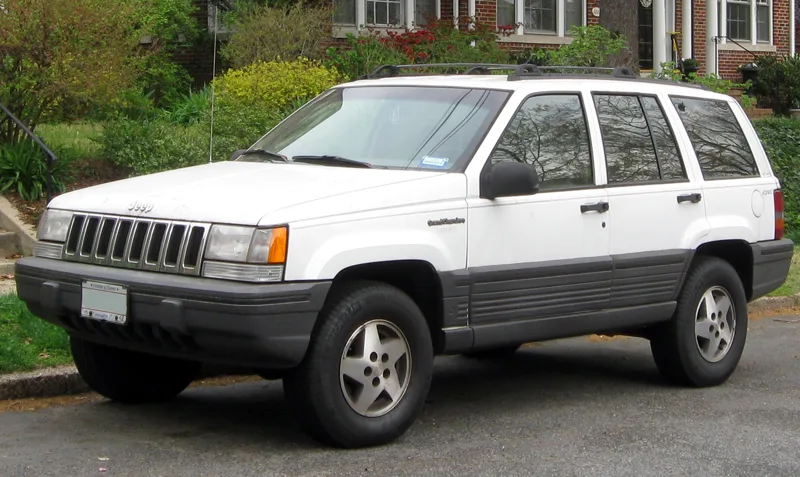
The ZJ, built from 1992 to 1998, launched with base (later called SE), Laredo and Limited trims, and Orvis and TSI versions followed. Its only engine at launch was a 4.0 L AMC-derived straight-six with 190 horsepower (193 PS; 142 kW). That fell to 185 horsepower (188 PS; 138 kW) in 1995, when new EPA rules applied.
The base model never had power windows or locks as standard, and low demand led to its discontinuation. The Laredo added power windows, cruise control and a leather-wrapped wheel. The Limited was the premium car, with leather seats, heated mirrors, keyless entry, a compass and a Jensen stereo with a multiband equaliser.
The transmissions began with the AW4 four-speed automatic, which the A500SE, later the 42RE, replaced during the 1993 model year. An Aisin AX15 manual was offered, but demand was low, so it was dropped after 1994. European ZJs kept it with the diesel, which was never sold in North America.
Heated seats arrived in 1996. The 5.2 L V8 became an option, and a 5.9 L V8 was added for 1998. Package groups brought fog lamps, skid plates and trailer-towing kits to the range.
What was the 5.9 Limited?
The 5.9 Limited arrived for the 1998 model year, carrying a 5.9 L OHV V8 rated at 245 horsepower (248 PS; 183 kW). Jeep advertised it as the world's fastest sport utility vehicle, a claim backed by third-party testing, and Petersen's 4-Wheel and Off-Road magazine named it 4x4 of the Year for 1998.
The package also brought functional heat-extracting hood louvers, a wide-slot grille with mesh inserts, a heavy-duty 46RE automatic and a 150-amp alternator with a two-speed electric fan. A 180-watt, ten-speaker Infinity Gold stereo and a soft-leather interior with calf's nap trim rounded it off.
Production was 14,286 units.
How did the WJ change the Grand Cherokee?
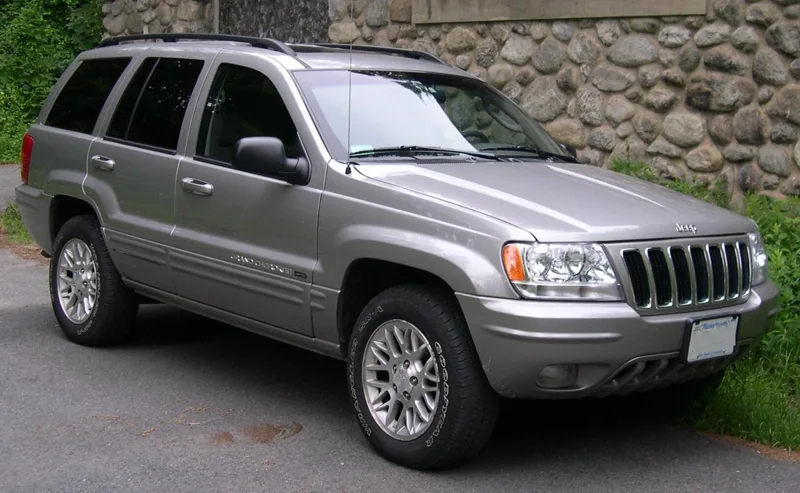
The second generation, the WJ for North America and WG in Europe, launched in September 1998. It shared just 127 parts with the ZJ, mostly fasteners, and it replaced the two pushrod V8s with Chrysler's new PowerTech V8. That engine made less torque, but it was lighter and more economical, with broadly similar on-road performance.
Quadra-Drive, an automatic four-wheel-drive option, used the NV247 transfer case. Its gerotor clutch pack moved torque to the front axle when the rear began to slip. The transfer case had 4-All Time, Neutral and 4-Lo modes, and in 4-Lo the axles were locked through a 2.72 reduction. Vari-Lok differentials sat at each end.
The 45RFE automatic had three planetary gear sets, which gave six theoretical ratios, yet only five were used. Chrysler still called it a four-speed. For MY 2001 the programming changed to use all six ratios, and 1999 and 2000 owners could have their programming updated.
The interior was redone with larger rear doors and more rear room. The Vehicle Information Center moved above the windshield, and a 10-CD changer was offered with the Infinity Audio package. UniFrame construction, developed with Porsche, mixed body-on-frame strength with a unitized build, and high-strength steel makes up over 70 percent of the underbody.
Grand Cherokee generations at a glance
| Generation | Years | Main engines | Notable change |
|---|---|---|---|
| ZJ (first) | 1993 model year to 1998 | 4.0 L straight-six, 5.2 L and 5.9 L V8 | Unibody debut, 5.9 Limited |
| WJ/WG (second) | 1999 to 2004 | PowerTech V8, straight-six | Quadra-Drive, UniFrame, 45RFE |
| WK (third) | 2005 to 2010 | 3.7 L V6, 5.7 L Hemi V8, 3.0 L diesel | Independent front suspension |
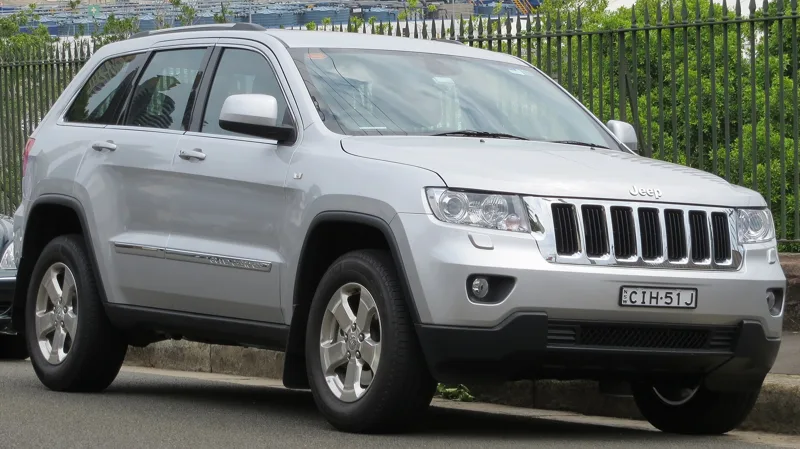
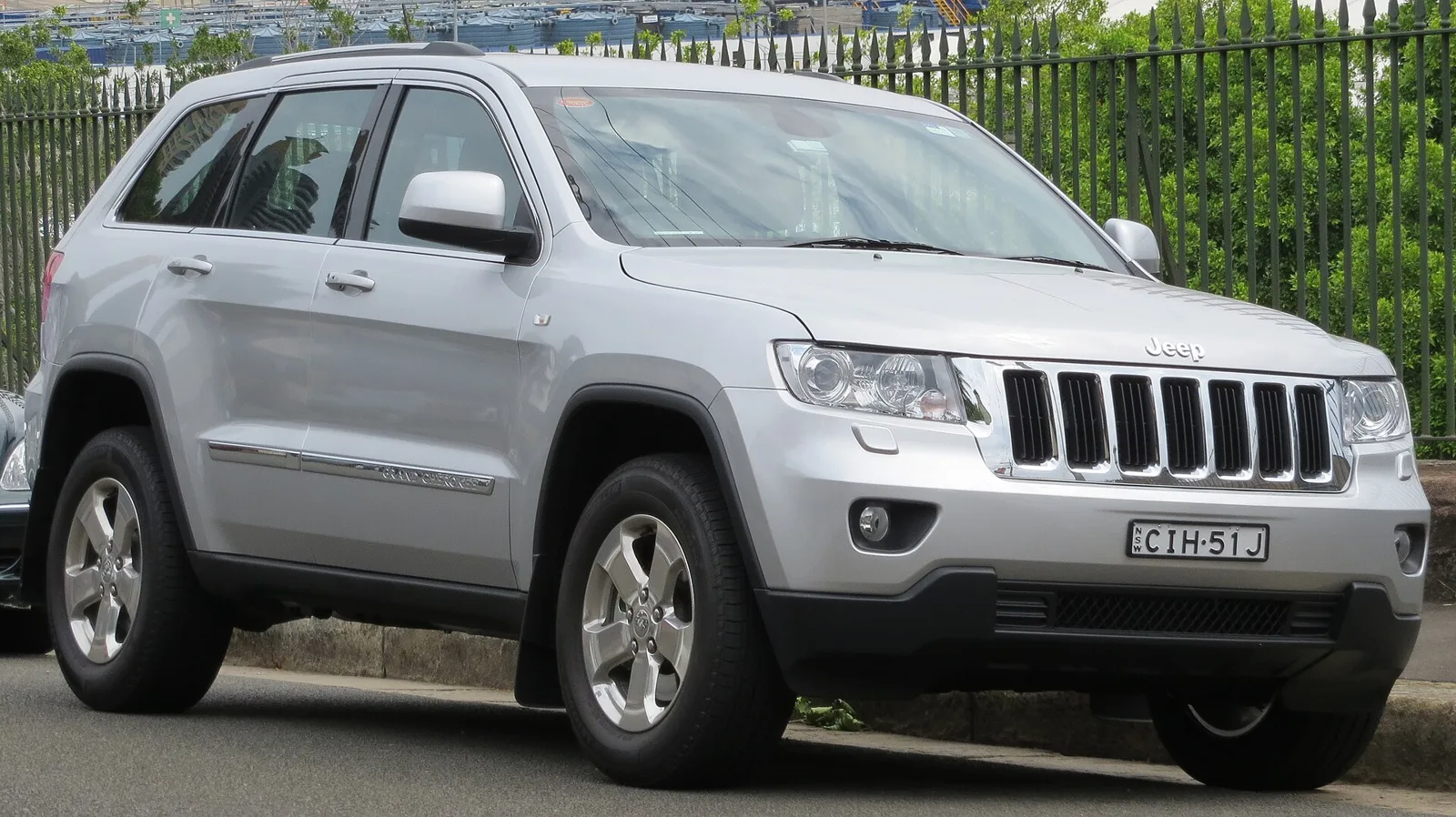
| WK2 (fourth) | 2011 to 2021 | 3.6 L Pentastar V6, 5.7 L Hemi V8 | Four-wheel independent suspension |
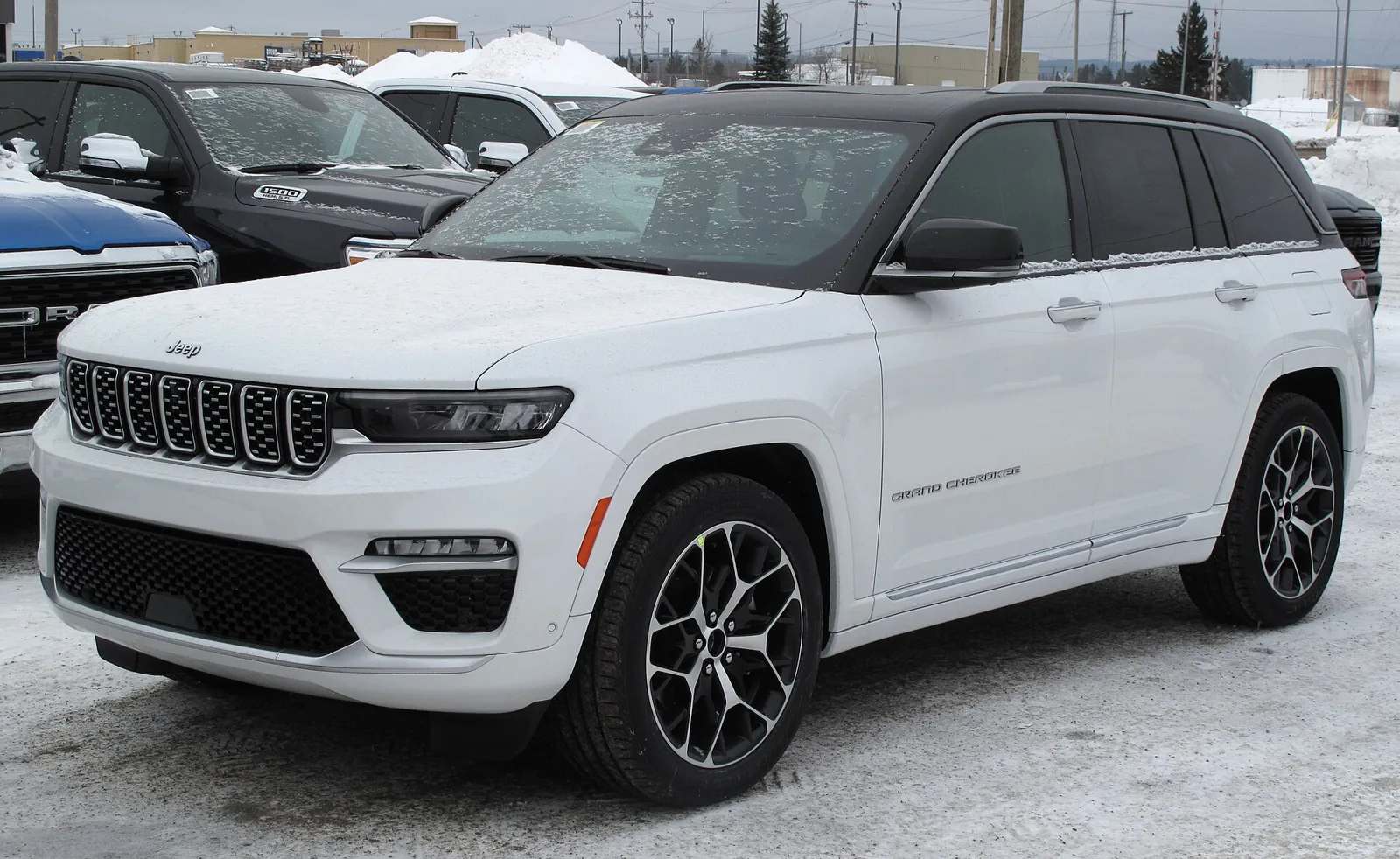
| WL (fifth) | 2021 onward | 3.6 L V6, 5.7 L Hemi V8, 2.0 L 4xe hybrid | Three-row Grand Cherokee L |
What did the WK bring?
The WK arrived in 2004 for the 2005 model year, shown first at the New York show with Quadra-Drive II four-wheel drive, a rear-seat DVD player and a 5.7 L Hemi V8 on the options list. The 3.7 L V6 replaced the 4.0 L straight-six, and the old live front axle gave way to independent double wishbones, as on the 2002 Liberty.
Buyers outside North America could also specify a 3.0 L V6 diesel from launch, a Mercedes-Benz design with common-rail injection. The WK earned four Euro NCAP stars in 2005 crash tests, and its European debut came at the Euro Camp Jeep in Ardeche, France, in 2007.
The 2008 facelift brought new headlights, optional high-intensity discharge lamps with auto-levelling and a refined 4.7 L engine. That unit made 309 PS (227 kW; 305 hp) and 334 lb ft (453 N m) of torque. For 2009 the 5.7 L Hemi reached 362 PS (266 kW; 357 hp), and torque of 527 N m (389 lb ft) came with variable valve timing.
What changed in the WK2?
The fourth generation, the WK2, reached showrooms in summer 2010 as a 2011 model, following its 2009 New York unveiling. Chrysler used it during development to persuade federal regulators to back a loan, and the company entered Chapter 11 reorganisation in the same year.
It kept a steel unibody but gained four-wheel independent suspension. The platform was Chrysler-designed, and Mercedes-Benz later adopted it for its W166 series. The Hemi models were rated to tow 7,400 pounds (3,357 kg), and Pentastar models 6,800 pounds (3,084 kg).
From mid-2011, export markets received a turbodiesel 3.0 L V6 from Fiat Powertrain Technologies and VM Motori, which produced 237 hp (241 PS; 177 kW). The SRT8 started production on July 16, 2011, with a 6.4 L Hemi V8 making 470 horsepower (350 kW; 477 PS). Jeep says fuel economy is 13 percent better than the car it replaces.
For the 2022 model year, Jeep sold the outgoing WK2 alongside the new WL under the Grand Cherokee WK name. That range was cut to Laredo E, Laredo X and Limited trims, and the only engine was the 3.6 L Pentastar V6.
What did the WL introduce?
Jeep first revealed the fifth-generation WL in its three-row guise, the L, on January 7, 2021. The shorter version followed on September 30, 2021. The L is built at the new Mack Avenue Assembly Complex in Detroit, while the two-row car stays at Jefferson North.
Three four-wheel-drive systems are offered: Quadra-Trac I, Quadra-Trac II with low range, and Quadra-Drive II with an electronic limited-slip differential and Quadra Lift air suspension, alongside rear-wheel drive. The WL towing limit is 7,200 pounds (3,300 kg) when properly equipped, and with Quadra Lift it can ford two feet (24 in) of water.
All engines pair with a ZF-sourced eight-speed automatic, operated by a rotary shift knob, and the Selec-Terrain system now uses a toggle switch in the centre console. The UConnect 5 infotainment suite offers a touchscreen of either 8.4 or 10.1 inches, wireless Apple CarPlay and Android Auto, and the Hey UConnect voice assistant.
The Grand Cherokee L reached showrooms in June 2021, and Mexico received it in September 2021, in Summit Reserve 4X4 trim only. Its wheelbase stretches 175 mm (6.9 in) beyond the previous two-row car. It also brings a McIntosh 950-watt, nineteen-speaker audio system in place of the earlier 825-watt Harman Kardon unit.
What powers the current Grand Cherokee?
The base engine is a 3.6 L Pentastar V6 that makes 290 hp (294 PS; 216 kW), with 257 lb ft (348 N m) of torque. The optional 5.7 L Hemi V8 uses Multi Displacement System cylinder deactivation, producing 268 kW (365 PS; 360 hp), with peak torque of 390 lb ft (529 N m). The V8 was not offered on the 2023 models.
The 4xe plug-in hybrid combines a 2.0 L turbo four with an electric motor and a 17 kWh battery pack. Together they make 375 hp (380 PS; 280 kW), plus 470 lb ft (637 N m) of torque, and the battery gives an estimated 25 miles (40 km) of electric range. The hybrid's trailer rating is 6,000 pounds (2,722 kg).
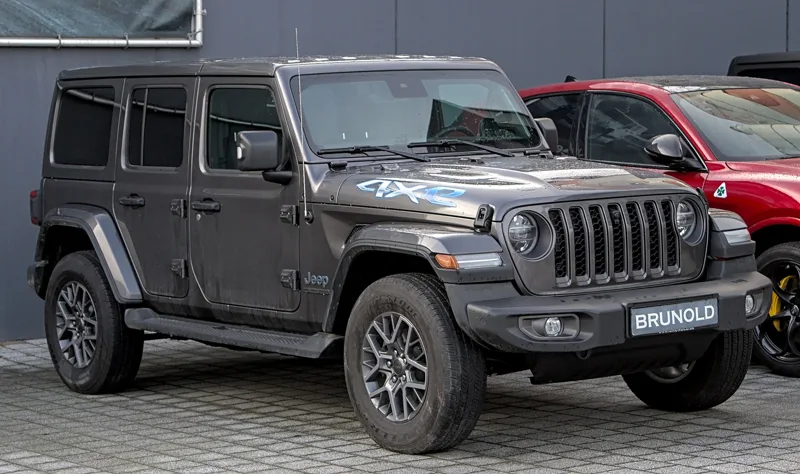
The 4xe first appeared in the Wrangler JL. From 2023 models, Trailhawk trim was available only as a 4xe plug-in. All engines use an eight-speed automatic, with Stellantis building the 850RE for the 3.6 L and ZF the 8HP70 for the 5.7 L.
What were the biggest recall campaigns?
The largest campaign began with a 2010 NHTSA investigation into 1993 to 2004 model year Grand Cherokees, whose rear fuel tanks could be compromised in collisions. NHTSA said it had reports of 157 deaths from fires in crashes of these vehicles, and about 5.1 million vehicles across several models were involved.
In June 2013 Chrysler agreed to recall 2.7 million Jeeps, though it removed the 1986 to 2001 Cherokee XJ and the 1999 to 2004 Grand Cherokee WJ from the campaign. The recall covered 1993 to 1998 ZJ and 2002 to 2007 Liberty KJ models, and the remedy was a trailer hitch that protects the tank in a rear impact.
Chrysler had argued that the vehicles were safe before the recall, citing its rates of fatal rear-impact fire crashes and compliance with FMVSS 301. Owners later reported that the transfer case in the WK models would not hold neutral or low range after the May 2013 software recall, and fewer than 10% of respondents in one survey had no problems afterwards.
In April 2016 the regulator ordered a recall of 2014 and 2015 Grand Cherokees, along with other models with electronic shifters, because the park position did not always hold. FCA was aware of 41 injuries that might be related. The final fix, Safety Recall S27 under NHTSA 16V-240, added an auto-park feature that engages park when a driver's door opens with the seatbelt unlatched.
Smaller campaigns followed. A July 2017 recall covered 2012 to 2014 models for alternator failure, and an October 2017 recall covered 2011 to 2014 models with improperly fitted brake shields. On February 25, 2022, a stop-sale order hit 2022 Grand Cherokee and L models after a radio frequency hub module stopped some key fobs working.