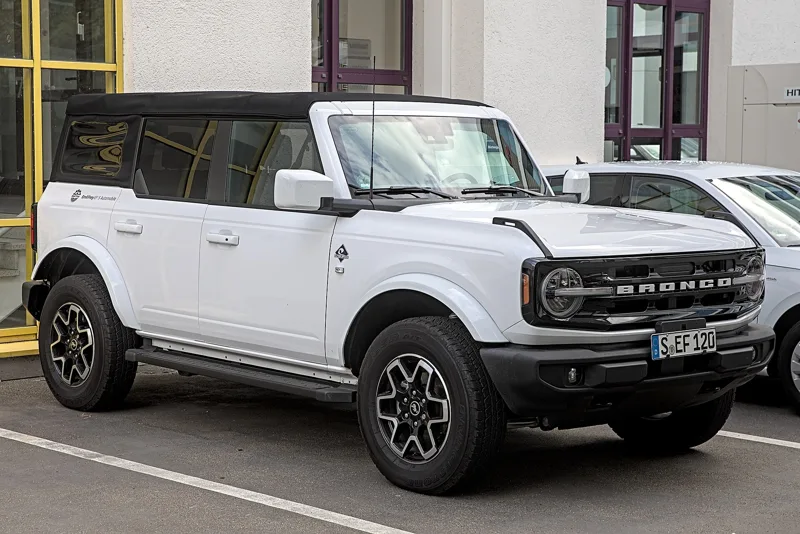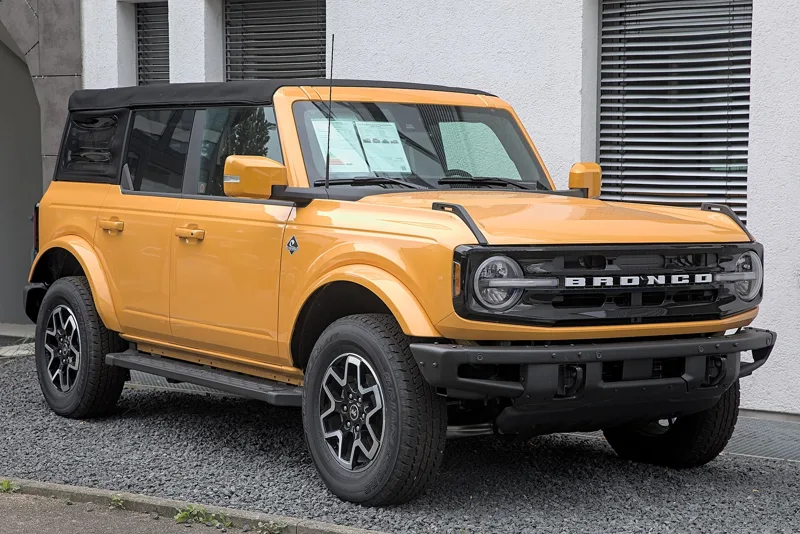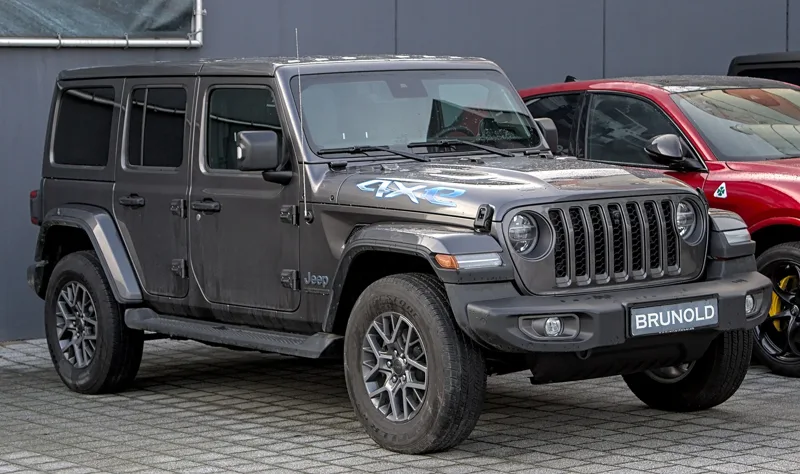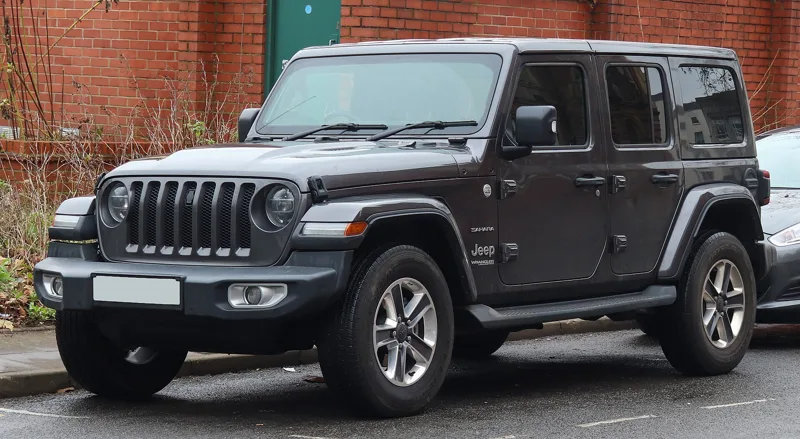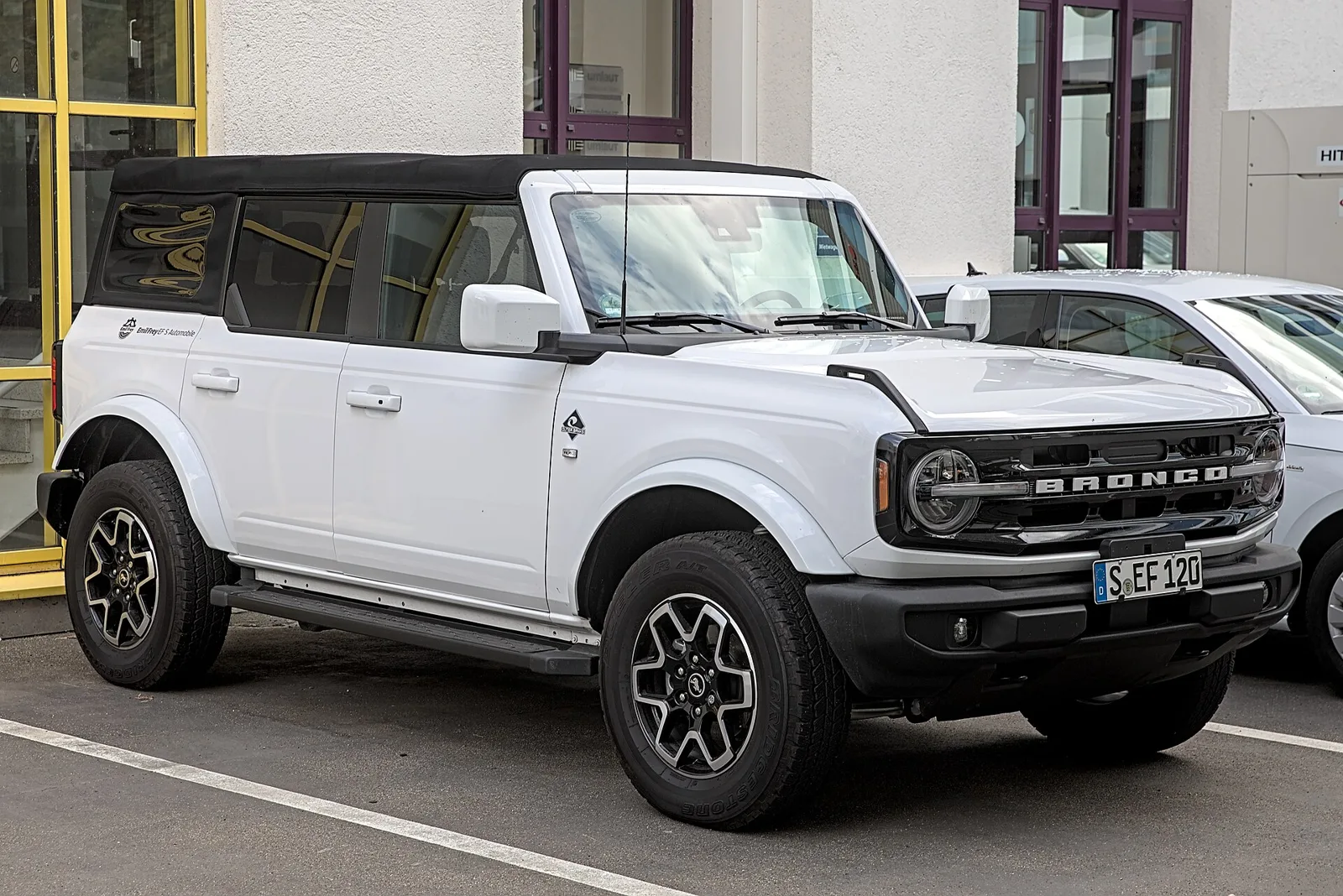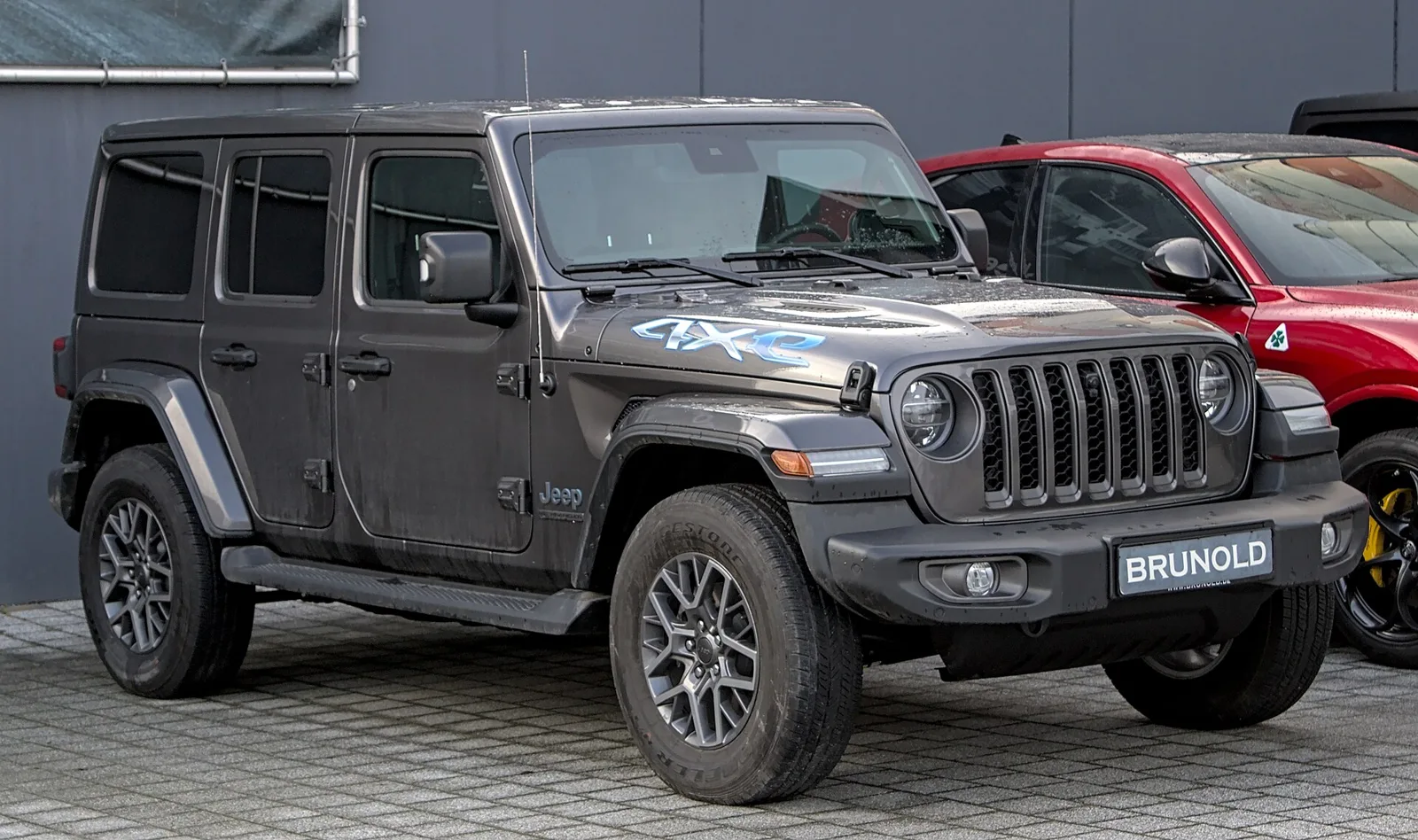
A 2017 Wrangler with a 470 hp V8 option, set against a Bronco whose first generation went on sale in 1965.
The Jeep Wrangler (JL) is a 2017 off-road SUV with a 3.6 L V6 as standard and a 470 hp Rubicon 392 V8 option. The Ford Bronco began in 1966, went through five generations and returned for 2021 as a mid-size two-door and full-size four-door that competes directly with the Wrangler.
The Jeep Wrangler (JL) and the Ford Bronco both sell as two-door and four-door off-road SUVs, and the sixth-generation Bronco competes with the Wrangler directly. The JL reached showrooms in 2017 with a range that runs from a V6 to a 470 hp V8. The Bronco has the longer story: its first generation went on sale in 1965, and the name carried through five generations before a break of 25 years.
Where did the Bronco come from?
Ford's Bronco began in the early 1960s with product manager Donald N. Frey, who had also conceived the Mustang. Engineer Paul G. Axelrad turned the idea into a vehicle, and Lee Iacocca approved the production model in February 1964. Ford pitched it against the Jeep CJ-5, the International Scout and the Toyota Land Cruiser.
The nameplate did not stop there. A Bronco II compact SUV sold from 1984 to 1990, a Bronco Sport compact crossover arrived in 2021, and a China-only Bronco New Energy followed in 2025. The original Bronco was built at Ford's Michigan Truck Plant in Wayne, Michigan, which also builds the sixth generation.
Two off-road SUVs: one with a 470 hp V8 option, the other with a racing history that started in 1965.
What did the Wrangler JL bring in 2017?
The modern Wrangler was revealed at the Los Angeles Auto Show on 29 November 2017. Unlimited four-doors began production that November, and two-door models followed in early 2018. Both were built at the Toledo Complex in Toledo, Ohio, where the outgoing JK kept building until April 27, 2018, so dealers could keep up with demand.
The front end is a raked grille cut into seven vertical slots, with round headlamps built into it, and Jeep moved its traditional logo off the grille. Underneath, the Wrangler kept body-on-frame construction and solid axles. Three four-wheel-drive setups were offered, called Command-Trac, Selec-Trac and Rock-Trac, and an anti-spin rear differential was optional on every model except the Rubicon.
The two-door is 2.5 inches (64 mm) longer than before, and the Unlimited is 3.5 inches (89 mm) longer. Even so, the JL weighs roughly 90 kilograms (198 lb) less than the outgoing JK. The front overhang measures 29.2 inches (740 mm) and the rear 40.8 inches (1,040 mm). The steering uses recirculating balls with electric assistance, a setup meant to make the JL more comfortable on the road.
What could you buy in the first Bronco?
The 1966 Bronco came as a wagon with two doors, as a half-cab pickup, or as an open-body roadster. Its base price was $2,194 (equivalent $22,415 in 2025), and standard equipment was thin. Buyers who wanted comfort ordered bucket seats, a tachometer or a rear bench, and the option list also ran to snowplows, winches and posthole diggers.
Economy shaped the design. The glass was flat, the bumpers were straight C-sections, and the door skins were symmetrical. Ford added a Sport package for the wagon in 1967, with chrome trim and red FORD grille lettering, and made it a freestanding model in 1970. The open roadster was dropped after the 1968 model year, and the half-cab left the range after 1972, by which time Ford sold the Courier compact pickup.
Under the hood sat a 170 cubic-inch inline six making 105 hp, an engine borrowed from the Ford Falcon. A 200 hp 289-cubic-inch V8 arrived in March 1966 and grew to 302 cubic inches for 1969. Every Bronco was four-wheel drive and rode on a 92-inch wheelbase. A three-speed manual was the only gearbox until 1973, when an automatic joined it as an option.
Why did the second Bronco become a full-size SUV?
For the 1978 model year Ford moved the Bronco onto the F-100 pickup chassis, adding 12 inches of wheelbase and entering the full-size SUV segment. The new car grew about 28 inches in length and 11 inches in width, and it gained 4 inches in height. Curb weight rose by between 1,100 and 1,600 pounds depending on the powertrain. Much of the body came from the F-100 as well, including the doors and the front of the roof. Ford gave the project the working name Project Shorthorn.
The move was aimed at the Chevrolet K5 Blazer and the Dodge Ramcharger, and it paid off. The second-generation Bronco overtook both in sales for the first time, and early demand was strong enough that buyers waited several months for their vehicles. Two V8s were offered, a 5.8 L 351M as standard and a 6.6 L 400 as an option. A catalytic converter was added to both for 1979.
Comfort features were new to the line, among them air conditioning, a radio and tilt steering. The front bench seated three, and folding the rear seat in gave six seats, a first for the model. Rectangular headlamps, introduced on the Ranger trim for 1978, were standard on every Bronco by 1979.
How did the Bronco race off-road?
Bill Stroppe, a race car builder, put together a Bronco team in 1965 for off-road endurance events. Working with Holman-Moody, the Stroppe/Holman/Moody entries ran in the Mint 400, the Baja 500 and the Mexican 1000, an event later renamed the Baja 1000. In 1969 the team returned with six Broncos for that Baja event.
Ford also sold a road-going version of that programme. The 1971 Baja Bronco package, marketed through dealers, brought quick-ratio power steering, an automatic transmission, fender flares covering Gates Commando tyres, a roll bar and reinforced bumpers. It was priced at $5,566 against $3,665 for a standard V8 Bronco, and just 650 were sold across four model years.
Drag racing had a go as well. A 1966 Bronco funny car, built by Doug Nash for the quarter-mile, ran a few times in the low 8-second range before sanctioning bodies barred pickups and aluminium frames and benched it.
What engines does the Wrangler offer?
The JL line-up starts with a 3.6 L Pentastar VVT V6 that makes 285 hp (213 kW; 289 PS), with 260 lb-ft (353 N m) of torque. It is standard on every model, with an Aisin AL6 six-speed manual as the default gearbox and an 850RE eight-speed automatic as the option. An eTorque mild hybrid system was offered as an option on the V6.
A 2.0 L turbocharged four-cylinder produces 270 hp (201 kW; 274 PS) and 295 lb-ft (400 N m), and it pairs only with the eight-speed automatic. Across Europe, China, Singapore and India it was the only petrol engine on sale. Jeep cancelled the 2.0 L eTorque hybrid in 2020.
In North America, a 3.0 L EcoDiesel V6 built by VM Motori arrived in 2020, rated at 260 hp (194 kW; 264 PS) and 600 N m (443 lb-ft). Elsewhere a 2.2 L Multijet II turbo diesel four is tuned to 200 hp (149 kW; 203 PS), with 450 N m (332 lb-ft).
The Wrangler 4xe plug-in hybrid appeared in 2021 with a 17 kWh battery and 375 hp (280 kW; 380 PS). Its battery-only range was put at 21 miles (34 km) by the EPA, which rated it 49 MPGe. Stellantis dropped the 4xe from the US market in 2025, citing weak sales and the loss of federal EV tax credits. The Rubicon 392, which debuted for the 2021 model year, is the most powerful Wrangler, with 470 hp (350 kW; 477 PS) from a HEMI V8 of 392 cu in (6.4 L).
How did the Wrangler perform in crash tests?
Euro NCAP awarded the JL one star in 2018. The IIHS result was harder to shrug off. In its 40-mph small overlap test in 2020, a four-door Unlimited hit the rigid barrier, its front axle tucked under the structure, and the vehicle rolled onto its side. The occupant structure held with minimal intrusion, and the dummy recorded only minor injury readings. The IIHS judged the risk of ejection too high and rated the Wrangler Marginal.
Jeep said the structure had been changed to prevent that outcome. A retest for the 2022 model overturned the vehicle again, despite some minor suspension changes, and it earned another Marginal rating. Side-impact airbags come as standard, the B-pillars were strengthened, and a blind spot monitor sits inside the taillight housing.
What changed on the Wrangler for 2024?
The 2024 model year brought a mid-cycle refresh. Every model received new tyre and wheel combinations, plus the grille that debuted on the Rubicon 20th Anniversary Edition of 2023. The Sport and Sport S trims stayed with the earlier grille. A new Rubicon X trim, offered on both body styles, gathered the equipment that had been optional on the Rubicon, which lost those features as standard.
Every Wrangler also gained a standard Uconnect 5 twelve-inch infotainment system. The refresh made 35-inch beadlock-capable tyres an option, and Jeep now officially supports 40-inch tyres.
What is inside the Wrangler?
The cabin takes its cues from the 1954-1983 CJ-5 and the 1987-1995 YJ. Most of the switchgear is unique to the JL. The steering wheel has three spokes in a retro style, and a colour instrument screen is available on upper trims. Luxury leather is standard on the MOAB and 392 trims, while heated front seats can be specified on every model.
Three Uconnect systems were offered, with screens of 5, 7 and 8.4 inches. Every model had a rear-view camera mounted on the spare tyre, which can be disconnected when the tyre is removed. Eight speakers come as standard, and a nine-speaker Alpine system is an option. Rear passengers get a 115 V AC outlet, and Unlimited models add rear USB charging ports.
Specifications side by side
| Feature | Jeep Wrangler (JL) | Ford Bronco |
|---|---|---|
| Generation in this comparison | Fourth, unveiled November 29, 2017 | Sixth, reintroduced for 2021 |
| Body styles | Two-door and four-door Unlimited | Two-door mid-size and four-door full-size |
| Construction | Body-on-frame with solid axles | Not listed |
| Four-wheel drive systems | Command-Trac, Selec-Trac and Rock-Trac | Not listed |
| Standard engine | 3.6 L Pentastar V6, 285 hp (213 kW; 289 PS) | Not listed |
| Most powerful engine | Rubicon 392 V8, 470 hp (350 kW; 477 PS) | Not listed |
| Gearboxes | Six-speed manual standard; eight-speed automatic optional | Not listed |
| Plug-in hybrid | 4xe, 375 hp (280 kW; 380 PS), 21 miles (34 km) EPA range | Not listed |
| Euro NCAP rating | 1 star (2018) | Not listed |
| Assembly plant | Toledo Complex, Toledo, Ohio | Michigan Truck Plant, Wayne, Michigan |
Which buyer suits which?
The Wrangler covers more ground in its engine range. Buyers can choose a manual or an automatic, a V6, a turbo four, two diesels, a plug-in hybrid or a 470 hp V8, although not every option reaches every market. Its awards add weight to that choice, including Motor Trend's SUV of the Year and J.D. Power's highest resale value in the compact SUV class.
The Bronco's case rests on lineage. The nameplate started with the 1966 original, passed through the full-size second generation of 1978, and returned in 2021 as a mid-size two-door with a full-size four-door alongside it. That four-door has a wheelbase 16 inches (41 cm) longer, which matters to anyone who wants the extra room of a full-size body.
Buyers who value motorsport history will find the Bronco's Baja record hard to ignore. Desert-racing entries from the 1960s and the 1971 Baja Bronco package put the Bronco in competition years before the JL was unveiled.
On the evidence covered here neither vehicle takes a clear lead. The Wrangler suits a buyer who wants a wide engine menu and a long list of awards. The Bronco suits one who wants a longer heritage and a choice between a mid-size two-door and a full-size four-door.