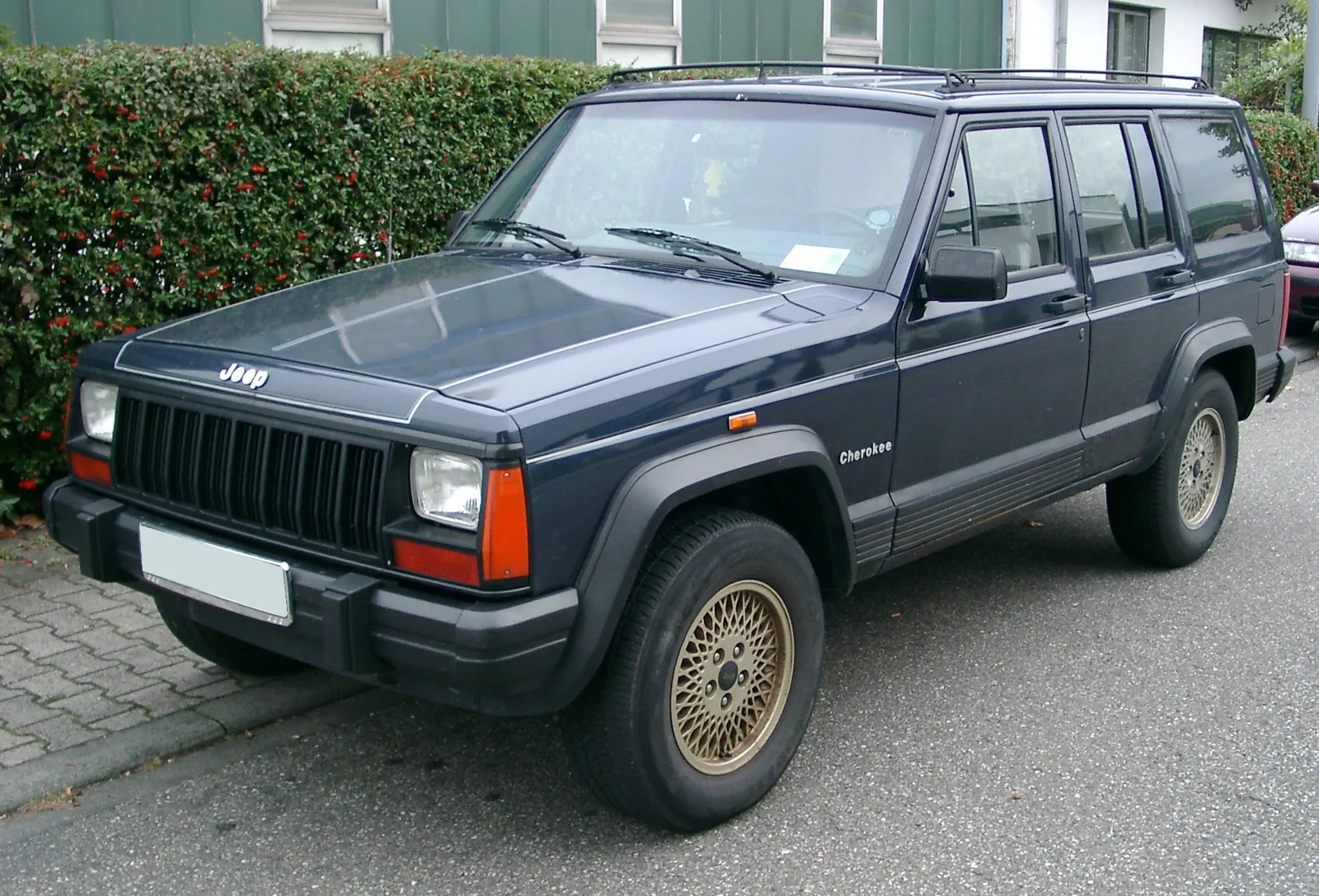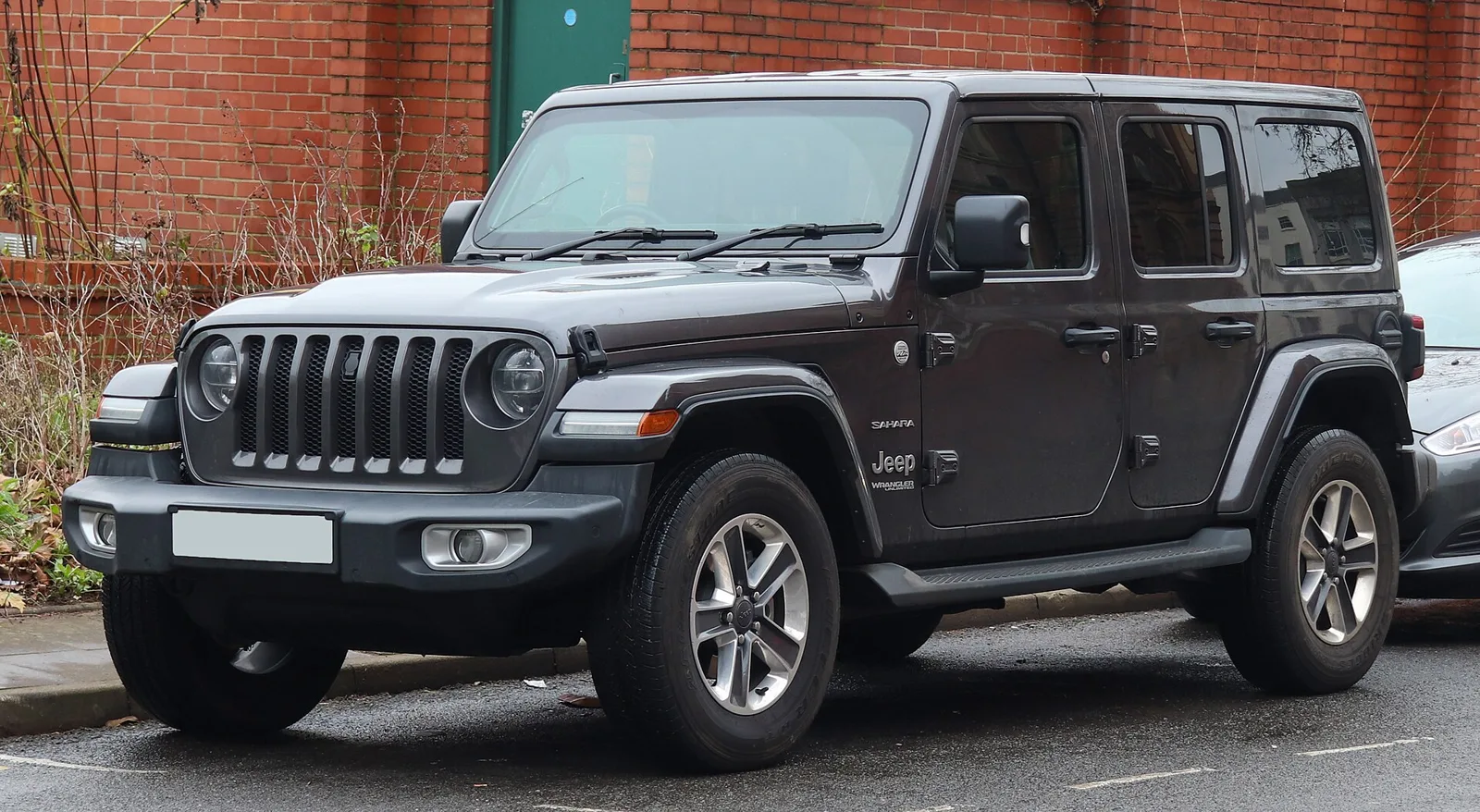
Four generations of a solid-axle recipe that has barely changed since the wartime Jeep, plus what off-roading is, its disciplines and the rules that shape it.
The Jeep Wrangler grew out of the wartime Jeep through the CJ line built by Willys, Kaiser-Jeep and AMC. The first Wrangler arrived in 1986 and is now in its fourth generation. Off-roading means driving on unpaved surfaces, from casual drives to competition.
By the middle of 2017, three out of every four new Jeep Wranglers sold had four doors. For a vehicle whose family line starts with a wartime military machine, that is a big shift in who is buying it, and the Wrangler was specifically redesigned to attract daily drivers.
The Wrangler's history runs from the CJ to the JL, and its natural habitat is off-roading, which covers everything from dune bashing to rock crawling.
How did the Jeep CJ become the Wrangler?
The Wrangler traces back to the Second World War Jeep. In between sat the CJ, short for Civilian Jeeps, built first by Willys, then by Kaiser-Jeep, and finally by American Motors Corporation (AMC), across a span from the mid-1940s into the 1980s. Chrysler bought AMC in 1987.
Neither AMC nor Chrysler has claimed the Wrangler descends directly from the original military model. Even so, the CJ and the Wrangler share a concept of solid axles and an open top, and the pair have been called as central to Jeep's identity as the rear-engined 911 is to Porsche.
Neither AMC nor Chrysler ever called the Wrangler a direct descendant of the wartime Jeep, yet the family resemblance has never been in doubt.
What has stayed the same across Wrangler generations?
Quite a lot. Like the Willys MB and the CJs, every Wrangler keeps a separate body and frame and rigid live axles at both ends. The nose tapers, the fenders are flared, the windshield folds flat and the vehicle can be driven without its doors. With few exceptions it has a part-time four-wheel-drive system with a choice of high and low gearing, plus an open body with a removable hard or soft top.
What changed was comfort. The Wrangler was redesigned to be safer and more pleasant on the road, to attract buyers who would drive it every day, with better suspension, drivetrain and interior than the CJ line. Every Wrangler has trackbars and anti-roll bars, and the 1997 TJ was the point where coil springs at both ends took over from leaf springs.
Jeep Wrangler generations, one at a time
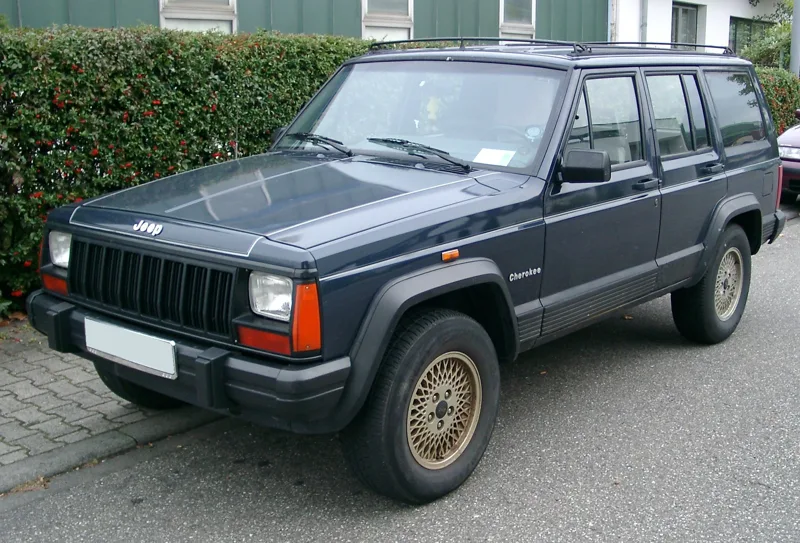
YJ, 1986 to 1995
The first Wrangler made its official debut at the 1986 Chicago Auto Show, in February. Outwardly it looked like a Jeep CJ-7, but Francois Castaing, AMC's vice president of product engineering, said the product philosophy behind the two was completely different. It went on sale on 13 May 1986 as a 1987 model. AMC, then controlled by Renault, had developed it, though by August 1987 it was under Chrysler.
Against the CJ-7, the YJ offered a wider track, a little less ground clearance and better handling and comfort. It kept the part-time four-wheel drive, rigid axles on leaf springs and the open body on a separate frame, on the same wheelbase. The springs were wider, though, and the trackbar links and anti-roll bars made it less likely to roll in the hands of untrained or unwary drivers. Rectangular headlights, a break from the CJ's round ones, lasted until 1995.
Production ran at Brampton Assembly in Canada and later at Toledo South Assembly. In Egypt the YJ was built in short and long-wheelbase forms, the two-door long version being called the LJ.
TJ, 1997 to 2006
Introduced in 1996 as a 1997 model, the TJ brought back round headlamps. The main engine was the AMC 242 4.0-litre inline-six, coil springs replaced leaf springs, and the automatic shifter moved to the floor. A long-wheelbase Unlimited followed in 2004. From 2006 Israeli Automotive Industries built the first five-door Wrangler derivative, under licence from Chrysler for the Israeli military, using a TJ stretched to a 2,931 mm (115.4 in) wheelbase. The long-wheelbase version continued as the TJL, also known as the J8, which inspired the JK's four-door.
JK, 2007 to 2018
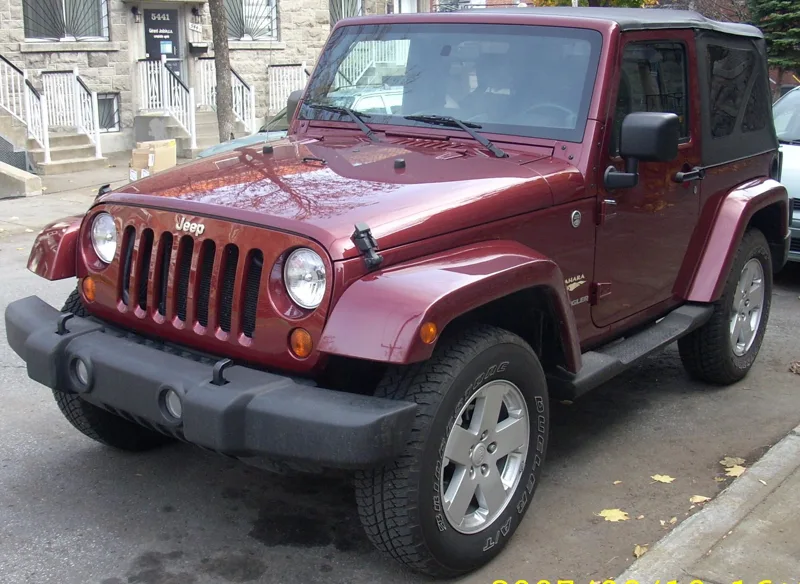
The third generation was released in 2006 for the 2007 model year under DaimlerChrysler. It was the first Wrangler whose body, frame and suspension were all clean-sheet designs. The JK added power windows, remote central locking, navigation and, on some models, sway bars that can be electronically disconnected.
Alongside the traditional two-door came a four-door Unlimited with a wheelbase more than 20 in (51 cm) longer, giving considerably more room. These sold well, as the three-quarters figure shows. Production moved to Toledo Complex in 2006, and post-2006 grilles are set apart by their angle, which shortens the bonnet and lengthens the fenders. In 2011 Jeep partnered with Activision for a special Modern Warfare 3 edition based on the Rubicon, on sale from November 2011.
JL, 2018 onwards
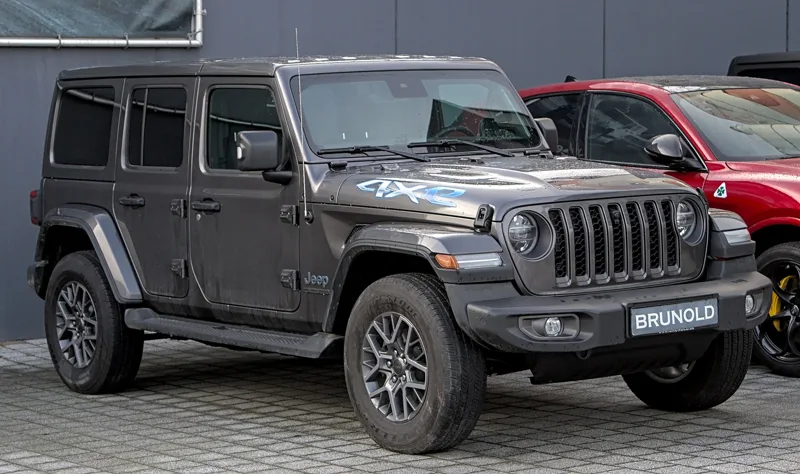
The JL arrived in late 2017, as a 2018 model, with powertrains beyond the Pentastar V6, an 8-speed automatic, a windshield that folds flat more easily, zipperless soft tops, blind-spot monitoring and a backup camera. The 2018 engines were a 2.0-litre turbocharged four rated at 270 hp (201 kW; 274 PS), torque 295 lb ft (400 N.m; 41 kg.m), and the 3.6-litre Pentastar V6 giving 285 hp (213 kW; 289 PS) with 260 lb ft (353 N.m; 36 kg.m) of twist. A 2.2-litre turbodiesel four came first in Europe, then to North America from 2020.
The Rubicon 392, released in the third quarter of 2021, is the most powerful JL built. Its 6.4L Hemi V8 makes 470 hp (350 kW; 477 PS) with torque of 470 lb ft (637 N.m; 65 kg.m), and Jeep says it covers the quarter mile in 13.0 seconds and reaches 60 mph in 4.5 seconds. The Wrangler-based Gladiator pickup began production in 2019 for the 2020 model year.
| Generation | Years | Springs | Headlamps | Notable change |
|---|---|---|---|---|
| YJ | 1986 to 1995 | Leaf | Rectangular | Wider track, trackbar links and anti-roll bars |
| TJ | 1997 to 2006 | Coil | Round | Floor-mounted automatic shifter, Unlimited from 2004 |
| JK | 2007 to 2018 | Coil | Round | Clean-sheet body, frame and suspension; four-door Unlimited |
| JL | 2018 onwards | Coil | Round | Added powertrains, 8-speed automatic, zipperless soft tops |
How far has electric power got in the Wrangler?
In September 2008 Chrysler vice-chairman Tom LaSorda unveiled a range-extended electric four-door Wrangler, which would run 40 miles (64 km) on battery before an engine started supplying more electricity. The production answer arrived for the 2021 model year as the Wrangler 4xe, a plug-in hybrid using Jeep's 2.0-litre turbocharged four. Its battery is 17 kWh with 15 kWh usable. Its all-electric range is put at an estimated 25 miles (40 km) by one account and 21 mi (34 km) per charge by another.
Jeep also built concepts. The Magneto of early 2021 put a battery-electric powertrain into a slightly modified two-door JL, with a 2 in (51 mm) lift kit, 17-inch black wheels, 35 in (890 mm) mud-terrain tyres, a roll cage, rock rails, steel bumpers, a winch and an underbody skid of steel. In April 2022 the Magneto 2.0 added a new power calibration that Jeep calls "electronic nitrous oxide", holding peak power for up to 10 seconds. Torque tops out at 850 lb ft (1,150 N.m; 118 kg.m) and output is rated at 625 horsepower, with 0-60 mph in 2 seconds.
What awards and records has the Wrangler collected?
Resale value is the pattern. Kelley Blue Book gave the Wrangler its Best Resale Value Award in the sport utility category in 2009, and in the compact category for 2012 and 2013. It also holds that firm's Models to Best Hold Its Value recognition for 1998, 1999, 2003, 2011 and 2012. Canadian Black Book gave it its Best Retained Value Award for 2011, 2012 and 2013, and in a 2018 iSeeCars.com study the Wrangler lost less value over five years than any other vehicle.
The 2007 Guinness World Record for highest altitude reached by a four-wheeled vehicle went to two Wrangler Rubicon Unlimiteds, which carried Matthias Jeschke and his Extreme Events team up Ojos del Salado in Chile, the highest volcano on Earth. The trek from base camp ran from 7 to 13 March and ended at 6,646 metres (21,804 ft). Four Wheeler named the Wrangler its Four-Wheeler of the Year in 2007 and for 2013, and Petersen's 4-Wheel & Off-Road gave it 4x4 of the Year in 1997, 2007 and 2012.
What is off roading?
Off-roading means taking a vehicle onto ground that has not been paved: sand, dirt, gravel, riverbeds, mud, snow and rocks. It spans everything from a casual drive in an ordinary vehicle to competitive events with customised machines and skilled drivers.
Vehicles built or adapted for it often carry suspension lifts, off-road tyres, skid plates and snorkels, along with roll cages or reinforced drivetrains. The recovery kit is simple but important: recovery boards, a high lift jack and a snatch strap.
What does each kind of off-roading ask of a car?
Sand and dunes
Dune bashing is off-roading on sand dunes, usually in dune buggies, SUVs or ATVs, often with a roll cage in case of an overturn. Drivers let air out of the tyres, which widens the footprint and lowers ground pressure, the same idea as snowshoes keeping a walker from sinking. Some vehicles carry beadlock wheels so pressure can fall further without the tyre parting from the rim. Entering the desert, drivers customarily join a pack under a group leader, who takes the convoy through in single file so nobody gets disoriented and lost.
Mud
Mudding means driving through wet mud or clay where traction is extremely low, trying to go as far as possible without getting stuck. Balloon, mud-terrain and paddle tyres are common. It is popular in the United States, though illegal on public land because of the environmental impact. In the United Kingdom, mud plugging refers to classic trials, where the aim is to finish a hard course of mostly unpaved, often muddy and frequently uphill terrain. It is one of the oldest forms of motorsport still running, going back at least to the 1920s.
Rocks
Rock crawling is about getting as far as possible over rocky ground with the fewest penalties, which come from hitting cones, winching free, leaving the boundary or going backwards. That makes the sport technical and rewards planning. Crawlers are usually altered with different tyres, suspension parts that allow more axle articulation and changes to the differential ratio for low-speed work, and often have a spotter on foot who sees what the driver cannot. Rock racing differs by allowing winching and reversing without penalty and adding high-speed sections.
Deserts and trials
Desert racing is flat out through rough terrain full of bumps and holes, so drivers use trucks that are rear-drive or four-wheel-drive, with a wide stance and suspension that travels a long way, often known as Trophy trucks or PreRunners.
Competitive trials work the opposite way, at low speed, with skill valued above finishing first. RTV (Road Taxed Vehicle) trials are for road-legal vehicles, run on farmland, in quarries or at dedicated centres, and the course is 10 to 12 gates, each marked by two vertical canes. A vehicle clears a gate if a front wheel hub passes between the canes. Failing Section 1 scores 10 points, ending in Section 2 scores 9, and a clear round scores 1, so the lowest total wins. Skill and experience count for more than a well-equipped vehicle.
CCV (Cross Country Vehicle) trials are open to non-road-legal vehicles on harder ground, with an anything-goes attitude. Competitors build machines with powerful engines and high ground clearance, plus light bodywork and generous approach and departure angles. For years the ultimate UK recipe was a Range Rover chassis cut to an 80-inch wheelbase under a Series I Land Rover body, keeping the V8 and coil springs. Rising values have ended that, and builders now start from Land Rover Defenders or a 100-inch chassis. Roll cages, front and rear recovery points, compliant fuel tanks and a 4-point harness for each occupant are required.
Endurance events
In some countries off-road activity is tightly regulated, while others promote cross-country events. The Dakar Rally, King of the Hammers and the Baja 500 and 1000 sit alongside the Africa Eco Race, Abu Dhabi Desert Challenge, Spanish Baja, San Felipe 250 and the Russian Baja Northern Forest, all of them tests of navigation and mechanical durability. Dedicated off-road parks and motocross circuits also stage events, and in some areas they are the only lawful ground.
What are the objections to off-road driving?
Some members of the US government and environmental groups such as the Sierra Club and The Wilderness Society, have criticised off-road vehicle use on public land, citing pollution, trail damage, erosion, land degradation and habitat destruction. Supporters argue that legal use under planned access, together with conservation work by their own groups, addresses the problems, and the BlueRibbon Coalition promotes responsible use. Noise is another concern: studies by Montana State University, California State University and the University of Florida, among others, have linked some off-road use to behaviour changes in wildlife, and Washington State requires noise-muffling devices.
In the Mojave Desert, where the Bureau of Land Management oversees large off-road areas, US District Judge Susan Illston ruled in 2009 against the bureau's designation of about 5,000 miles (8,000 km) of vehicle routes made in 2006. She found it had not examined a reasonable range of alternatives, nor adequately studied the impact on air quality, soils, plants and sensitive species, including the endangered Mojave fringe-toed lizard.
What does this mean for someone buying or driving a Wrangler?
The Wrangler's recipe lines up neatly with what the disciplines reward: live axles, part-time four-wheel drive with low gearing and a body that comes apart.
For buyers, the strongest evidence in the record is financial. The resale awards and the depreciation study point to a vehicle that holds its value, and the generation differences tell you which layout, headlamp and suspension you are looking at. The spread of engines from the 2018 turbo four to the 392 V8 and the 4xe means the same body can serve very different uses.