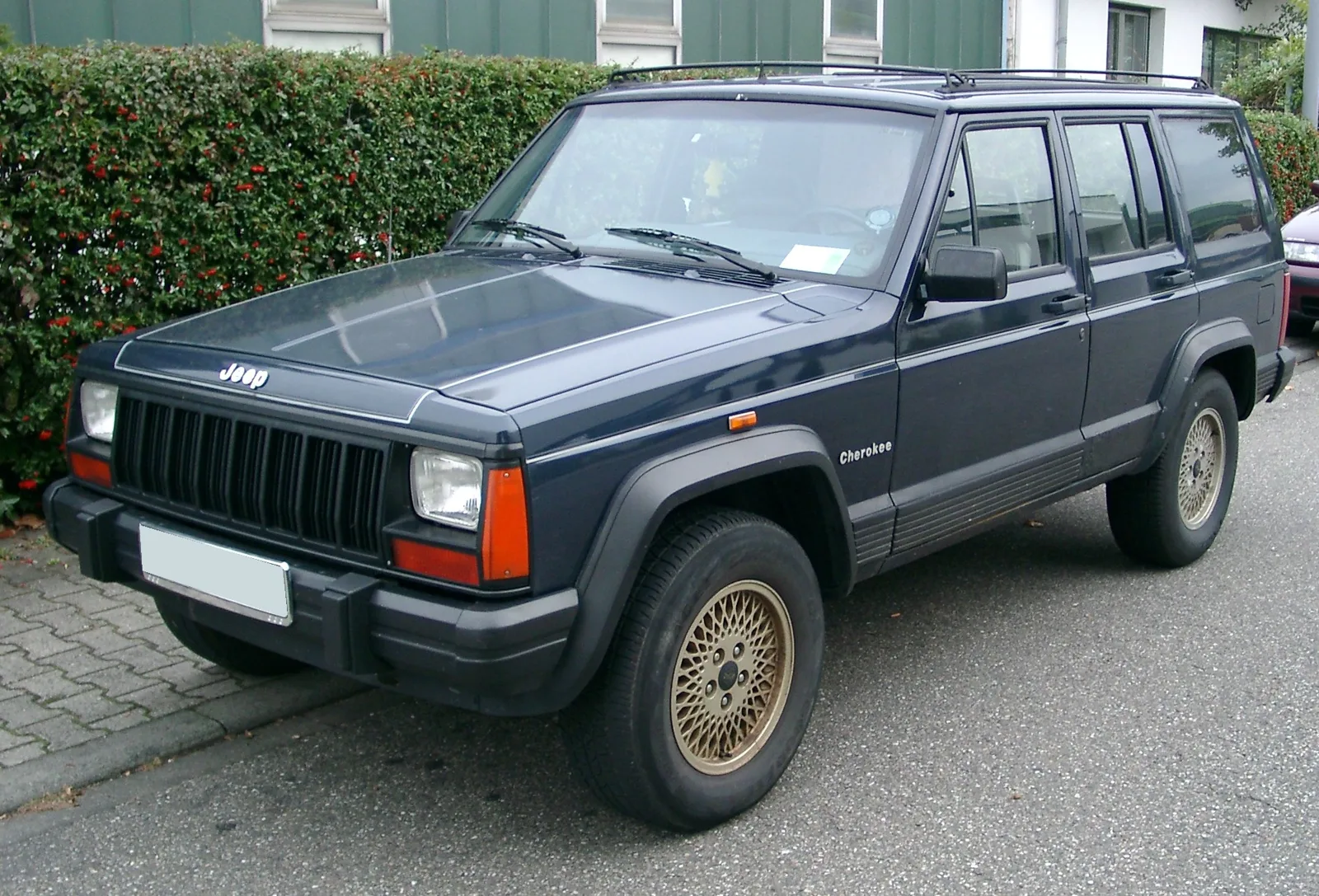
American Motors' compact unibody Cherokee arrived in 1983, carried Jeep off-roading into a new shape and stayed on sale in the United States until 2001.
The Jeep Cherokee XJ was a unibody sport utility vehicle built by American Motors and sold by Jeep from 1983 to 2001 in the United States. It was 1,200 pounds lighter than the SJ it replaced, came with four- and six-cylinder engines and was sold globally until 2014.
The Jeep Cherokee XJ was a sport utility vehicle developed by American Motors and sold by Jeep in the United States from 1983, as the 1984 model year, until 2001. Its unibody structure made it lighter and shorter than the full-size model it replaced, and it kept selling in other markets through 2014. It is widely credited with starting the modern SUV boom.
When did the Jeep Cherokee XJ go on sale?
The XJ arrived as the 1984 model year after American Motors began work on a replacement in the late 1970s. It was meant to replace the full-size SJ Cherokee with a more compact vehicle, following reports that General Motors and Ford were planning similar downsizing for their utility vehicles.
Renault had a strong hand in the project. Its 1979 acquisition of a 22% stake in AMC pushed the design towards a smaller footprint, less weight, better fuel efficiency and improved ergonomics. The early styling proposals showed a distinctly European influence, conceived mainly by AMC engineers under design vice president Dick Teague.
American Motors committed $250 million to the XJ's design and production. Its strategy held that the compact SUV was where American motoring was heading, and the XJ was the bet that tested the idea.
A unibody Jeep that made the compact SUV the future and kept off-roaders loyal for almost two decades.
Why was the XJ such a big change?
The XJ was a unibody vehicle, meaning the body and frame formed one integrated structure. That made it far lighter and shorter than the SJ it replaced, yet the interior still offered close to the same room. It was also the first American off-road vehicle built this way, which made it a landmark for the whole segment.
The numbers were striking. The XJ weighed 1,200 pounds less than the SJ, measured 31 inches shorter, six inches narrower and four inches lower, and kept 90 percent of its predecessor's interior volume. Fuel economy improved sharply, and articulation, ground clearance and approach, departure and breakover angles all got better as well.
Roy Lunn, American Motors' vice president of engineering, created the Quadra-Link suspension to reduce the risk of rollover. Renault's Francois Castaing developed a drivetrain that used a much smaller engine than 4WD vehicles usually carried. Together these choices gave the XJ its character.
What engines and drivetrain did the XJ use?
At launch the XJ used AMC's 2.5 L four-cylinder engine, with a 4.0 L inline six offered as the stronger option. Later came a 2.1 L diesel and a 2.8 L V6, and a VM Motori 2.5 L turbodiesel reached Europe in 1995. The Command-Trac system was standard on the 4WD models.
Transmissions came from Borg-Warner and Aisin-Warner across the years, with four- and five-speed manuals and three- and four-speed automatics. Manual gearboxes were matched to particular engines, and the automatic choice depended on the engine fitted.
The axles were live beam units rather than independent suspension, a choice that helped off-road capability at some cost in on-road comfort. The front used a Dana 30, while the rear used a Dana 35 or Dana 44 depending on the year. Gear ratios ran from 3.07:1 to 4.56:1, so buyers could pick a setup for towing or for economy.
Suspension was coil-sprung at the front and leaf-sprung at the rear. The front Quadra-Link layout used four leading control arms and a track bar, with two coil springs on the axle housing and a sway bar to reduce body roll. The rear used four-leaf packs with gas-charged shock absorbers.
How did the XJ change between 1984 and 1996?
The 1984 XJ was the first Jeep whose ladder-style frame was merged into one monocoque shell, rather than bolted to a separate body. In mid-1985 a two-wheel drive version joined the range, the first Jeep product offered in two-wheel drive since 1967. In 1996 the engine management moved to Chrysler's JTEC system to meet OBD-II rules.
Two- and four-door models shared track and wheelbase dimensions. The two-door had longer doors and front seats that folded forward for rear passengers, and its extended rear windows did not open, although some had a vent window. The body carried around 3,200 welds, which helped its rigidity despite the light weight.
Two-wheel drive models used the same suspension and steering as the four-wheel versions, with a single axle tube running hub to hub. That meant no front differential and no transfer case, which kept the cost of the front end low.
American Motors had been preparing a larger successor, the ZJ, but the compact model kept selling well and Chrysler executives rethought the plan. The ZJ arrived in 1993 as the Grand Cherokee, while the XJ stayed in production until 2001.
What was the Wagoneer version?
The Wagoneer was a variation on the Cherokee sold from 1983 until 1990, with the Wagoneer Base trim discontinued after the 1987 model year. It was unrelated to the full-size Grand Wagoneer, and AMC considered it a separate model rather than part of the Cherokee series.
The Wagoneer Limited came with vinyl wood trim on the sides, cloth seats with leather bolsters and the word Limited embossed on the seat backs. Standard equipment included air conditioning, cruise control, power disc brakes, a rear window wiper and washer, and an adjustable steering wheel.
Early Wagoneers from 1983 to 1985 wore a different grille, and their small Jeep badge sat on the driver's side. For 1986 the sealed beam headlamps gave way to stacked quad headlights, and the front indicators moved behind the grille.
Why did police and fleet buyers adopt the XJ?
In the early to mid-nineties the Cherokee became popular with government and police users. The Cherokee AHB police package arrived in the 1992 model year, and from 1996 Jeep sold a special SE version for police and fleet work. It lost its interior rear door handles and gained a high-output engine.
That fleet engine was a 190 hp (142 kW) version of the 4.0 L Power-Tech six, replacing the earlier 177 hp (132 kW) unit in all installations. By 1997 the Special Service Package produced 195 hp (145 kW), and it stayed in production through the 2001 model year.
The Cherokee was also built in right-hand drive, initially for the United States Postal Service. That capability let Jeep enter right-hand drive markets, and the Cherokee went on sale in the United Kingdom and Ireland in 1993. Many Japanese-market examples later came back to the United States for rural mail carriers, because Japan's Shaken inspection rules were strict.
How did the XJ end its run from 1997 to 2001?
After 13 years of production, 1997 brought updated exterior and interior styling. The steel liftgate replaced the fiberglass one, the taillights were restyled, and a new front header panel gave the car more aerodynamic styling. The interior received an all-new design and instrument panel.
The new instrument panel used the first blow-molded symmetrical retainer structure, and a beeper replaced the buzzer. A stiffer unibody frame and new door seals improved noise, vibration and harshness, and reduced wind noise at higher speeds.
A new spare tire carrier was designed by Peter Gruich while working for Jeep Special Programs. It used the trailer hitch bar and a pivot bracket, and although it was the only external carrier to pass the full Jeep durability test, it was never sold.
In mid-1999 the 4.0 L engine received a revised intake manifold to offset smaller exhaust porting on newer cylinder heads, which had been changed for tighter emissions rules. For 2000 and 2001 the six-cylinder cars used coil-on-plug ignition, which gave a small gain in power and better emissions. The straight six was the only engine offered in 2001.
Major change was also underway at the top. Wolfgang Bernhard arrived from Mercedes-Benz as a cost cutter and helped end the Jeep Cherokee line. The XJ was replaced in 2001 by the Jeep Liberty (KJ), which carried the Cherokee name to ride on the XJ's success in most foreign markets.
US production ended in June 2001, and the part of the Toledo South Assembly Plant devoted to the XJ was torn down afterwards.
How did the XJ reach European buyers?
The XJ reached left-hand drive European markets in 1985, a year after its American debut, but the strong dollar kept sales low at first. Switzerland's import organisation began in 1988, France followed in 1989 through Renault, and right-hand drive markets received the car from 1993.
Early European cars used the 4.0 L six. From 1995 European models added a 2.5 L petrol engine and the VM Motori turbodiesel alongside the earlier 2.1 L diesel, which widened the choice considerably for buyers.
Much of the European trade ran through Renault's network, and some marketing used the phrase Renault Jeep Cherokee, although no production car carried Renault badges. Motorsport versions that competed in the Dakar Rally did wear Renault badges.
A van variant was offered in some European markets to suit relaxed tax rules for commercial vehicles. It swapped the rear side glass for metal panels, dropped the rear seats and offered a flat load area, with two- and four-wheel drive options.
What happened to the XJ in China?
AMC started the first car joint venture on Chinese soil, building the four-door Cherokee there, and output carried on after Chrysler bought the company. The BJ2021 four-wheel drive and BJ7250 rear-wheel drive models had a raised rear roof, as they were often meant to be chauffeur-driven.
The BJ2021 used a 2.5 L engine with a four-speed manual from the 1985 through 2005 model years. A 4 L six paired with a five-speed manual was available for 1993. The BJ2021 measured 4290 mm long, 1800 mm wide and 1620 mm high on a 2580 mm wheelbase, while the BJ7250 was 90 millimeters shorter and 40 millimeters narrower.
Production under Mercedes-Benz continued in the partnership renamed Beijing-Benz DaimlerChrysler Automotive. The last model, known as the Jeep 2500, was built until 2005 with a new grille, headlights and tail lamps. After 2009 Beijing Auto Works built the BAW Qishi, and production ended in 2014.
A copy from Shuanghuan, the SHZJ213, used the BJ212 platform and a 2.4 L BAW engine with a five-speed manual. It ran from 1994 to 1997, and other Chinese firms made clones of the four-door Cherokee as well as pickup versions.
Trim levels and specifications at a glance
| Trim | Years | Notable equipment |
|---|---|---|
| Base | 1984 to 1993 | Vinyl or cloth upholstery, steel wheels, AM radio |
| SE | 1994 to 2001 | Replaced Base in 1994; only trim for the two-door in later years |
| Chief and Pioneer | 1984 to 1990 | Cloth plaid-pattern upholstery, AM/FM or AM radio |
| Wagoneer | 1984 to 1990 | Ribbed cloth with leather trim, alloy wheels, air conditioning |
| Laredo | 1985 to 1992 | Chrome accenting, alloy wheels, dual power seats |
| Limited | 1987 to 1992 and 1998 to 2001 | Monotone paint, leather-and-vinyl seats, lace-spoke wheels |
| Sport | 1988 to 2001 | Cloth-and-vinyl upholstery, optional alloy wheels, air conditioning |
| Briarwood | 1991 to 1992 | Succeeded Wagoneer; faux maple interior accents |
| Country | 1993 to 1997 | Two-tone paint, lace-spoke wheels, optional overhead console |
| Classic | 1996 and 1998 to 2001 | Monotone paint, 16-inch alloy wheels, overhead console |
| Orvis | 1999 to 2000 | Limited production, UK only; Infinity audio, leather seats |
| Freedom | 2000 | Special badging, SE appearance group on sport body |
| 60th Anniversary | 2001 | Special badges, special floor mats, monotone paint |
Engine options across the run were the AMC 2.5 L (150 cu in) four, the 4.0 L (242 cu in) inline six, the 2.1 L diesel, the 2.8 L V6 and the VM Motori 2.5 L (153 cu in) turbodiesel. The six became the flagship engine, and its 190 hp fleet version and 195 hp Special Service Package were the most powerful of the line.
How was the Cherokee name revived?
Chrysler released press photos on 22 February 2013 and confirmed that a new replacement for the Liberty would bring back the Cherokee name. The new Cherokee (KL) sat on the compact US wide platform and came with a nine-speed automatic.
Engines included a 2.4 L Tigershark four with Fiat's MultiAir 2 variable valve system and a 3.2 L V6 derived from the Pentastar unit. Front-wheel and four-wheel drive were both offered, and the four-wheel system was Jeep's Selec-Terrain.
The Liberty was sold outside North America as the Jeep Cherokee (KK), so the new car could be marketed globally under one name. Jeep used the Cherokee name to reconnect with earlier owners, and the new car was built in Toledo and Belvidere.
Why does the XJ still matter?
The XJ is still a favourite among off-road enthusiasts, and its design is often ranked among the best of all time. Its stock off-road ability is part of the reason, and its popularity has produced strong aftermarket support in the form of a wide variety of products.
Critics have been generous. A 2007 title on off-road Jeeps described the XJ as a major step in the story of four-wheel drive. In 2011 Kiplinger placed it among the cars that refuse to die, and the automotive writer Robert Cumberford included it among the 20 greatest cars of all time, praising its shape as possibly the best SUV shape ever drawn.
The vehicle is often pointed to as the start of America's modern love affair with the SUV. Popular Mechanics placed it among the 25 greatest boxy cars of all time, and the British presenter Quentin Willson called it a real 4x4 icon.