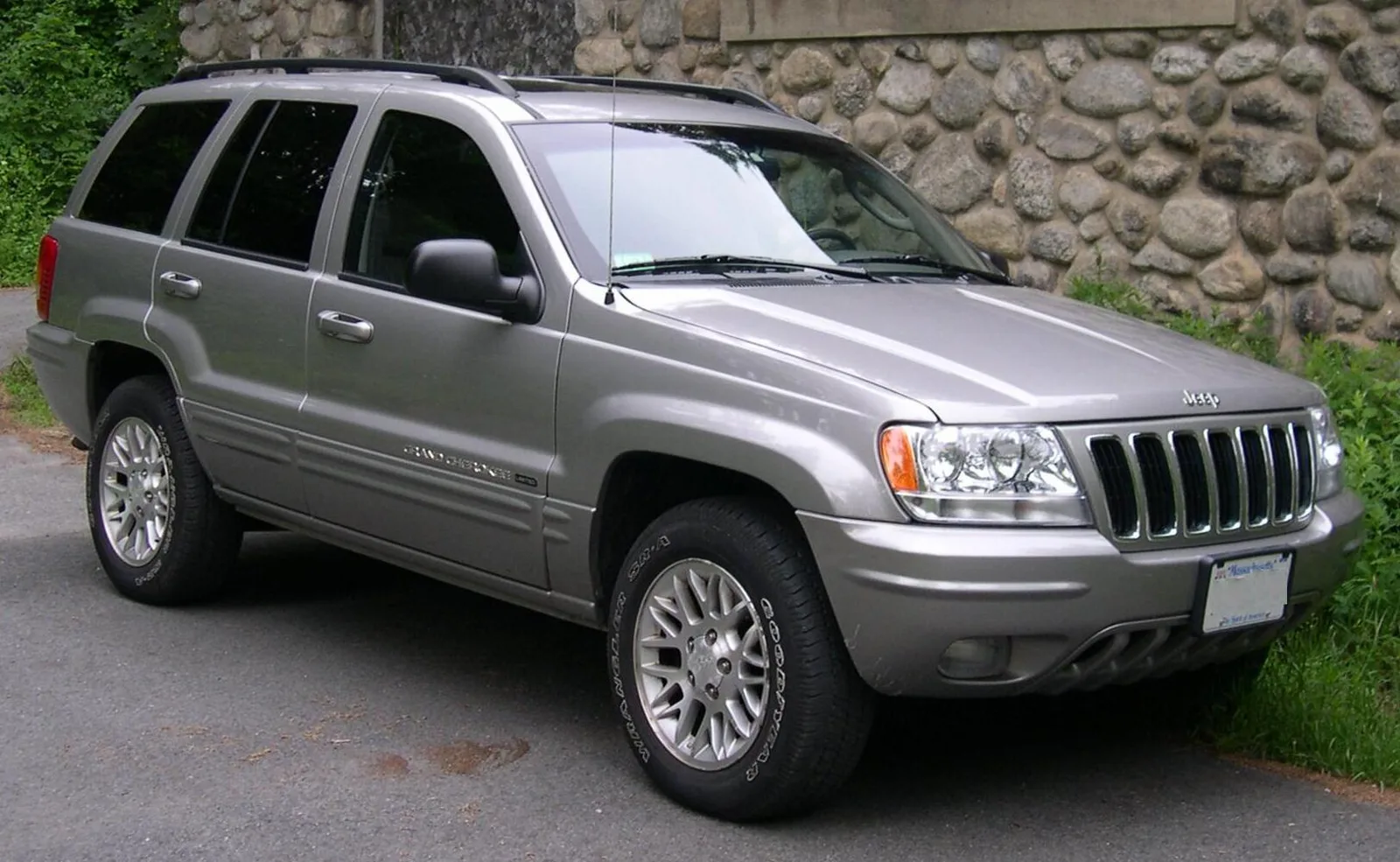
A 1998 redesign that shared only 127 parts with its predecessor, a new 4.7-litre V8 and a four-wheel-drive system that could lock the centre.
The Jeep Grand Cherokee WJ, built from 1998 to 2004, was a redesign that shared 127 parts with its predecessor. It introduced the PowerTech V8, the Quadra-Drive four-wheel-drive system and a unitised UniFrame structure.
The Jeep Grand Cherokee WJ was the second generation of Jeep's Grand Cherokee sport utility vehicle. It was unveiled in Detroit on 16 June 1998, and it was built in the United States until May 2004, with overseas production running a year longer. Jeep rebuilt the car from its ZJ predecessor and leaned on its off-road credentials, marketing it as the most capable SUV the company had made.
How much did the WJ change from the ZJ?
Only 127 components carried over from the ZJ, and they were mainly small fixings, after 28 months of work that began at a March 1996 design freeze. Styling had been approved in the third quarter of 1995. Most of the car was new, from the engines to the interior, and the structure took a different route to achieve its strength.
Export WG models, built at Graz in Austria, carried a relocated radio antenna, power folding mirrors and height-adjustable headlights, and leather shift knobs on Overland trim. The spare tyre moved from the side of the cargo area to a position under the floor. That freed the rear for a more usable load area, though it reduced the space left for cargo. The change also made the spare easier to reach when it was needed.
The WJ shared just 127 parts with the car it replaced, yet it kept the off-road ability that defined the name.
What engines did the WJ use?
The two heavy pushrod V8s were replaced by Chrysler's new PowerTech 4.7-litre V8. That engine made less torque than the old units, but it was lighter, returned better fuel economy and gave similar on-road performance. The 4.0-litre inline six carried over, and it was updated for model year 1999 with a redesigned intake manifold that added 10 hp (7.5 kW).
The 5.9-litre Magnum V8 was dropped after the 1998 model year, and the older 5.2-litre Magnum gave way to the new engine. A fuel tank of 23 gallons shrank to 20.5 gallons with the redesign, which was a trade-off for the lighter overall package.
How did Quadra-Drive four-wheel drive work?
Quadra-Drive was the automatic four-wheel-drive system, built around the NV247 transfer case from New Venture Gear. Its two speeds were driven by chain, and a gerotor paired with a clutch pack and hydraulic pump shifted torque fore and aft. Neutral, 4-All Time and 4-Lo were the three positions on the selector.
In 4-All Time the rear wheels took the full load under ordinary driving. When they outpaced the front, pressure in the gerotor grew and bled torque forward, gradually, until the axles matched speeds again. Neutral was for towing, and 4-Lo locked the axles together through a 2.72 reduction ratio.
Jeep's Vari-Lok differentials sat in both axles and used the same gerotor principle. The strength of Quadra-Drive was that the transfer case and the locking differentials could control traction across all four wheels automatically. The limitation was that only the centre differential could be locked, and only in 4-Lo.
Quadra-Trac II used the NV247 with standard open front and rear differentials, offering a cheaper route to four-wheel drive within the same body.
Why was the 45RFE transmission unusual?
The 45RFE, used in the 545RFE update that followed, had three planetary gear sets where a four-speed automatic would normally have two. That gave it six theoretical ratios, which would have made it the first six-speed transmission built in volume. Chrysler programmed it to use only five, so the car was sold as a four-speed.
Four of the ratios handled upshifts, while a separate second-gear ratio came into play on downshifts. In 2001 the programming changed so that the transmission acted as a five-speed. Owners of 1999 and 2000 cars could have the programming flashed to unlock the extra gear, because the two transmissions were physically the same.
For 2000 the 545RFE five-speed replaced the 45RFE in V8 cars. The 42RE four-speed remained the transmission for the inline six, with only slight changes from the previous Grand Cherokee. At 70 mph (113 km/h) a 545RFE car turns 2000 rpm, which is 200 rpm lower than the 45RFE programming.
What did the body and interior offer?
The interior was redesigned from the ground up, with larger rear doors and more room for passengers in the back. Switches for the lamps, heated seats and rear wiper were relocated to places a driver could reach more easily. The Vehicle Information Center sat above the windscreen, becoming standard on 2000 and later cars, while Limited models gained automatic dual-zone climate control.
Jeep's UniFrame construction was central to the car's body. It combined the strength of body-on-frame design with a unitised shell, and DaimlerChrysler worked with Porsche to stiffen the frame and reduce noise, vibration and harshness. More than 70 percent of the underbody was high-strength steel, and all Grand Cherokees used UniFrame.
Convenience features were a strong point. HomeLink, operated from the overhead console, could be taught up to three remote devices, including garage doors and estate gates. The Jeep Memory System recalled two drivers' seat, mirror and radio settings, with colour-coded keyless remotes to tell them apart.
What did the 2002 refresh change?
For 2002 the WJ received its first mid-cycle refresh, which introduced the Overland at the top of the range, along with the value-orientated Sport and a Laredo-based Special Edition. A new 4.7-litre High-Output V8 became available on Limited models, and it was standard on the Overland. The change also brought new radios, with RDS capability on the Overland.
Smaller changes followed. The Infinity Gold badge disappeared from the speaker grilles, the Laredo lost its carpeted lower door panels, and every model received a chrome Jeep emblem on the steering wheel. Sport and Laredo kept cloth seats in new Landscape or Millennium fabric, while the Limited adopted Royale leather.
The refresh added a full-size spare as standard equipment and offered front side-impact airbags and power-adjustable pedals as options. Buyers could tell the airbag fit from the VIN, where the third character was 4 for frontal airbags only and 8 for frontal plus front side-impact airbags. New wheel designs and a new front grille for Limited models also arrived. Midyear, a full-colour GPS navigation radio appeared on the Limited and Overland, and dealer-fitted satellite radio and hands-free Bluetooth were offered on all models.
Which trims made up the Grand Cherokee WJ range?
The Laredo was the base trim from August 1998 until 2004, and it remains the base Grand Cherokee trim today. The Limited sat at the top from 1998 to 2001 and then became the more luxurious trim below the Overland. Its standard kit included a premium 180-watt Infinity Gold stereo, leather seats and a leather-wrapped steering wheel.
The Limited's standard kit also included colour-keyed body-side cladding, six speakers, dual power front bucket seats, a full-size spare, a security alarm, two-position driver memory and wood interior trim. The 2001 New England Special Group, sold only in select Northeastern states, added seventeen-inch tyres, Silverblade alloy wheels, a stereo with cassette and CD players, a power front seat and a 3.73 rear axle ratio to the Laredo.
Several value and special editions came along the way. The Sport arrived for 2002 with dual power heated front seats and a sunroof. The Special Edition returned for 2004 after a 2003 break. The Freedom was a Laredo-based edition from March 2003, and the Columbia Edition, a partnership with Columbia Sportswear, arrived for 2004 with a free parka for buyers.
The Overland was the top model from August 2001 to 2004. It added leather-and-suede seating, rain-sensing wipers, rock rails and a skid plate group, along with seventeen-inch chrome alloys and the 265 hp High-Output V8. The 60th Anniversary Edition, based on the Limited, marked Jeep's 60th year in 2001. It carried chrome-plated seventeen-inch alloys, heated front seats, a sunroof and embroidered seat backs with matching floor mats.
The Special Edition, built on the Laredo, came with a full-size spare, heated power front seats, leather upholstery and wheel, a ten-disc rear-mounted CD changer, colour-keyed cladding and a power sunroof. The Freedom edition of 2003 offered graphite-finish alloys, unique cloth seats and a 180-watt Infinity Gold system with six speakers, each marked with Freedom badging on the doors.
How did the Grand Cherokee WJ end production?
The 2004 model year was the WJ's last. A second facelift introduced revised grilles and fascias for all models, along with round fog lamps on Laredo models. The Laredo was condensed into a single E package, and four-wheel-drive models gained Jeep's Trail Rated 4X4 certification. The 2003 season had been shortened, with 2004 production starting in mid-2003. Two in-year changes that year swapped the oil pressure gauge for a warning-style dummy gauge and fitted a solid front sway bar on cars built after 7 November 2002.
Production ended in April 2004, and the all-new WK appeared that same month at the New York show. The Jefferson North assembly plant was retooled for the new model.
Was there a diesel Grand Cherokee WJ?
Yes, a 3.1-litre turbo-diesel was offered for European models. It was developed with Detroit Diesel and VM Motori and built at Cento, Italy, at 13,000 units a year. The engine had electronic injection, controlled exhaust gas recirculation and a catalyst for oxides of nitrogen, which allowed it to meet European stage III emissions.
The diesel displaced 3,124 cc and produced 104 kW (141 PS; 139 bhp) and 367 N m (271 lb ft) of torque. A four-speed electronically controlled automatic transmission handled the drive.
What happened to the WJ in China?
Beijing Jeep bought the old WJ tooling when the WK was introduced for the US as a 2005 model. The WJ reached Chinese buyers at the end of 2004 under the names Jeep 4000 and 4700, with engine codes that differed from the foreign units. Pricing ranged from 358,000 to 496,000 yuan across four trims.
The Chinese flagship closely matched the 2004 Grand Cherokee Limited in styling and kit. It kept the solid axle suspension, a choice of four-wheel-drive systems, body-colour cladding, alloy wheels and Chrysler sound and climate systems. Beijing Jeep had reworked its older XJ Cherokee heavily for the Chinese market, but it changed the WJ far less.
Were there recalls on the WJ?
In November 2012 Chrysler announced a recall of certain 2002 to 2004 models. A component in the airbag control module could fail, so that the front bags, curtain bags or belt pretensioners could fire unexpectedly while driving. The affected vehicles were built between February 2001 and May 2003.
Specifications
| Specification | Detail |
|---|---|
| Generation | Second generation Grand Cherokee (WJ) |
| Unveiled | 16 June 1998, Detroit |
| Production (US) | July 1998 to May 2004 |
| Inline six | 4.0-litre Power-Tech, updated for 1999 |
| V8 | 4.7-litre PowerTech; High-Output 265 hp |
| Diesel (Europe) | 3,124 cc turbo, 104 kW (141 PS; 139 bhp), 367 N m (271 lb ft) |
| Transfer case | NV247 Quadra-Drive, 2.72 low range |
| Transmission | 45RFE, later 545RFE five-speed, 42RE four-speed with inline six |
| Parts shared with ZJ | 127, mostly fasteners |
| Wheel bolt pattern | 5 x 127 mm |