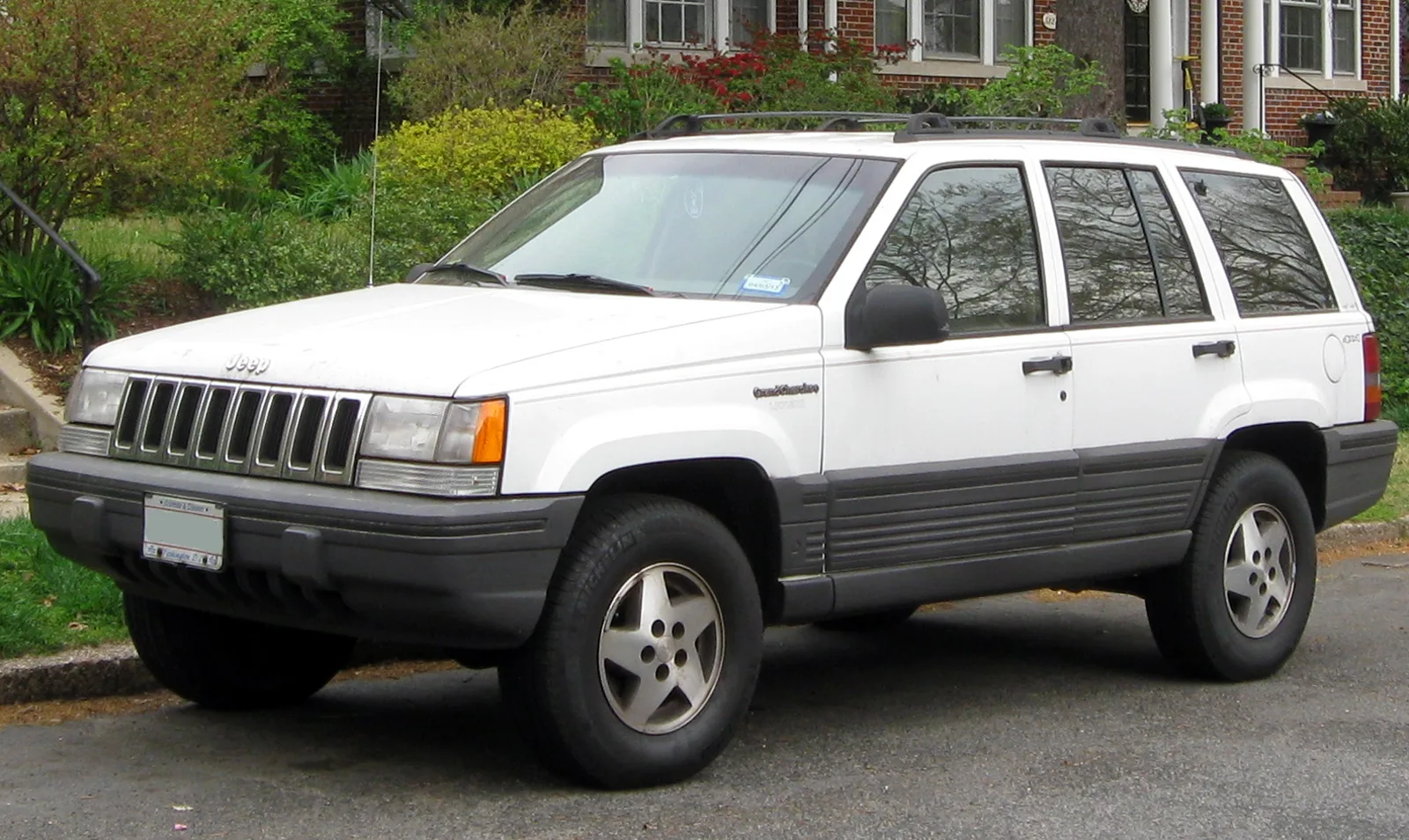
A mid-size successor to the Cherokee XJ with six-cylinder and V8 power, a family of four-wheel-drive systems and a 5.9 Limited to close the run.
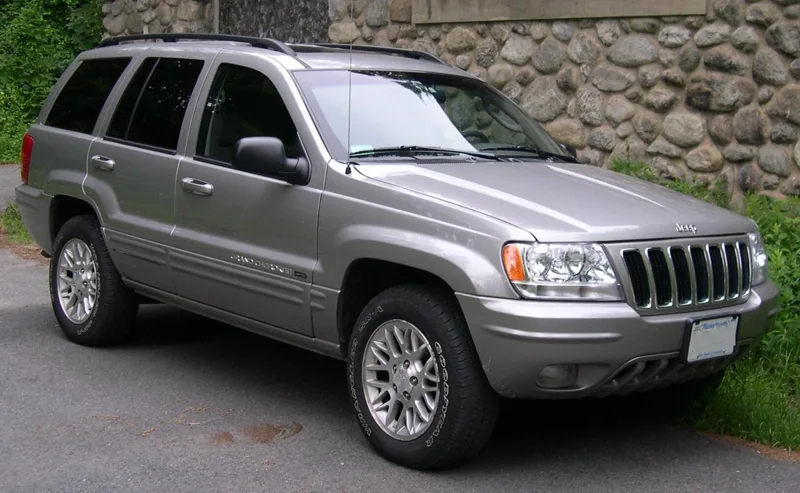
Launched in April 1992 for the 1993 model year, the ZJ was the first Grand Cherokee, a mid-size SUV built until mid-1998. It used a six-cylinder base engine, a 5.2 L V8 option and a family of four-wheel-drive systems that set it apart from its rivals.
The ZJ introduced the Grand Cherokee name in 1993, a mid-size sport utility that reached showrooms after its April 1992 launch. It was meant to take over from the compact Cherokee XJ and the ageing Wagoneer, and it stayed in production until mid-1998. Four-wheel drive, six-cylinder and V8 engines, and a long list of class-exclusive features set it apart from its rivals.
Why did American Motors build the ZJ?
American Motors started the ZJ as a larger follow-up to the small Cherokee XJ, meant to take over from that model and the ageing Wagoneer. The aim was a single vehicle that could cover both roles in the company's range.
Chrysler bought AMC in 1987, and the XJ carried on in production beside the new model.
Larry Shinoda styled a prototype in 1985, but the work was not credited to him at first. Shinoda had to sue for payment and recognition, and Chrysler later settled with his estate for more than $200,000.
A mid-size SUV that Jeep launched in 1993 with a six-cylinder base engine, a V8 option and a 5.9 Limited to finish.
What did the Jeep Concept 1 show?
The Jeep Concept 1 was a working preproduction ZJ shown in 1989. It had brown paint with two-tone lower panels, smoked lamps, minivan-style door handles and P295/55R17 tyres, and its styling closely previewed the production car.
The Concept 1 also had lettering on one spoke of every wheel, and it had a roof rack that appeared on that car alone.
Did Dodge plan its own version of the ZJ?
Dodge had a plan of its own in the early nineties: a midsize replacement for the Ramcharger, a truck-based SUV that had been around for years. Its unnamed prototype looked much like the Concept 1 but had a Cross-Hair grille, slimmer headlamps and its own bumpers.
Chrysler cancelled the Dodge project before the 1993 Jeep reached the market. The Ramcharger's successor did not appear until the 1998 model year, when the Durango arrived on the midsize Dakota pickup platform.
What set the ZJ's equipment apart?
The ZJ offered features that rivals such as the Blazer and Explorer lacked. Every model had a standard driver's airbag in the steering wheel, and the Limited added digital climate control. For a mid-size SUV in 1993 it was a long list.
The Electronic Vehicle Information Center, or EVIC, watched the doors, hood, tailgate, coolant and oil levels, and the lighting, then gave audible and visual warnings when something failed. It also showed the date, the time and service reminders.
An overhead console held a mini trip computer with Trip A and Trip B readouts, along with storage for a garage door opener, sunglasses for two and four map lamps. Keyless entry could arm or disarm the security system, and the ignition barrel sat on the right of the column, lit for night driving.
The audio system, sold as AccuSound by Jensen and later as Infinity Gold from 1994, had a 120-watt amplifier under the rear seat and a five-band graphic equaliser. An in-dash CD player could be paired with it.
How did Quadra-Trac and the other four-wheel drive systems work?
Quadra-Trac was a fully mechanical, full-time system that sent torque to the wheel with grip and could switch from rear-wheel drive without driver input. Selec-Trac and Command-Trac were the other choices, with Command-Trac dropped in 1996.
The system could send as much as 60 percent of the drive to the rear, and it dropped to a 50-50 split when the rear lost grip. From 1996 the low range gave a true 50-50 lock between the axles.
Selec-Trac was a shift-on-the-fly system that could run full-time or part-time. Command-Trac was the standard part-time unit, giving 4 HI and 4 LO alongside two-wheel drive.
Every system used a selector lever beside the gear selector, and low range always needed that manual lever. The rest of the chassis used a Quadra-Link suspension with four control arms on each axle and a Panhard rod to locate the axle sideways.
The optional Up Country package used heavier German-made gas shocks, taller springs and longer bump stops, raising ride height by one inch.
Which engines could buyers choose?
At launch the ZJ had one engine, a 4.0 L Power Tech six from the AMC family, rated at 190 hp. A 5.2 L (318 cu in) Magnum V8 arrived in early 1993 as an option, and it made 164 kW (220 hp) with 380 N m (280 lb ft) of torque.
Both the six and the V8 could tow up to 5,000 lb, although the six was refined in 1995 with more torque and quieter running.
Early cars used the AW4 automatic, which gave way to the A500SE, later the 42RE, during 1993. A five-speed Aisin AX15 manual was also offered at first.
The manual gearbox was dropped for North America after 1994 because few buyers chose it, though European ZJs kept it.
What changed in the 1996 restyle?
For 1996 the ZJ received new bumpers, side cladding, a larger grille and an entirely new interior with a front passenger airbag. The Laredo became the base model, and the SE was discontinued. The OBD II diagnostics port became mandatory for that model year, which also brought dual front airbags as standard.
A three-spoke steering wheel carried cruise controls, the horn became a single pad, and the seats were redesigned. Heated front seats, a memory system that recalled seat and mirror settings from the key, and a power tilt-and-sliding sunroof all joined the options.
The 4.0 six lost 5 hp, falling to 185 hp, to meet EPA rules for 1996.
What was the Orvis Edition?
The Orvis Edition was a Limited-based package sold from 1995 to 1997 in Moss Green paint with Orvis badging, built in partnership with the Orvis catalogue. Production was 10,020 cars in 1995, 2,341 in 1996 and 2,733 in 1997.
The cabin was the real difference. Green and tan leather covered the seats, trimmed with roan red piping and Orvis insignia. The 1996 dashboard was black and the 1997 one was tan.
Jeep ended its Orvis catalogue tie in 1997, and the Edition disappeared from the American line-up. European right-hand-drive ZG versions of the Orvis carried a high-output 4.0 six rated at 195 bhp.
Which trim levels did the ZJ offer?
The ZJ launched in Base, Laredo and Limited trims. The Base became the SE in 1994 and was dropped after 1995, the Laredo became the entry model in 1996, and the Limited stayed on top until the end of production.
The Limited was the luxury grade. It had leather seats, a power sunroof, heated mirrors and seats, and a remote keyless system, plus body-coloured front and rear bumpers and gold-plated badges.
A Laredo Special Edition arrived for 1997 with the Infinity Gold audio system and power front bucket seats. The TSi, also from 1997, used 16-inch alloys, leather trim and a sporty body treatment, and it sat between the Laredo and the Limited before being dropped after two years.
TSi cars could be ordered only in Black, Platinum or Deep Amethyst, and they came with 225/70R16 Goodyear tyres.
Was there a Grand Wagoneer?
Yes, but only for 1993. The Grand Wagoneer was an ultra-luxury Limited with a standard 5.2 L V8 and Quadra-Trac, woodgrain vinyl and chrome emblems, and beige interiors in every colour. It was dropped after the 1993 model year.
It paid tribute to the full-size Grand Wagoneer SJ that the ZJ had replaced, and it carried a full-size spare tyre in the cargo area. Options were few, because the car already came with most of the luxury kit.
How quick was the 5.9 Limited?
The 5.9 Limited, built only for 1998, paired a 5.9 L V8 with 183 kW (245 hp) and 468 N m (345 lb ft) of torque. A 0-60 mph (97 km/h) sprint took 6.8 seconds, the quickest figure for an SUV that year.
Fewer than fifteen thousand 5.9s were built, out of nearly a quarter million Grand Cherokees made in 1998. The engine came from the Dodge Ram 1500, and the car needed premium gasoline.
Its extras included a higher output alternator, calf leather upholstery, heat-extracting hood louvers, a 46RE four-speed automatic and 3.73 gearing with a rear Trac-Lok differential. Petersen's 4-Wheel & Off-Road magazine gave the car its title as the four-wheel drive vehicle of 1998.
How did the press rate the ZJ?
Car and Driver put the Grand Cherokee V8 on its Ten Best list, and Motor Trend named the model its Truck of the Year for 1993. Petersen's gave the Grand Cherokee 4x4 of the Year honours in 1993, 1996 and 1998.
Regional outlets also took to the V8, and the Asheville Chronicle named the Grand Cherokee its Best Vehicle of the Year from 1996 to 2000.
How did the ZJ launch in Detroit?
The ZJ made its debut in Detroit at the North American International Auto Show of 1992. Bob Lutz, then Chrysler's chief executive, drove a Laredo 4X4 out of the Jefferson North Assembly Plant and up to Cobo Hall.
Detroit mayor Coleman Young took part as well, and the pair rolled through the building's entrance and broke a plate-glass window that shattered just before the car got there. Showroom sales opened in April 1992 with Base, Laredo and Limited versions available.
What was the Grand One concept?
The Grand One was a 2017 concept built for the Easter Safari in Moab, Utah, to mark the 25th anniversary of the Grand Cherokee. It began as a stock 1993 Laredo 4X4 bought on Craigslist, and it kept the 5.2 L V8 and 46RH automatic.
The car was repainted robin's-egg blue over a light woodgrain finish, a tribute to the 1993 Grand Wagoneer. It also gained eighteen-inch laced aluminium alloy wheels, a slight lift and an eight-slot black grille.
Inside, the seats were re-wrapped in grey leather and suede with blue stitching. Retro touches included a factory radio, an Audiovox car phone and an original Game Boy on the rear seat.
How did the ZJ production run end?
Production of the first Grand Cherokee ended in mid-1998, when the WJ generation began at the Jefferson North Assembly plant. The 1998 model year marked the last ZJ, with the Laredo carried over beside the new 5.9 Limited.
The ZJ also had a second life in Canada by the mid-to-late 2000s. Japanese-market right-hand-drive examples shared the North American car's chassis, body, suspension and engine, and they became popular with Canadian mail carriers.
What were the ZJ's core specifications?
| Specification | Detail |
|---|---|
| Model years | 1993-1998 |
| Launch | April 1992, 1993 model year |
| Base engine | 4.0 L AMC-derived Power Tech I6, 190 hp |
| Optional V8 | 5.2 L (318 cu in) Magnum, 164 kW (220 hp), 380 N m (280 lb ft) |
| 1998 V8 | 5.9 L (360 cu in) Magnum, 183 kW (245 hp), 468 N m (345 lb ft) |
| Towing | Up to 5,000 lb (2,268 kg) |
| Transmissions | AW4, then 42RE four-speed automatic; Aisin AX15 five-speed manual, dropped for North America after 1994 |
| Four-wheel drive | Command-Trac, Selec-Trac, Quadra-Trac |
| Orvis Editions | 10,020 (1995); 2,341 (1996); 2,733 (1997) |
The ZJ line-up ran from a six-cylinder base engine to V8 options, with the 5.9 Limited marking the strongest version of the generation. Buyers could choose between rear-wheel drive and several four-wheel drive systems, a spread of choice that was wide for a mid-size SUV.