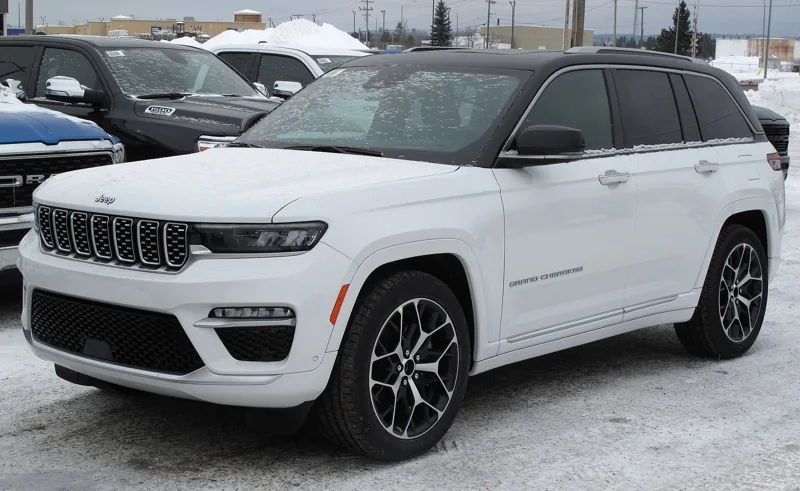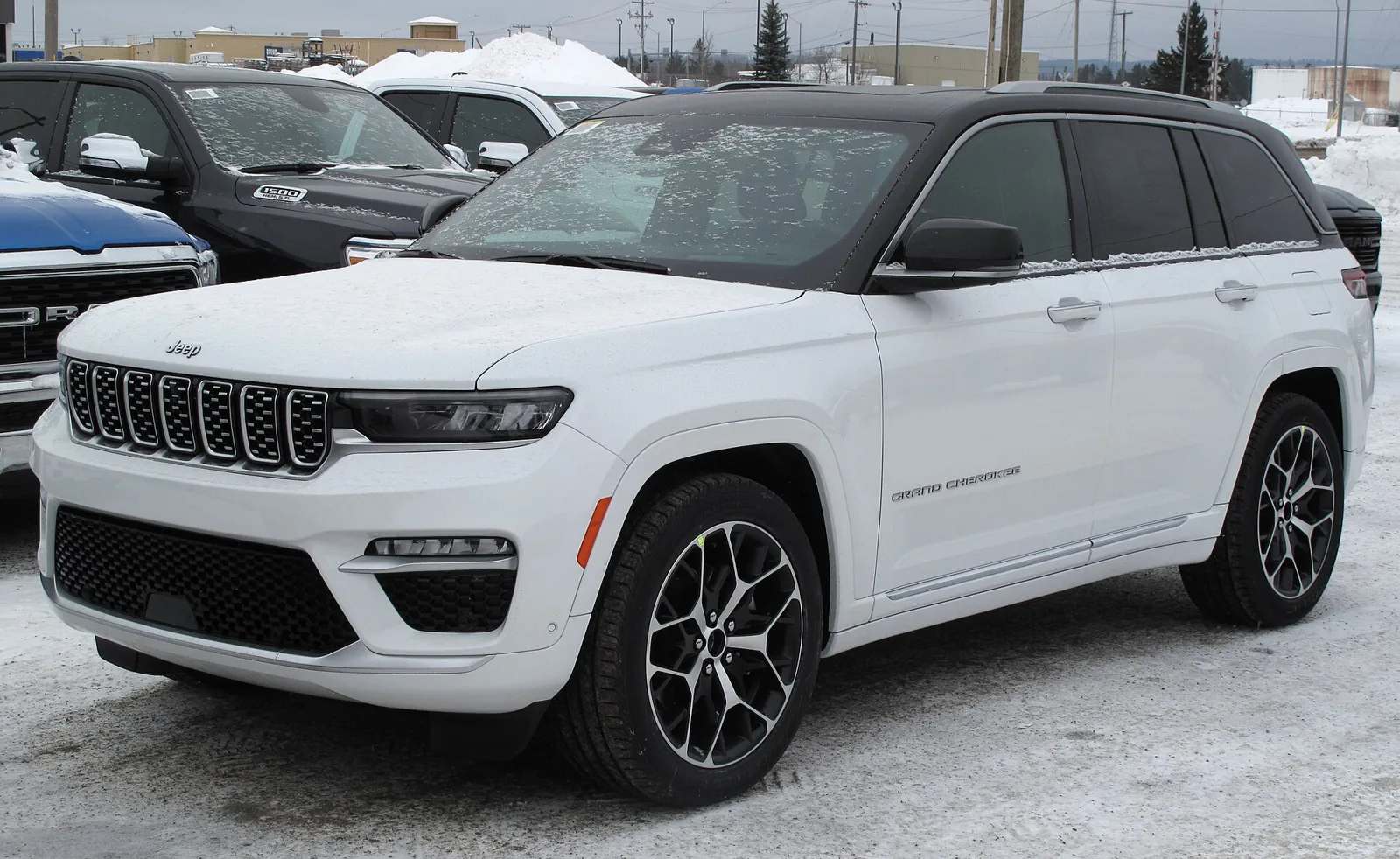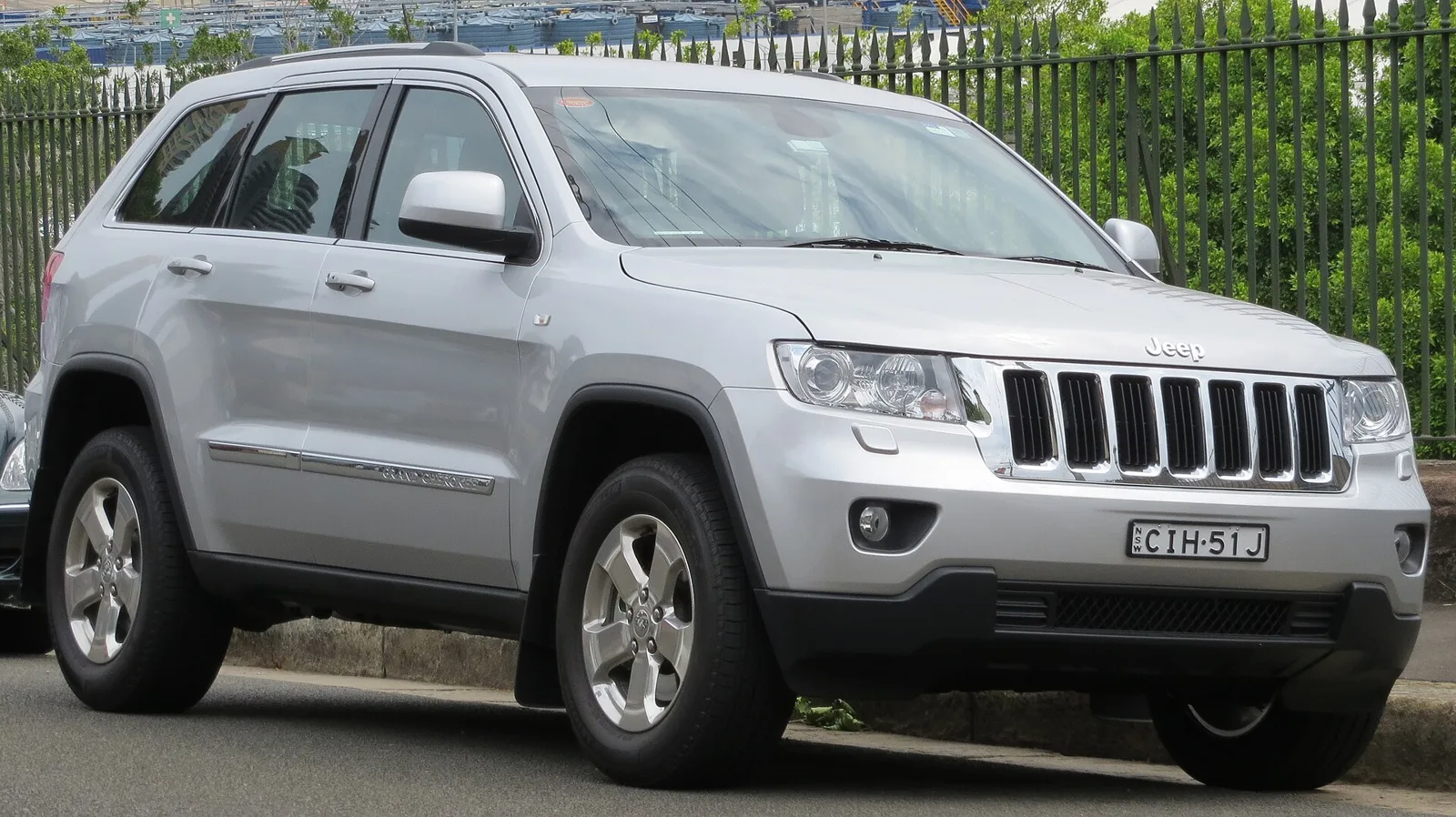
Four-wheel independent suspension, Quadra-Trac systems, a 5.7 L Hemi and a Trackhawk with 707 hp on top.
Built from mid-2010 to 2022, this generation rode on a platform derived from Mercedes-Benz's W166 series. Its range ran from a diesel V6 to the 707 hp SRT Trackhawk. The shifter recall in particular changed how Jeep handled repairs in its later years.
The Jeep Grand Cherokee WK2 was the fourth-generation Grand Cherokee, built by Jeep from mid-2010 to 2022. It introduced four-wheel independent suspension to the nameplate and reached its peak with the 707 hp Trackhawk.
Few generations of a family SUV have covered so much ground. The WK2 ran on a diesel V6 and a Hemi V8 at one end of its life and a supercharged Hellcat at the other, with a long list of trims and recalls in between.
Where did the WK2 come from?
The fourth-generation Grand Cherokee was code-named WK2 and was introduced for the 2011 model year. It was unveiled at the 2009 New York Auto Show, where it received 30 awards before it had reached any customer.
The WK2 platform was a derivative of Mercedes-Benz's W166 series. The Dodge Durango of 2011 used the same platform, which made it a shared architecture rather than a one-off design.
Jeep announced a US$1.8 billion expansion of its Jefferson North Assembly plant in Detroit in 2009. The 285,000 square feet (26,477 m2) of new space allowed flexible building of the next model and the Durango.
A four-wheel independent suspension, a diesel and a Hellcat in one nameplate, and a recall history that shaped the rest.
How did the body, chassis and suspension change?
The body design gave a 146 percent increase in torsional rigidity over the previous design. That stiffness helped improve durability and reduced noise, vibration and harshness.
The chassis remained a steel unibody, as on earlier Grand Cherokees. What was new was a four-wheel independent suspension, which gave the car better on-road handling than the layouts it replaced.
Which four-wheel drive systems did the WK2 use?
Four-wheel drive systems included Quadra-Trac I, Quadra-Trac II and Quadra-Drive II. Selec-Terrain allowed the driver to choose between Auto, Sport, Snow, Sand/Mud and Rock modes, which put the system's logic in the driver's hands.
The optional height-adjustable air suspension, which Jeep called Quadra-Lift, could raise the vehicle's ground clearance to 11.1 in (282 mm). That gave the car real off-road capability alongside its on-road manners.
Which engines did the WK2 offer?
Engine choices included the 3.6 L Pentastar V6 and the 5.7 L Hemi V8. The Pentastar replaced the 3.7 L and 4.7 L PowerTech engines, and the Hemi was retained as the V8 option.
The Hemi kept the Multiple Displacement System, which shuts down four cylinders in low-power driving situations. The V8 stayed with a multi-speed automatic that included Electronic Range Selection, which limits the high gear range manually.
Trailer towing was rated at 7,400 lb (3,400 kg) for Hemi models and 5,000 lb (2,300 kg) for Pentastar models.
What was the EcoDiesel story?
A 3.0 L turbocharged diesel V6, developed with Fiat Powertrain Technologies and VM Motor, was offered in export markets from mid-2011. It produced 177 kW (241 PS; 237 hp) and 550 N-m (406 lb-ft) of torque.
On January 14, 2013, at the Detroit Auto Show, Jeep announced that the EcoDiesel would be available in the 2014 to 2021 Grand Cherokee. The diesel returned for 2018, re-certified for the US, on the Limited and higher trims.
Australian buyers received a 3.0 L turbodiesel producing 184 kW and 570 N-m, paired with the 8HP70 eight-speed automatic. European markets had a 140 kW (190 PS; 188 hp) low-power version of the 3.0 L CRD diesel.
How fast did the SRT8 go?
Jeep announced the SRT8 on April 20, 2011, for its debut at the New York show. The car could accelerate from 0 to 60 mph in 4.7 seconds and cover the quarter-mile in 13.4 seconds, with auto reviews measuring 4.5 seconds.
The SRT8's 6.4 L Hemi made 470 hp (350 kW) and 465 lb-ft (630 N-m). Its production started on July 16, 2011, and it was the most powerful engine fitted to any Jeep at the time.
Jeep claimed 13 percent better fuel economy than the predecessor, with an EPA rating of 12 MPG city and 18 MPG highway. That made it still the least efficient Jeep in the line-up, even with the gain.
Did the Grand Cherokee pass the moose test?
In 2012, Swedish magazine Teknikens Varld reported that the Grand Cherokee failed its avoidance manoeuvre test, the so-called moose test. Other SUVs in the class passed without difficulty, which made the result stand out.
Results of this kind matter to buyers, because a car that fails a sudden swerve can be unsafe in a real emergency.
German magazine AMS later tested the same press vehicle in a slightly different avoidance test that met ISO standards. The Jeep stayed on all four wheels and did not lose a tyre to a blowout, so the result was far more positive.
Teknikens Varld tested the updated 2014 model and found that it passed, up to a speed of 44.1 mph (71 km/h). That result showed how much the car's handling had improved in its updated form.
What were the fuel pump and shifter recalls?
In late 2014 the NHTSA issued a recall for 2011 to 2013 Grand Cherokee and Dodge Durango vehicles, because the fuel pump relay could suffer silicon contamination on its contacts. The fault could cause the relay to fail.
The remedy was free of charge at an authorised dealer, who would fit a new fuel pump relay and wiring harness. The recall was a practical fix for a fault that could leave the car without fuel pump power.
The fuel pump recall covered a narrower group of 2011 to 2013 cars than the shifter recall that followed in 2016.
How serious was the shifter recall?
In 2016 about 1.1 million 2014 and 2015 Grand Cherokees were recalled for rollaway risks. The shifter design made it difficult for drivers to tell whether the car was still in gear.
The issue was linked to 41 injuries, 212 crashes and 308 reports of property damage. A fatal rollaway followed the recall announcement, and a wrongful death suit against FCA was settled out of court in 2018.
The company accelerated the recall campaign after the fatal incident and took steps to get affected Jeeps repaired faster than originally planned. The shifter design was discontinued in 2016 in favour of a more traditional arrangement.
What changed for 2013 and 2014?
For 2013 Jeep introduced the Trailhawk off-road trim. The Overland Summit gained Front Park Assist, power-folding side mirrors and headlight washers, and Nappa leather became available in black or saddle colour.
The 2014 revision brought a new front end with a revised body-colour grille, smaller headlamps and new tail lamps. The trim list became Laredo, Limited, Overland and Summit, and an eight-speed TorqueFlite 8 automatic arrived.
The 2014 model also had an 8.4-inch touchscreen with Garmin navigation. The Summit received the nineteen-speaker Harman Kardon system, and every model got a new steering wheel with paddle shifters.
The 2014 engine lineup ran from the 3.6 L Pentastar at 290 hp and the 5.7 L Hemi at 360 hp to the 6.4 L Hemi at 470 hp, which was offered in the SRT only.
In 2014 the SRT line dropped the 8 from its name, and the car became an SRT Jeep Grand Cherokee. Its features included six-piston Brembo brakes at the front, four-piston units at the rear, and Launch mode for quick starts.
Taken together, the SRT line became the performance face of the Grand Cherokee, a role the Trackhawk later took to its extreme.
What were the updates from 2015 to 2019?
The 2015 Limited no longer had dual exhausts, which were kept for the Overland and above. The SRT gained a modest 5 hp (4 kW) from a reflash of the engine control module.
For 2017 the Trailhawk returned with Quadra-Drive II and Quadra-Lift air suspension, and the Summit was revamped with LED front fog lamps and 20-inch polished alloy wheels. Blind Spot Detection and Forward Collision Warning became standard for 2019.
The 2018 changes included a 7-inch infotainment system with Apple CarPlay and Android Auto, and the second-generation 850RE automatic replaced the 845RE on the 3.6 L models. The Sterling Edition celebrated the Grand Cherokee's 25th anniversary.
Buyers on the Laredo, Laredo E and Limited trims got Apple CarPlay and Android Auto as standard, which kept the car current with the phones of the day.
The Trailhawk, Summit and Limited X
The Trailhawk first appeared as an off-road trim for 2013, and it returned for 2017 with Quadra-Drive II four-wheel drive and Quadra-Lift air suspension. It was the WK2's most purpose-built trim for rough ground.
The Summit was the upscale version of the Grand Cherokee. It was revamped in 2014 and again for 2017 with a restyled front end and upscale interior trim.
The Limited X package for 2019 added SRT-inspired styling cues to the mid-level Limited. It gave buyers a sportier look without moving them up to the performance models.
Buyers chose between the Trailhawk and the Summit according to whether they wanted trail capability or upscale comfort.
What was the SRT Trackhawk?
Jeep introduced the 2018 SRT Trackhawk at the 2017 New York International Auto Show. It was the highest-performance Grand Cherokee to date, with a 6.2 L Hellcat HEMI V8 producing 707 hp (527 kW; 717 PS).
The V8 made 645 lb-ft (875 N-m) of torque and was paired with an eight-speed ZF automatic with steering-wheel shift paddles. It was rated to tow 7,200 lb.
Brembo brakes with six-piston calipers at the front and four-piston at the rear handled the power. Standard 20-inch polished forged aluminium wheels and Pirelli runflat tyres completed the car's performance kit.
How did the WK2 rate for safety?
The 2011 Grand Cherokee earned an IIHS Top Safety Pick, and it was named a Best Buy for 2011 by Consumers Digest. MSN Autos also called it the safest SUV in America that year.
The 2013 vehicle structure was rated Marginal by the IIHS, a result that sat uneasily beside the car's awards. The comparison showed how a one model can earn praise in one test and criticism in another.
How did the WK2 end, and what came next?
For 2022 Jeep marketed the outgoing WK2 alongside the all-new Grand Cherokee WL as the Grand Cherokee WK. The lineup was condensed to Laredo E, Laredo X and Limited trims, all with the 3.6 L Pentastar V6.
The ZF-built 8HP75 eight-speed automatic, previously available only with the 5.7 L Hemi, was offered at no extra cost on all models. That change gave the final WK2 a broader transmission option than before.
Grand Cherokee WK2 key figures
| Specification | Detail |
|---|---|
| Built | Mid-2010 to 2022 |
| Introduced | 2011 model year; unveiled at the 2009 New York Auto Show |
| Pentastar V6 | 3.6 L; 290 hp in 2014 |
| Hemi V8 | 5.7 L; 360 hp in 2014 |
| SRT8 Hemi | 6.4 L; 470 hp (350 kW); 465 lb-ft (630 N-m) |
| Trackhawk V8 | 6.2 L Hellcat; 707 hp (527 kW; 717 PS); 645 lb-ft (875 N-m) |
| Towing | 7,400 lb (3,400 kg) Hemi; 5,000 lb (2,300 kg) Pentastar |
| Ground clearance | 11.1 in (282 mm) with Quadra-Lift |
| Shifter recall | About 1.1 million 2014 and 2015 models |