A compact crossover that brought the Cherokee name back to North America, built on a new platform and remembered for its nine-speed gearbox.
The Jeep Cherokee (KL) was a fifth-generation compact crossover built by Jeep from 2013 until 2023. It used the Fiat Compact Wide platform, offered 2.4-litre, 3.2-litre and 2.0-litre petrol engines plus a diesel in select markets, and paired them with a ZF nine-speed automatic.
The Jeep Cherokee (KL) is a compact crossover that Jeep built from 2013 and sold as a 2014 model until production ended in February 2023. It was the first Jeep to ride on the Fiat Compact Wide platform, and it arrived with a nine-speed automatic that delayed its launch and drew a steady stream of owner complaints. Jeep kept the car in production through a 2019 facelift and a much simpler range of trims.
Where did the Jeep Cherokee KL come from?
Jeep previewed the fifth-generation Cherokee in February 2013 and unveiled it at the New York International Auto Show that March. The model brought back the Cherokee name in North America for the first time since 2001, and it sat between the smaller Compass and the larger Grand Cherokee.
Production started at the Toledo Complex in Toledo, Ohio, in spring 2013. Jeep pushed back the launch so that ZF could finish its nine-speed automatic, and the car reached dealerships in mid-autumn 2013. Sales had started in both the United States and Canada by November, with four weeks of stock already sold through pre-orders.
Jeep classes the Cherokee as a mid-size crossover, reflecting its exterior dimensions and the engine options on offer. Its interior is comparatively small, though, so the car is often grouped with compact crossovers such as the Compass.
The Cherokee was the first Jeep built on the Fiat Compact Wide platform, a platform co-developed by Chrysler and Fiat. Its wheelbase measured 2,700 mm (106.3 in), which was 28 mm (1.1 in) longer than the 1993 Grand Cherokee, 130 mm (5.1 in) longer than the Cherokee XJ it succeeded, and 69 mm (2.7 in) shorter than the original Cherokee SJ.
The four-wheel-drive setup was also distinctive. Three systems were offered, Active Drive I, Active Drive II and Active Drive Lock, and each one came with Selec-Terrain traction control. A rear-axle disconnect switched the rear axle off when extra traction was not needed, which Jeep described as a first for a compact SUV and which cut drivetrain losses to help economy.
A compact crossover that brought the Cherokee name home, then spent its life defending a nine-speed gearbox.
What were the Jeep Cherokee KL trim levels?
The Cherokee was sold in several trims over its life. The Sport started as the base model, the Latitude became the volume trim, and the Trailhawk, Limited and Overland pushed the car towards off-road and luxury use. From 2019 the Latitude took over the entry point, and by 2023 only two versions remained.
Sport (2014 to 2018)
The Sport was the base model until 2018. It rode on seventeen-inch steel wheels and came with a Uconnect 5.0 touchscreen radio, six speakers, cloth seats, a 2.4-litre Tigershark four-cylinder and the nine-speed automatic. It was offered in both 4x2 and 4x4 forms, and the 3.2-litre Pentastar V6 became available on it in 2015.
Latitude (2014 to 2023)
The Latitude was Jeep's volume trim. It added alloy wheels and body-coloured door handles and mirrors, and in Canada it was badged the North. It became the base model in 2019, when a new Latitude Plus took the place of the old Latitude.
The Latitude Lux arrived for 2021 with Nappa leather-trimmed seats, an 8.4-inch Uconnect 4 touchscreen and dual heated front seats. The other Latitude trims were dropped for 2022, but the Lux stayed on sale until 2023.
Altitude and Altitude Edition
An Altitude trim derived from the Latitude appeared in spring 2014, with black alloy wheels and blacked-out accents. The Altitude Edition followed in 2015 and ran until 2021, adding 18-inch gloss black alloy wheels, a black lower front fascia, black roof rails and an all-black leather interior. Its base price was $25,495 MSRP, only $600 more than the Latitude it was built from.
Trailhawk (2014 to 2022)
The Trailhawk was the off-road specialist and came only with four-wheel drive. It had dark alloy wheels, recovery hooks, the Active Drive Lock system with a mechanical locking rear differential, revised bumpers for better approach and departure angles, wider fender flares, skid plates and a full-size spare wheel. Jeep marketed it as Trail Rated. Trailhawk L and Trailhawk Elite versions joined the range from 2017.
Limited and Overland
The Limited was the top trim until the Overland arrived in 2016. It came with bright-finished alloy wheels, leather seats, heated front seats and Keyless Go with remote start, and it stayed on sale until 2023.
The Overland was the most luxurious version sold in the United States. It added 18-inch polished alloy wheels, a nine-speaker 506-watt Alpine sound system, heated and ventilated leather seats, and a heated steering wheel finished in leather and wood. Its engines were the 187 PS (184 hp) 2.4-litre four-cylinder and the 275 PS (271 hp) 3.2-litre V6. Jeep dropped it after 2020, citing slow sales and its close similarity to the Limited.
Anniversary editions
A 75th Anniversary Edition arrived in spring 2016 to celebrate Jeep's 75th anniversary. Based on the Latitude, it offered a Recon Green Metallic paint option, bronze-painted accents, bronze-painted 18-inch alloy wheels and a full panoramic power moonroof. An 80th Anniversary Edition followed for 2021.
What engines and transmission did the Cherokee use?
The Cherokee offered a 2.4-litre Tigershark four-cylinder, a 3.2-litre Pentastar V6 and, from 2019, a 2.0-litre turbocharged Hurricane four-cylinder. Select markets also received a 2.2-litre turbodiesel. Cars sold in the United States used a nine-speed ZF automatic, while some European cars could be fitted with a six-speed manual.
The 2.4-litre Tigershark produced 187 PS (138 kW; 184 hp) and 232 Nm (171 lb ft) of torque. Its highway rating was 7.6 L/100 km (31 mpg-US; 37 mpg-imp), which was 45% better than the Liberty and Cherokee it replaced, and Jeep quoted a driving range of 797 km (495 miles).
The 3.2-litre Pentastar V6 was rated at 275 PS (202 kW; 271 hp), with 324 Nm (239 lb ft) of peak torque and a highway rating of 8.1 L/100 km (29 mpg-US; 35 mpg-imp). The Cherokee was the first Chrysler product to use the engine.
Diesel cars were offered in select markets with a 2.2-litre Multijet II turbodiesel producing 185 PS (136 kW; 182 hp) or 200 PS (147 kW; 197 hp), along with 440 Nm (325 lb ft) of torque. Combined economy stood at 5.70 L/100 km (41.3 mpg-US; 49.6 mpg-imp). Europe's diesels were based on a 2.0-litre Multijet unit rated at 170 PS (168 hp; 125 kW).
The 2019 facelift added a 2.0-litre Hurricane turbocharged four-cylinder with 270 hp (274 PS; 201 kW), along with 400 Nm (295 lb ft) of torque between 3,000 and 4,500 rpm, thanks to direct fuel injection. For 2022 the Tigershark was discontinued and the Pentastar V6 became standard on every model.
Jeep Cherokee KL specifications at a glance
| Specification | Detail |
|---|---|
| Type | Compact crossover, classed by Jeep as mid-size |
| Platform | Fiat Compact Wide |
| Wheelbase | 2,700 mm (106.3 in) |
| Model years | 2014-2023 |
| Base engine | 2.4-litre Tigershark I4, 187 PS (138 kW; 184 hp) |
| V6 engine | 3.2-litre Pentastar, 275 PS (202 kW; 271 hp) |
| Base torque | 232 Nm (171 lb ft) |
| V6 torque | 324 Nm (239 lb ft) |
| Transmission | Nine-speed ZF automatic; six-speed manual in some European markets |
| Highway rating, 2.4-litre | 7.6 L/100 km (31 mpg-US; 37 mpg-imp) |
| Driving range, 2.4-litre | 797 km (495 miles) |
| Production | Toledo, Ohio to spring 2017; Belvidere, Illinois to 28 February 2023 |
| Units built at Toledo | 949,151 |
Why did the nine-speed transmission cause problems?
The nine-speed ZF automatic was the first of its kind to reach the market, and its compact design drew complaints from the start. The launch was delayed by several weeks over quality concerns, and reports of shift quality and reliability piled up soon after the car went on sale.
The 2014 and 2015 cars drew a large number of complaints on safecar.gov and carcomplaints.com, compared with similar models in their class, and most of them concerned the transmission. A poor Consumer Reports dependability assessment that included the Cherokee was followed by the departure of FCA's chief quality officer.
Chrysler released three software updates for the 2014 and 2015 transmissions and insisted the problem was software-related. Some Cherokees were also repaired by replacing a snap ring, which the company did to address durability concerns. ZF, the transmission's designer, took the same view and would not say what improvements it was making.
Other vehicles with the same ZF unit, including the Range Rover Evoque, Honda Pilot, Acura TLX, Chrysler 200 and the Jeep Renegade, also reported problems of varying severity. In August 2016 ZF recalled 505,000 vehicles fitted with the 9-speed automatic. ZF also said that a faulty control sensor could cause the transmission to drop into neutral while driving.
What was the July 2015 software hack recall?
In July 2015, FCA recalled 1.4 million vehicles after a software glitch was found that let hackers take control of certain cars wirelessly. The fix was a patch that owners could install from a USB stick or have fitted by a dealer.
Security researchers Charlie Miller and Chris Valasek hacked a 2014 Cherokee over the internet. From there they reached the radio, the air conditioning and the windscreen wipers, and then the steering, brakes and transmission. The demonstration gave the car industry a warning about connected vehicles.
The glitch affected the 2014 and 2015 Cherokee and several other FCA models, including the Grand Cherokee (WK2) and Ram trucks from the 1500 through to the 5500. Only cars fitted with the Uconnect 3C 8.4A (RA3) or 8.4AN (RA4) head units were exposed, because those radios used a Sprint 3G CDMA wireless connection to reach services.
How did the 2019 facelift change the Cherokee?
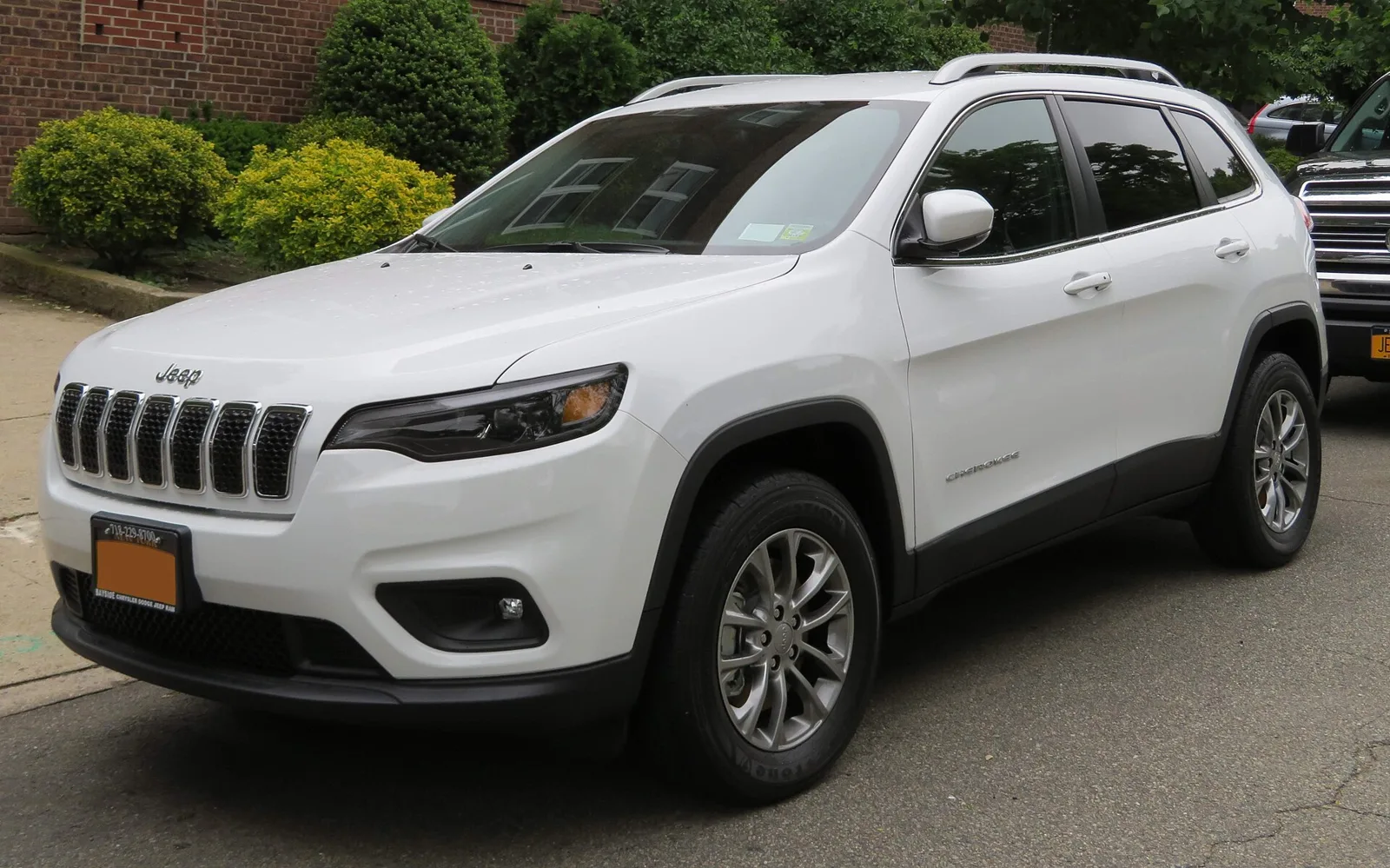
The restyled 2019 Cherokee made its debut at the 2018 North American International Auto Show in Detroit on 16 January 2018. It moved the grille down, fitted larger headlamps with LED daytime running lamps and integrated the turn signals into the headlamp units.
The rear end took on a look close to the second-generation Jeep Compass, with similar LED tail lamps. Inside, most of the design stayed the same, although some seat fabrics and interior materials changed and the infotainment moved to the fourth-generation Uconnect 4 system.
The base Uconnect 4 7.0 replaced the older Uconnect 3 5.0BT on base trims, while the larger Uconnect 4C 8.4 added 4G LTE Wi-Fi connectivity, SiriusXM Guardian and support for Amazon Alexa. Apple CarPlay and Android Auto were standard across the range, and the V6 became standard on the upper trims.
Where was the Cherokee built and when did production end?
The Cherokee was built at the Toledo Complex in Ohio from spring 2013 until spring 2017, when production moved to the Belvidere Assembly Plant in Illinois. Belvidere made its last Cherokee on 28 February 2023 after Stellantis idled the plant, and Toledo had built 949,151 units by then.
The move to Belvidere took place in late 2017 to free up Toledo for the all-new 2018 Jeep Wrangler (JL). Both plants were retooled, and Belvidere did not need to be rebuilt to make the Cherokee. The Grand Cherokee, built at a different plant, was unaffected by the Belvidere idling.
With the Cherokee gone, the Compass became Jeep's sole compact crossover.
How did the Cherokee sell in other markets?
The Cherokee reached Europe in spring 2014 with diesel engines, and it returned to China in October 2015 as a 2016 model, assembled by GAC Fiat Chrysler in Changsha. Chinese prices ran from 185,800 to 319,800 yuan, which was about US$26,830 to US$46,180.
In China the car was offered with a 2.0-litre naturally aspirated petrol engine and a 2.0-litre Tigershark turbocharged unit, paired with a nine-speed automatic. The pre-facelift version was known locally as the New Cherokee Classic, and the newer car was called the New Cherokee.
Chrysler's 2013 advertising carried the tagline Built Free, and the company said in December 2013 that the campaign was the most successful since the launch of the 2011 Dodge Charger.