A Humber built beside the Hillman Super Minx and Singer Vogue, with its own windscreen, two engine sizes and a V8 that never reached production.
The Humber Sceptre was a four-door upper-middle-class saloon built by Rootes from 1963 to 1967. It sat beside the Hillman Super Minx and Singer Vogue, used a 1,592 cc or 1,725 cc four-cylinder engine, and was built in 17,011 Mark I and 11,985 Mark II cars.
The Humber Sceptre was a four-door saloon that the Rootes Group sold under its Humber brand from 1963 to 1967. It shared its main body panels and much of its engine design with its Hillman and Singer siblings. Within that family, it was the dearest car and the best equipped.
The Sceptre is a textbook case of badge engineering, the practice of selling closely related cars under several names, which was widespread in Britain at the time. Humber was the group's top brand, and the Sceptre was the only one of the trio built in two series rather than four.
Why did Rootes build the Humber Sceptre?
Rootes wanted a larger and dearer car than its Audax range, which was already selling well. Management kept those older models in production and launched the new cars under other names. The third model of the family was meant to be a Sunbeam, but it was switched to Humber at the last minute.
From 1956 the Rootes Group had offered the Audax in the middle class, under the names Hillman Minx, Singer Gazelle and Sunbeam Rapier. Humber, the group's top brand, had no Audax variant and no model of comparable size.
For 1961 Rootes drew up a new type of car that was bigger, heavier and more expensive than the Audax. The new cars were first intended to replace the Audax models. Those still sold steadily and brought the group regular profits, so at the start of 1961 management chose to keep building them and sell the new cars alongside under different names.
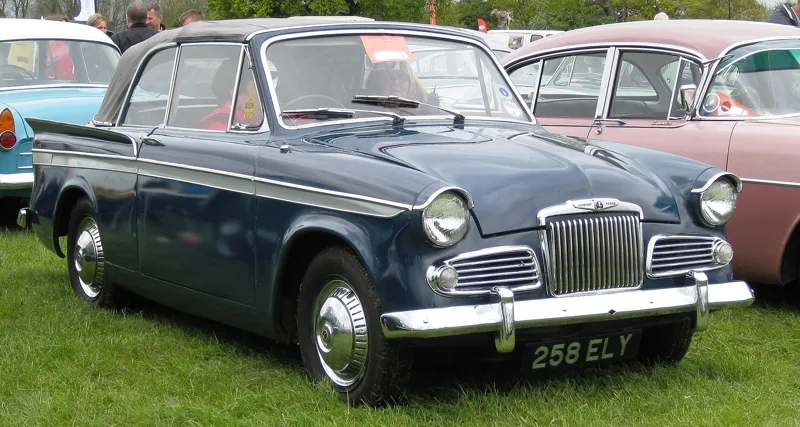
The Singer Vogue, positioned above the Gazelle, reached the market in July 1961, and the cheaper Hillman model followed in October. The Humber version did not appear until January 1963, more than a year after the first two. Rootes had already built pre-production cars with Sunbeam badges, but the car's comparatively high weight did not suit the sporty image of Sunbeam, so it went on sale as a Humber. The move also took the Humber brand into the middle class for the first time.
Within that family, it was the dearest car and the best equipped.
How did the Sceptre differ from its sister cars?
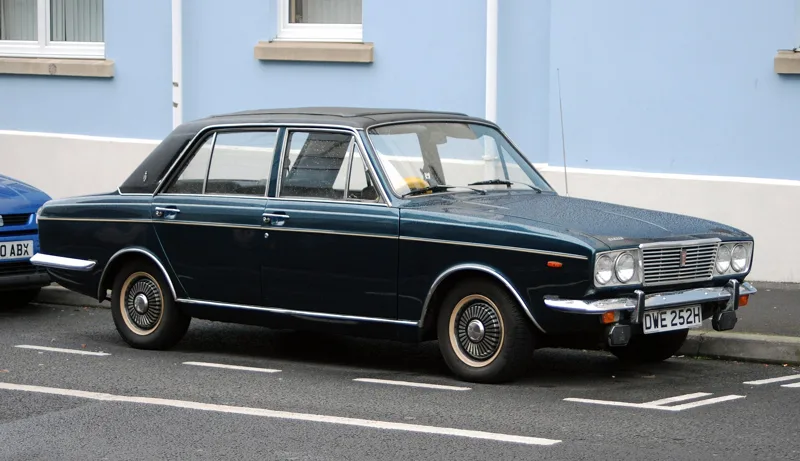
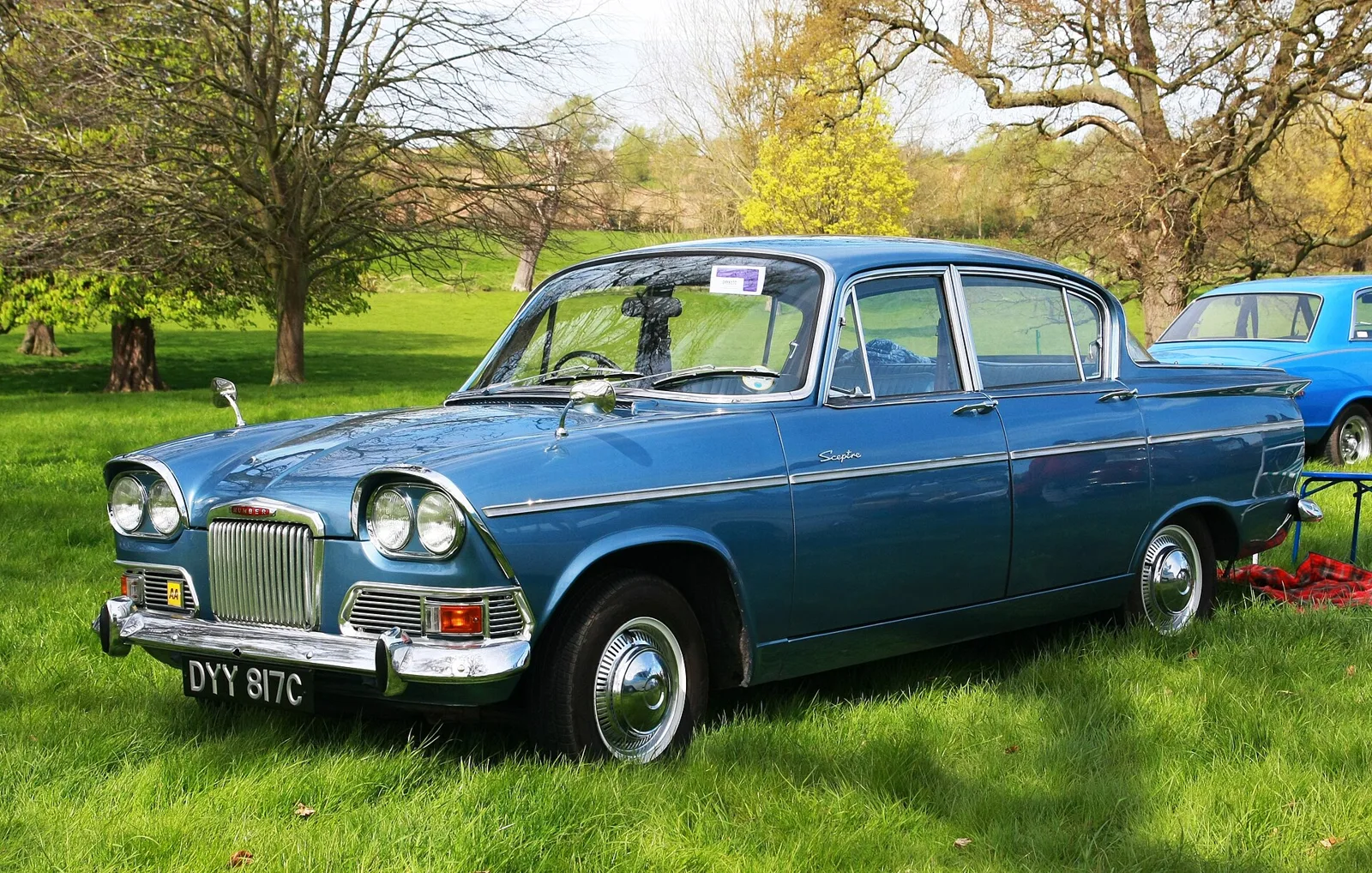
The Sceptre shared most of its panels with the Hillman and Singer, but it had its own windscreen and chrome trim, and it kept its rounded roof and panoramic rear window after the sister cars dropped them. Its styling carried American influence. The broad chrome frame around the rear window was unique to the Humber, and chrome triangular tail-light surrounds were a special feature of the car.
The body is a unitary structure, and Ted White directed the styling at Rootes' design studio. Raymond Loewy, who had worked on the forerunner of the Audax range, took no part in the Sceptre.
The windscreen is the car's most distinctive feature. It is larger than the windscreens of the Hillman and Singer and rises high into the roof. The wraparound shape follows the Forward Look that Virgil Exner styled for American Chrysler models from 1957 onward.
At the rear, horizontal fins lean inward at the boot lid, a style borrowed from Chevrolet models of the late 1950s. A two-tone paint option could be ordered to emphasise the flanks and fins. The Humber kept its rounded, sloping roof and panoramic rear window until production ended in 1967, while the Hillman and Singer adopted a trapezoidal roofline with a nearly flat back window in 1964.
What engine powered the Humber Sceptre?
Up front sat a longitudinally installed four-cylinder in-line unit, a design developed by Hillman that first appeared in 1953. The Mark I's engine displaced 1,592 cc (97.2 cu in) and produced 80 bhp (60 kW; 82 PS), stronger than the units in the Hillman and Singer.
The Mark I used the same variant as the Sunbeam Rapier Mark IV. Early cars had two downdraught carburettors, while engines built from 1964 had a twin downdraught carburettor. Other changes from the sister engines included a water-cooled inlet manifold, revised valve timing and stronger valve springs, so the valves seated properly at high engine speeds.
Power went to the rear wheels through a four-speed manual gearbox, and an overdrive on third and fourth gears was standard. The driver operated it with a lever on the steering wheel. The first gear of Mark I cars built up to September 1964 was not synchronised. A three-speed automatic was available at extra cost, but the easy-drive automatic offered on the Hillman and Singer was not sold on the Humber.
At the front, the Sceptre had independent suspension on double wishbones with coil springs. The driven rigid rear axle hung on longitudinal leaf springs. Stabiliser bars also cut back the strong understeer of the Hillman and Singer. Front discs came as standard, and the recirculating-ball steering had no power assistance.
How did the Mark II change the car?
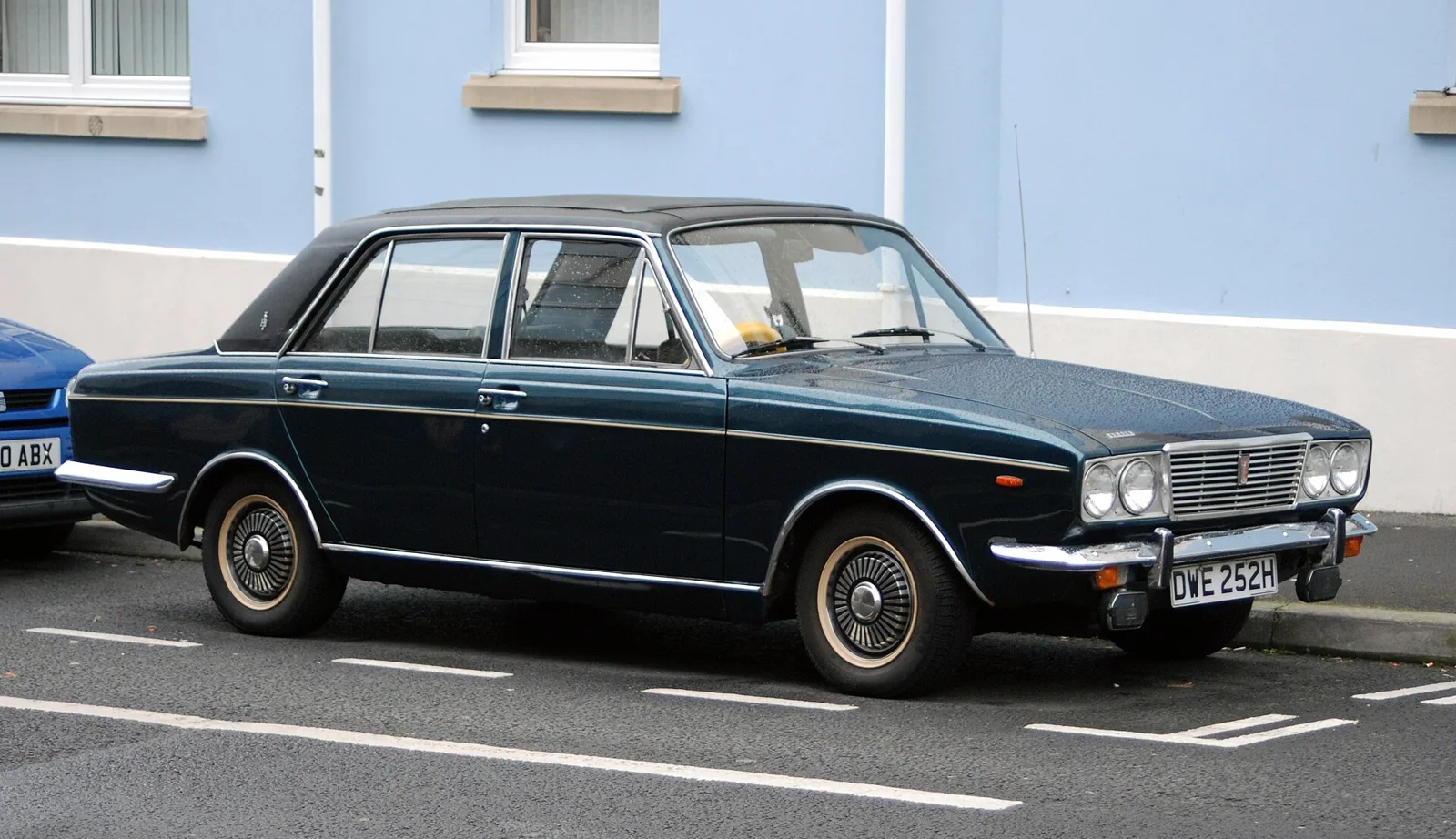
The Mark II arrived in autumn 1965 with a 1,725 cc (105.3 cu in) engine producing 85 bhp (63 kW; 86 PS), matching the Singer Vogue. The Sceptre therefore gave up its status as the strongest of the three siblings, and for rationalisation reasons its front end was built on the Hillman Super Minx design.
The front wings end in canopies that shelter the indicators and side lights, a feature the press sometimes called cat's ears. Beneath each canopy sits a single round headlight, mounted lower than on the Mark I, which the maker said gave better light. Chrome bars run across the whole nose, with a square grille in the middle, and a second pair of headlights set into that grille keeps the look of twin lamps. The rear end stayed unchanged.
How much did the Humber Sceptre cost?
The Mark I cost 997 pounds sterling in 1963, which was 30 percent more than the Hillman Super Minx at 768 pounds sterling. Standard kit covered warmth and airflow through a blower, dials for engine speed and oil pressure, electric wipers and a reversing light.
The Humber's standard equipment clearly went beyond what the Hillman and Singer offered as standard.
What were the Humber Sceptre specifications?
| Feature | Mark I (1963-1965) | Mark II (1965-1967) |
|---|---|---|
| Body | Four-door saloon, unitary construction | Four-door saloon, unitary construction |
| Engine | 1,592 cc (97.2 cu in), four-cylinder | 1,725 cc (105.3 cu in), four-cylinder |
| Power | 80 bhp (60 kW; 82 PS) | 85 bhp (63 kW; 86 PS) |
| Gearbox | Four-speed manual with overdrive; three-speed automatic optional | Four-speed manual with overdrive; three-speed automatic optional |
| Front suspension | Independent, double wishbones, coil springs | Independent, double wishbones, coil springs |
| Rear axle | Rigid, on longitudinal leaf springs | Rigid, on longitudinal leaf springs |
| Steering | Recirculating-ball, not power-assisted | Recirculating-ball, not power-assisted |
| Brakes | Front discs | Front discs |
| Built | 17,011 cars, to autumn 1965 | 11,985 cars, to summer 1967 |
How many Humber Sceptres were built?
Humber built 17,011 Mark I cars until autumn 1965 and 11,985 Mark II cars until production ended in summer 1967. A number of CKD kits were also produced for Mark I, and a few for Mark II, though the total for the Mark I is not known.
The bodyshells came from an independent maker in Cowley, Oxfordshire, the same arrangement Rootes used for the Hillman and Singer. Final assembly took place at the Rootes works at Ryton-on-Dunsmore, near Coventry.
How did the British press judge the Sceptre?
Critics of the day were wary of badge engineering in principle, arguing that manufacturers spent more effort keeping several brands alive than improving the cars. Even so, the Humber drew good reviews. Small Car magazine praised it as a bright newcomer, rating its sturdiness on a par with a Volvo and its quietness with a Rover.
What variants were built from the Sceptre?
Rootes experimentally fitted at least six Sceptre saloons with a 4.7-litre (287 cu in) American Ford V8, the engine also used in the open Sunbeam Tiger. A production V8 Humber never came about, and one prototype survives. Australia and Italy produced their own spin-offs.
The V8 car was meant to rival the Rover P5, whose top version used an eight-cylinder V engine from General Motors. Chrysler, already a shareholder in Rootes, is suspected of turning down a rival's engine.
In Australia, the Rootes branch at Port Melbourne ran a Humber Vogue from 1962 to 1965, sitting beside the Hillman model. Technically and in styling it was the unchanged Singer Vogue, sold under the Humber name for marketing reasons, and a sport version could be had with the Sceptre's stronger engine.
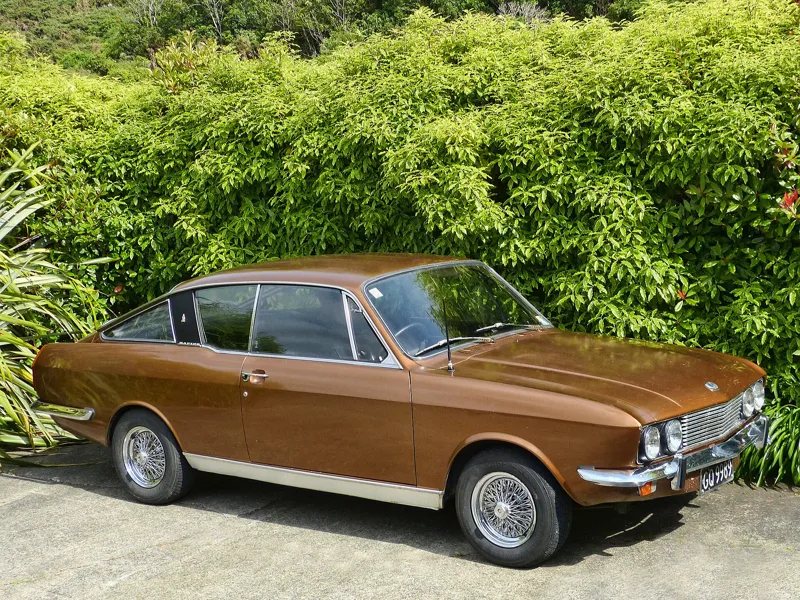
Carrozzeria Touring in Milan built the two-door Sunbeam Venezia from 1963 to 1965. Its floor pan and engine came from the Sceptre, and about 145 coupes were made with Humber running gear. Once Rootes pulled out of the order early, Touring carried on with roughly 50 more on the Hillman floor pan. A former Rootes developer recalled that the company briefly weighed the Venezia as a coupe edition of the Sceptre, though it never formally joined the British range.