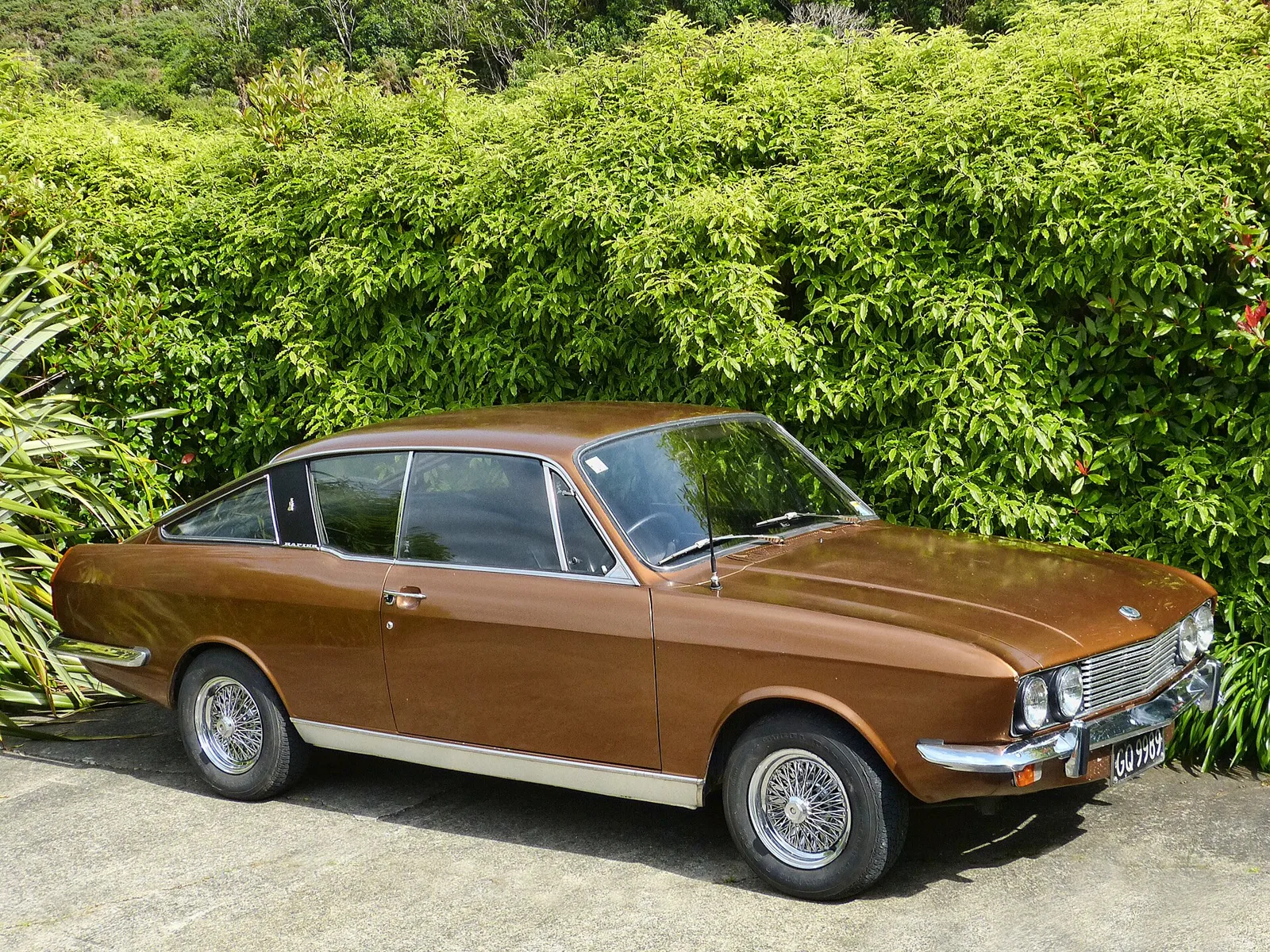
A two-door fastback from Rootes and Chrysler Europe, built from 1967 to 1976 with 1.7-litre engines, the H120 tune and a simpler Alpine.
The Sunbeam Rapier was a two-door fastback coupe built from 1967 to 1976 by Rootes and later Chrysler Europe. It shared the Arrow saloons' drivetrain and suspension, wore its own body and sold only under the Sunbeam name. A total of 46,204 coupes were built.
Sunbeam's two-door Rapier arrived in 1967 as the coupe of the Arrow range, and for a time it stood as the last of the marque's cars. Its underpinnings came from the Hillman Hunter estate, but the body was its own, with fastback glass and a sweeping belt line. Chrysler Europe kept the coupe going until 1976, and 46,204 were built across the whole run.
Where did the Rapier name come from?
The name came from the Audax family, which Rootes sold from 1956 as the Hillman Minx, Singer Gazelle and Sunbeam Rapier. When the two-door coupe joined the Arrow range in 1967, it took over the Rapier name. Labels such as New Rapier and Rapier Fastback became common for telling it apart from the older car.
The older Audax generation did not give way straight away. A Sunbeam version of the successor was ready, but it was moved to the Humber brand before series production, and the outdated Audax Rapier stayed on sale at Sunbeam until 1967. Rootes had also offered that successor range as Hillman, Humber and Singer models from 1961.
A two-door fastback that carried Sunbeam's sporting reputation on Arrow running gear.
What was the Arrow family?
Rootes introduced the Arrow range in 1966 as a successor to the Super Minx line and the older Audax models. Its core model was a four-door saloon, sold in a wide spread of marque and model variants. Hillman offered the Hunter and Minx, Singer the Vogue and Gazelle, and Humber the Sceptre Mark III, while Hillman and Singer added four-door estates.
The coupe followed in 1967 with the most powerful engines of the family. Unlike the saloons, which were sold under several marques, it stayed with Sunbeam, a departure from the group's usual practice. Sunbeam had a reputation for sporty cars, and the group chose it for the coupe on that basis.
Rootes had developed the coupe under its own management, and the American maker Chrysler took over the group in 1967. The coupe continued to be built under the new owner.
How did the coupe differ from the Arrow saloons?
The coupe looked nothing like the four-door Arrow saloons that Hillman, Singer and Humber sold. It had its own outer panels, round twin headlamps and a heavily glazed tail. Round twin headlamps came as standard, a feature the saloon had at first reserved for the Humber Sceptre.
Roy Axe, a Rootes designer, shaped the coupe. The door glass is frameless and there is no centre pillar, and the side glass sitting between the door and the C-pillar drops fully. The C-pillar is black on the standard car.
Above the rear wheels the belt line curves gently, in the coke-bottle style popular in the USA in the 1960s. Observers often compared the tail with the Plymouth Barracuda, a comparison Axe rejected. Where the Barracuda had a single rear panoramic window, the Rapier used three panes: a metal strut ran from the roof almost to the tail on each side of the rear window, with fixed triangular windows outside them. That arrangement was cheaper to produce. The upright tail lamps came from the Hillman Hunter estate.
Which engines did the Rapier use?
Every coupe used a Hillman in-line four-cylinder with a light-alloy head, five crankshaft bearings and overhead valves, displacing 1,725 cc (105.3 cu in). The 1.5-litre versions of the same block were left out. Output ran from 74 bhp (54 kW; 74 PS) in the Alpine to 93 bhp (69 kW; 94 PS) in the H120.
The engine sat at the front, tilted 10 degrees lengthways, and drove the rear wheels. A four-speed manual with overdrive was standard, and the overdrive could be used in third and fourth gear, raising the ratio by just under 25 percent. Some versions offered a three-speed automatic at extra cost, and the transmission never changed across the production run.
The chassis mirrored the four-door Arrow cars and was conventional. MacPherson struts located the front wheels, and the rear had a live axle on leaf springs. Discs stopped the front wheels and drums the rear, with servo assistance. The Arrow models used recirculating-ball steering.
What changed on the H 120?
The H120 arrived in October 1968 above the standard Rapier and stayed until 1976. Holbay Engineering had developed its more powerful 1.7-litre engine, which received a reworked head and camshaft, a different exhaust manifold, and a pair of Weber carburettors (40 DCOE). Output rose to 93 bhp (69 kW; 94 PS).
Power went through a manual four-speed gearbox with overdrive only. The automatic offered on the other coupes was not available on the H 120. From 1972 to 1976 the same unit could also be had in the Hillman Hunter GLS, a four-door saloon.
The H 120 looked different too. It had a boot lid with a built-in spoiler, Rostyle wheels as standard, broad contrasting accent stripes along the flanks, and a black-painted radiator grille.
Rapier, H 120 and Alpine at a glance
| Version | On sale | Output | Distinguishing features |
|---|---|---|---|
| Rapier | September 1967 to summer 1976 | 88 bhp (66 kW; 89 PS) | Black C-pillar, chrome radiator grille |
| Rapier H 120 | October 1968 to 1976 | 93 bhp (69 kW; 94 PS) | Twin Weber carburettors (40 DCOE), Rostyle wheels, boot spoiler |
| Alpine | 1970 to 1975 | 74 bhp (54 kW; 74 PS) | Base version, body-coloured C-pillar, plain chrome hubcaps |
The standard Rapier was the most frequently built version, marketed without any suffix and in production from September 1967 to summer 1976. Its 88 bhp (66 kW; 89 PS) engine was a version of the 1.7-litre unit, and the car was recognisable by its black C-pillar and chrome grille. In Great Britain it cost GBP 1,200 in 1967.
How was the Alpine different from the Rapier?
The Alpine was the simpler, cheaper base model. It was added in 1969 and built from 1970 to 1975, with a plainer interior, a dashboard trimmed in imitation wood and the lowest-output 1.7-litre engine at 74 bhp (54 kW; 74 PS). It cost GBP 1,096 when introduced. Fewer instruments and lighter equipment set it apart from the standard Rapier.
Stylistically the two cars were nearly identical. The Alpine used the same engine that powered the base Hillman Hunter, and overdrive was an extra-cost option on it rather than standard. A three-speed automatic could also be ordered, which the H120 did not offer.
The Alpine name came from earlier sports cars of the same name, so the new base model reversed the old order. Before 1969 the Alpine badge stood for the faster, better-equipped car, sitting above the Rapier. The Alpine was also the first coupe variant to leave production, while the standard Rapier and the H 120 continued one year longer.
Did the Rapier race?
No works entry was ever made in a motorsport event, despite the sporting reputation of the Rapier and the Alpine. Competition appearances were rare, and they involved specially prepared Hillman Hunter saloons rather than the coupes.
What did the Rapier become in North America?
Chrysler did not use the Rapier name for the standard car in the USA or Canada. There it was sold as the Sunbeam Alpine GT, which was not identical to the British Alpine. The four-door Arrow sold there was in effect a Hillman Hunter under another name.
There the Alpine GT joined the four-door Sunbeam Arrow saloon in the line-up.
What happened to the coupes after 1976?
Chrysler ended the coupes in 1976, when it dropped the Hillman, Humber and Sunbeam names in favour of Chrysler. In 1977 the Sunbeam name came back on a compact saloon, which was first sold under the Chrysler name and from 1979 under the Talbot name. That car used Avenger technology and had no link to the Arrow range.
How were the coupes built?
Pressed Steel Company made the bodyshells at Cowley, Oxfordshire, until 1968, when Rootes Pressings (Scotland) took over at Linwood. Final assembly remained at Ryton-on-Dunsmore, near Coventry, for a time, and in 1970 all Arrow production, coupes included, moved to Scotland.
Because of that split, bodyshells had to be carried across the country by goods train. In all, 46,204 Arrow coupes came out between 1967 and 1976, a figure that covers the standard Rapier, the H 120 and the Alpine.