Two drivers' titles with the W196 in the 1950s, a return as an engine supplier in 1994 and a hybrid era that produced eight straight constructors' crowns.
Juan Manuel Fangio gave the marque its first two drivers' titles in 1954 and 1955. After an engine partnership with McLaren and the purchase of Brawn GP, the works team went on to take eight straight constructors' titles between 2014 and 2021.
Mercedes-Benz has been involved in Formula One as both a team owner and an engine manufacturer for several periods since 1954. Its current team competes as Mercedes-AMG Petronas Formula One Team from Brackley in England, holding a German racing licence, and it is one of the most successful organisations in the sport's history.
How did Mercedes-Benz start in Grand Prix racing?
Before the Second World War Mercedes-Benz raced in the European Championship and won three titles. Its Silver Arrows dominated the 1930s alongside the rival Auto Union team, and both were heavily funded under the Nazi regime. Rudolf Caracciola won three European titles for the marque in that period.
The team returned to what had become the Formula One World Championship in 1954, under the leadership of Alfred Neubauer, with the technically advanced W196. The car ran in both a conventional open-wheeled form and a streamlined version with covered wheels and wider bodywork.
Juan Manuel Fangio, the 1951 champion, moved from Maserati mid-season to join the team for its debut at the French Grand Prix on 4 July 1954. The team scored an immediate 1-2 with Fangio and Karl Kling, and Hans Herrmann set the fastest lap.
Two titles in the first Mercedes period, then a long hybrid dynasty built on engineering depth and a deep bench of drivers.
What were the 1954 and 1955 seasons like?
Fangio went on to win three more races in 1954 and the drivers' championship. He repeated the success in 1955, when he took four races and his new team-mate Stirling Moss won the British Grand Prix. The two finished first and second in the championship that year.
The 1955 season ended in tragedy at Le Mans on 11 June, when a crash killed the Mercedes-Benz sports car driver Pierre Levegh and more than 80 spectators. The Grands Prix in France, Germany, Spain and Switzerland were cancelled, and at the end of the year the team withdrew from motor sport, including Formula One.
During that first period Mercedes won nine races in total. Three of those wins, at the 1954 French and Italian Grands Prix and the 1955 Italian Grand Prix, came from the streamlined Type Monza, which made them the only closed-wheel cars to win a race in the sport's history.
How did the team return with engines in 1994?
In 1994 Mercedes came back to the grid as an engine maker, working with Ilmor, a British engineering house. The engines were developed by Ilmor, and the partnership supplied Sauber for a single season before moving to McLaren from 1995.
The McLaren partnership lasted 20 years. Together the works operation won one constructors' title and three drivers' titles before it ended in advance of the 2015 season. Ilmor itself was rebranded as Mercedes AMG High Performance Powertrains in 2005.
In 2009 the company turned its attention to a team as well as an engine. Daimler bought a 45.1% stake in Brawn GP, with Aabar Investments taking 30%, and the team was renamed Mercedes GP Petronas Formula One Team for 2010.
What happened to the works team between 2010 and 2013?
Ross Brawn stayed on as team principal, and the team kept its Brackley base, a 60,000 m2 (650,000 sq ft) facility. Michael Schumacher returned after a three-year absence to drive alongside Nico Rosberg, while Nick Heidfeld was the test and reserve driver.
The 2010 team was not as strong as Brawn's title-winning car. Rosberg finished third three times, at Sepang, Shanghai and Silverstone, and the team ended fourth in the Constructors' Championship with 214 points. Schumacher had a difficult return, and he failed to score a podium in his first season back.
In 2011 the team finished fourth again, with 165 points and no wins. For 2012 the AMG name was added to the team's title, and at the Chinese Grand Prix Rosberg took the first works pole position since Fangio in 1955 and went on to win the race, the first victory for the team in 57 years.
That win was also the first for a German driver in a German car since Hermann Lang at the 1939 Swiss Grand Prix. In January 2013 Toto Wolff became an executive director, taking 30% of Mercedes-Benz Grand Prix Ltd, while Niki Lauda held 10% as chairman and the parent company retained 60%.
How did the hybrid era begin for Mercedes?
Lewis Hamilton joined from McLaren for 2013, and Rosberg won the Monaco Grand Prix from pole that season. The team then took its third win of the year when Hamilton won the Hungarian Grand Prix, which left it second in the Constructors' Championship behind Red Bull.
The V6 turbo hybrid rules arrived in 2014, and Mercedes dominated them from the start. The team won 16 races from 19, with 18 pole positions and 11 1-2 finishes, and its average winning margin over the nearest rival was 23.2 seconds.
Hamilton won the 2014 drivers' title, finishing 67 points ahead of Rosberg, and the team took its first works Constructors' Championship at the Russian Grand Prix. The team finished 296 points ahead of Red Bull in the standings.
In 2015 Hamilton won his second straight title by 59 points over Rosberg, and the team took its second consecutive constructors' crown. Mercedes won 16 races from 19 that year, with 12 1-2 finishes, and the winning margin fell to 19.7 seconds.
Why was the 2016 season so dominant?
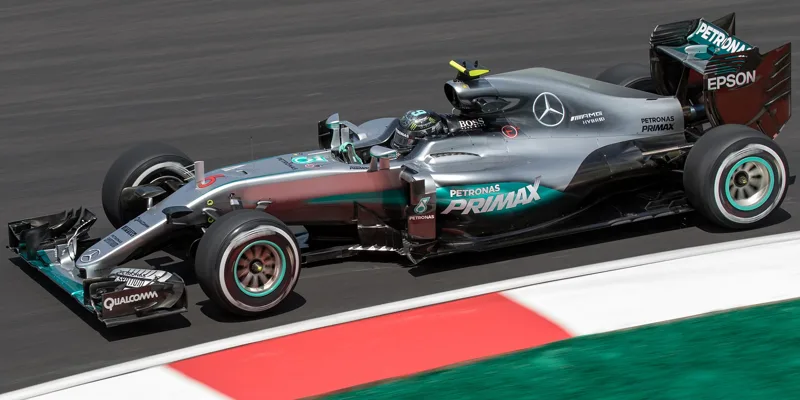
In 2016 Mercedes won the Constructors' Championship for the third consecutive season, taking 19 wins from 21 races, while securing 20 poles, a record 95.2% share of the grid. The typical winning margin shrank to 14.6 seconds over the nearest rival outside the team.
Rosberg won the drivers' title by five points over Hamilton and retired shortly afterwards. Valtteri Bottas took his seat for 2017, and George Russell joined the junior team that year.
In 2017 the team won its fourth straight constructors' title with 12 wins from 20 races. Hamilton also became the first British driver to win four world championships that year, and the car set up 15 poles and four 1-2 finishes.
In 2018 Mercedes won 11 races, all for Hamilton, and clinched its fifth straight constructors' title. That made Mercedes only the second squad to complete five straight double titles, after Ferrari managed the feat in the early 2000s.
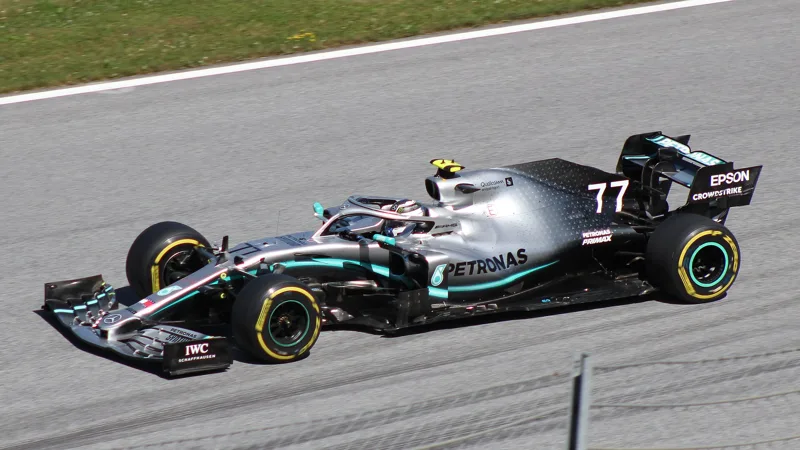
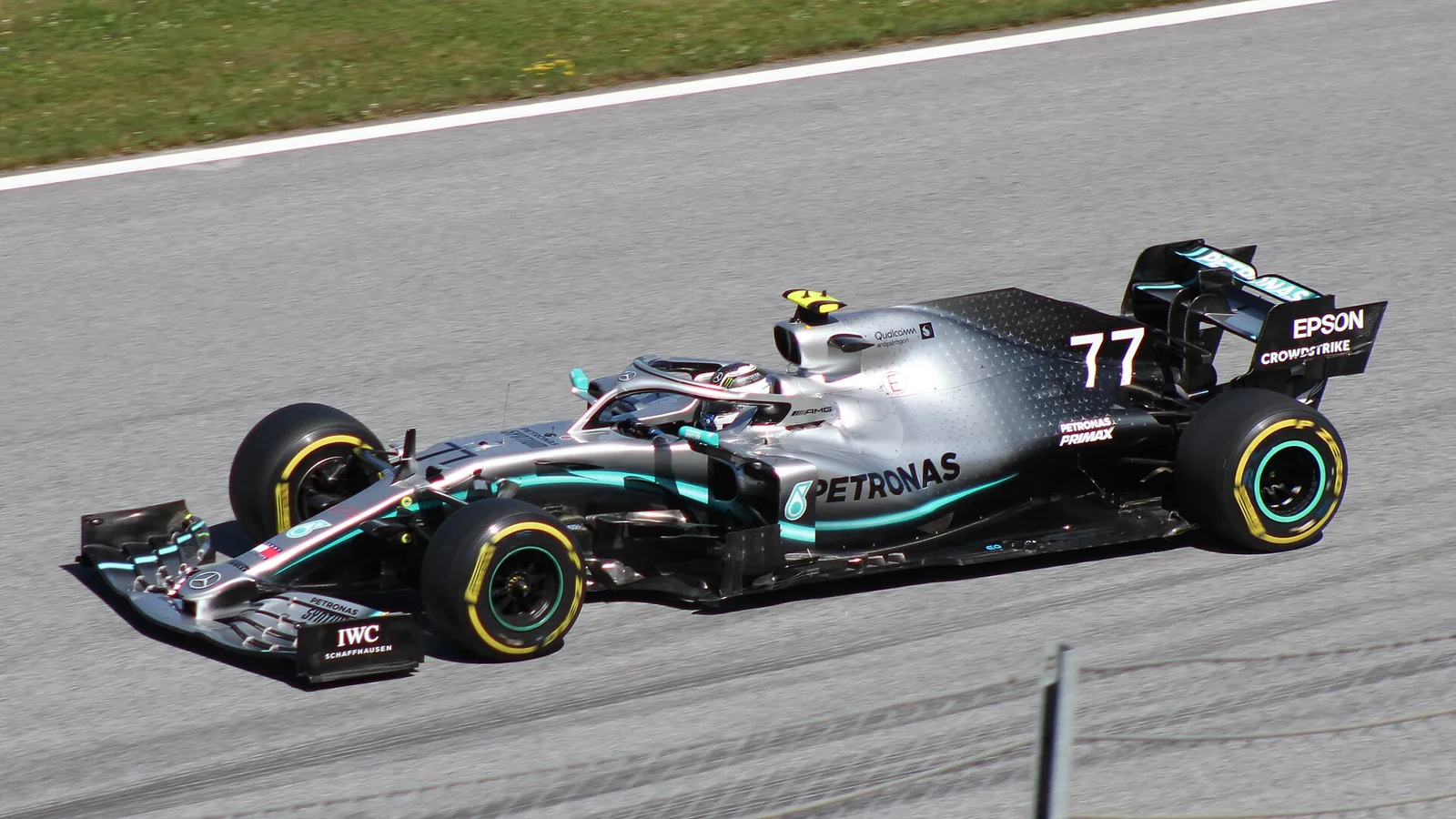
The 2019 season brought the sixth constructors' title, as Mercedes won 10 of 12 races by the summer break. Bottas took his first victory since 2017 at the opening race, and the team went on to win both championships again.
What was the team's 2020 and 2021 story?
Mercedes debuted the Dual-Axis Steering system during pre-season testing for 2020. It allowed the driver to change the toe of the front wheels, which helped the tyres warm up on straights and gave more mechanical grip in corners. The system was allowed for 2020, but it was made illegal for 2021.
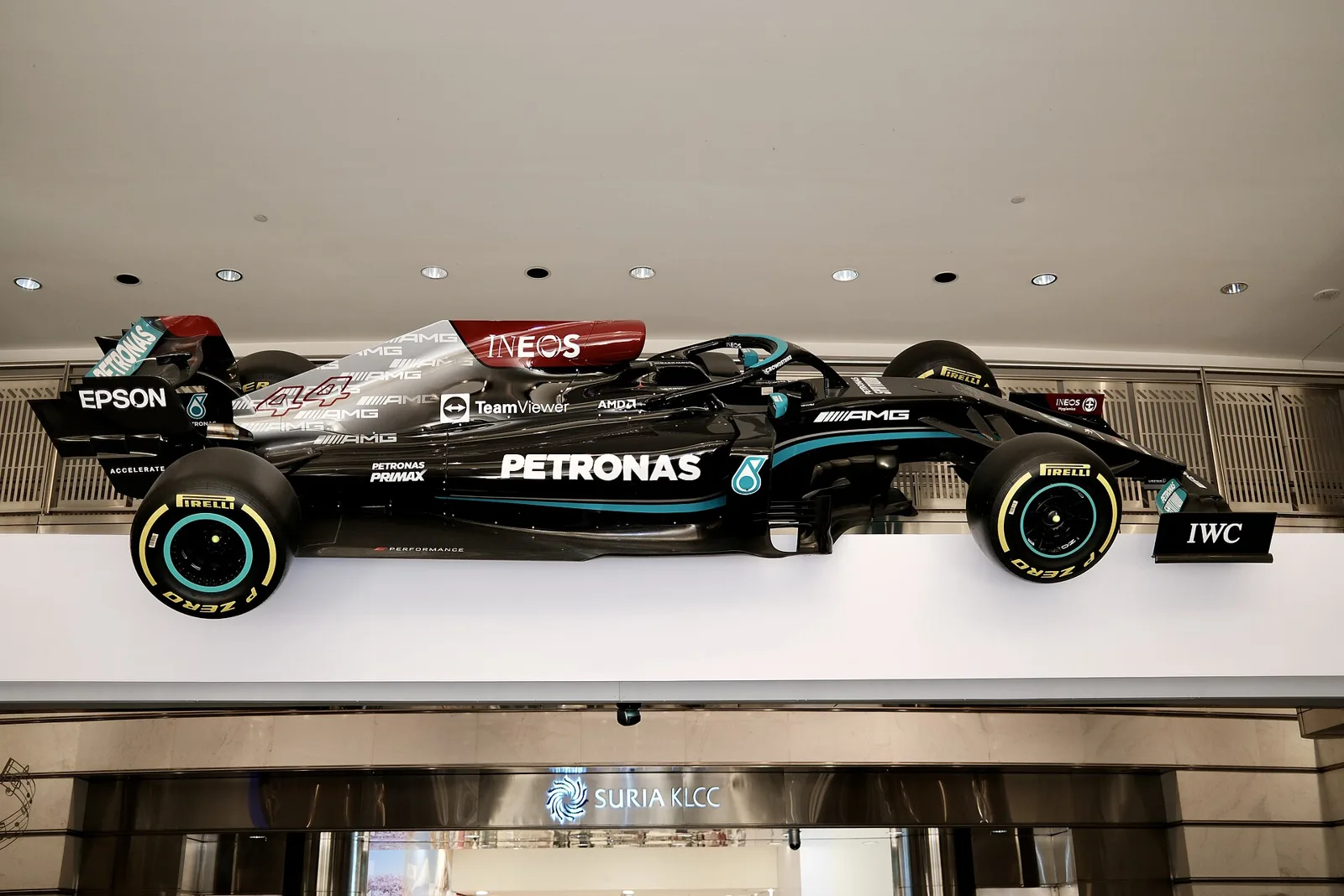
In 2021 Hamilton lost the drivers' title to Max Verstappen by eight points after a controversial safety car restart at Abu Dhabi. The team still won its eighth consecutive constructors' title, a record run.
How did the team struggle with ground effect?
Russell replaced Bottas beside Hamilton for 2022, when the rules reintroduced ground effect. The team's radical zero-pods concept did not work well, and the car suffered from porpoising, which was reduced ahead of the Canadian Grand Prix.
Despite the struggles the team's reliability was strong, and it regularly appeared on the podium. Russell claimed his first pole and the team's first of the season at the Hungarian Grand Prix, and he won at Sao Paulo with Hamilton second, the only win of the year for the squad.
In April 2023 the team replaced technical director Mike Elliott with James Allison, while Elliott became chief technical officer. That season the team finished second in the Constructors' Championship, three points ahead of Ferrari, but it went without a win for the first time since 2011.
At the United States Grand Prix Hamilton finished 0.3 seconds behind the champion, Max Verstappen, before being disqualified because his rear skid blocks were worn below the limit. In Hungary Hamilton took his ninth pole at the circuit, a record for a single venue.
What did the 2024 to 2026 seasons bring?
The 2024 car, the W15, had a completely different concept aimed at catching the leading team. The team won the Austrian and British Grands Prix in consecutive races, and Hamilton's British win ended a long wait and broke Michael Schumacher's record for most wins at a single circuit.
On 1 February 2024 Mercedes confirmed that Hamilton would leave after 12 years to join Ferrari from 2025. Kimi Antonelli, a Mercedes junior, was announced as his replacement on 31 August 2024, and Bottas returned as a reserve driver.
Russell won in Canada and Singapore in 2024, and Antonelli took his maiden podium in Canada. The team ended the year as runner-up in the Constructors' standings that year, and the Mercedes W17 began 2026 in strong form.
In 2026 the team recorded 1-2 finishes in the first two races. Antonelli became the youngest driver ever to lead the world championship after winning the Japanese Grand Prix, and at Miami he converted his first three consecutive poles into wins at the same events.
| Era | Key milestone | Result |
|---|---|---|
| 1954 to 1955 | First Mercedes period in Formula One | Two drivers' titles with Fangio, nine race wins |
| 1994 to 2009 | Engine partnership with McLaren | One constructors' title and three drivers' titles |
| 2010 to 2013 | Brawn team in Mercedes colours | Fourth in 2010 and 2011, first win in 57 years in 2012 |
| 2014 to 2021 | Hybrid era dominance | Eight straight constructors' titles |
| 2022 to 2025 | Ground effect struggle | Second in 2023 and 2024, no wins in 2023 |
| 2026 onwards | Return to title contention | 1-2 finishes in the opening races |
Who owns and sponsors the team?
In 2025 Toto Wolff sold part of his shareholding to George Kurtz, the chief executive and founder of the cybersecurity firm CrowdStrike, making Kurtz a co-owner. Wolff remains team principal and chief executive, and the strategic steering committee includes the Mercedes-Benz chairman, Ola Kallenius, and the chairman of Ineos, Jim Ratcliffe.
Ineos took a one-third stake alongside Mercedes-Benz Group and Wolff, effective 25 January 2022. Petronas has been the title sponsor since the team's rebrand, and the two companies renewed their title and technical partnership from 2026.
Not every sponsorship worked out. A planned Henkel deal was found to be invalid in 2009, and the team's FTX sponsorship was suspended before the 2022 Sao Paulo Grand Prix, after which a lawsuit over the promotion was filed in Miami in November 2023.
A 2021 deal with the Kingspan Group drew criticism because of the Grenfell Tower inquiry, which concerned a fire that killed 72 people. Mercedes ended the deal on 8 December 2021, a week after announcing it.
What is the team's record as an engine supplier?
Mercedes-Benz supplied engines to Alpine, McLaren and Williams in 2026, alongside its own works team. Its engines have won more than 200 races as a supplier, and they have carried twelve constructors' and fourteen drivers' titles.
The company first supplied Force India in 2009, a relationship that later passed to Racing Point and Aston Martin. Williams joined the supply programme in 2014, and Mercedes supplied the Lotus team for one season in 2015 and Manor for one in 2016.
What is the legacy of Mercedes-Benz in Formula One?
Mercedes-Benz's record divides into two clear periods, the Fangio-era Silver Arrows that won two drivers' titles and the modern hybrid era that delivered an unprecedented run of constructors' championships. Its racing record of 50% constructors' titles and 50% drivers' titles is among the strongest in the sport.
The team's junior programme has also been influential. Pascal Wehrlein was the first graduate to race in Formula One, and Russell and Antonelli have since driven for the works team, while Esteban Ocon is the only other former driver in the 2026 field.