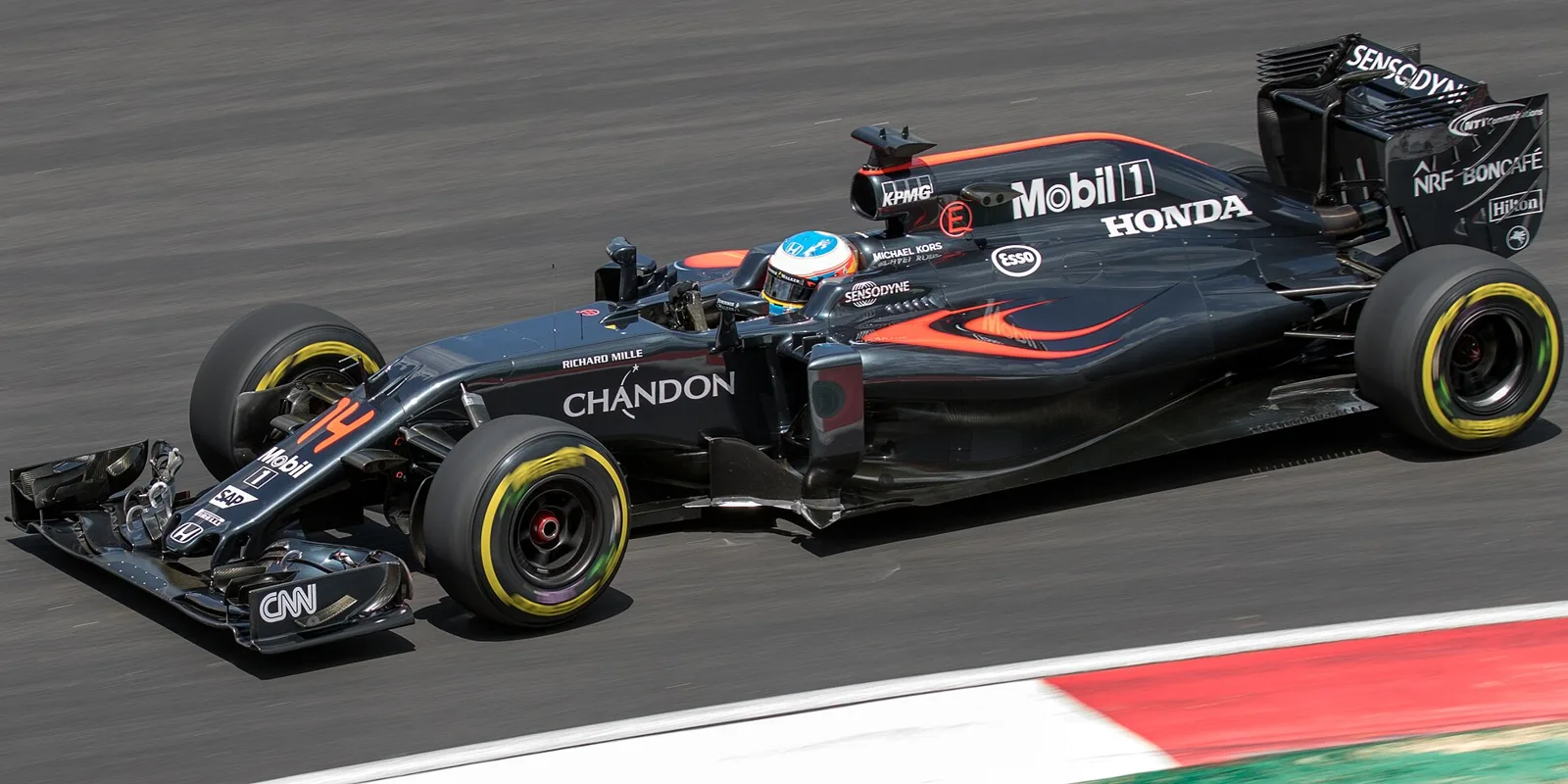
Fernando Alonso and Jenson Button drove a car that climbed from ninth to sixth in the standings, but reliability and crashes never went away.
The McLaren MP4-31 was McLaren's 2016 Formula One car, driven by Fernando Alonso and Jenson Button with a Honda engine. It finished sixth in the Constructors' Championship, up from ninth the year before, while reliability and crashes limited its results.
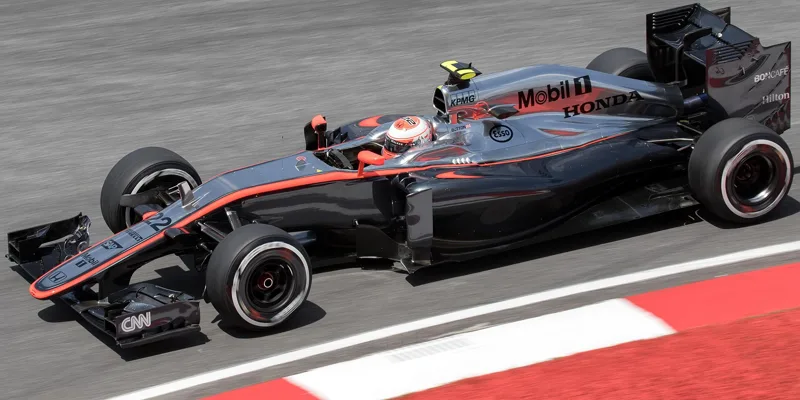
The McLaren MP4-31 was the Formula One car McLaren ran in 2016, and it was the last McLaren to carry the MP4 name. Fernando Alonso and Jenson Button drove it, with Stoffel Vandoorne as reserve, and it was built around a Honda engine that had struggled in the year before. The team finished sixth in the Constructors' Championship, but reliability and crashes never went away.
What was the McLaren MP4-31?
The MP4-31 was McLaren's car for the 2016 Formula One season, driven by two former champions, Fernando Alonso and Jenson Button. Stoffel Vandoorne was the reserve driver. The car finished sixth in the Constructors' Championship, ahead of ninth place in 2015, though the team still struggled for consistency.
Alonso had won the title in 2005 and 2006, and Button took his in 2009. Between them they gave the team a strong pairing on paper, but the car rarely let them show it across a full weekend.
The MP4-31 was the last McLaren to carry the MP4 name, and a car that climbed from ninth to sixth while reliability problems still held it back.
How was the MP4-31 developed?
The MP4-31 grew out of the MP4-30, the car that had raced in 2015. That season had been marred by reliability problems and an underperforming Honda engine. Before the year ended, development had already shifted to the 2016 car, so the new design began with the previous year's lessons.
The MP4-31 also marked a change in the team's identity. The MP4 prefix stopped there, once chief executive Ron Dennis had left the team.
What power unit did the MP4-31 use?
McLaren's power came from Honda's RA616H, the marque's second engine since the 2015 reunion. It was also the last McLaren to use ExxonMobil fuel and lubricant, because that sponsorship moved to Red Bull Racing in 2017.
The engine's problems were the defining theme of the season. Reliability improved on the 2015 picture, but the power unit still failed in several races.
How did the 2016 season open?
The season opened in Australia with both cars qualifying 12th and 13th, but Alonso crashed with Haas driver Esteban Gutierrez, and his car rolled before landing upside down. Alonso suffered broken ribs and a collapsed lung, which ruled him out of Bahrain. Vandoorne replaced him.
Button's race in Australia was also affected. A red flag came out after he had made a pit stop, leaving him behind cars that changed their tyres under it, and he finished 14th.
In Bahrain Vandoorne picked up McLaren's first point of the season with a tenth-place finish, including an overtake on Sergio Perez's Force India. Button, who was on course for a good result, retired after eight laps with an engine problem. Alonso returned in China, where both cars reached Q2 but not Q3, and both finished outside the points.
How did the middle of the season go?
The middle rounds brought the team its strongest results. Russia saw both cars finish in the points, with Alonso sixth and Button ninth, and Monaco gave Alonso fifth, his best finish since rejoining McLaren. Hungary put both cars into Q3 for the first time since 2014.
Qualifying was still the weak point. Neither car reached Q3 in Russia, extending a run of 23 races without a Q3 appearance, yet the race went well because turn-one incidents thinned the field. At Spain Alonso qualified tenth and retired, and Button claimed the points in his place.
Monaco was steady. Alonso was ninth on the grid after Kimi Raikkonen took a five-place penalty, then used good timing for tyres in changeable conditions to finish fifth, while Button finished ninth. In Canada Button retired with an engine failure, and Alonso finished 11th after losing time at pit stops.
Baku and Austria were mixed. At Baku Button recovered to 11th, while Alonso retired with a gearbox problem. In Austria Button finished sixth, but Alonso retired in the closing laps with an energy storage battery failure. The Hungarian round was better for Alonso, who finished seventh after a steady race, although Button was out on lap 60 after an oil leak, following a brake sensor problem and a penalty for illegal radio communications.
At Hockenheim Alonso finished 12th, while Button moved into eighth on the final lap after Valtteri Bottas slowed. Spa was dramatic. Alonso had an engine failure in qualifying and started from the back, but he climbed through the field to finish seventh and score six points. Button was hit by Pascal Wehrlein at Les Combes and retired. At Monza both cars were eliminated in Q2, but Alonso's lap was the first fastest lap by a Honda-powered car since Ayrton Senna's in 1992.
Did qualifying hold the car back?
Qualifying was often the car's limiting factor. Both cars regularly reached Q2, but Q3 was reached only occasionally, which made strategy harder to plan, and the race pace often did not match the grid positions the team had earned on Saturday.
In Bahrain both cars cleared Q2 with ease. In Austria Button qualified fifth, although many had expected the high-speed circuit to be a struggle, while Alonso went out on old tyres and qualified 14th after a team error.
Honda's upgrades arrived at Spa, and the team said the engine's true potential would not show until Singapore. Singapore itself was a disappointment, since the team felt it could have been the fourth-best outfit that weekend, though Button only managed 13th on the grid.
How did the final rounds go?
The closing rounds were mixed. Malaysia brought a double points finish, with Alonso seventh and Button ninth, while Japan at Suzuka was the team's most difficult weekend. The car and engine did not suit the circuit, and the pair finished 16th and 18th after Button took a penalty that left him starting last.
Singapore was tough for Button. He qualified 13th, started 12th after a penalty for Sergio Perez, and retired on lap 43 with brake problems. Alonso finished seventh again, and in Austin he matched his best finish of the year with fifth, helped by a Virtual Safety Car pit stop, while Button climbed from 19th to finish ninth.
In Mexico the pair slipped outside the points again, with Button 12th and Alonso 13th. At Sao Paulo Alonso recovered from a spin to finish tenth after starting 17th, while Button finished 16th.
The season ended in Abu Dhabi. Alonso qualified ninth and finished tenth, while Button qualified 12th and retired after breaking his right-front suspension on the kerbs. That retirement may have been his last race in Formula One.
How did the MP4-31 compare with its rivals?
The car's season is best read through its results. The table below sets out how the two drivers fared in a selection of rounds, showing the swings between strong weekends and retirements that defined the year.
| Round | Alonso | Button |
|---|---|---|
| Australia | Crashed out, injured | 14th |
| Bahrain | Missed the race | Retired after eight laps |
| Russia | 6th | 9th |
| Monaco | 5th | 9th |
| Canada | 11th | Retired, engine |
| Austria | Retired, battery | 6th |
| Hungary | 7th | Retired, oil leak on lap 60 |
| Singapore | 7th | Retired on lap 43 |
| Malaysia | 7th | 9th |
| Austin | 5th | 9th |
| Mexico | 13th | 12th |
| Brazil | 10th | 16th |
| Abu Dhabi | 10th | Retired, suspension |
How did McLaren finish the season?
McLaren finished sixth in the Constructors' Championship with 76 points, compared with 27 in 2015 and ninth place that year. The result was not a title challenge, but it was a clear recovery from the previous season and showed what the new car could do when the engine held together.
The team's progress was tied to Honda's progress. Upgrades were promised to both car and engine until the end of the season.
Why does the MP4-31 matter today?
The MP4-31 is remembered as the last car bearing the MP4 designation, and as the car that closed a chapter in the team's history. Its results show a team that was moving in the right direction, but one that still had work to do on reliability.
It also marks the point where McLaren and Honda had to prove that their partnership could deliver consistent results. The 2016 season showed progress, but the step from sixth place to a title fight was still a long one.