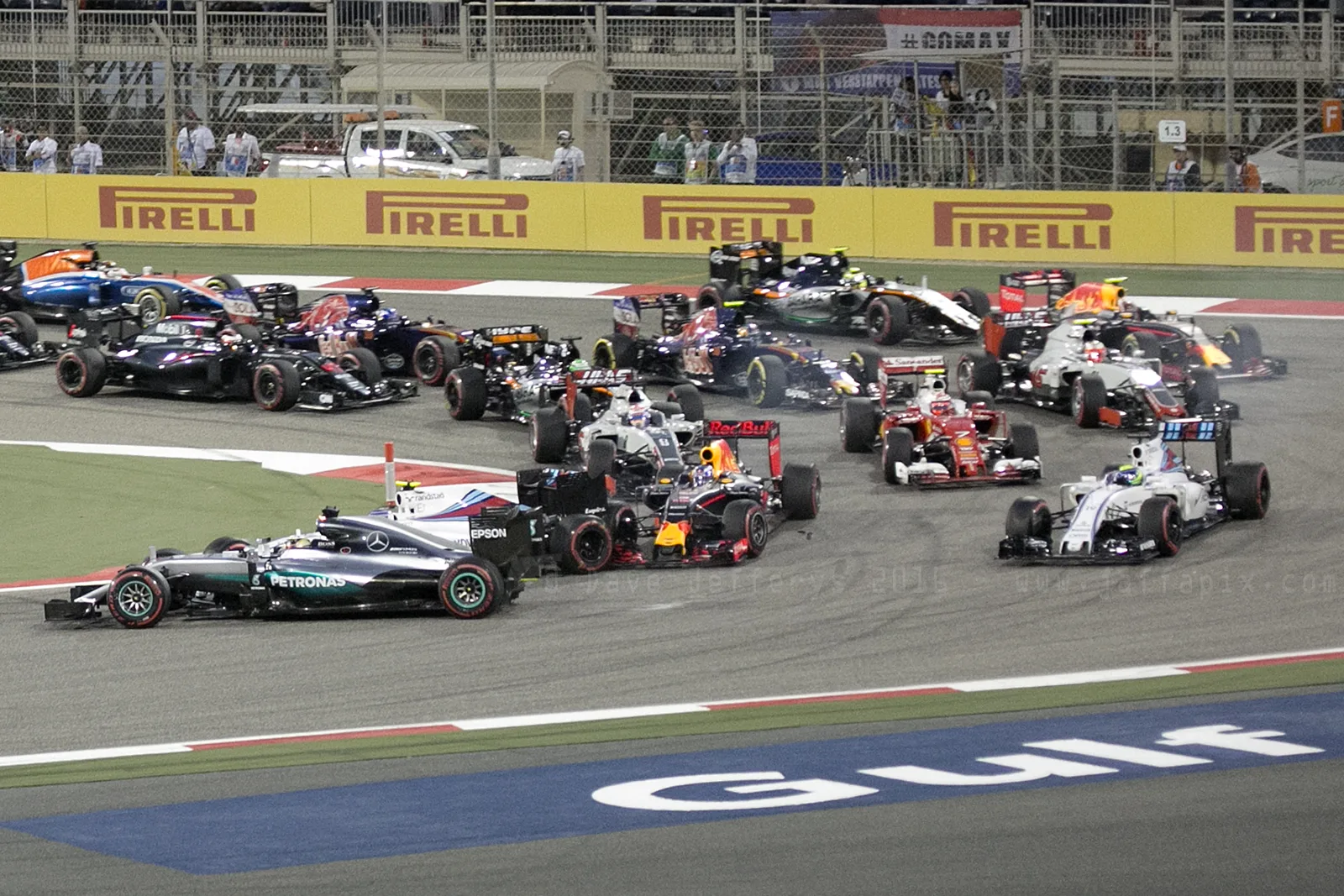
Nico Rosberg led from the start to win at Sakhir, while the elimination qualifying format that angered teams and fans dominated the paddock conversation.
Nico Rosberg won the 2016 Bahrain Grand Prix on 3 April 2016, the second round of the year, after leading from the start. Raikkonen was second and Hamilton third, while the elimination qualifying format used for the weekend kept the paddock arguing about the rules.
The 2016 Bahrain Grand Prix was the second round of the Formula One World Championship, held at the Bahrain International Circuit in Sakhir on 3 April 2016. Nico Rosberg won from the front, with Kimi Raikkonen second and Lewis Hamilton third, but the weekend was overshadowed by a row over the qualifying format that the teams had voted to scrap. The result gave Rosberg a commanding start to the title defence.
Why was the qualifying format still in dispute?
The elimination qualifying system had been heavily criticised after the Australian Grand Prix, and the teams voted to abandon it and return to the system used between 2006 and 2015. A meeting of the sport's Strategy Working Group the following week, however, chose to keep the elimination format for Bahrain and to review it before the next round in China. The teams had been offered only a choice between the elimination format and a hybrid of the two systems, so a straight return to the old rules was never on the table.
The drivers were just as unhappy. Sebastian Vettel said he was as disappointed as anyone he knew, while Hamilton called the decision strange, particularly because the fans had been unhappy with the format. Mercedes motorsport director Toto Wolff was adamant that the system needed to be reverted and did not expect qualifying to be more entertaining than it had been in Australia. Another meeting was scheduled for race day, with FIA president Jean Todt and commercial rights holder Bernie Ecclestone both present.
An elimination format, a warm-up lap failure and a clean race from the front made Sakhir 2016 about more than one driver.
Who was missing from the Bahrain grid?
Fernando Alonso was not in Bahrain. He had suffered broken ribs and a pneumothorax after a collision with Esteban Gutierrez in Australia, and McLaren's reserve driver Stoffel Vandoorne took his place. Gutierrez received a new chassis because the original was too damaged to repair, with the damage mostly caused by the crane during recovery rather than by the impact itself.
Ferrari were able to keep the same engine in Raikkonen's car as in Australia, where it had caught fire after a turbo failure. Quick action by the crew at the scene prevented serious damage to the combustion engine, so only the turbo needed changing. At Force India, Alfonso Celis Jr. made his first appearance in a Formula One session during the opening practice.
How did the tyre choices and the protest shape the weekend?
Pirelli brought the super-soft, soft and medium compounds to Bahrain, the same selection used in Australia, and drivers could choose from those three. The frontrunners approached the weekend differently. Mercedes took only one set of the harder medium tyres for each driver, while Ferrari took three sets, which cut into its allocation of soft tyres.
Human rights were also in the background, as they had been in previous years. The Bahrain Institute for Rights and Democracy wrote an open letter to Todt in the week before the race. It said that severe rights violations had been committed during the race authorised by the FIA, and it urged the governing body to be ready to cancel the race in the years ahead.
How did the three practice sessions go?
Three practice sessions took place, two of ninety minutes on Friday and a one-hour session before qualifying on Saturday. In the first practice on Friday, Rosberg was fastest at 1:32.292, more than half a second ahead of his team-mate Hamilton, with Raikkonen third, almost two seconds slower than Rosberg. Vandoorne and Celis were 18th and 21st. The weather was unusually cool, which the teams saw as representative of the expected conditions for the night race, so many drivers ran long programmes, and sixteen of them completed twenty laps or more.
Rosberg was fastest again in the second session, at 1:31.001, more than one and a half seconds quicker than the pole time from the previous year. Hamilton was 0.241 seconds behind him. Jenson Button was the best of the McLarens in third, more than a second off the pace, and Verstappen was fourth ahead of the two Ferraris. Vettel had set the third-fastest time on the soft tyre but made mistakes on the super-softs and ended his session early when a rear wheel nut came loose.
Sebastian Vettel led a Ferrari one-two in the third session at 1:31.683, ahead of Raikkonen. The Mercedes pair followed, with Valtteri Bottas and Romain Grosjean behind them. Felipe Massa ran a new, shorter nose for Williams and managed only ninth. Magnussen had failed to stop for his weigh-in at the end of the second session and was therefore sent to start from the pit lane. Jolyon Palmer ended the day with a puncture.
How did elimination qualifying work in practice?
Qualifying ran in three parts of 16, 15 and 14 minutes. The slowest runner was eliminated every ninety seconds, beginning seven minutes into the first part, six minutes into the second and five minutes into the third. Drivers who had set their fast laps therefore had to return to the pit lane and watch the clock, while those under threat stayed on track to try to get out of the bottom places.
Felipe Nasr made a mistake on his only lap and qualified last. Pascal Wehrlein qualified 16th, ahead of Sergio Perez, while Magnussen was 19th but still faced the pit lane start because of his penalty from practice. The second part started badly, when the red light at the pit lane exit was still showing as the clock began to run. A marshal then waved the drivers out.
Hamilton set the fastest time in that part, but a mistake by Rosberg allowed Vettel to take second place. Daniil Kvyat was the first driver out. Vandoorne, on his debut, out-qualified his team-mate Button. Only Hulkenberg went out again to improve and reached the third part in eighth, leaving Grosjean, Verstappen and Sainz behind him.
In the final part the four fastest cars came out again. Hamilton ran wide at the last corner and dropped behind Rosberg and both Ferraris, but he later took pole in 1:29.493, the fastest lap ever set at the Bahrain circuit. Rosberg was 0.077 seconds slower, with Vettel third and Raikkonen fourth.
| Grid | Driver | Note from qualifying |
|---|---|---|
| First | Lewis Hamilton | 1:29.493, quickest lap yet set at Sakhir |
| Second | Nico Rosberg | 0.077 seconds slower than pole |
| Third | Sebastian Vettel | Ferrari, ahead of team-mate Raikkonen |
| Fourth | Kimi Raikkonen | Ferrari, the last driver in the top four |
Hamilton was reprimanded after the session for reversing in the pit lane, an investigation that threatened his pole. He kept the position. Vettel and Palmer did not reach the grid and their slots were left empty, while Magnussen started from the pit lane.
What did the teams decide after qualifying?
At a meeting between the FIA, Formula One Management and the teams on race day, no agreement was reached to return to the old format, and the representatives ruled out that option for the rest of the season. A new proposal was put forward in which every driver would set two timed laps in each part of qualifying, with the two times added together to set the grid.
Reactions were mixed. Vettel dismissed the idea in strong terms, Ricciardo said he would not be too keen on it, and Button described it as a better plan than the existing system. On 7 April the teams unanimously rejected the scheme and demanded a return to the 2006 to 2015 format. The decision was finalised four days later.
How did the race start?
Two drivers were out before the lights went out. Vettel's engine failed on the warm-up lap, which was the first time in his Formula One career that he was unable to start a race. Palmer stopped in the pit lane with a hydraulic failure and did not take his place on the grid.
Rosberg pulled into the lead ahead of Hamilton at the start, but Hamilton came into contact with Bottas and dropped back to ninth. Bottas and Ricciardo both damaged their front wings in the incident. Massa took advantage to move into second behind Rosberg, and further back Sergio Perez and Carlos Sainz collided, leaving Sainz with a puncture and Perez with front wing damage. Kvyat and Hulkenberg were also caught up in contact on the first lap.
After five laps the order was Rosberg, Massa, Bottas, Ricciardo and Raikkonen, who moved into fourth a lap later. Button retired after his energy recovery system failed. Bottas was later given a drive-through for the collision with Hamilton, and Esteban Gutierrez retired with brake failure on lap eleven.
How did the strategies unfold in the middle of the race?
Raikkonen came in first among the leaders, stopping on lap twelve. Rosberg and Hamilton were not far behind, pitting over the next few laps. Hamilton came out behind Kvyat and Massa, passed both and then took third from Ricciardo on lap 17. A lap later Grosjean went ahead of Massa for fifth, and Rosberg pulled clear at the front, leading Raikkonen by twelve seconds on lap 22.
Grosjean moved past Ricciardo for fourth on lap 25, and Ricciardo later pitted for fresh tyres. Three laps after his stop he used the new rubber to pass his team-mate Kvyat for fifth. The main pit stops then began on lap 29, when Hamilton, Raikkonen and Grosjean came in, followed by Massa a lap later. Rosberg stopped on the next lap and returned in the lead, while Hamilton closed on Raikkonen, who was then 3.7 seconds ahead of him.
By lap 38 Rosberg led Raikkonen by nine seconds, with Hamilton a further five seconds back. Raikkonen pitted on that same lap, and the two Mercedes drivers followed him into the pits over the next two laps. Grosjean's stop on lap 41 lasted 25 seconds, which cost him ground, and Kvyat pitted on lap 45 before passing Massa a lap later.
How did Rosberg hold on to win?
Rosberg kept his advantage over Raikkonen through the closing laps, extending it to eight seconds once he had ten laps to go. Kvyat passed Bottas for eighth on lap 51, while Wehrlein moved ahead of Hulkenberg for 13th the following lap. Wehrlein then chased Marcus Ericsson's Sauber without success, and Kvyat took seventh from Massa on lap 56.
Rosberg took the chequered flag ahead of Raikkonen and Hamilton. Ricciardo finished fourth and Grosjean fifth, improving on his result from Australia. Stoffel Vandoorne scored a point on his debut in tenth. The result was the best start for a new team in Formula One since Shadow in 1973, as Haas finished fifth and sixth in their first two races.
What did the drivers say after the race?
At the podium interviews, Rosberg described it as an awesome weekend and said the start had been the key to his win. Raikkonen and Ferrari lamented their poor start, which they felt might have cost him victory. Ferrari team principal Maurizio Arrivabene praised Raikkonen's move around the outside of Ricciardo, saying it reminded him of drivers from the old days.
Hamilton said his second start incident in a row was perhaps more painful than the one in Australia, and he explained that the damage from the first-turn contact prevented him from matching Raikkonen's pace ahead of him. Grosjean earned his second consecutive Driver of the Day award, and he had been saved from retirement by a mechanic who replaced a loose wheel nut on his left-rear wheel. Bottas picked up two penalty points on his licence for the start collision, and Button was frustrated to lose a possible points finish. Vandoorne called his first point a bonus to a successful weekend.
What did the result mean for the championship?
Rosberg collected the maximum 50 points from the first two races and led the drivers' standings. Hamilton was second, 17 points behind, and Ricciardo third, a further nine points adrift. Mercedes led the constructors on 83 points, 50 ahead of Ferrari, while Red Bull were third, three points further back.