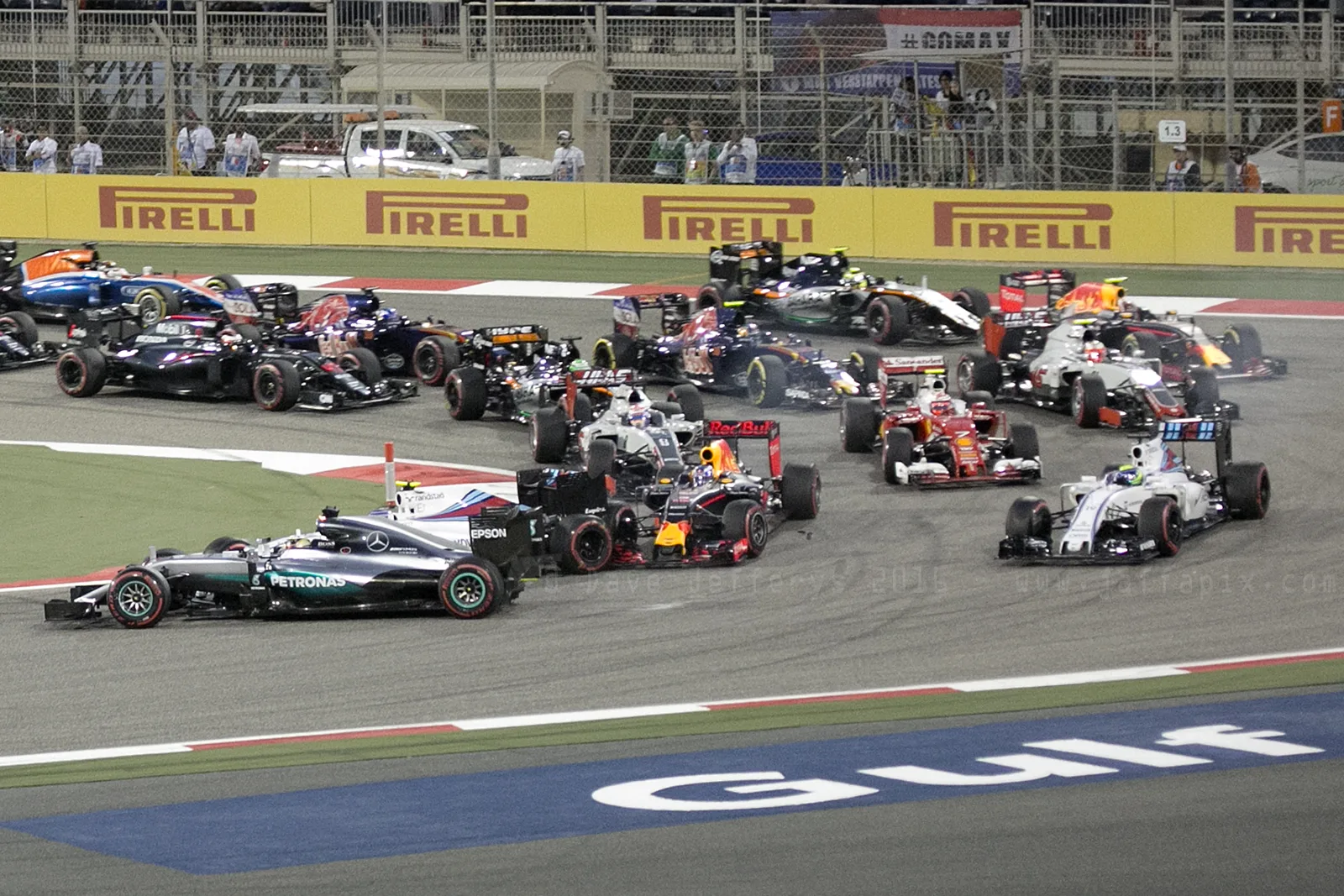
Nico Rosberg won the first Grand Prix in Azerbaijan, while Valtteri Bottas set the fastest speed ever recorded in an official session.
The 2016 European Grand Prix was held on 19 June 2016 at the Baku City Circuit in Azerbaijan, the first Grand Prix staged in the country. Nico Rosberg won for Mercedes, with Sebastian Vettel second and Sergio Perez third for Force India, and Rosberg's win extended his championship lead.
Nico Rosberg won the 2016 European Grand Prix at the Baku City Circuit on 19 June, the first Grand Prix ever held in Azerbaijan. Valtteri Bottas had set the highest speed ever recorded in an official Formula One session during qualifying, and Sebastian Vettel and Sergio Perez completed the podium.
Who led the championship going in?
Rosberg arrived in Baku with 116 points, nine ahead of his teammate Lewis Hamilton. Sebastian Vettel was third on 78 points, six clear of Daniel Ricciardo, with Kimi Raikkonen on 69 in fifth place in the drivers' table.
In the constructors' table Mercedes led with 223 points, ahead of Ferrari on 147 and Red Bull Racing on 130, with Williams a further 49 points behind Red Bull.
Rosberg won the first Grand Prix in Azerbaijan, while Bottas set the fastest speed ever recorded in an official session.
Why was Baku's race so closely watched?
The Baku City Circuit was brand new, and the race was the first Grand Prix in Azerbaijan. Bernie Ecclestone first announced the race in May 2014, saying it would take the place of the Korean race from the 2015 season, before the debut was pushed back to 2016.
Hermann Tilke designed the street track and released first pictures in October 2014. The government confirmed the plans in July 2014 under the title Grand Prix of Europe, and Ecclestone gave the final go-ahead in April 2015. Baku became the second Grand Prix held in the former Soviet Union, after Sochi.
The event drew criticism over the country's human rights record. The campaign group Sport for Rights wrote to Ecclestone in June asking him to speak out, although it did not call for the race to be cancelled. It asked the sport to put those issues in front of the public through the event.
Why did the start time change?
The date of 19 June collided with the closing hours of the 2016 Le Mans race. Hulkenberg, who had triumphed at Le Mans in 2015 for Porsche, could not go back to defend that title, and critics accused Formula One of picking the date to keep its drivers away from Le Mans.
In May 2016 the Azerbaijan government dropped daylight saving time, so the organisers moved the start, and the new timing ended the overlap with the closing hours of Le Mans.
When Sport for Rights pressed Ecclestone, he replied a week later that Formula One's conscience on human rights was clear, and he asked where the sport could race if it avoided every country with corruption.
What did the circuit look like before the race?
The track cleared its final inspection during May 2016, and FIA Race Director Charlie Whiting said he was satisfied it would be ready. Drivers nonetheless pointed to a shortage of run-off in some corners, and a tight pit entry placed near one of the quickest parts of the lap.
Loose kerbs caused problems in free practice. Those at turns 6 and 12 were swapped for painted lines on the asphalt, and the white line marking the pit entry lane was lengthened before qualifying to give drivers more time to react to cars joining the pits.
Pirelli brought the supersoft, soft and medium tyres but left out the ultrasoft, which it had designed for street circuits. The company said the lack of performance data for the track was the reason, and most teams took the minimum number of medium tyres the rules required, filling the rest of their allocation with soft and supersoft sets.
Pirelli also warned about standing waves caused by the high-speed straights and direction changes, which can distort a tyre's build. Fears over the temporary surface protecting the cobblestones of the Old City added to the concerns about the heat. After the first practice, bolts holding kerb segments began to cut into tyre rubber, and the circuit was modified to fix it.
Two DRS zones were used, one on the main straight and one on the back straight, between turns 2 and 3. The GP2 championship's third round of 2016 ran as a support race on the same weekend.
How did practice go in Baku?
Two 90-minute sessions on Friday and a 60-minute session on Saturday morning were the only practice before qualifying. On Friday morning Hamilton set the fastest time in the first session on the new track, 1:46.435, with Rosberg almost four-tenths back. Bottas and Alonso set their quickest times on the soft tyre, rather than the supersoft that the Mercedes drivers used. Bottas was third for Williams, within a second of Hamilton, and Alonso was an encouraging fourth for McLaren.
The biggest incident came when Daniel Ricciardo crashed his Red Bull at the exit of turn 15, losing a rear wheel and causing an eleven-minute red flag. Earlier, Esteban Gutierrez was forced into the run-off at turn 15, and Hamilton touched the barrier at turn 3.
In the second session Hamilton was again quickest, almost seven-tenths ahead of Rosberg, who coasted to a halt with twenty minutes left after losing drive. Ferrari struggled with energy recovery problems, leaving Vettel eighth and Raikkonen thirteenth, while Perez led the charge behind the Mercedes cars in third. Alonso was eleventh but spent long spells in the garage, and Ericsson lost track time to an exhaust pipe problem. Sainz spun at the first corner yet still finished sixth fastest, the quickest car without a Mercedes power unit.
Saturday morning's session saw Hamilton top the timesheets again, at 1:44.352, just a quarter second ahead of Rosberg. Hulkenberg took third for Force India, with Ricciardo and Vettel behind him. Bottas damaged his floor on a drain cover during his installation lap, and a red flag came out after the chequered flag when Perez crashed at turn 15. Raikkonen's running was limited by a loss of power.
How did qualifying shape the grid?
Rosberg set the early benchmark in the first part of qualifying, and he was fastest when the session ended, which eliminated the two Manor cars of Rio Haryanto and Pascal Wehrlein in 17th and 18th. For Manor, that was the strongest qualifying of 2016. Button ended up 19th after going wide at turn 15 on his opening flying lap, and Ericsson took 20th, ahead of the Renaults of Magnussen and Palmer, who had lacked power on the long straights.
The second part was topped by Rosberg again, the first driver to go under 1:43.000 all weekend. Hamilton locked his brakes approaching turn 7 and damaged his race tyres, but he narrowly avoided elimination with a time on his last attempt. Grosjean and Hulkenberg were eliminated. Sainz and Alonso finished thirteenth and fourteenth, filling the seventh row of the grid. Hulkenberg's exit was blamed on a miscommunication with his engineer about how much fuel he had on board.
The third part lasted twelve minutes. Perez set the early pace until Hamilton crashed at turn 10, breaking his front suspension and bringing out a red flag. The session resumed with two minutes remaining, and Ricciardo set a lap good enough for third. Vettel matched his time to the thousandth of a second but was classified fourth, because Ricciardo had set his time first. Rosberg, who had already set the provisional pole time, elected not to go out again.
Raikkonen was fifth, Massa sixth and Kvyat seventh, the first time that season Kvyat had out-qualified a teammate. Bottas, who had overcome damage and a lack of running, took eighth alongside Verstappen. Hamilton finished tenth after a run that ended on the escape road.
Bottas set the fastest speed ever recorded in an official session at 378 km/h (235 mph), beating the 369.6 km/h (229.7 mph) that Antonio Pizzonia set at the 2004 Italian Grand Prix.
Who was demoted after qualifying?
Sergio Perez was demoted to seventh with a gearbox penalty, because a change was needed after his practice crash at turn 15. That promoted Ricciardo, Vettel, Raikkonen, Massa and Kvyat, while Sainz and Magnussen also dropped back, and Magnussen had to start from the pit lane.
Hamilton was allowed to change his front-left tyre before the race. A driver who qualified in the top ten had to start on the tyres used for his best time, but his lock-up at turn 7 had damaged that tyre, so it was changed on safety grounds.
How did the race begin?
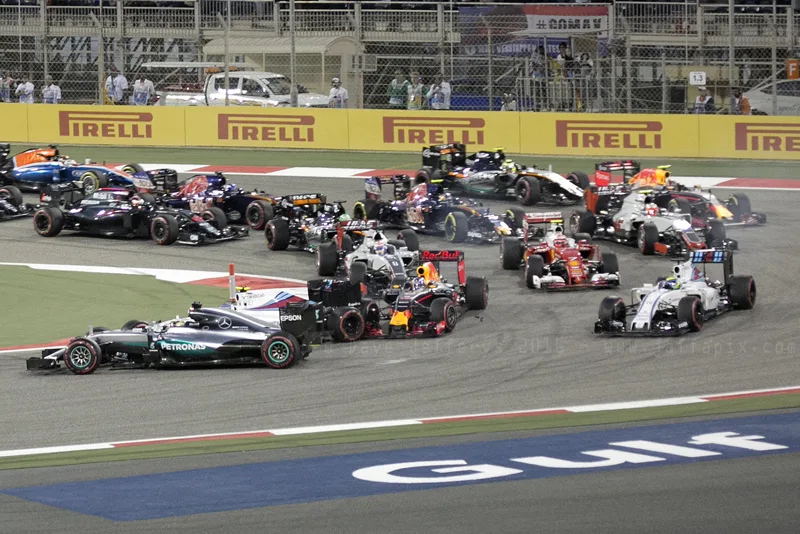
Rosberg kept the lead at the start, ahead of Ricciardo, Vettel and Raikkonen. Perez gained two places to fifth, one of the early gains of the afternoon, while Gutierrez damaged his front wing in contact with the back of Hulkenberg's car.
Hamilton, who had started tenth, passed Kvyat for ninth on lap 4. A lap later he and Bottas both moved past Verstappen, who had run wide into turn two. Red Bull changed Verstappen's tyres in reaction, and Ricciardo followed a lap after that.
Kvyat retired from Toro Rosso on lap eight. Hamilton passed Bottas for fourth on lap 10 but was more than twenty seconds behind Rosberg. He pitted on lap 15, and Force India responded by bringing Perez in two laps later, so Perez came out just ahead of Hamilton.
Raikkonen took fourth from Ricciardo on lap 18, and Perez passed Massa for seventh on lap 20, with Hamilton following a lap later. Vettel stopped as lap 21 ended and fell in behind Ricciardo, before Rosberg pitted one lap later and kept the lead.
Vettel then moved up to second when Raikkonen let him past, although he was 18 seconds down on the leader. From lap 32 Hamilton was stuck in the wrong engine mode, and Rosberg was still leading the race at that stage.
What were the key moments?
| Milestone | Driver | Detail |
|---|---|---|
| Race winner | Nico Rosberg | Mercedes, first win since the Russian Grand Prix |
| Fastest speed in qualifying | Valtteri Bottas | 378 km/h (235 mph), a new record for an official session |
| Early retirement | Daniil Kvyat | Toro Rosso, on lap eight |
| Third place | Sergio Perez | Force India, from seventh on the grid |
| Qualifying crash | Lewis Hamilton | Hit the barrier at turn 10 in the final part |
Perez's climb from seventh on the grid to third came after his post-qualifying demotion, and it put Force India on the podium. For a team that had started the race from seventh, the result was a reward for a steady run through the field.
What did the result mean for the championship?
Rosberg's win was his first since the Russian Grand Prix, and it extended his championship lead to 24 points over Hamilton, who remained second in the drivers' table. It was also his second career grand slam, a feat that combines pole position, victory, fastest lap and leading every lap.
Mercedes extended its constructors' advantage over Ferrari to eighty-one points, with Vettel's second place added to Ferrari's total, even though the team had struggled with energy recovery problems in practice, and Raikkonen's running had been limited by a loss of power in the final session. Hamilton's Q3 crash left him starting tenth.