Ricciardo won from tenth as a red flag and three safety cars reshaped the maiden Baku world championship race.
The 2017 Azerbaijan Grand Prix was the eighth round of the Formula One season, held at the Baku City Circuit on 25 June 2017. Daniel Ricciardo won for Red Bull after starting tenth, with Valtteri Bottas second and Lance Stroll third on the podium. A red flag and a Vettel and Hamilton collision marked the afternoon.
Daniel Ricciardo won the 2017 Azerbaijan Grand Prix for Red Bull, even though a qualifying crash had left him starting tenth. It was the maiden Azerbaijan round of the world championship, and the afternoon was disrupted by a red flag, three safety cars and a Vettel and Hamilton collision.
Why did Baku matter in 2017?
The 2017 race was the maiden Azerbaijan Grand Prix as a world championship round, and only the second Grand Prix ever staged in the country. It came with the title race already under way. Sebastian Vettel led Lewis Hamilton by twelve points, and Mercedes held an eight-point lead over Ferrari in the constructors' standings.
The circuit had hosted only one race before this one, so the street course was still new to the calendar. The weekend included three practice sessions before qualifying.
Ricciardo won from tenth as a red flag and three safety cars kept reshaping the order.
What did practice show?
Max Verstappen set the fastest time in the first practice session, ahead of Ricciardo and Vettel. Valtteri Bottas then set the quickest time across all three sessions, with Raikkonen second and Hamilton third in the final session. Verstappen crashed heavily at Turn 1 late in the second session.
Jolyon Palmer had a harder weekend. A fire during the third practice session left him without a lap time in Q1, although the stewards allowed him to race at their discretion.
How did qualifying shape the race?
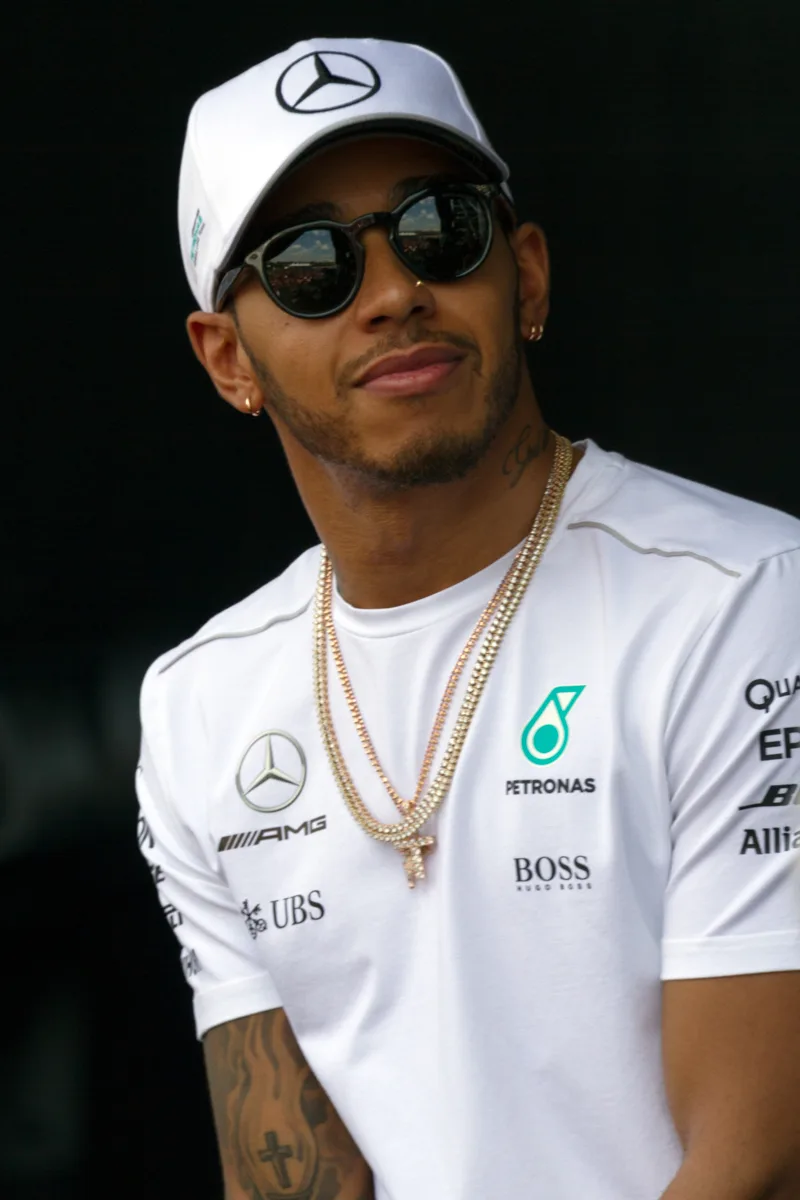
Lewis Hamilton claimed pole with a time of 1:40.593, 0.434 seconds clear of Valtteri Bottas, while Kimi Raikkonen was third, 1.100 seconds back. Daniel Ricciardo hit the wall and started tenth, a setback that set up the drive that followed. Lance Stroll out-qualified Felipe Massa for the first time that season.
Hamilton's pole put Mercedes on the front row alongside Bottas, while Raikkonen completed the top three for Ferrari. From tenth, Ricciardo had to pass his way forward through the field.
Further penalties reshuffled the grid behind the front runners. Fernando Alonso took a forty-place grid penalty because he had used more power unit parts than allowed, while Stoffel Vandoorne received thirty places plus five for an unscheduled gearbox change. Carlos Sainz Jr. also took a three-place penalty for a collision with Massa at the previous race.
What happened in the opening laps?
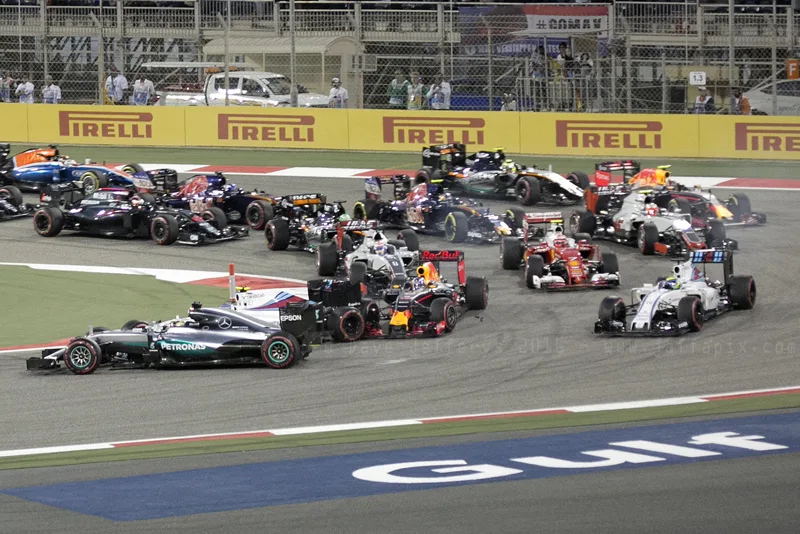
Hamilton led away from the start, with Bottas, Raikkonen and Vettel in pursuit. On the first lap, Bottas and Raikkonen collided at corner three, and Bottas suffered a front right puncture that dropped him a lap down after a pit stop. Vettel took advantage to move into second.
Daniil Kvyat ran wide at Turn 1, and his Toro Rosso teammate Carlos Sainz Jr. spun while avoiding him. Ricciardo pitted on lap six to clear debris from his brakes and rejoined in 17th. Verstappen retired on lap 12 with an engine issue, and a safety car came out on that same lap to remove Kvyat's stranded Toro Rosso.
Hamilton repeatedly griped about how slowly the safety car was going. Racing resumed on lap 17, but a second safety car came out almost at once to deal with debris from Raikkonen's Ferrari. Bottas, meanwhile, had turned his puncture into a recovery drive, and he would finish second.
Why did Vettel and Hamilton collide?
On lap 19, with the field still behind the safety car, Vettel drove into the rear of Hamilton's car. The impact damaged Vettel's front wing and the diffuser on Hamilton's car. Vettel then swerved into him, protesting what he believed was a brake test. TV replays and car data showed Hamilton had not braked before the first contact.
The stewards placed the incident under investigation. On the same lap Hamilton pitted, Vettel was handed a ten-second stop-go penalty for dangerous driving. Vettel served it on lap 33 and rejoined seventh, just ahead of Hamilton.
Hamilton's own problems followed. A loose headrest led race control to order him into the pits on lap 31, and he rejoined stuck in traffic after his unscheduled stop.
Why was the race red-flagged?
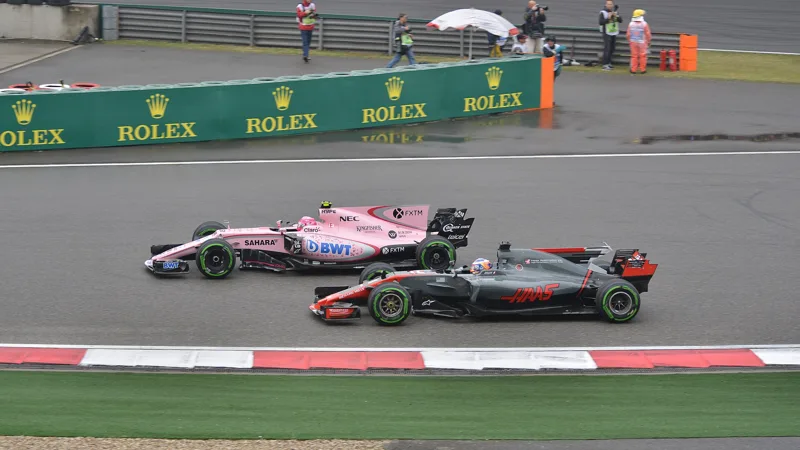
Ocon and Perez collided on lap 20, leaving debris on the track. Ocon punctured, Perez retired after losing his front wing, and Raikkonen also retired after debris damaged his car. After Alonso complained over the radio about the debris, race control red-flagged the race on lap 22 so marshals could clear it.
The stoppage lasted over 20 minutes. Teams used the time to repair cars: Force India changed Ocon's tyres, Ferrari replaced Vettel's front wing, and Mercedes attended to Hamilton's rear diffuser, which was damaged only cosmetically. Raikkonen and Perez were allowed to rejoin a lap down, but both took drive-through penalties because their cars had been worked on in the garage rather than in the pit lane.
Once the debris was off the track, the race restarted behind the safety car, and Hamilton still led, with Vettel, Massa, Stroll and Ricciardo behind him in that order. Ricciardo then went around both Williams cars at Turn 1 to move into third. Massa's front suspension was shaking violently, and a broken damper soon ended his race. Kevin Magnussen took advantage to overtake for fifth, and Nico Hulkenberg hit the wall on lap 25 with suspension damage.
How did Hamilton end up fifth?
Hamilton had led the early laps, but the Vettel collision, the loose headrest and time stuck in traffic all cost him ground. Mercedes only had to deal with minor cosmetic damage to his rear diffuser during the stoppage. He finished fifth, one place behind Vettel.
Ocon, who had dropped to the back of the field after his puncture, recovered to finish sixth, one place ahead of Magnussen.
How did Ricciardo win the race?
Ricciardo inherited the lead when Hamilton pitted on lap 31 with a loose headrest. Stroll, who was second, had a 12-second cushion over the chasers at one point, but Bottas closed the gap in the closing laps. Ricciardo cruised to the flag as Red Bull's first win of the 2017 season.
Bottas came back from a lap down to clear Esteban Ocon and take third, and then pressed on to Stroll. Vettel, serving his stop-go penalty, rejoined seventh. Bottas went by Stroll on the final straight, metres short of the flag, to take second by 0.105 seconds.
Ricciardo's win was his fifth career victory, and it came from tenth on the grid.
Why was Stroll's podium significant?
Stroll finished third for his maiden podium, making him the second-youngest driver to reach the top three. He was also the first Canadian on a Formula One podium since Jacques Villeneuve, whose last such result came at the 2001 German Grand Prix. It was also the last Williams podium until the 2021 Belgian Grand Prix.
Earlier in the weekend he had out-qualified Massa for the first time that season, and the podium was his first.
What did the result change in the standings?
The result moved Vettel's lead over Hamilton from twelve points to 14 in the drivers' standings. Mercedes extended its constructors' advantage over Ferrari from eight points to 24. Nine different teams scored points, which spread the reward across the grid.
Alonso's ninth place gave McLaren their first points of the season. Sainz finished eighth, ahead of Alonso and Wehrlein, who finished tenth despite a collision with Ericsson while the pair fought for that place.
Three different teams filled the front of the result, with Red Bull, Mercedes and Williams taking first, second and third. Vettel finished fourth after serving his penalty, with Hamilton fifth behind him. This was the last red flag in Formula One until the 2020 Italian Grand Prix.
Top ten finishers
| Position | Driver | Team |
|---|---|---|
| 1 | Daniel Ricciardo | Red Bull Racing |
| 2 | Valtteri Bottas | Mercedes |
| 3 | Lance Stroll | Williams |
| 4 | Sebastian Vettel | Ferrari |
| 5 | Lewis Hamilton | Mercedes |
| 6 | Esteban Ocon | Force India |
| 7 | Kevin Magnussen | Haas |
| 8 | Carlos Sainz Jr. | Toro Rosso |
| 9 | Fernando Alonso | McLaren |
| 10 | Pascal Wehrlein | Sauber |