Sebastian Vettel won at Albert Park for the second year running, while the halo made its competitive debut and Lewis Hamilton, from pole, finished second.
Sebastian Vettel won the 2018 Australian Grand Prix for Ferrari on 25 March 2018, repeating his 2017 win at Albert Park. Lewis Hamilton was second from pole and Kimi Raikkonen third, and the halo made its competitive debut.
Sebastian Vettel won the 2018 Australian Grand Prix at the Melbourne Grand Prix Circuit on 25 March 2018, repeating his victory of the previous year. Lewis Hamilton started from pole and finished second, and Kimi Raikkonen completed the podium for Ferrari. The race also marked the first competitive outing of the halo, the cockpit protection device that had been developed after a run of serious accidents.
Who won the 2018 Australian Grand Prix?
Vettel won for Ferrari, collecting his 48th career victory and his 100th podium. He moved to the front during the pit stops, emerging ahead of Hamilton and Raikkonen under the virtual safety car, and he held the lead to the flag.
Fernando Alonso held off Max Verstappen to keep fifth place. Raikkonen finished third, which gave Ferrari a result with both of its drivers on the podium.
A halo debut, a record pole and a second straight Melbourne win for Vettel.
What was the background to the race?
The race had been confirmed in December 2017 as the first of 21 in the World Championship. It was the 83rd race staged under the Australian Grand Prix name, a series that stretches back to a 100-mile road race in 1928, and the 23rd time the event had been held at Albert Park.
The halo went through a long testing programme before its competitive debut. Its design is a wishbone-shaped frame that sits above and around the driver's head, and it followed a string of serious open-wheel accidents, including the fatal Formula Two accident involving Henry Surtees, at Brands Hatch, in 2009.
Felipe Massa was struck on the helmet by a detached spring from Barrichello's car at the Hungaroring, six days after Surtees's accident, which added to the case for better head protection. Drivers had raised concerns that the halo would block their view, so the FIA lowered the starting gantries at circuits, and drivers were allowed to practise standing starts after both Friday sessions.
A third DRS zone had also been added for the season, with its detection point on the approach to the turn 11 and 12 chicane and its activation on the exit of turn 12. The existing zones were unchanged, one on the main straight and another between turns two and three.
Pirelli supplied three dry compounds, with the purple-banded ultrasoft as the option tyre, a red-banded supersoft, and a yellow-banded soft for the prime role. Two drivers made their competitive debuts. Charles Leclerc, the reigning Formula 2 champion, replaced Pascal Wehrlein at Sauber, while Sergey Sirotkin took over the Williams seat that Felipe Massa had vacated when he retired at the end of 2017.
The race was the first in which no Brazilian driver took part since the 1982 San Marino Grand Prix. Pierre Gasly and Brendon Hartley were the full-time Toro Rosso drivers, having raced for the team late in the previous season.
How did the title battle look before the race?
Hamilton and Vettel were the favourites, and both had the chance to match Juan Manuel Fangio's five world titles. Hamilton said he wanted to break barriers and keep pushing the limits of his ability, while Vettel said the title was a long way off and that he was focused on the season ahead.
How did practice and qualifying go?
In the opening practice hour Hamilton was quickest on the supersofts, with Valtteri Bottas second and Max Verstappen third. The Ferrari pair were fourth and fifth, and Daniel Ricciardo was sixth. Alonso missed much of the first hour because of an exhaust problem. Romain Grosjean, Carlos Sainz Jr. and Stoffel Vandoorne completed the top ten, while Sebastian Vettel and Kevin Magnussen both ran onto the grass beside the track.
Hamilton switched to ultrasofts in the second session and posted 1:23.931, the fastest lap of the day. Verstappen had set the early pace, and Esteban Ocon ended up in the gravel at turn three. Bottas also ended up in the gravel after a moment with Raikkonen at turn three, and the stewards found that Raikkonen had not unnecessarily impeded him. A five-minute stoppage followed when a timing cable came loose and landed on the start-finish straight.
Ricciardo received a three-place grid penalty, plus two super licence points, for not staying above the minimum time set by the timing unit under red flag conditions. Saturday morning brought thunderstorms that soaked the track, and wet tyres were used until the surface dried enough for dry compounds.
Vettel set the fastest time of the final practice session at 1:26.067 in damp conditions. Force India set no timed laps in the final hour, having run short of spare car parts. Hamilton's steering wheel had been replaced in the pit lane after a fault.
Qualifying had three parts. The first lasted 18 minutes and removed cars finishing 16th or lower, the second lasted 15 minutes and removed those finishing 11th to 15th, and the final 12-minute part decided the top ten. The 107 per cent rule applied in the first part.
Hamilton topped the first part with 1:22.824 set on his second run, ahead of Raikkonen and Vettel. The five drop-outs were Brendon Hartley, Marcus Ericsson, Charles Leclerc, Sergey Sirotkin and Pierre Gasly, the last after a driving error that ended in the turn three gravel trap.
Red Bull sent its drivers out on supersofts in the second part, which settled the tyre choice for the race. Vettel was the first driver to go below 1:22 all weekend, with 1:21.944. Alonso and Vandoorne were eliminated, and Perez, Stroll and Ocon missed the final part.
On his first timed lap in the final part, Bottas took too much kerb at the first turn and spun into the barrier at turn two, hitting it heavily with an impact measured at 27 g. The session was stopped while the barriers were repaired and the debris cleared.
When the session restarted, Hamilton set a circuit-record 1:21.164 to take pole. It was his fifth consecutive pole at the track and his seventh in Melbourne, which moved him past Ayrton Senna in the number of Australian poles, and it was his 73rd career pole. Raikkonen was 0.664 seconds slower, and Vettel finished the lap in third after an error at turn 13. Verstappen was fourth.
Bottas was sent five places back for changing his gearbox after the crash. The start order therefore opened with Hamilton, Raikkonen, Vettel, Verstappen and Magnussen, and Bottas now started in the lower half of the field.
How did the race unfold?
Before the start a tribute was paid to Ron Walker, the late former promoter of the Australian Grand Prix, when the main straight was named the Walker Straight. The top three kept their positions into the first corner, although Verstappen lost a place to Magnussen.
Sirotkin was the first retirement, on lap four, when his brakes failed after overheating. On lap nine Verstappen spun at turn one while chasing Magnussen and dropped to eighth. Hamilton led Raikkonen, Vettel, Magnussen and Grosjean, and that order held until the first round of pit stops.
Raikkonen pitted for soft tyres on lap 18, and Hamilton covered him by stopping for softs on lap 19, rejoining ahead of his rival. Verstappen came in on lap 20, and Magnussen made his stop at the close of lap 21, but he retired the next lap after a loosely fitted wheel nut.
Grosjean suffered the same wheel nut problem. He retired at turn two on lap 24, having been seventh, and a virtual safety car was called. Vettel pitted under it on lap 26 and emerged ahead of Hamilton and Raikkonen. Mercedes had miscalculated the gap Hamilton needed to hold Vettel back, because of a software glitch.
A full safety car came out on lap 27 and went back into the pits at the end of lap 31. The top ten at that point were Vettel, Hamilton, Raikkonen, Ricciardo, Alonso, Verstappen, Hulkenberg, Bottas, Vandoorne and Sainz, and none of them stopped again.
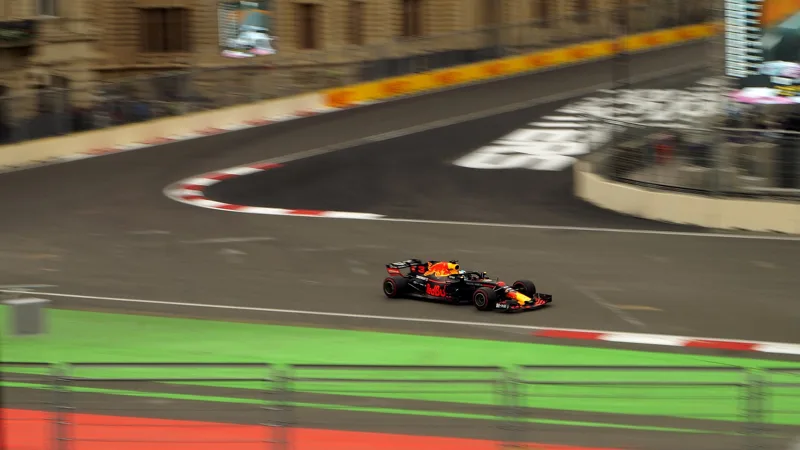
Ricciardo pursued Raikkonen for the rest of the race and set the fastest lap while doing so. Alonso resisted Verstappen to keep fifth, and Vettel took the chequered flag to win for the second year running, with Hamilton and Raikkonen on the podium.
Renault scored its first double points finish since the 2011 Turkish Grand Prix, with Nico Hulkenberg seventh and Carlos Sainz Jr. tenth. Ricciardo's fourth place equalled Mark Webber's fourth place in 2012 and was Ricciardo's joint best result at Albert Park. After the race the FIA fined Haas 10,000 euros for sending both of its drivers back onto the track without tyres attached properly.
What did the race mean for the halo and the title race?
The halo had its first competitive outing at this race, which Vettel won. The race showed that decisions made under a safety car can reorder the field, because Mercedes had miscalculated the gap it needed to keep Vettel behind, and the virtual safety car let Vettel pit cheaply and emerge in front.
Who were the leading finishers?
| Finish | Driver | Team | Note |
|---|---|---|---|
| 1 | Sebastian Vettel | Ferrari | Won; his 100th podium |
| 2 | Lewis Hamilton | Mercedes | Started from pole, a record seventh in Melbourne |
| 3 | Kimi Raikkonen | Ferrari | Second on the grid, third at the flag |
| 4 | Daniel Ricciardo | Red Bull | Joint best finish at Albert Park |
| 5 | Fernando Alonso | McLaren | Held off Verstappen for fifth |
| 6 | Max Verstappen | Red Bull | Spun at turn one on lap nine |