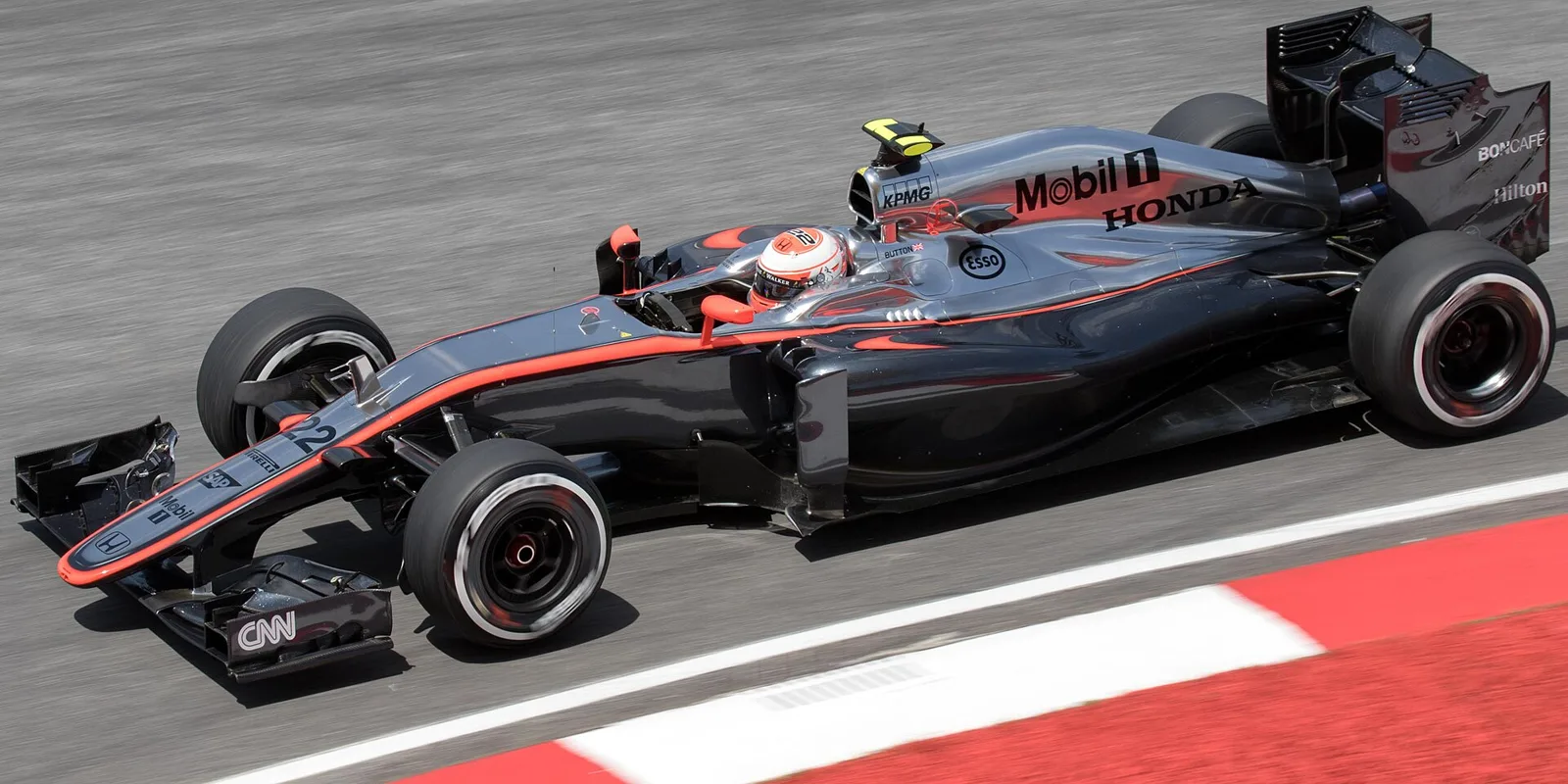
Alonso and Button, a Honda power unit that arrived late and a car nicknamed size zero made the 2015 campaign McLaren's hardest in decades.
The MP4-30 was designed by Tim Goss and Neil Oatley for 2015 and driven by Fernando Alonso and Jenson Button. Its Honda RA615H engine struggled for power and reliability, and the team's season ended in ninth place with 27 points.
The McLaren MP4-30 was the team's car for the 2015 Formula One season, and it produced the hardest campaign McLaren had faced in decades. Fernando Alonso returned to the team alongside Jenson Button, but a new Honda engine struggled from the first test to the last race.
Who designed the MP4-30 and who drove it?
Tim Goss and Neil Oatley designed the MP4-30 for 2015. Alonso, a two-time champion returning after eight years away, and Button, the 2009 champion, drove it through most of the season. Kevin Magnussen took over from Alonso after a testing crash.
The design group was strengthened by Peter Prodromou, who had been with McLaren between 1991 and 2006 and had since served as Red Bull's head of aerodynamics. He was recruited back to help with the design and to oversee trackside operations with Matt Morris, a former Sauber designer. The team also added testing and development support from Magnussen, Stoffel Vandoorne and Oliver Turvey.
A Honda engine that arrived late and a car nicknamed size zero made 2015 the hardest season McLaren had faced in decades.
Why did McLaren switch to Honda?
The Mercedes tie-up of two decades ended at the close of 2014, when the sport brought in a new engine formula and Mercedes set up a works team of its own. McLaren wanted a long-term engine supplier, and the Honda deal was first made public in May 2013.
Honda had competed in Formula One as a constructor before, buying British American Racing in 2006 and selling the team to Brawn GP before the 2009 season. Its return as an engine supplier came with a development programme at Utsunomiya in Tochigi Prefecture, the same site that produced the Honda Civic WTCC and the Honda NSX-GT for Super GT. Yasuhisa Arai led the RA615H project, and McLaren received direct factory works support from Honda.
The engine itself had been in development for eighteen months before the season began. The MP4-29 had run a Mercedes PU106A Hybrid through 2014, and the new car was the first McLaren built since the MP4/7A of 1992 to use Honda power. It was also only the second McLaren Formula One car to run a turbocharged Honda engine, after the dominant MP4/4 of 1988.
How was the car designed and launched?
The team called the MP4-30 size zero, a nod to its sharply tapered rear, which the Honda engine's higher running temperatures made possible. The car was also the first 2015 entry to pass its mandatory crash tests, with final FIA approval arriving in December 2014.
The early development car was a variant of the MP4-29 nicknamed the MP4-29H test car. It appeared at the Silverstone and Yas Marina test circuits, driven by Stoffel Vandoorne, but engine problems prevented significant running. The chassis was shelved after Yas Marina, and the engine was moved into the MP4-30 chassis before the first pre-season test at Jerez.
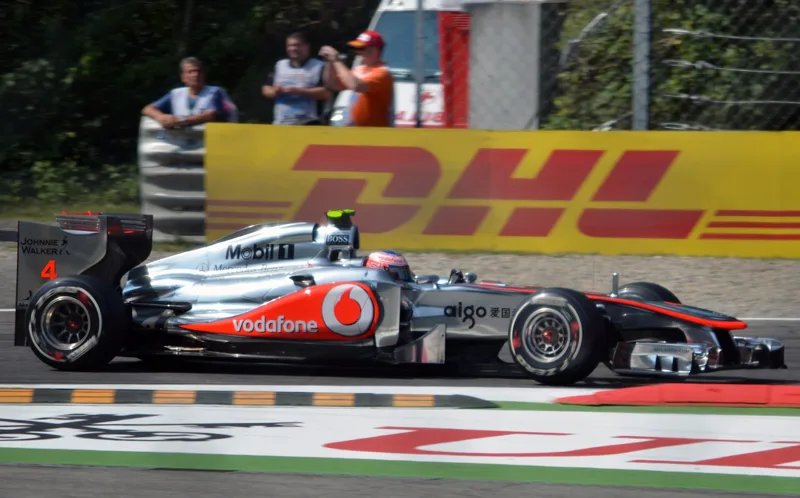
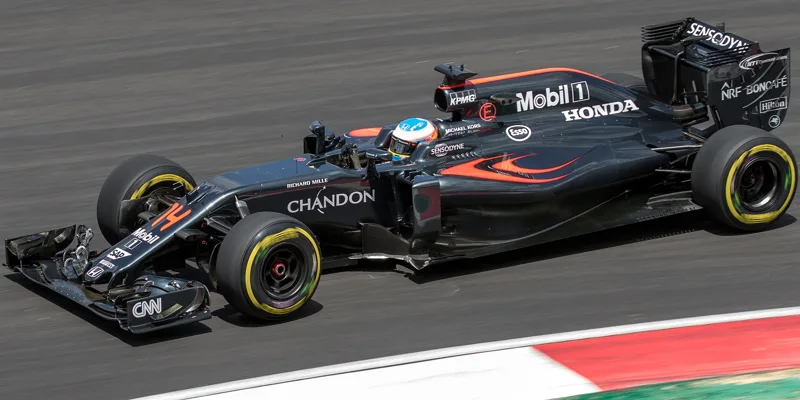
The livery was revealed on 29 January 2015. The black and silver chrome design with red trim was criticised by fans, who disliked the silver element because it resembled Mercedes-Benz's corporate colour. McLaren replaced it with a black and red scheme from the Spanish Grand Prix.
What happened in pre-season testing?
The opening Jerez test was a hard one. Repeated mechanical faults with the RA615H cut running over four days, and McLaren finished the test with the least mileage of the teams present. Parts supplied by Honda were swapped for components McLaren had developed on its own in 2014 before the second test at Barcelona.
Running improved only at the end of testing. After seven laps on the first day of the final Barcelona test, Button completed more than one hundred on the second. Even so, the longest continuous stint before the opening race was twelve laps, covering 55.8 km (34.7 mi). That is less than a quarter of a 307.1 km (190.8 mi) race distance.
The pre-season was overshadowed by an accident involving Alonso on the final day of testing. He was hospitalised with a concussion and missed the final test and the opening round. Alonso later blamed a steering failure, although McLaren said the telemetry showed no sign of a car fault. Magnussen was drafted in as his replacement.
Why was the RA615H power unit so difficult?
Honda had the 2016 season in view when it designed the RA615H, so the 2015 unit was less mature than it might have been. To squeeze into the car's tight packaging, the engine was made very compact, weighing just 145 kg (320 lb), at the cost of extra water cooling to keep temperatures under control.
The turbocharger was split and placed alongside the MGU-H within the cylinder banks, and the compressor used several smaller fans in place of a single centrifugal unit. The MGU-K was placed in front of the engine to feed energy into the crankshaft. Both generators could harvest 4 MJ (1.1 kWh) per lap, but the 2015 rules allowed only 2 MJ (0.56 kWh) of deployment per lap.
Honda gave each engine an individual name, such as PU18 Greyhawk and PU22 Erica, which was noticed at the Hungarian Grand Prix. The naming reflected the fact that every unit was a separate development project, in a season when each manufacturer was limited in how far it could change its engines.
How did the engine develop during the season?
Under the 2015 rules, each engine was split into thirty-two development areas, and Honda could work on nine of them. Canada brought the first updates, targeting the reliability of the MGUs. By mid-season the engine was producing 120 bhp (89 kW) less than the Mercedes PU106B, the benchmark of the grid.
Ron Dennis believed the aerodynamic data was encouraging and that the car's mid-corner speeds matched those of rivals. Eric Boullier, the team principal, argued that the core problem was improving the efficiency of the energy recovery systems, both in harvesting and in deployment. He believed that gaining those areas could find several seconds a lap.
Belgium brought the second round of updates, which altered the combustion chamber and the intake and exhaust layout. Analysis also found a fault in the chamber that stressed the other components, and an MGU-H that drew energy faster than it could be harvested. The engine could shed up to 160 bhp (120 kW) halfway round a lap, and Alonso later estimated that the car lost up to three seconds a lap to Mercedes at Monza.
The third upgrade package, due for Russia, concentrated on the combustion engine, and the MGU-H work was pushed back to the end of the year. Alonso was given the first version, and Button received it two rounds later in Mexico. The altitude at Mexico, 2,229 metres (7,313.0 ft), reduced turbine power, and Button had predicted a hard weekend there.
How did the season unfold?
The season began badly. Button finished last of the classified runners in Australia, two laps behind the winner, after the pair had qualified on the final row. Alonso returned for Malaysia, where the engine had been retuned, but both cars retired.
Points came hard. Alonso matched the team's best result to that point with eleventh in Bahrain, and Button scored the car's first points with eighth in Monaco. Alonso followed with tenth in Great Britain, after four consecutive retirements, before a double points finish appeared in Hungary, where Alonso took fifth and Button ninth.
The middle of the year was harder. Both drivers took 25-place grid penalties in Austria after using up their engine quotas, and Alonso's race ended on the opening lap after contact with Raikkonen. Belgium brought fresh engines and moved both drivers back, and Italy saw Button finish fourteenth and Alonso eighteenth.
| Round | Result |
|---|---|
| Australia | Button last of the classified finishers, two laps down |
| Monaco | Button 8th, first points |
| Great Britain | Alonso 10th, his first point |
| Hungary | Alonso 5th, Button 9th; the only double points finish |
| Italy | Button 14th, Alonso 18th |
| Mexico | Both out in qualifying; Alonso retired, Button 14th |
| Brazil | Button 14th, Alonso 15th after a disqualification |
| Abu Dhabi | Button 12th, Alonso 17th after a drive-through |
Why was the car criticised?
The RA615H drew criticism across the sport, aimed mainly at the separate structure of the two companies and at Honda's failure to recruit engineers from rival engine makers. Arai admitted Honda had underestimated the sport's demands, and he blamed the size zero approach for limiting the engine.
Alonso defended Honda's independent programme as a barrier to copying, but he grew frustrated with results. He called the engine embarrassing and compared it to a GP2 unit over the team radio after being unable to defend against repeated overtakes at Japan. Alonso also pointed to a lack of running in Friday practice and to unreliable parts such as the gearbox.
Brundle, a former driver turned broadcaster, felt McLaren were running research and development rather than racing. Dennis took a broader view, citing chassis and morale problems in addition to the engine. Boullier admitted the team faced a budget shortfall of US$23 million (15 million pound) for 2016, because it had expected fifth rather than ninth.
How did the season end?
That result was Button's worst individual season since 2008 with Honda Racing F1, while Alonso's was his worst since his 2001 debut with Minardi.
After Abu Dhabi the car became a test platform for 2016, with more than half its parts experimental, and Vandoorne set the fastest time of the post-season Pirelli tyre test. The MP4-30 made one final appearance in wet tyre tests at Paul Ricard, and it was then replaced by the MP4-31. Under the 2014 rules the FIA classed the car, along with all 2015 cars, as a previous car, which restricted its use in testing and promotional filming.
What is the MP4-30's legacy?
The MP4-30 is remembered as a car that produced the most difficult season McLaren had endured in 35 years. Its failures were blamed on communication between McLaren and Honda, the way the engine was developed and critical faults in its design. The episode is a reminder of how closely an engine partner and a chassis team must work together.
The car's reliability problems were the central story. Its one fifth place in Hungary and the team's ninth place in the constructors' standings are the clearest measures of a season that did not meet expectations. Honda then turned its attention to the RA616H successor.