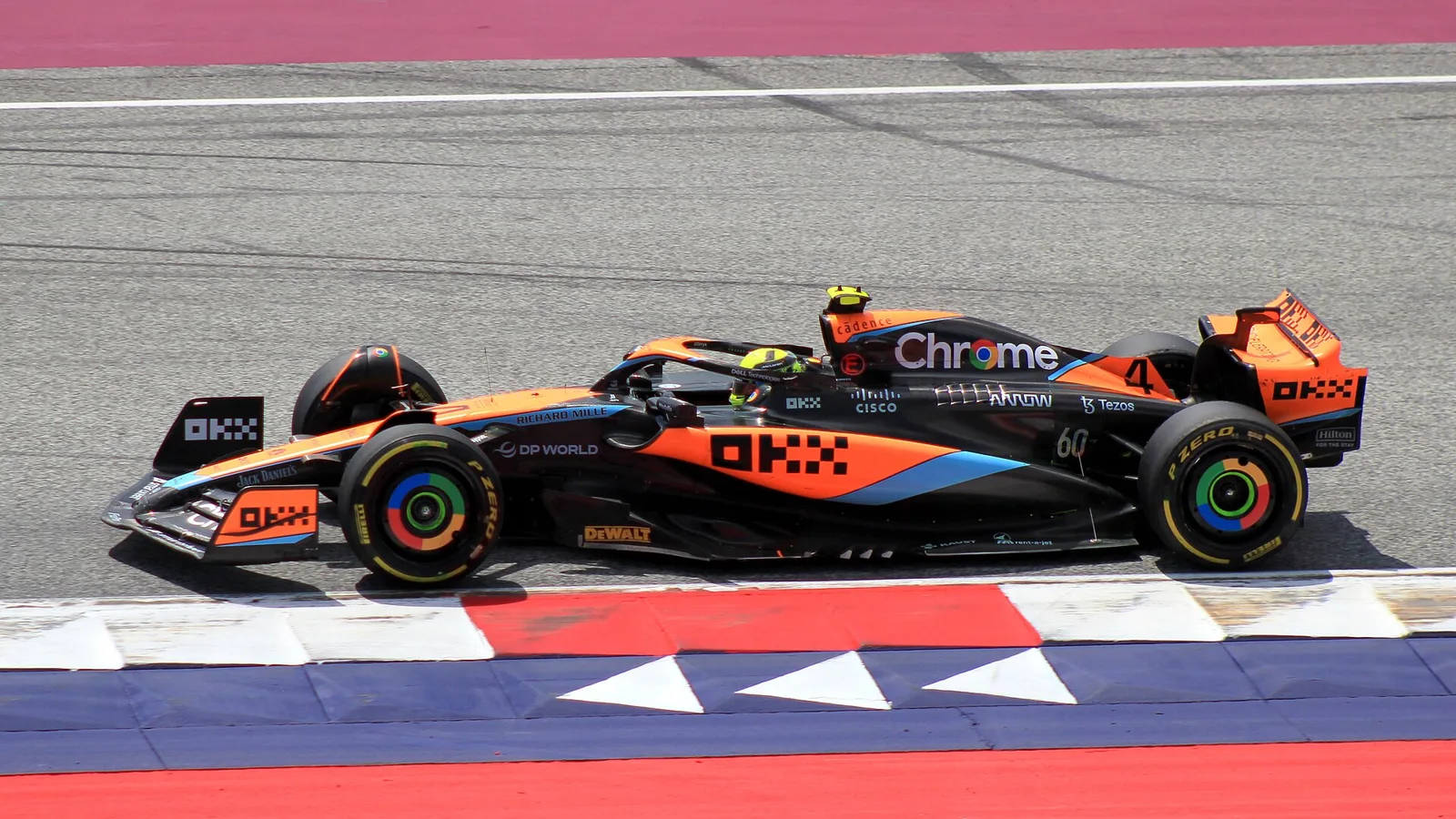
A launch car the team admitted was not right, rebuilt through a design change that made the MCL60 the most improved car of 2023.
Designed under James Key, the MCL60 was McLaren's 2023 Formula One machine. Its launch version struggled with drag and tyre wear, but the Austrian and British upgrades turned it into a regular podium contender. It finished the year with nine Grand Prix podiums and a sprint win.
The McLaren MCL60 was the team's 2023 Formula One car, named to celebrate sixty years since Bruce McLaren launched the squad. Its launch version was uncompetitive, with excess drag and heavy tyre wear, but a mid-season upgrade programme made it the sole steady rival to Red Bull Racing's RB19. The story is one of a sharp change in design direction carried out while the season was already under way.
Why was the car called the MCL60?
The car was first referred to as the MCL37, continuing a numbering line that began with the MP4/1 in 1981. The MCL60 name marked the sixtieth anniversary of the squad, which Bruce McLaren had set up in 1963. The MP4 prefix had already been dropped in 2017, after Ron Dennis left the team.
The predecessor, the MCL36, had looked competitive in its first test, but it suffered serious brake overheating. That limited its performance early on and delayed much of its development. The 2022 regulations had started a new generation of cars, and McLaren was still digesting the lessons of that year when the MCL60 was drawn.
A launch car the team admitted was wrong, rebuilt mid-season into the only consistent challenger to the RB19.
How did the design direction change?
Seidl had said back in 2022 that just a portion of the MCL36 concept would carry over to its successor. James Key hoped the new car would need less in-season development. Key later conceded that by September 2022 the team had recognised the floor-height rule changes would clash with its design philosophy, so work on a fresh concept had begun. That concept was not mature enough for the launch.
Seidl left in December 2022 to take charge at Sauber, after the sudden exit of its chief executive. Andrea Stella, previously the squad's executive director of racing, took over. The aim for 2023 was to restore the squad's standing as the top midfield outfit.
What did the launch car look like?
At its launch the MCL60 was considered an evolution of the MCL36, which had itself been heavily developed during 2022. It kept the unusual front pullrod and rear pushrod suspension layout that had returned with the MCL36. Its sidepods had a tighter geometry and a more aggressive undercut, partly to free space for the ground-effect inlet tunnels. The engine cover inlet was lengthened, and the floor edge cut-out moved forward.
Stella said the team was not entirely happy with the launch car, and it promised substantial upgrades from the fourth round at Azerbaijan. Norris had argued for a change of philosophy towards driveability rather than raw performance. He said that certain undesirable characteristics had persisted in McLaren cars across several rule changes, and he did not expect to know whether they were fixed until pre-season testing. The team had begun a complete change of design course in September 2022.
Who took over the car's development?
Key's exit came in March 2023, when a reorganisation split the executive technical director role into three departments. Peter Prodromou became head of aerodynamics, and Neil Houldey took charge of engineering and design. The MCL60 was the last project Key led at the team.
Liveries and sponsors
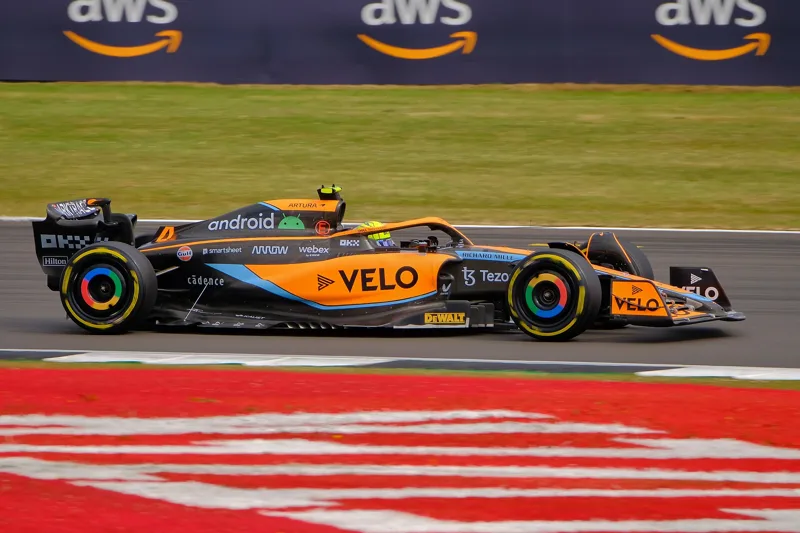
The MCL60 livery largely resembled the design first used on the MCL36, with extra exposed carbon fibre to save weight. Like every McLaren since the MCL35, it was applied as a vinyl wrap rather than paint, which was lighter, more aerodynamically efficient and quicker to prepare. The e-ink advertising, supplied by Seamless Digital, could be changed at any moment, and the technology had debuted on the MCL36 at the 2022 United States round.
For Monaco and Spain the car celebrated McLaren's Triple Crown of Motorsport, a feat the team was the only motorsport outfit to have completed by 2023. Its paint was split into three bands, one for each of the team's first wins in the trio of races. The rear was papaya, a nod to the M16C/D that Johnny Rutherford drove to win the 1974 Indianapolis 500. White filled the centre, honouring the MP4/2 Alain Prost drove to victory at the 1984 Monaco Grand Prix. Black covered the nose, a salute to the McLaren F1 GTR, which JJ Lehto, Yannick Dalmas and Masanori Sekiya steered to the 1995 24 Hours of Le Mans win.
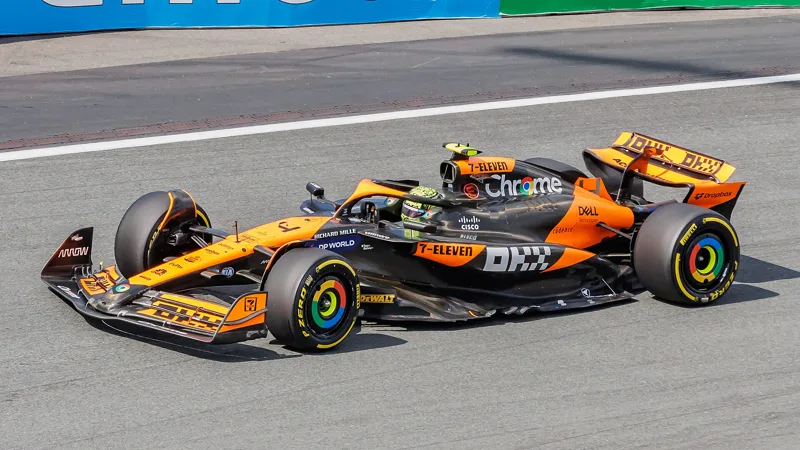
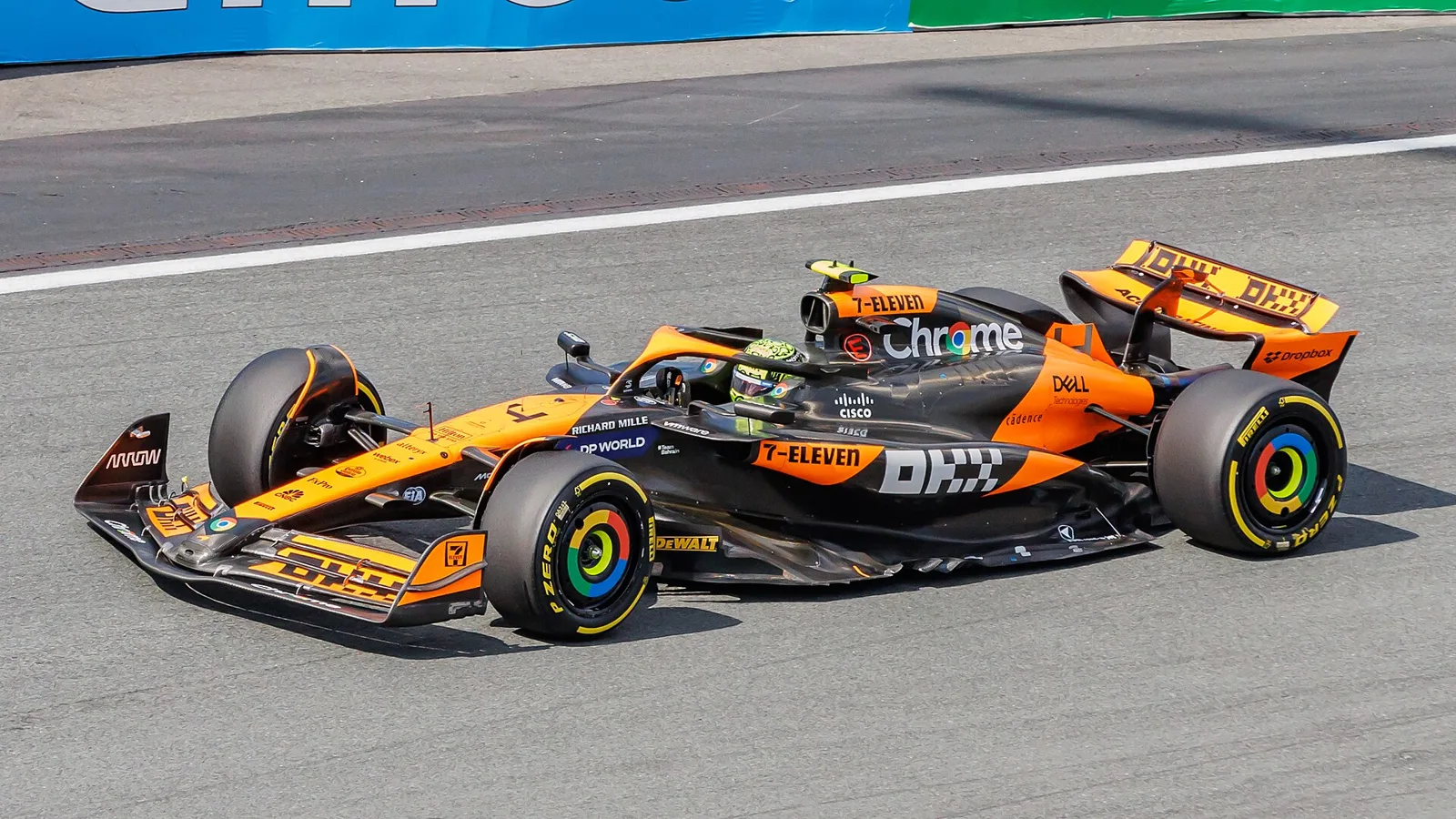
The British Grand Prix brought a chrome livery in conjunction with Google Chrome, a tribute to the look used when Vodafone was the team's title sponsor. Singapore and Japan saw a predominantly black Stealth Mode livery with papaya orange highlights, run with the sponsor OKX. The Abu Dhabi car got a locally designed scheme for the third consecutive season, with artwork by Nujood Al-Otaibi made with Vuse.
How did the 2023 season start?
Bahrain was a poor start. Norris qualified eleventh and Piastri eighteenth, and Piastri retired on his debut with an electrical fault. Norris finished last after six pit stops for pneumatic pressure, and the team was classified tenth and last in the constructors' championship.
The Bahrain race exposed how fragile the car was. Norris's pneumatic pressure kept dropping, which hurt gearbox performance and forced stops roughly every ten laps to top up the tank. The squad wanted data from the extra stops, and Norris still judged the car closer to the leaders than some critics suggested.
Saudi Arabia brought more trouble. Norris needed a second engine of the season, and he clipped a wall in qualifying, which damaged the steering and left him nineteenth on the grid. Piastri and Pierre Gasly collided on the opening lap, and debris from the crash hit Norris's car. Piastri finished fifteenth and Norris seventeenth, leaving Piastri nineteenth in the drivers' championship and Norris twentieth.
Australia was better. A tighter engine cover and new floor fences helped, and Norris finished seventh and Piastri ninth after both were promoted by a penalty for Carlos Sainz Jr. McLaren moved from last to fifth in the constructors' standings.
What did the Azerbaijan upgrade change?
The first big upgrade arrived at Baku: a fresh floor plus wings tailored to the circuit. The floor moved aerodynamic load around in a sweeping manner, with the most striking changes just ahead of the back tyres. It was the final package shaped under Key, and the opening step of three upgrades that season.
Norris qualified seventh, and Piastri tenth after feeling unwell. In the sprint shootout Piastri ended eleventh, Norris tenth. Norris then skipped the final session to save a set of soft tyres for the race, which left him seventeenth in the sprint. Both had pitted just before a safety car, then spent the race queued in a DRS line until the final laps. Norris finished ninth and Piastri eleventh, which dropped Norris to ninth in the drivers' championship.
Miami went badly. Norris started sixteenth and Piastri nineteenth after both were knocked out in Q1, something that had not happened since the 2018 Brazilian round. Nyck de Vries struck Norris from behind on the opening lap, and the floor damage cost around two to three tenths of a second per lap. Piastri's car suffered brake-by-wire and energy recovery faults. Stella said afterwards that McLaren needed to focus on performance on low-grip surfaces and during off-brake, off-throttle phases.
Monaco brought a revised tunnel inlet, a new rear wing endplate and track-specific wings. Norris qualified tenth and Piastri eleventh, and each gained a place in the race. Both were the quickest cars out there once the rain came in late on, but the team lost fifth in the constructors' order to Alpine.
Spain brought reprofiled front brake ducts. Norris qualified third, but Lewis Hamilton struck him on the first lap and he dropped to last. He ended the race seventeenth. Canada saw a fresh rear flap and beam wing arrive. Norris ended ninth but was docked five seconds for slow driving under the safety car, falling to thirteenth. Piastri crashed late in qualifying and was moved up to eighth by another driver's grid penalty.
What did the Austrian and British upgrades change?
The new technical leadership of Prodromou and Houldey developed a package that changed almost every aerodynamic surface of the car, and it started to arrive in Austria. The sidepods, floor, diffuser, halo and engine cover were all reworked on Norris's car, while the British round brought a new front wing and rear suspension geometry. Piastri had been slated to get both packages at Silverstone, yet only Norris's car received the British parts.
In Austria Norris qualified fourth and finished fifth, promoted to fourth after penalties for others. Still on the old spec, Piastri lined up thirteenth after a track-limits penalty, then clashed with Kevin Magnussen in the race. He crossed the line seventeenth before a promotion put him sixteenth.
At Silverstone Piastri's car was brought to the Austrian specification. Norris qualified second and Piastri third, and Norris finished second while Piastri was fourth after an untimely safety car denied him a podium. That haul was bigger than the total from all the earlier rounds of the year combined. The team retook fifth in the constructors' championship from Alpine, and Norris moved up to ninth in the drivers' standings.
After Silverstone the car ran unchanged in FIA wet-weather tests, serving as a baseline for the Mercedes-AMG W14 E Performance, which carried experimental spray guards.
Hungary brought the British-specification upgrades to Piastri's car, because the final stage of the package had been delayed. Norris qualified third and Piastri fourth, and Norris finished second while Piastri was fifth after floor damage. Norris moved up to eighth in the drivers' championship.
Belgium was a mixed round. Piastri qualified sixth and was promoted on the grid by a penalty for another driver. He finished second in the sprint after leading several laps in the rain-shortened race, but he retired from the Grand Prix after tangling with Carlos Sainz Jr on the opening lap. Norris recovered from seventeenth to finish seventh after McLaren had loaded too much downforce for a dry race.
At Zandvoort Norris qualified second and Piastri eighth. Unpredictable wet conditions and poor strategy meant that Norris finished seventh and Piastri ninth, and McLaren started a review of its strategic communication. Piastri fell to twelfth in the drivers' championship.
Italy brought new front and rear wings, a front brake duct and rear corner winglets. Hamilton hit Piastri while the latter was running eighth, and the stewards handed Hamilton a five-second penalty. Piastri set the fastest lap but finished twelfth, while Norris finished eighth.
How did the season finish?
Singapore brought the most extensive package of the year, including a new sidepod channel and inlet, a new engine cover, a new floor with fences and an edge, and a new diffuser. Norris received the entire package and finished second after qualifying fourth. Piastri received only part of it, and he recovered to seventh.
The Japanese Grand Prix brought Piastri the rest of the Singapore package. Piastri qualified second and Norris third, but they finished the other way round, which gave Piastri his first Formula One podium. Norris moved up to seventh in the drivers' championship and Piastri to ninth.
In Qatar Piastri took pole for the sprint and won it, and in the Grand Prix Piastri climbed to second and Norris to third. In the United States Norris took third, then inherited second when another car was excluded. Piastri retired with a water leak and radiator damage, which left McLaren ahead of Aston Martin for fourth in the constructors' standings.
Mexico City's altitude prompted an engine cover tailored to the circuit and bigger front brake ducts. Norris finished fifth and Piastri eighth. In Sao Paulo Norris finished second, while Piastri was struck by another car and carried winglet damage to the finish, ending fourteenth.
At Las Vegas Norris bottomed out on an uneven stretch and hit a barrier hard, ending his race. Piastri was struck by Hamilton yet still took tenth and clocked the quickest lap, a new benchmark for the Strip layout. Norris beat that mark the following year in the MCL38.
In Abu Dhabi, McLaren IndyCar driver Pato O'Ward took part in first practice in place of Norris. Piastri was third on the grid, Norris fifth. Norris crossed the line fifth and Piastri sixth, which gave them sixth and ninth in the drivers' table. McLaren finished the season fourth in the constructors' championship.
How good was the MCL60 by the end?
Come the final rounds, the car had earned the label of a capable all-rounder, and it was the only steady challenger to the RB19. Its remaining weaknesses were tyre management and handling that was tricky to live with, and commentators hailed the change of direction as remarkably effective, something rarely seen in the modern era.
The early verdicts were harsh. Scott Mitchell-Malm of The Race called the start of the season borderline disastrous, and the team believed it had been hit harder than its rivals by the 2023 rule changes, particularly the raised rear floor edge and diffuser. Stella said the car had too much drag and too little downforce, and that it was especially weak on low-grip surfaces.
Opinions turned once the upgrades arrived. Mark Hughes said the car generated heat in its front tyres very effectively, which explained its strong performance in the wet closing stages at Monaco and in cool qualifying conditions in Spain. Mat Coch of Speedcafe argued that the launch car was not fundamentally bad but had idiosyncrasies that held it back, including excessive tyre degradation in race conditions.
The mid-season turnaround drew praise from across the paddock. Lawrence Barreto called it one of the all-time great turnarounds, Andrew Benson one of the most impressive mid-year development jobs in Formula One, and Hughes a miracle leap. Tony Dodgins of Motor Sport called it a quantum leap.
Not everyone was convinced the car had become easy to drive. Norris did not believe it was fundamentally easier, since it still lacked off-throttle performance through the mid-corner, and the MCL60 still had a clear straight-line deficit to the RB19. Stella said the team had achieved not even half of its aerodynamic goals, and that the work would continue on the MCL38. After the finale, he speculated that the upgrades had improved pace but may have worsened handling.
The design shift was copied elsewhere. Hughes and the analyst Giorgio Piola observed that Alfa Romeo, Alpine and AlphaTauri, with the C43, A523 and AT04, were seemingly following the direction McLaren had set in Austria and Britain.
What happened to the MCL60 after 2023?
The car was used for a range of testing and display work. It was a mule for Pirelli's tyre programme, adapted to simulate a 2026 car, and it carried prototype intermediate, wet and slick tyres in tests at Paul Ricard, Barcelona, Jerez and the Hungaroring. Piastri completed 120 laps and Norris 123 at Paul Ricard in January 2025, and two days at Barcelona that February brought 139 laps for Norris and 152 for Piastri.
Other drivers took the wheel as well. Actor Brad Pitt also took the wheel at COTA in 2025, sharing the session with Norris, Piastri, development driver Alex Dunne and Martin Brundle. At Goodwood in 2025 the car appeared in the MCL39's chrome livery, and in 2026 Norris drove it up the hill in the MCL40 livery. Leonardo Fornaroli, McLaren's 2026 reserve, made his first Formula One test in the MCL60 at Barcelona in March 2026.
Specification and results at a glance
| Item | Detail |
|---|---|
| Season | 2023 Formula One World Championship |
| Designers | James Key, then Peter Prodromou and Neil Houldey |
| Drivers | Lando Norris and Oscar Piastri |
| Debut | Bahrain Grand Prix |
| Grand Prix podiums | Nine, plus three fastest laps |
| Sprint results | Two sprint poles, four sprint podiums and one sprint victory |
| Constructors' result | Fourth in the World Constructors' Championship |
| Piastri's first podium | Japan |