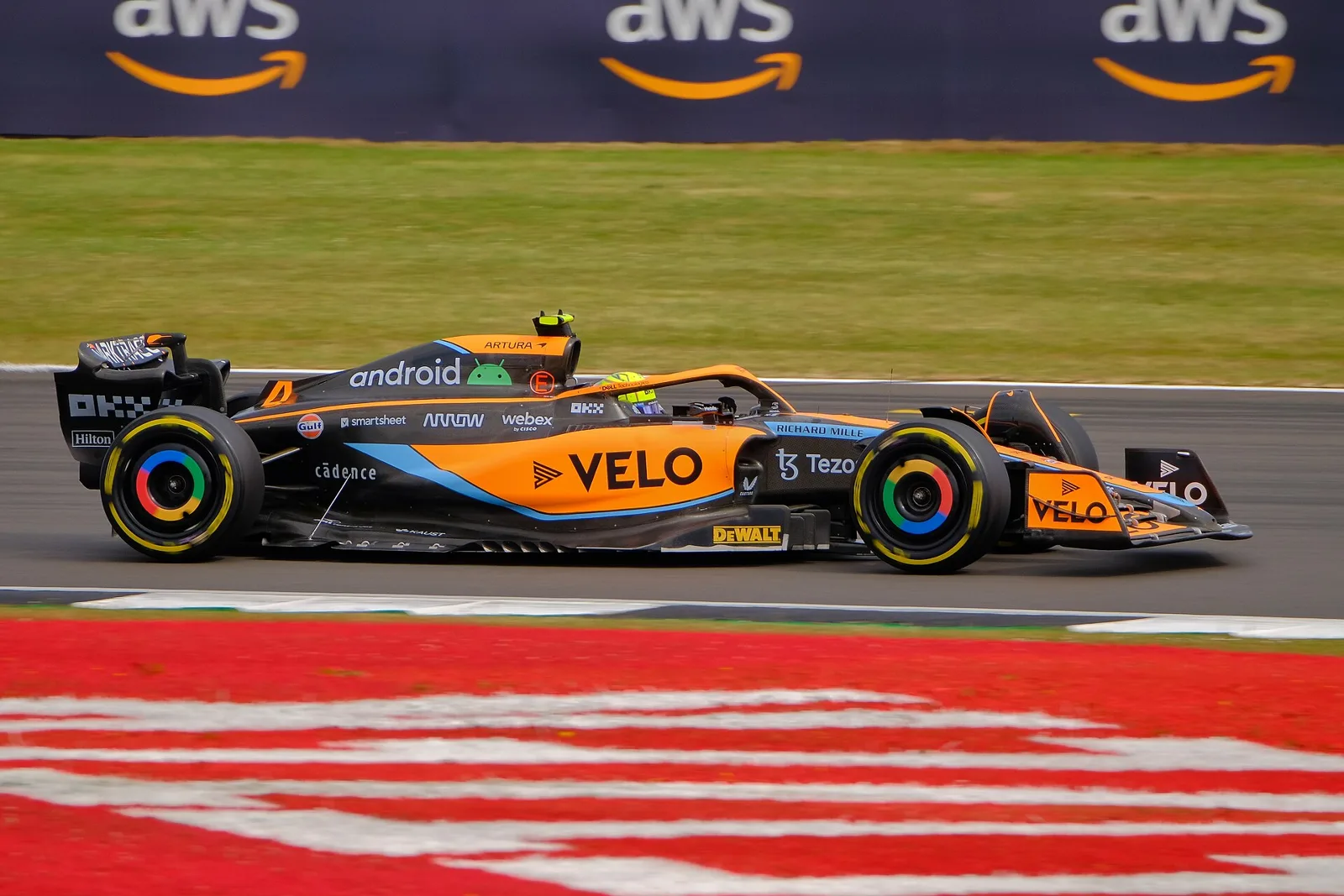
A James Key design built for the new ground-effect rules, with an unusual pull-rod front end, a strong start to its life and a long run of compromises that kept it out of the front-runners.
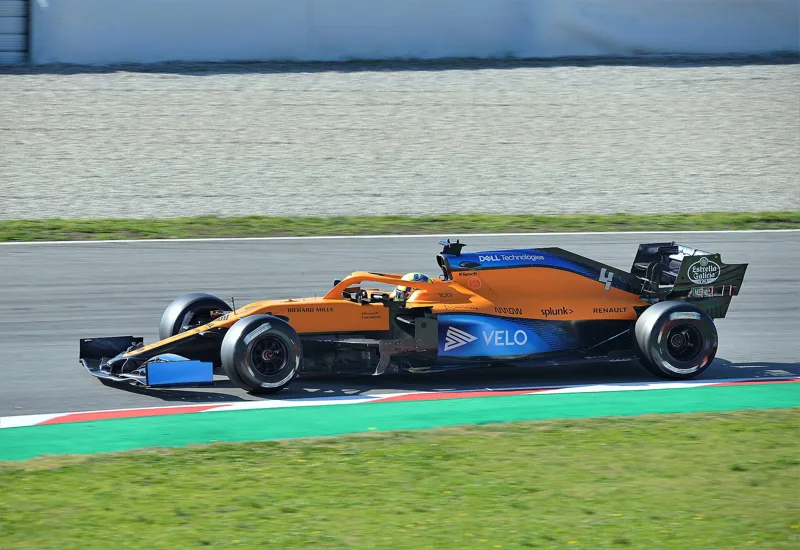
The MCL36 was McLaren's 2022 car, designed by James Key around the new ground-effect rules. Its unusual pull-rod front suspension was its talking point, and its one podium came when Norris finished third in wet conditions at Emilia Romagna. Its season was marked by inconsistent performance across circuits.
The McLaren MCL36 was the Formula One car McLaren raced in the 2022 championship, designed under James Key to suit the new ground-effect technical regulations. It was driven by Daniel Ricciardo and Lando Norris, and it made its debut at the Bahrain Grand Prix. The car had an unusual suspension layout and was reliable for much of the year, but it was generally seen as a disappointment, and Norris's single podium at Emilia Romagna was the only one a car from outside the top three teams achieved that season.
What was the McLaren MCL36?
The MCL36 was built to the new 2022 generation of technical regulations, which had originally been planned for 2021. It was designed under James Key and manufactured by McLaren, and it competed in the 2022 Formula One World Championship with Ricciardo, in his second year at the team, and Norris, in his fourth.
Its engine packaging was seen as conventional, but the car stood out for a suspension layout not seen on any Formula One car for nearly ten years. It was also noted for a lack of porpoising and for good mechanical reliability.
A car with an unusual suspension that gave McLaren one podium and a season spent chasing answers.
Who designed the MCL36 and when was it built?
Key was hired by McLaren from Toro Rosso in early 2019, after the MCL34 had already been designed and built. He had designed the MCL35 and its MCL35M upgrade, but the MCL36 was his first completely original car for the team.
He described the development of the 2022 car's larger and less intricate surfaces as a significant departure from the detailed work allowed in earlier years.
The regulation change was postponed, so planning that began in early 2019 and active development from 2020 had to adapt. Aerodynamic development of all teams' 2022 cars was paused from 28 March 2020 to 31 December 2020, and McLaren restarted in early January 2021. Manufacturing of some components, mainly chassis and gearbox parts, was under way by July 2021.
The switch to Mercedes engines had been planned for the new regulations and was contracted for 2021. Because of the postponement, it happened in the car's predecessor, the MCL35M, rather than in the MCL36 itself.
What made the MCL36's suspension unusual?
At its launch the car was noted for its reversed suspension layout. The MCL36 used pull-rod front suspension and push-rod rear suspension, a combination that had not been seen on a Formula One car since the McLaren MP4-28 of 2013.
The layout was designed to maximise the downforce produced by the Venturi and ground effects, by allowing unimpeded airflow into and out of the air inlets.
The floor carried an L-shaped edge wing and a ridged underfloor. Other teams later copied that approach, most notably on the Ferrari F1-75. By October 2021 the car had been run on the McLaren simulator, and the chassis passed FIA homologation tests in early December 2021.
How did the MCL36 start the 2022 season?
Pre-season testing at Barcelona was a mixed picture. Many teams suffered from porpoising, the rocking caused by the ground effect, but the MCL36 avoided most of it, partly because of its edge wing. The team was forced to fit aggressive brake cooling options during that test, which had not been expected until the Bahrain test.
The second test in Bahrain exposed a brake problem in the hotter conditions, and the team was unable to complete any long runs. Ricciardo tested positive for COVID-19 and had to isolate, leaving Norris to do the test alone. The team said it had been unable to do any optimisation of the car there.
The Bahrain Grand Prix was disappointing. Norris qualified thirteenth and Ricciardo eighteenth, with neither car reaching the final stage of qualifying. Norris finished fifteenth and Ricciardo fourteenth. Key said the car was performing as expected and that the drivers found it consistent and predictable, but that it lacked aerodynamic and mechanical grip.
Saudi Arabia brought no upgrades, because parts had been delayed in favour of the front brake cooling solution. Norris finished seventh, while Ricciardo retired with mechanical problems. Australia brought an upgrade to the area around the rear brakes, and Norris qualified fourth and finished fifth, with Ricciardo sixth.
How did Norris earn the MCL36's only podium?
Norris earned the podium at the Emilia Romagna Grand Prix, which was wet, and the MCL36 had a new beam wing for the weekend. Norris qualified third and Ricciardo sixth for the sprint, and the drivers finished the sprint fifth and sixth.
In the race Ricciardo understeered into Carlos Sainz, ending his race and damaging his own diffuser. Norris made his way back to third by the end of the first lap and ran fourth for most of the race. In the closing laps Charles Leclerc bounced over a kerb and had a mild collision with the barriers, which handed Norris third place.
That result meant that Norris was the sole driver from outside the top three teams to reach the podium in 2022, and the MCL36 the only car to do so. It was the car's high point, although the rest of the season did not match it.
What happened in the middle of the season?
The mid-season rounds brought a series of upgrades that did not change the car's fundamental issues. Miami saw a stiffer front suspension and an extra floor stay to reduce porpoising, but Norris collided with Pierre Gasly and both retired. Spain brought a total of ten upgrades, and Ricciardo likened the Friday running to winter testing because of the number of changes.
At Spain Norris, despite suffering from tonsillitis, finished eighth, while Ricciardo finished twelfth. Monaco brought extra front brake cooling and different steering geometry, and Norris finished sixth in a rain-affected race and set the fastest lap. Ricciardo was twelfth.
Azerbaijan used a track-specific aero kit with reduced load and more cooling. Norris finished ninth and Ricciardo eighth, but the team's use of team orders twice during the race was criticised, since it compromised both drivers' pace. Canada brought a rear wing update and a moved floor stay, but Norris suffered a power unit problem in qualifying and then a pit stop error in which the wrong tyres were fitted to his car.
The team announced before Britain that the MCL36 would not receive further major upgrades because of the budget cap. At Silverstone Norris finished sixth after losing fifth in the pits, and Ricciardo finished thirteenth after a drag reduction system failure forced an extra stop.
How did the MCL36 change through the second half of the year?
Austria brought revised brake ducts and rear wing endplates. Norris suffered an engine failure in first practice and reverted to an older engine. He was given a time penalty for exceeding track limits, which he said cost him the chance to challenge for sixth, and he finished seventh while Ricciardo finished ninth.
France brought a substantial package with a new diffuser, underfloor and sidepods. The sidepods changed the most. Through the turbo-hybrid era teams had pursued narrow sidepods that exposed as much floor as possible, but the 2022 rules limited that concept, so the new McLaren sidepods were closer to those of the title challengers, the Ferrari F1-75 and Red Bull Racing RB18. The upgrade looked effective in qualifying, with Norris fifth, but Norris finished seventh and Ricciardo ninth, which cost McLaren fourth place in the constructors' table to Alpine.
Hungary added revised front brake cooling and new underfloor flow conditioners. Ricciardo was demoted to fifteenth after a five-second penalty for a collision with Lance Stroll, while Norris finished seventh. Belgium brought an extensive package aimed at straight-line speed on the low-downforce layout at Spa, but Norris was relegated to seventeenth on the grid for exceeding the power unit component allowance. Both drivers were caught in DRS trains, and they finished twelfth and fifteenth.
What did the closing rounds bring for McLaren?
The closing rounds were more encouraging. Norris finished fourth at Singapore, where a new upgrade package took fourth place in the constructors' table from Alpine, while Ricciardo finished fifth. At Italy Norris finished seventh in a low-downforce specification, after his clutch map failed at the start.
Japan saw both cars finish where they qualified, tenth and eleventh, in a race shortened by heavy rain. The United States brought an unusual weekend, in which the 2021 IndyCar champion Alex Palou drove in first practice. Norris finished sixth after being struck by debris and making an extra stop.
In Mexico Ricciardo collided with Yuki Tsunoda and received a ten-second penalty, but he finished seventh on a medium to soft strategy. Sao Paulo was harder, because Norris fell ill and McLaren prepared Nyck de Vries as a replacement. Norris was able to race, but he collided with Leclerc and retired with electrical issues after a five-second penalty.
Abu Dhabi closed the season. Pato O'Ward replaced Norris in the first practice session, and Norris qualified seventh and finished sixth with the fastest lap of the race. McLaren finished fifth in the constructors' championship, and Norris finished seventh in the drivers' table.
How did the MCL36 compare with its rivals?
The MCL36 had a strong early season in parts and then fell away. Its fastest race was Emilia Romagna, and its most consistent run came from Norris. The table below sets out the key results for both drivers, so the gap between them and the car's pace can be seen in one place.
| Event | Norris | Ricciardo |
|---|---|---|
| Bahrain | Fifteenth | Fourteenth |
| Saudi Arabia | Seventh | Retired |
| Australia | Fifth | Sixth |
| Emilia Romagna | Third, the podium | Eighteenth |
| Miami | Retired | Thirteenth |
| Spain | Eighth | Twelfth |
| Monaco | Sixth | Twelfth |
| Azerbaijan | Ninth | Eighth |
| Canada | Fifteenth | Eleventh |
| Britain | Sixth | Thirteenth |
| Austria | Seventh | Ninth |
| France | Seventh | Ninth |
| Belgium | Twelfth | Fifteenth |
| Singapore | Fourth | Fifth |
| Abu Dhabi | Sixth | Ninth |
What happened to the MCL36 after 2022?
The MCL36 stayed in use after its racing career, mainly for private tests. McLaren ran it in February 2024 at Circuit Paul Ricard, with Oscar Piastri and reserve driver Ryo Hirakawa at the wheel. All of that running was in private tests, with no further race outings.
Later that month Norris, Piastri and the test drivers Will Stevens and Oliver Turvey ran it at Barcelona. In March Piastri and Hirakawa tested it at Imola, and in September Gabriel Bortoleto, a McLaren development driver competing in Formula 2, drove it at the Red Bull Ring.
Later in September McLaren ran a multi-day test at Silverstone, with Pato O'Ward driving an MCL36 while Zak Brown drove an MCL35M. In November Hirakawa and former AlphaTauri driver Nyck de Vries tested the car again at Paul Ricard.