A motorcycle maker that became a Formula One champion, an IndyCar engine supplier and a touring car force, with a record that runs from 1959 to the present.
Honda has raced motorcycles, Formula One, IndyCar, touring cars and sports cars since 1959. Its Formula One record includes a 1986 constructors' title, and its engines won the Indianapolis 500 in 2004 and 2005.
Honda has raced in motorsport since its early years, with Formula One, IndyCar, touring cars, sports car racing and MotoGP among its main areas. Its Formula One history includes a 1986 crown shared with Williams and a run of McLaren titles, while its engines have also won the Indianapolis 500. Its motorsport work is managed by Honda Racing Corporation.
What is Honda's motorsport programme?
Honda competes in a wide range of series, including Formula One, MotoGP, Super GT, Super Formula, IndyCar, IMSA, the BTCC, TC2000 and several GT3 and TCR series. All of these activities are managed by Honda Racing Corporation, known as HRC.
The breadth of the programme is one of the features that sets Honda apart from many manufacturers. It has run cars, motorcycles and engines across decades, and it has supplied different teams in different categories at the same time.
A manufacturer that moved from motorcycles to Formula One, IndyCar and touring cars, and keeps coming back.
How did Honda start racing?
In 1954 Soichiro Honda announced plans to race at the Isle of Man TT. Engineers spent the next five years on the machines, and Honda entered the event in 1959 with the RC142 bike, taking 6th, 7th, 8th and 11th places.
In 1961 Mike Hailwood won two Isle of Man TT races for Honda. The company also won the 250cc and 125cc titles in the 1961 World Grand Prix season, which gave its motorcycle programme a strong start.
When did Honda enter Formula One?
Soichiro Honda pushed the company toward Formula One in 1962. The team needed several years of development before the 1964 German Grand Prix, where the RA271 made its bow with Ronnie Bucknum at the wheel.
The RA271 was the first Japanese car to race in Formula One. The RA272 followed in 1965 with Richie Ginther alongside Bucknum, and Ginther took Honda's first Formula One victory at the 1965 Mexican Grand Prix, leading from start to finish.
What did the 1966 to 1968 seasons bring?
The RA273 appeared in 1966 with a new 3.0L V12 that the rule changes required. It ran in the first seven races of 1967 and reached the podium at the South African Grand Prix.
Surtees was the sole Honda driver in 1967, and he won the Italian Grand Prix in the RA300 on that car's debut. He ended the year fourth in the drivers' table, while the team placed fourth among constructors with one driver alone.
What happened at the 1968 French Grand Prix?
The RA302 was on hand for the French Grand Prix in 1968. Surtees declined to race it, judging it unsafe, so Jo Schlesser took the wheel and died in an accident in it.
Later that season Surtees took pole at the Italian Grand Prix and a podium in the United States. Honda then quit Formula One at the close of 1968.
Why did Honda return to Formula One in 1983?
Honda came back in 1983 as an engine supplier to Spirit. Before that year closed, it had also linked up with Williams, a partnership that lasted several seasons.
The Honda engines showed good performance but were unreliable at first. Keke Rosberg won the 1984 Dallas Grand Prix for Honda, which gave the company its first win since its return to the sport.
How did the Williams years go?
Honda's Williams partnership grew stronger in 1985, when a new engine arrived at the Detroit Grand Prix and Rosberg won the race. The team won the last three races of 1985 to finish fourth in the constructors' championship.
The engine developed for 1986 combined great power with dependability. Williams-Honda won the constructors' title with nine wins, while the drivers' title slipped to Alain Prost after Nigel Mansell's tyre blew up at the last race.
How did the Lotus and McLaren years unfold?
Honda started supplying Lotus in 1987 after signing Satoru Nakajima, and the season also began Honda's relationship with Ayrton Senna. Nelson Piquet won the drivers' championship that year, while Williams-Honda won the constructors' title.
For 1988 Honda made a deal to supply McLaren and ended its deal with Williams. The new RA168E was built to comply with the rules for that year, which was the final season of turbo engines in Formula One. The McLaren-Honda cars were dominant, taking 15 wins from 16 races.
Who were the McLaren-Honda champions?
Senna took the 1988 drivers' title, clinching it with a win at Suzuka, Honda's home race. McLaren-Honda also took the constructors' crown, finishing with more than triple the points of second-placed Ferrari.
The 1989 car used a naturally aspirated 3.5L V10 built for the new regulations. The team scored 10 wins and 15 pole positions from 16 races, and Alain Prost won the drivers' title ahead of Senna. The V10 was retained for 1990, when the team won the constructors' title again and Senna won the drivers' title.
Honda and McLaren introduced upgrades in 1991 that made the team competitive again after a slow middle of the season. The team won the constructors' and drivers' championships that year, a strong close to Honda's first spell as an engine supplier to the team.
Why did Honda leave after 1992?
Honda announced that it would leave after 1992, having achieved its goals. McLaren-Honda finished second in the constructors' standings after Gerhard Berger won the last race of the season, and the closely related Mugen company stayed in the sport.
Mugen's time in the sport lasted until 2000 and produced a best result of third in the constructors' championship in 1999 with the Jordan team. Honda itself did not return to Formula One until 2000.
How did Honda's later Formula One years go?
Honda returned in 2000 supplying engines to BAR, and the team finished fifth in its first season. BAR-Honda's best year came in 2004, when Jenson Button and Takuma Sato took 11 podiums and the team finished second in the constructors' championship.
Honda fully bought BAR in 2005 and became the Honda team for 2006. Jenson Button won the Hungarian Grand Prix that year. Honda exited Formula One once the 2008 campaign ended, amid the global economic crisis.
Honda came back in 2015 as an engine maker for McLaren, but the partnership was a disappointment and the two parted after the 2017 season. A deal with Toro Rosso followed for 2018, and Pierre Gasly finished fourth at Bahrain that year.
What did the Red Bull era deliver?
Honda agreed to supply Red Bull Racing for 2019 after a fairly successful season with Toro Rosso. Max Verstappen scored Honda's first podium of the V6 turbo-hybrid era at the Australian Grand Prix, and at the Austrian Grand Prix he scored Honda's first victory of that era.
The 2020 season was another good one. Verstappen took the 70th Anniversary Grand Prix at Silverstone, and Gasly's surprise victory at the Italian Grand Prix made Honda the first engine maker in the V6 turbo-hybrid era to win with two teams. Verstappen closed the year by winning the Abu Dhabi Grand Prix.
In October 2020 Honda announced that its F1 engine work would stop after 2021. It said the pandemic had not driven the choice; its zero-carbon commitments did.
How did Honda do in touring cars?
Honda entered the World Touring Car Championship with the Accord from 2005, and James Thompson won the 2008 Race of Europe at Imola. In 2013 the Civic won four races in its first full season and helped Honda win the manufacturers' championship.
Honda first joined the British Touring Car Championship in 1995. Team Dynamics later converted Integra Type Rs into BTC-T racers, and Matt Neal won the BTCC drivers' title in 2005 and 2006 with the car.
Honda won the BTCC manufacturers' title in 2010, 2011, 2012 and 2013. Gordon Shedden won the drivers' championship in 2012, and the Civic Type R took the manufacturers' title in 2015. The FK8 Civic Type R won the teams' championship in 2019.
Honda's touring car work also extended to the TCR category, where JAS Motorsport built Civic models. Those cars have won over 600 races and 125 championships. In Argentina, Honda backed the Pro Racing team in TC2000, and Jose Maria Lopez won the title in 2008.
What about sports car racing?
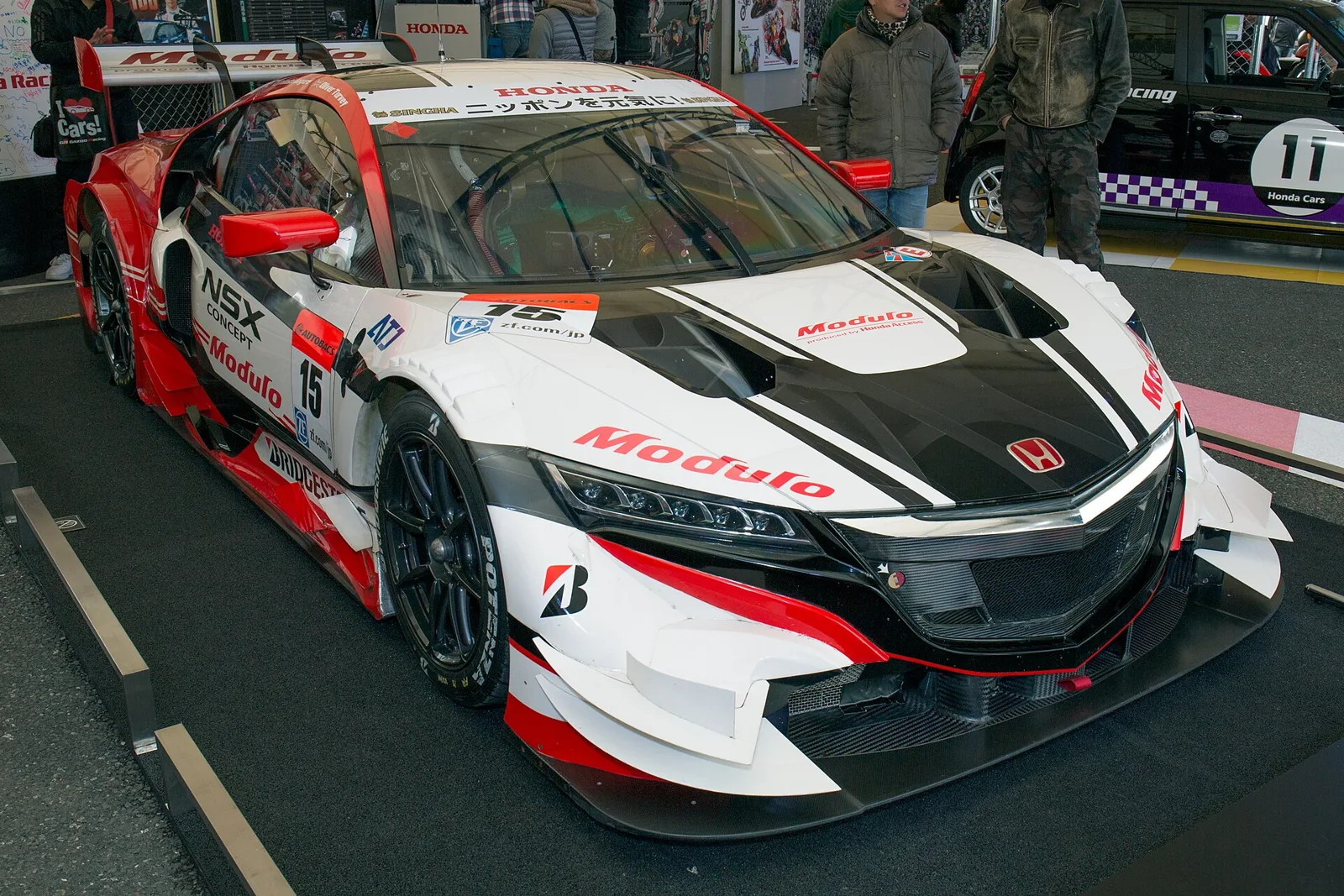
Honda's first Super GT involvement came in 1996, when Team Kunimitsu entered an NSX GT2 in the GT500 category. The Castrol Mugen NSX of Ryo Michigami won the title in 2000, and ARTA won the 2007 championship before the final race.
Honda's HSV-010 GT was introduced for 2010, after new rules barred the mid-engined NSX. Dome and Loic Duval won the 2010 title in the car, and Team Kunimitsu won the 2018 title with Naoki Yamamoto and Jenson Button.
Honda's first Le Mans entry dates from 1994, when three NSX GT2 cars started the race.
In North America, Acura entered the American Le Mans Series in 2007 in LMP2 and won its first race, the 12 Hours of Sebring. Honda won the 2009 LMP1 title with Highcroft Racing, and it won the 24 Hours of Daytona in 2016.
How did Honda do in IndyCar?
Honda started competing in IndyCar in 1994 and won its first race in 1995. Its first manufacturers' and drivers' championships came in 1996, and Honda left the CART series after 2002 before joining the IndyCar Series in 2003.
Honda won the Indianapolis 500 in 2004 and 2005. Between 2003 and 2005 it scored 28 wins from 49 races. When Toyota and Chevrolet left after 2005, Honda became the only engine manufacturer in the series from 2006 to 2011.
During those six seasons the engines completed 1,188,376 miles of practice, qualifying and racing. Honda is also the sponsor of the Honda Indy in Toronto, which is held every July.
What are the key results at a glance?
| Year | Series | Driver or team | Result |
|---|---|---|---|
| 1959 | Motorcycle | Honda team | Isle of Man TT, 6th, 7th, 8th and 11th |
| 1965 | Formula One | Richie Ginther | First Formula One win for Honda, Mexican Grand Prix |
| 1967 | Formula One | John Surtees | Italian Grand Prix win with the RA300 |
| 1984 | Formula One | Keke Rosberg | Dallas Grand Prix win |
| 1986 | Formula One | Williams-Honda | Constructors' championship, first Honda title |
| 1988 | Formula One | Ayrton Senna | Drivers' championship with McLaren-Honda |
| 2004 | IndyCar | Honda engines | Indianapolis 500 win |
| 2006 | Formula One | Jenson Button | Hungarian Grand Prix win for Honda |
| 2019 | Formula One | Max Verstappen | Austrian Grand Prix, Honda's first win of the V6 era |
| 2013 | World Touring Car | Honda Civic | Manufacturers' championship |
| 2010 | BTCC | Honda | Manufacturers' title |
| 2010 | Le Mans | Strakka Racing | LMP2 class win |
Why does Honda's motorsport record matter?
Honda's record matters because it shows a manufacturer that moved from motorcycles into Formula One and then into cars, engines and multiple series. Its engines have won at Indianapolis and in Formula One, and its touring car and sports car programmes have produced many championships.
The programme also shows how a company can shift strategy. Honda left Formula One more than once and returned each time, and its final exit after 2021 came from a wider commitment to zero-carbon technology rather than a loss of competitive ability.