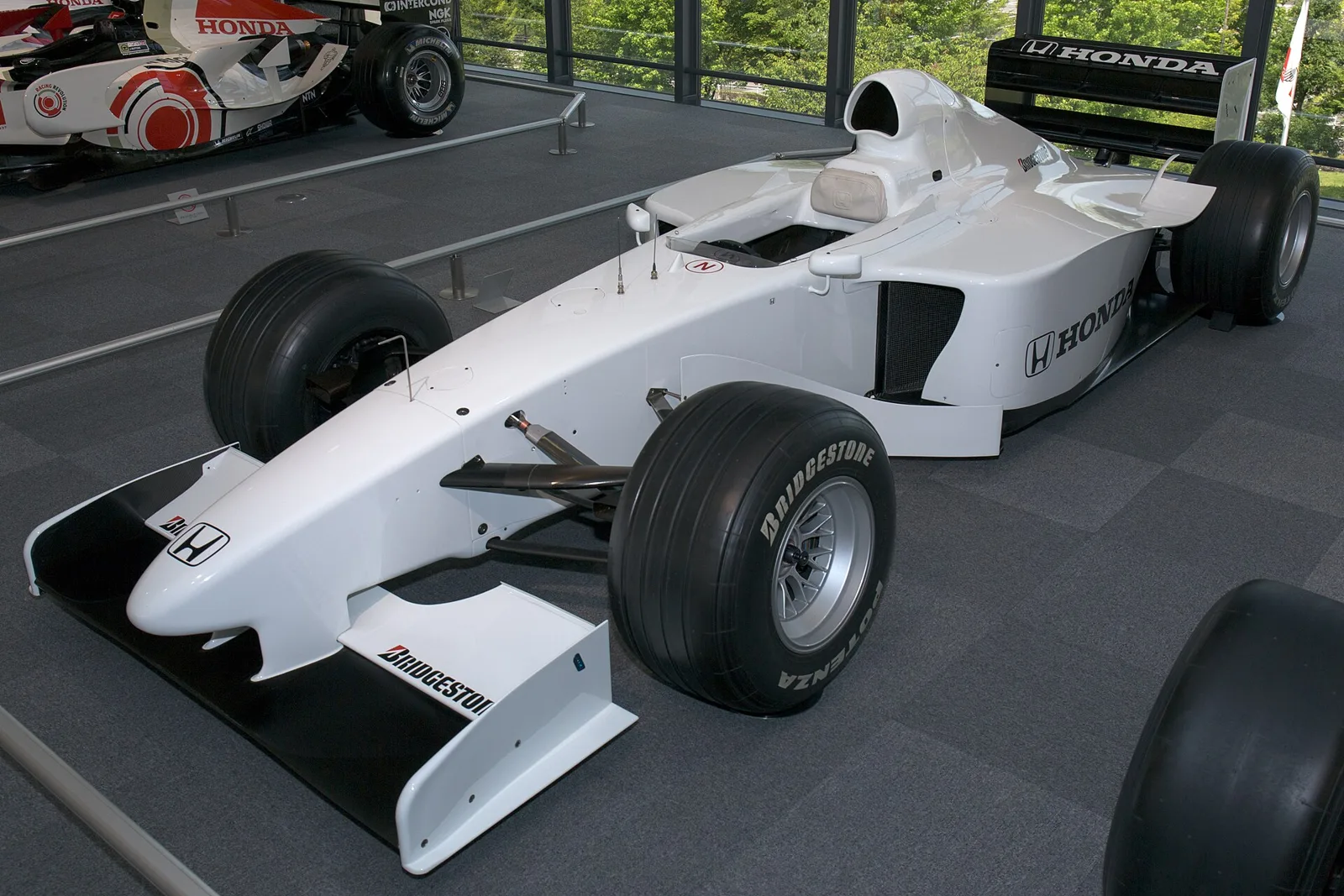
Harvey Postlethwaite's 1999 prototype impressed in winter testing, then vanished when Honda pulled out of running its own team.
Built by Dallara in 1999 from a design by Harvey Postlethwaite, this Honda test car carried a 680 hp Mugen-Honda V10. It was meant to prepare the company for a full entry, but Honda abandoned its team in May 1999 and the car never competed in a Grand Prix.
Commissioned by Honda in 1998, the RA099 was a prototype Formula One machine that Dallara put together in 1999. Harvey Postlethwaite, a former Tyrrell designer, led its design, and the car was meant to show whether Honda could return to the sport as a full constructor. Honda dropped the project in May 1999, and the RA099 only ever ran in testing.
Why did Honda build a test car in 1998?
Honda wanted a working car for testing before it committed to a full Formula One team. The RA099 gave its engineers a platform to refine engines, aerodynamics and chassis work while the company weighed a return to Grands Prix. The car was designed quickly by a group of engineers who had recently left Tyrrell.
Those engineers had joined Honda after British American Racing took over the Tyrrell team, and they brought their experience of building competitive chassis with them. Honda's board, however, expressed reservations about committing fully as a constructor, and that uncertainty shaped everything that followed.
A car built to prove a comeback, it impressed in winter testing and then disappeared when Honda walked away.
Where did Honda's Formula One history begin?
Honda's first serious attempt came in the 1960s, when Soichiro Honda wanted one of the company's cars to become world champion. Talks with Lotus broke down when Colin Chapman ended them at the beginning of 1964, so Honda built its own RA271. That car failed to finish any of its four races that year.
Richie Ginther gave Honda its first Grand Prix victory at the 1965 Mexican Grand Prix, and John Surtees added a second at the 1967 Italian Grand Prix. The 1967 car was a lighter chassis built by Lola, the RA300, which weighed only 600 kg (1,300 lb). The programme ended after Jo Schlesser was killed driving an RA302 at Rouen in the 1968 French race.
Honda returned in 1983 as an engine supplier, first to Spirit Racing and then to Williams. Williams won the Constructors' Championship in 1986 and 1987 with Honda power, and Honda later supplied McLaren from 1988 to 1992. Between 1984 and 1992 Honda won 68 Grands Prix as an engine supplier, and it left Formula One after 1992 to race in the American Champ Car series.
How did the RC100 and RC101B projects lead to the RA099?
Honda engineers began a study in 1991 under Ken Hashimoto and Keinosuke Taki, working outside normal hours with university partners. The study produced the carbon monocoque RC100, which was painted white and nicknamed the white crow by its engineers. Wind tunnel tests did not satisfy the company, so the design was reworked.
From mid-1992 the reworked chassis, the RC101B, was refined to meet the Formula One rules for 1993. In March 1993 it passed an FIA-approved crash test, which meant it could in principle have been entered in a Grand Prix. The RC101 was shown at Suzuka in January 1994, but observers quickly turned their attention to a slimmer second car, the RC101B, which complied with the 1994 regulations.
The deaths at the 1994 San Marino Grand Prix led the FIA to change the technical rules at speed, and Honda applied those changes to its car until 1996. That period of rule churn shaped the design choices that eventually went into the RA099.
How did the return plan change between 1996 and 1999?
Honda's plan moved back several times. Kawamoto wanted a constructor return by 1998, but in October 1996 he said the company was not ready. By March 1998 he was studying a five-year commitment that would begin in 1999.
Other teams and rumours shaped the timing. Dome planned a year of testing with its F105 chassis before 1997, and Jordan Grand Prix signed for Mugen-Honda V10 engines from 1998. Hirotoshi Honda, the son of the founder, owned 40% of Mugen-Honda and viewed the constructor plan unfavourably.
In July 1997 the Japanese press reported a return for the 2000 season. When Yoshino announced the return at the end of December 1998, the plan had become a full team of its own, with Harvey Postlethwaite and Rupert Manwaring appointed to its technical management. Earlier reports had also named Kawamoto as chairman and Satoru Nakajima as sporting director. Yoshino hoped to win races by 2003 and to reach the podium from 2000.
How was the RA099 designed and built?
Honda chose Dallara to build the chassis in March 1999, after its own 1998 prototype suffered delamination in the carbon fibre. Honda lacked European facilities for building a chassis, so it hired a specialist builder while setting up a racing base in Bracknell, England.
Honda recruited Postlethwaite to lead the work. Several former Tyrrell engineers followed him, and the design was built around a simple architecture that could take aerodynamic improvements as testing went on. Engineers first considered a three-litre V12, but they quickly moved to a more traditional V10 that drew on experience from the Mugen-Honda engines.
By October 1998 four examples had been built, and two of them stayed in Europe for track tests under Postlethwaite's direction. The first shakedown took place on 15 December at the Varano circuit in Italy. A Honda spokesperson said the company's role was simply to put an engine in the car, and observers nicknamed it the Dallaronda after the 1960s Hondola.
What were the RA099 specifications?
With its driver aboard the RA099 tipped the scales at 605 kg (1,334 lb), and it stretched 4,500 mm (180 in) from nose to tail. Power came from a Mugen-Honda MF-301HD V10 with 2,998 cc (182.9 cu in), rated at 680 hp (510 kW) and peaking at 15,000 rpm, which fed a six-speed sequential box that Honda developed itself.
| Specification | Detail |
|---|---|
| Weight | 605 kg (1,334 lb) with driver |
| Length | 4,500 mm (180 in) |
| Width | 1,800 mm (71 in) |
| Height | 950 mm (37 in) |
| Wheelbase | 3,020 mm (119 in) |
| Monocoque | Carbon fibre with honeycomb structure |
| Engine | Mugen-Honda MF-301HD V10, 2,998 cc (182.9 cu in) |
| Output | 680 hp (510 kW), peaking at 15,000 rpm |
| Gearbox | Six-speed sequential, developed by Honda |
| Shock absorbers | Developed by Showa |
| Brake discs | Carbon, designed by AP Racing |
| Wheels and tyres | Enkei wheels, Bridgestone tyres |
The suspension used a classic layout and was connected to Showa shock absorbers. The carbon brake discs came from AP Racing, and the chassis was built so the engineers could keep changing its aerodynamics while the testing went on.
Who was lined up to drive the RA099?
Honda considered several names in 1998, including Jacques Villeneuve, the 1997 world champion, and Toranosuke Takagi, a Honda protege with Mild Seven backing. Jos Verstappen was the driver who actually signed, on a three-year deal, and he drove the car through most of the 1999 testing.
Takagi joined Arrows for 1999 instead, and Mika Salo chose to stay with Arrows rather than accept a higher offer from Honda. Satoshi Motoyama, the 1998 Formula Nippon champion, was also on the list, but Honda recruited only Verstappen. He had been a Formula One driver since 1994 and had lost his seat at Stewart Grand Prix.
Verstappen said that Honda's reputation meant the company settled for nothing less than winning, and he called it an honour to be picked for the first steps of the programme.
How fast was the RA099 in testing?
The RA099 made a strong impression in its first winter tests. At Jerez, Verstappen set the fastest time on the first day, 1 min 26 s 580, and he improved to 1 min 25 s 18 by the fourth day. Rival teams were suspicious, and some suspected the car was running below the minimum weight.
The first test run was at Mugello in mid-January 1999, and the car went through a Jerez session from 23 to 28 January alongside Benetton, British American Racing and Stewart Grand Prix. On day one Verstappen completed thirty laps, and Villeneuve was second, 1.2 seconds behind. On day two Verstappen set 1 min 26 s 027 over thirty-two laps, and on day three he beat Ricardo Zonta by more than a second.
At Barcelona in early February, Verstappen completed 221 laps over three days, with a best time of 1 min 26 s 915. That was 1.4 seconds off the Prost AP02 of Jarno Trulli, and it put him thirteenth out of eighteen participants. Bernie Ecclestone then ruled that Honda could not take part in pre-season running with the rest of the field, so the car went to Lurcy-Levis, a track near Magny-Cours with a straight of 1.5 km (0.93 mi).
What ended Honda Racing Developments?
Reports said Honda's board was weighing a 200 million annual budget over five years, a claim Honda denied. Meanwhile the Bracknell factory employed 120 people, Honda had paid a 25 million deposit to reserve a twelfth team place, and British American Racing offered 60 million for three years of engines.
The turning point came in April 1999. Postlethwaite suffered chest pains during testing at Barcelona, and he died of a heart attack that night in hospital. Honda cancelled the rest of its Barcelona tests and the Jerez sessions planned for late April, and Rupert Manwaring took interim management of the team.
On 19 May Honda's board ordered an immediate stop to testing while Verstappen was still on track. That day Verstappen posted 1 min 24 s 25, sixth of twenty-one drivers and 1.5 seconds slower than Mika Hakkinen's McLaren MP4/14. Honda then offered the team to Bernie Ecclestone to find a buyer, and Flavio Briatore also considered taking it over, but the team never entered a race.
Other parties tried to find a way forward. Supertec, the engine preparer owned by Bernie Ecclestone and Flavio Briatore, considered taking over the team to enter under its own name, and John Macdonald, a former RAM Racing boss, pushed for an immediate takeover. In mid-May Max Mosley travelled to Honda's headquarters in Tokyo, while McLaren boss Ron Dennis criticised the U-turn as unprofessional.
The Concorde Agreements allowed only twelve teams in the championship, so Honda's reserved place also ended the return of Zakspeed, a German team that had competed from 1985 to 1989. Honda had paid a deposit to secure that place, and withdrawing would have meant a heavy penalty from the governing body.
Where are the RA099 cars today?
Dallara built six examples of the RA099, and four of them were functional. The RA099-3 was restored to the white livery used during development tests, and it is now on display at the Honda Collection Hall at Motegi. The Bracknell facilities still housed four RA099s, two of them bare chassis.