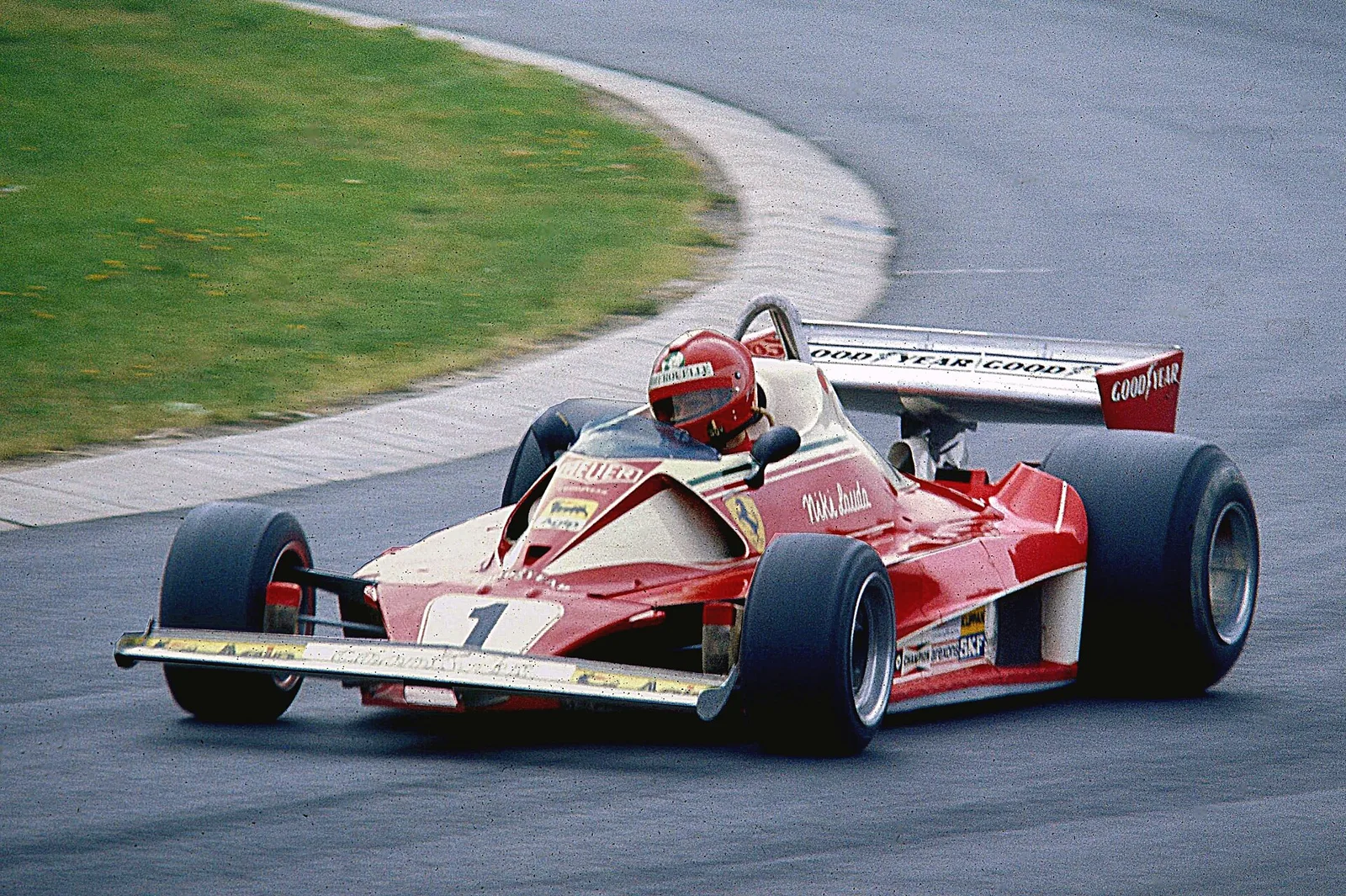
A flat-12 Ferrari with its gearbox laid across the car, a run of 27 wins and the team's mid-1970s title years.
Built on the 312B3 and raced from 1975 to 1980, the 312T was Ferrari's flat-12 workhorse, designed by Mauro Forghieri. Across its family of versions it won 27 races, four Constructors' titles and three Drivers' titles, a result that makes it the most successful car design in Formula One history.
The Ferrari 312T was the car most closely associated with Maranello's success in the mid-seventies. Designed by Mauro Forghieri for 1975, it was a development of the 312B3 with a transverse gearbox, and its family of versions won 27 races and seven titles across four Constructors' and three Drivers' championships. It was Ferrari's last naturally aspirated Formula One car until the Ferrari 640 of 1989.
What was the Ferrari 312T?
The Ferrari 312T was a Formula One car based on the 312B3 of 1974, and it was used from 1975 until 1980. Mauro Forghieri led its design, and its versions won 27 races and four Constructors' titles. The 312T was replaced for 1981 by the 126 C, Ferrari's first turbocharged car.
The design was simple and tidy, and it took mechanical upgrades well. Its origins lay in the handling problems of the 312B3, which small changes could not fix. The answer was a fresh chassis, bodywork and gearbox, plus a reworked engine and suspension. Its handling was found to be inherently neutral, and it responded well to changes made through its life.
A flat-12 with its gearbox laid across the car, 27 wins and a run of title years that made Maranello's mid-seventies era.
How was the 312T engineered?
The car was powered by the Tipo 015 flat-12 engine, which produced around 510 bhp. Its power-to-weight ratio was about the same as that of the Cosworth DFV, even though it carried more fuel, oil and water. The 3 stood for 3 litres, and the 12 for the cylinder count.
Forghieri's chassis was a semi-monocoque built from a tubular frame skinned with riveted aluminium sheets, a move away from the 312B3's full monocoque. It weighed slightly more but matched the earlier car's rigidity, and it was simpler to adjust and to repair. It also accepted bodywork with a smaller frontal area.
Why was the gearbox mounted transversely?
Mounted across the car behind the engine and in front of the rear wheels, the gearbox shifted the mass forward and cut the polar moment of inertia. The T in the name stood for trasversale, the Italian word for transverse, and the March 721X had used a similar layout before it.
Forghieri and engineer Walter Salvarani developed the gearbox together. In 1979 Ferrari also tested a semi-automatic version, operated by hydraulics and buttons on the steering wheel, to speed up changes and cut human error. Gilles Villeneuve tried it at Fiorano but preferred the manual, so it never raced. Ferrari returned to the idea a decade later in the 1989 Ferrari 640.
How did the 312T win the 1975 title?
The team used the old 312B3 for the opening two races, and the 312T made its race debut at the South African Grand Prix. Niki Lauda won four of five races in mid-season, and the title was settled at Monza, where Clay Regazzoni's victory secured Ferrari's first Constructors' title since 1964.
The debut was disappointing. Regazzoni's car had been set up incorrectly, and Lauda's engine lacked power until a test revealed a technical problem. The 312T then proved faster than the 312B3 at Fiorano, and it won the non-championship International Trophy with Lauda at the wheel. Lauda had tested the car extensively over the winter, preparing for a serious title challenge.
Brabham, Tyrrell and McLaren pushed hard in the slow start to the year, but Lauda's mid-season run carried Ferrari ahead. Lauda finished third at Monza to take the drivers title, and he added the United States Grand Prix at the end of the season.
How did the 312T2 handle the 1976 season?
Regulations outlawed tall airboxes from May 1976, when the Spanish Grand Prix was held, so the 312T ran for the first three races of that year. Lauda took the first two and Regazzoni the third until the 312T2 took over.
Behind the cockpit the 312T2 had no airbox; instead, NACA-style intakes were cut into the cockpit sides. Its wheelbase measured 2560mm, which was 42mm longer than before. A de Dion rear end appeared at launch, but testing led to a conventional arrangement.
The 312T2 first appeared in competition at the Race of Champions at Brands Hatch in March 1976, and its first world championship race was the Spanish Grand Prix in May. Lauda led the championship after three more wins, but at the German Grand Prix at the Nurburgring a rear suspension failure caused a huge crash in which he nearly burned to death.
Lauda was back racing six weeks later, but he lost the title to James Hunt by a single point. The 312T2's superiority still helped Ferrari win a second consecutive Constructors' title.
What changed with the 312T2B and 312T3?
The 312T2B, an uprated version for 1977, was shaped by the Goodyear tyres. As the Lotus 78 pushed the tyre makers toward high-downforce compounds, the Ferrari struggled to build enough tyre temperature, and the car became hard to drive. The 312T3 arrived in 1978 with a new monocoque, but the Lotus 79 proved the stronger car that year.
Early 1977 races used cars barely changed from 1976, two of them built the year before. Fiat logos made their first appearance on a Ferrari F1 car. Lauda led a test programme during the weeks after the Brazilian race, which brought a fresh rear wing, reworked bodywork and altered suspension.
Lauda's South African win was overshadowed by tragedy: his car took heavy damage from debris thrown up by Tom Pryce's fatal crash, yet he still took the chequered flag. Over the season, three new cars were built and the Ferrari won three races for Lauda and one for Reutemann, which secured another Constructors' title.
Lauda then clinched the 1977 drivers title at Watkins Glen and left the team before the season ended. Gilles Villeneuve replaced him, and the T2B's neutral handling did not suit his oversteering style. At the Japanese Grand Prix Villeneuve was launched over Ronnie Peterson's six-wheeled Tyrrell, and two spectators were killed when the car landed in a restricted area.
The 312T3 was introduced at the third race of 1978, with the flat-12 tuned to around 515 bhp. Its monocoque and suspension were new, the design was made to work with Michelin tyres, and the flatter bodywork top helped airflow to the rear wing. Reutemann won four races, and Villeneuve won his home Canadian Grand Prix, but the Lotus 79 beat all comers that year.
Did the 312T4 win the 1979 title?
Yes. Jody Scheckter won his only Drivers' Championship in the 312T4, which won six races, three each for Scheckter and Villeneuve. Ferrari also took its fourth Constructors' title in five seasons, and the car recorded only one mechanical retirement all year.
The 312T4 debuted at the 1979 South African Grand Prix as a near copy of the 312T3. Its monocoque was pinched as narrow as possible to make use of ground effect, but the flat-12 filled space that an upswept underside needed, so the car leaned on wing-style downforce, much as the Lotus 78 had.
The car made later appearances: Scheckter ran it at the 2010 Bahrain weekend, marking Formula One's 60th anniversary, and at the 2019 Italian Grand Prix, forty years after his title. It was sold at auction in 2024.
What went wrong with the 312T5 in 1980?
The 312T5, a substantially revised 312T4, arrived at the start of 1980. Ferrari's wide flat-12 Boxer did not match the aerodynamic demands of the period. The car was unreliable and slow, and it did not win a race for the first time since 1973. Ferrari finished tenth in the Constructors' Championship.
Its development went nowhere while rivals improved through the season. Scheckter failed to qualify in Canada, scored two points and retired at the end of the year. Villeneuve qualified third fastest for the Brazilian Grand Prix, the car's best grid slot, and the best results were three fifth places, one for Scheckter at Long Beach and two for Villeneuve at Monaco and Canada.
The 126CK replaced the 312T5 for 1981, and it was a completely new car.
What were the 312T6 and 312T8?
The six-wheeled 312T6 ran four tyres on its rear axle, a set made specially for it. Lauda and Reutemann tested it in 1977, but it never raced. It breached the width limits by a wide margin, and it proved hard to drive.
During one Fiorano session Reutemann crashed on lap 12 and the car burst into flames, and another test suffered a rear upright failure.
Italian press later showed pictures of a secret eight-wheeled 312T8. Those images were a mock-up that Ferrari released itself, and the car never existed.
Version summary
| Version | Year | Notable results |
|---|---|---|
| 312T | 1975 | Four wins for Lauda in mid-season; Constructors' title at Monza |
| 312T2 | 1976 | Lauda loses the drivers title to Hunt by one point; second Constructors' title |
| 312T2B | 1977 | Lauda wins three races; third successive Constructors' title |
| 312T3 | 1978 | Reutemann wins four races; Ferrari second in the Constructors' table |
| 312T4 | 1979 | Six wins; Scheckter wins the drivers title; fourth Constructors' title in five seasons |
| 312T5 | 1980 | No wins; tenth in the Constructors' table; best results three fifth places |
What is the 312T's legacy?
The 312T family combined 27 race wins with seven championship titles, which makes it one of the most successful designs in Ferrari's history. Its transverse gearbox and flat-12 engine were distinctive features that set it apart from the cars of its time.
The car also recorded a long life in the team's story, from the Lauda years to the title that Scheckter won in 1979. Its eventual decline in 1980 showed how quickly a successful design could fall behind when rivals pushed their aerodynamics further. Several of its drivers are remembered for their work in it, from Lauda's comeback in 1976 to Villeneuve's breakthrough in 1978.