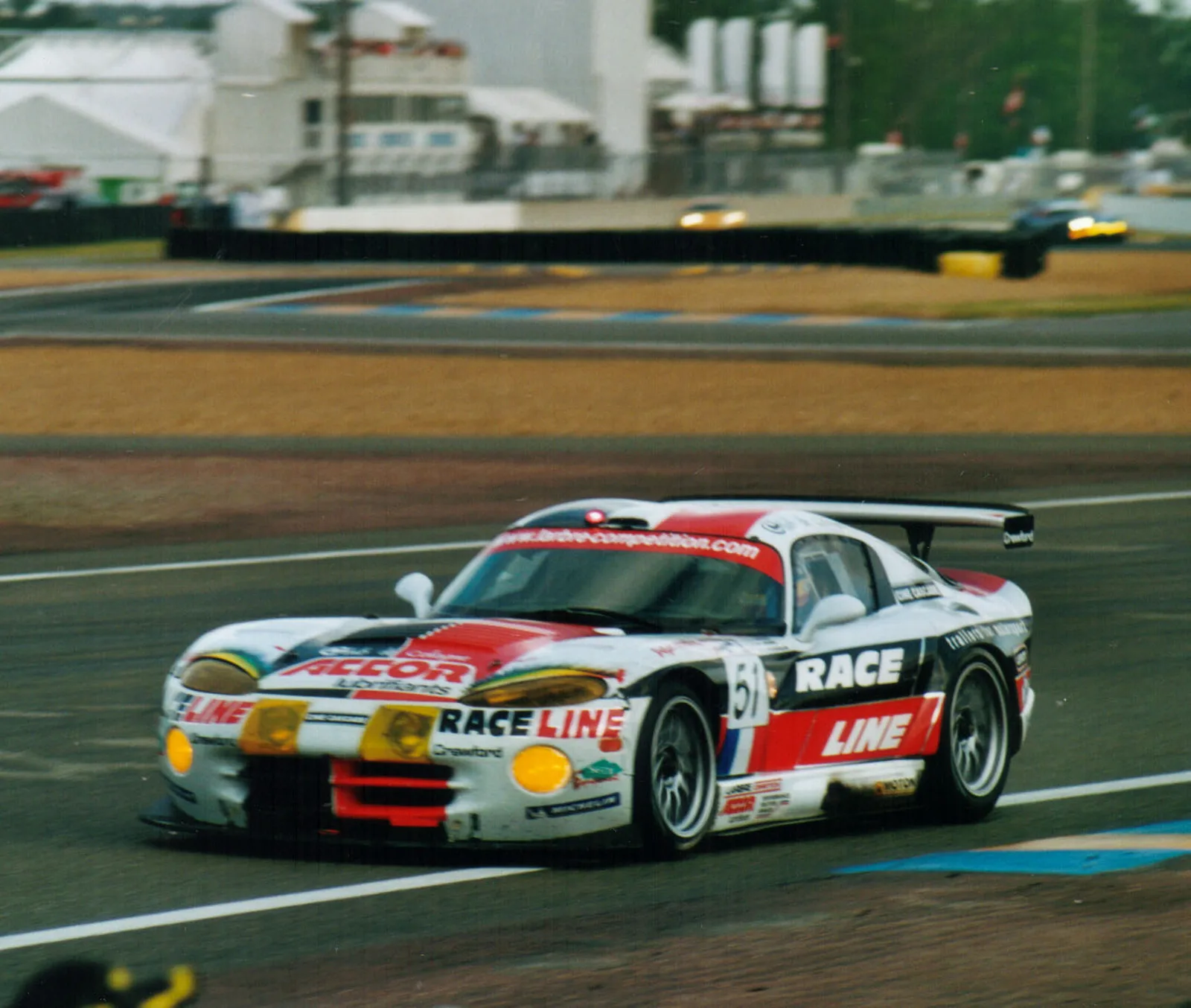
Developed with Oreca and Reynard, the GTS-R raced from 1996, won the FIA GT2 championship in 1997 and was built in 57 examples before production ended in 2005.
Developed with Oreca and Reynard Motorsport, the Viper GTS-R was unveiled in 1995 and raced from 1996. Oreca's FIA GT2 titles came in 1997, and 57 cars were built before production stopped in 2005.
The Chrysler Viper GTS-R was a racing variant of the Dodge Viper, known as the Chrysler Viper GTS-R in Europe and the Dodge Viper GTS-R when raced in North America. It was officially unveiled at the 1995 Pebble Beach Concours and was developed with Oreca of France and Reynard Motorsport of the United Kingdom.
Over the following decade the car won numerous championships and several famous events. Its career covered the FIA GT and British GT series, the American Le Mans Series and the 24 Hours of Le Mans, with customer cars spreading the design across Europe and North America.
Why did Dodge build a racing Viper?
First-generation Viper RT/10s had been modified for GT racing in North America and Europe, but without much success. The roadster body lacked the rigidity a coupe would have, and teams did not have the money to build a car that could match the factory efforts.
Dodge began redesigning the Viper in 1995, upgrading the roadster and adding a coupe, the Viper GTS, which was still in development at the time. The racing programme and the coupe therefore went forward together, each feeding ideas to the other. The racing programme was approved to show off the car's handling and to lift sales in Europe, where Viper imports had struggled.
Chrysler believed it needed outside help to adapt the car to European circuits as well as North American ones. Oreca had years of sports car experience and had helped the Mazda 787B win the 1991 Le Mans race, so it was the natural partner.
For North America, Chrysler recruited the Canaska Southwind team to run the factory effort. The arrangement meant that elements of the racing car could feed into the road car, and the road car's changes could improve the racer in return.
A road Viper turned into a racer by Oreca and Reynard, the GTS-R won the 1997 FIA GT2 title and was built in 57 examples.
Who built the GTS-R?
Reynard Motorsport of the United Kingdom built the basic chassis and other integral parts. Those parts were shipped to Oreca in France for assembly, and Oreca built and maintained the cars in its own shops.
Oreca also ran Chrysler's official factory teams in Europe, and after production it spent its effort supporting a growing fleet of customer cars. Its construction work covered 18 chassis in total, and most of those were sold directly to customers for use in whichever series would accept them.
In total 57 GTS-Rs were built. Five prototypes were made first for testing and early use by Oreca and Canaska Southwind, and 52 more followed. Production continued until 2005, after which Oreca concentrated on maintaining and supporting the existing fleet.
The naming also depended on where the car ran. In Europe it was mostly known as the Chrysler Viper GTS-R, because the new cars were built there, while in North America it was the Dodge Viper GTS-R. The cars carried no Chrysler or Dodge badges, only the GTS-R name on the bonnet.
What did the GTS-R change from the road car?
The race car kept much of the Viper GTS bodywork, but it gained the mandatory rear wing, a rear diffuser and a front splitter. The exhaust was routed out of the side of the car, just under the doors, and the road car's side exhausts were not kept.
Vents were added to the bonnet to cool the engine, and intakes were placed on the roof and rear fenders. Early cars had their fog lights covered over, although they were restored later for night visibility, and optional lights sat in square notches above the grille.
The V10 measured 7998.5 cc, which sat just under the 8000 cc limit, so the 356-T6 engine needed only light modification. Redesigned intakes were the main change for power, and reinforcements were added for endurance running.
The GT2 Champion Edition, offered in 1997 through the top Dodge Viper dealers, was a road-going version of the race car. It shared the race livery and carried a large rear wing, front dive planes and a splitter, with GTS-R badging.
How did the GTS-R race in 1996?
Two racing teams developed the GTS-R separately for competition in 1996. Canaska Southwind started in the North American IMSA GT Championship at the 1996 Daytona 24 Hours, where it finished 29th, and improved to twelfth at the 12 Hours of Sebring.
Viper Team Oreca ran a limited schedule that began with the 24 Hours of Le Mans. Both teams entered two cars at Le Mans, and three of the four finished, with Canaska Southwind taking the best result in tenth place.
The two teams then returned to their own series. Viper Team Oreca finished eighth at Brands Hatch, ninth at Spa and sixth at Nogaro in the BPR Global GT Series, while Canaska Southwind ended its year with second in class at Mosport.
Canaska Southwind left the Viper programme in 1997. Oreca made a single IMSA GT appearance at the 1997 Rolex 24 at Daytona, where it finished 12th, before concentrating on the FIA GT Championship.
Did the GTS-R win the FIA GT championship?
Yes. Oreca won the FIA GT2 team and driver championships in October 1997, after a season that began with a 1-2 finish in its class and continued with six more victories in an eleven-race season.
The team moved to the GT2 class in 1997 because Porsche and Mercedes-Benz were strong in GT1. Chamberlain Engineering joined as a customer, and Oreca finished 14th overall at Le Mans that year, fifth in class. Team Taisan also ran a customer Viper in All Japan GT, making two appearances with a best finish of eighth.
In 1998 Oreca won all but one of the ten FIA GT events, and its first class victory at Le Mans came with an eleventh-place overall finish. Orion Motorsport, meanwhile, scored six class wins in the British GT Championship.
Orion's season in British GT carried Kurt Luby and Richard Dean to the drivers' championship. It was a reminder that the Viper also worked well for privateers, not only for the factory-backed Oreca team.
How did the GTS-R fare from 1999 to 2001?
In 1999 Oreca expanded to two championships, running a two-car team in the new American Le Mans Series alongside its FIA GT programme. The team won nine FIA GT events in 1999 and, in the ALMS, six races and the title.
Oreca also won its second straight Le Mans class victory that year. In 2000 the team concentrated on North America, opening with a win at the Daytona 24 Hours by a small margin over the new Chevrolet Corvette factory team.
In the 2000 ALMS Oreca won ten races and was ultimately beaten by Corvette in two late-season rounds, but it secured the championship again. At Le Mans the team won its third straight class victory with a seventh-place finish overall.
Chrysler's backing officially ended in 2001, because Chrysler and Oreca had begun work on a Le Mans Prototype the year before. Oreca left its Viper teams to pursue the new project, and privateers carried the car in FIA GT and the British and French series.
What happened to the GTS-R after 2001?
Larbre Competition won the 2001 FIA GT championship with Vipers, and it defended the title in 2002 with a single win. Ferrari 550s showed their potential that year, winning four races, and Prodrive-built Ferraris began their dominance of FIA GT from 2003.
Vipers made their final Le Mans appearance in 2003, with Larbre finishing fourth in class. The car stayed competitive in French GT, where Alain Prost ran chassis C50 in 2005 and the Vipers won nine races that season.
Viper GTS-R homologation came to an end in 2007, nearly seven years after the Viper GTS bodystyle had been replaced. Historic racing kept the car alive, and a restored 1999 championship car, chassis C23, raced at the GT90s Revival at Magny-Cours in 2007.
Which privateers ran the Viper?
Privateers ran many Vipers in the late 1990s and early 2000s. Teams such as Zakspeed, Hayles Racing, DDO and Carsport Holland raced customer cars, and several of them won championship rounds and titles.
Zakspeed claimed the overall win at the 24 Hours Nurburgring in 1999, and it won the race again in 2001 and in 2002. Those results made the team one of the most consistent long-distance users of the car.
Hayles Racing won four races and the British GT championship in 2001, finishing two points ahead of Lister. DDO won five French GT events that year, while Larbre won three FIA GT events, including the Spa 24 Hours, and the FIA GT title.
In 2000 the Lister Storm won five FIA GT races, which left the Paul Belmondo and Carsport Holland teams second and third in the championship. The same era saw Team Taisan run a Viper in All Japan GT, where it took its first class victory at Fuji Speedway in 2003.
What came after the GTS-R?
After Dodge ended its factory-backed programme, it sold ready-made track cars called Dodge Viper Competition Coupes to customers. Oreca built them as FIA GT3 cars, which meant they could not match the extreme performance of the earlier GT1 racers.
Chrysler returned to racing in 2012 with the SRT Viper GTS-R, which won the GTLM class of the Tudor United Sportscar Championship in 2014 before factory support was ended. Privateers still raced the newer cars, and the 2013 Dodge Viper SRT GT3-R was homologated as GT3-036.
| Specification | Detail |
|---|---|
| Unveiled | 1995 Pebble Beach Concours |
| Known as | Chrysler Viper GTS-R in Europe, Dodge Viper GTS-R in North America |
| Developers | Chrysler of North America, Oreca, Reynard Motorsport |
| Engine | 356-T6 V10, 7998.5 cc |
| Cars built | 57: five prototypes and 52 more |
| Oreca chassis | 18 built by Oreca |
| Key title | FIA GT2 team and driver championships, 1997 |
| Le Mans best | Tenth overall, Canaska Southwind, 1996 |
| Production ended | 2005 |
| Homologation ended | 2007 |
| Successors | Viper Competition Coupe, SRT Viper GTS-R, Viper SRT GT3-R |