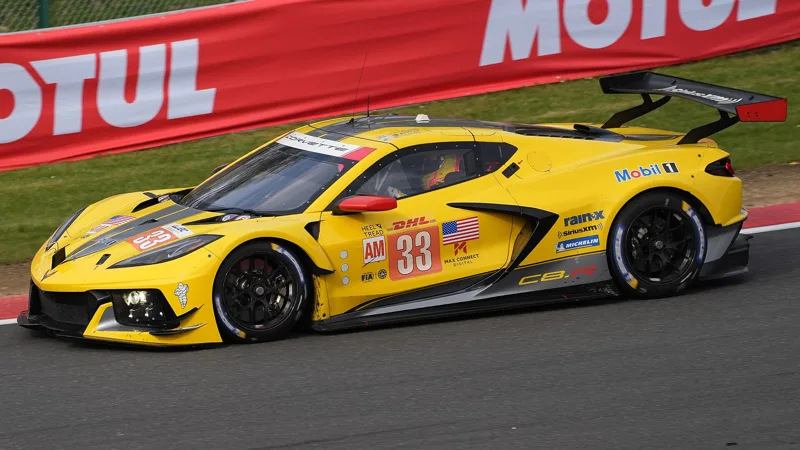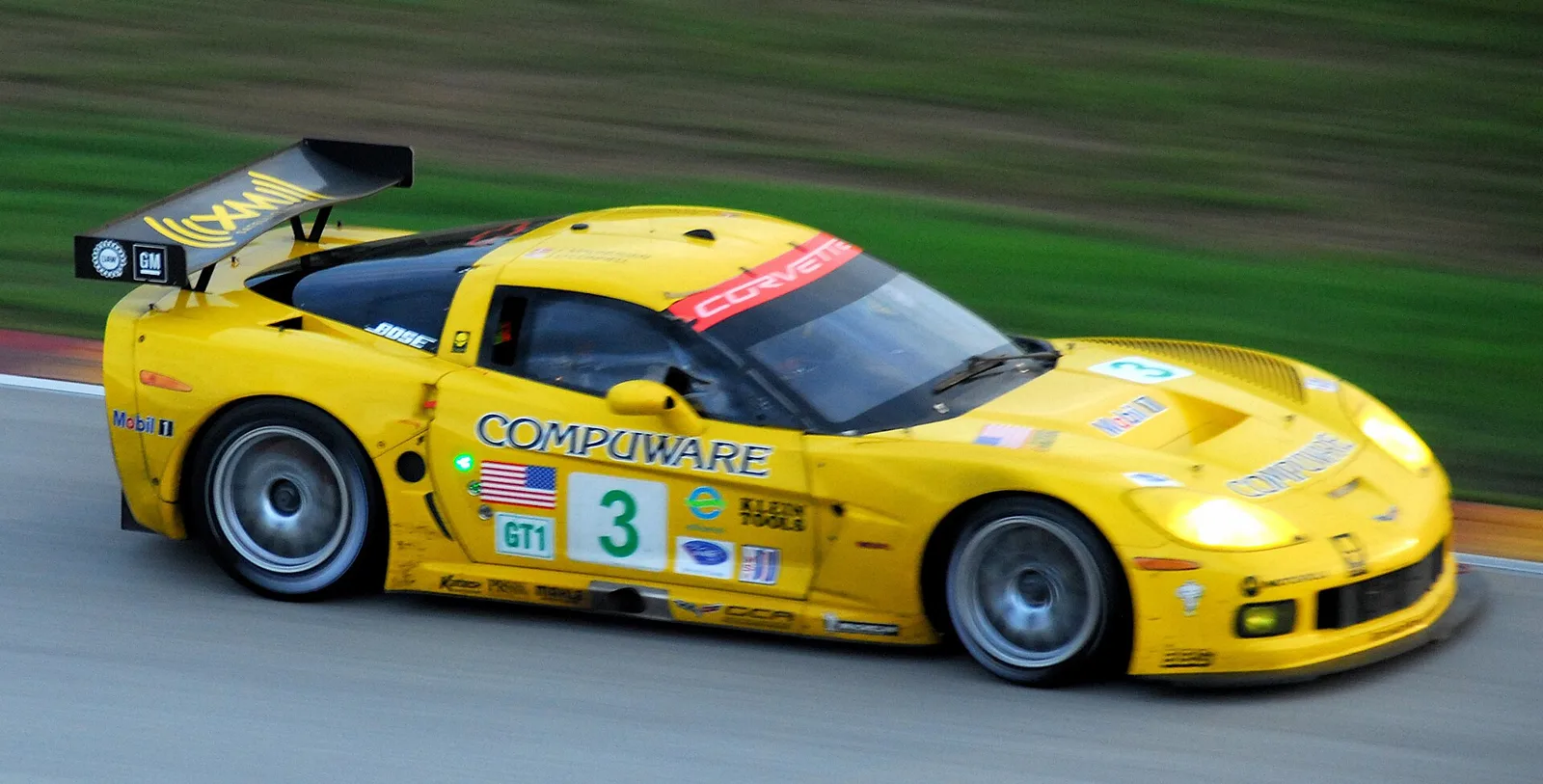
Built by Pratt Miller and Chevrolet to replace the C5-R, the C6.R won Le Mans classes and American Le Mans Series titles in GT1 and GT2 form.
Built by Pratt Miller and Chevrolet, the Corvette C6.R replaced the C5-R in 2005. Its Katech V8 powered GT1 and GT2 versions that won Le Mans class races and American Le Mans Series titles.
Pratt Miller and Chevrolet built the Corvette C6.R as a grand tourer for endurance racing. It replaced the Corvette C5-R and applied the body style of the new C6 generation road car, with improvements for speed and reliability on track.
Since its debut in 2005 the car has built on the dominance of its predecessor, winning multiple American Le Mans Series championships and race wins in the Le Mans Series, the FIA GT Championship and at the 24 Hours of Le Mans. It came in two main versions, GT1 and GT2, and it was retired from GT1 competition in 2012.
What was the C6.R designed to do?
The C6.R was built to replace the C5-R as Corvette Racing's factory endurance car. Pratt Miller and Chevrolet kept the car close to its road-going relative, while adding the changes needed to make the car faster and more reliable on the track.
Development was more an evolution than a new design. The C6.R and the C6 road car were developed at the same time, which allowed race elements to feed into the road car and road car features to be used on the track.
Much of the C6 road car's framework was kept on the race car, and the team made wider use of lightweight aluminium to save weight. The road car also replaced the C5's pop-up headlamps with fixed designs, which improved the airflow over the nose.
The racer shared its exterior styling with the Corvette Z06 performance car. Its large grille opening fed the brake cooling ducts and helped downforce by exiting air through the top of the bonnet.
A grand tourer built for endurance racing, the C6.R carried Corvette from the GT1 class to GT2 titles and Le Mans class wins.
What engine and brakes did the C6.R use?
The C6.R used a Katech-built 7.0-litre V8 based on the LS7 from the Z06. The engine, known as the LS7.R, was named Global Motorsports Engine of the Year in 2006, recognising its performance and durability.
The GT1 version produced 590 HP with carbon ceramic brakes and aggressive aerodynamics. The GT2 version produced 470 HP with cast-iron brakes and relatively stock aerodynamics, which made it closer to the road car.
Unrestricted, the LS7.R was expected to produce around 800 hp, so the engine's output depended mainly on the rules of the class in which it ran.
The car also carried innovations that were unusual for a race car. A small camera in the rear bumper fed a monitor on the roof of the cockpit, which gave the drivers a view behind them instead of relying on mirrors alone.
Air conditioning was another addition, to help drivers cope with high cockpit temperatures. It needed a large suction fan at the rear and intakes built into the side mirrors.
Variable displacement was tested in 2007 to save fuel during caution periods by disabling half of the cylinders. Its failure at the 2007 Le Mans led the team to remove it until it could be properly evaluated.
How did Corvette Racing start in 2005?
Corvette Racing began 2005 with two new C6.Rs, and unlike the C5-R, the new cars competed in the full American Le Mans Series season from their first year. Prodrive's Aston Martin DBR9 won the opening round at Sebring, which was Corvette's first loss since the end of 2003.
After Sebring the Corvettes won each succeeding race that season, and they stayed unbeaten when Prodrive returned for the last two rounds. The team also went to Europe for the 24 Hours of Le Mans, where it outlasted the quicker DBR9s to take a 1-2 in GT1 and finish fifth and sixth overall.
In 2006 Prodrive focused on the American series, and Corvette faced a real battle. Aston Martin won several races later in the year, and the two teams stayed close in the points until Corvette took a three-point margin in the final round to win its second straight championship.
At Le Mans in 2006 the Aston Martins once again faltered after leading the race, which let a C6.R finish fourth overall and win GT1. The duel between the two cars produced record-breaking pace for homologated GT cars, and the distance record set by Corvette that year still stood as of 2022.
How did the C6.R win titles in 2007 and beyond?
Prodrive returned to Europe to concentrate on improving the DBR9 for Le Mans, which left Corvette without its main American rival. Corvette was the only GT1 competitor in nine of the twelve races that year, and that allowed it to win its third championship.
At Le Mans the Corvettes were beaten by Aston Martin, which finally kept its pace over 24 hours and took its first class victory. Corvette took second in class, and the result showed that reliability was still the deciding factor in the endurance races.
Corvette Racing ran the GT1 C6.Rs in the early events of the 2009 ALMS season. It then retired those cars at the 2009 Le Mans to concentrate on a new GT2 programme.
What was the GT2 C6.R?
The newly designed GT2 car used a V8 of six litres making 470 bhp, which was based on the 7.0-litre LS7.R from the GT1 car. For the 2010 regulations the engine was cut to five and a half litres, which added weight and waivers that put the car at a disadvantage against the Ferrari F430 GTC.
The GT2 car took styling cues from the then-new Corvette ZR1 road car. It used an aluminium frame rather than the GT1's steel one, with a smaller front splitter and rear wing, and steel brakes in place of the GT1's carbon ceramic units.
The GT2 car began its campaign at the 2009 Mid-Ohio race. The number 3 car of Jan Magnussen and Johnny O'Connell took second in its first race and won its third race at Mosport after a long battle with a Risi Competizione Ferrari.
At the 2010 Le Mans the factory GT2 Corvettes retired after engine problems and a collision with a Peugeot. The only Corvette to finish the race was a privateer GT1 car, which took second in class. In 2011 the GT2 car gained a paddle-shift transmission, and that car went on to win the GTE-Pro class at Le Mans.
In 2012 the C6.R took advantage of new regulations and grew 50mm wider at the wheel arches, which reportedly improved stability and mechanical grip. Corvette scored second at the 2012 Sebring 12 Hours and won the ALMS round at Long Beach.
At the 2012 Le Mans one car was unclassified after a wheel was lost, and the other finished fifth in class. Corvette still won the 2012 GT Team and Driver championships with four class wins, and in 2013 it added five GT victories and the ALMS GT title, including the 12 Hours of Sebring.
What did privateer C6.Rs achieve in 2008?
In 2008 the privateer cars were busy across Europe. Carsport Holland partnered with GMAC, entered two C6.Rs and collected several pole positions along with two race wins, while Selleslagh Racing Team scored its first win in the FIA GT Championship at Monza.
The Carsport Holland partnership had a lasting effect on the factory team. After gaining one win and five pole positions, Marcel Fassler was hired by the factory Corvette Racing squad in late 2008.
Selleslagh's Monza win came with Christophe Bouchut and Xavier Maassen, and it was the first time the Belgian squad had won in the championship. The team had bought its first Corvette, a C5-R, back in 2001, so the result reflected a long relationship with the marque.
Who ran privateer C6.Rs?
Corvette Motorsport, based in Belgium, handled team and media promotion for the privateers competing in Europe. Customer cars were sold less than a year after their debut, much sooner than the four years it took a C5-R to reach a customer.
GLPK-Carsport, formed by a merger of PK Carsport and Carsport Holland, ran a C6.R in the FIA GT Championship and won at Paul Ricard. Carsport Holland later won the 2007 Spa 24 Hours, which was the first time Corvette had won that race.
Larbre Competition won the GTE-Am class at Le Mans in 2011 and again in 2012. Its 2012 car finished 20th overall with a weight of 1260 kg, and the team's success proved that the C6.R could win in private hands.
Luc Alphand Aventures won the 2008 Le Mans Series teams and drivers titles, beating Team Modena's Aston Martin to both. The team had bought a C6.R to run alongside its C5-R, and it used factory support from Pratt Miller for its European campaign.
What were the other C6.R versions?
The Pratt Miller C6RS is a Corvette Z06 conversion that resembles the C6.R and shares components with the race car. It uses a Katech engine of just over eight litres, rated at 600 horsepower, and the top speed was quoted at 202 mph.
Production began in April 2008 with a planned run of 25 cars for the first year, but only seven C6RS were built. A version running E85 ethanol was created with Jay Leno and shown at the 2007 SEMA show, and a convertible was unveiled at the 2008 Sebring 12 Hours.
The car has also found a place in popular culture. Jeff Gorvette, the character in the 2011 Pixar film Cars 2, is based on the C6.R, and he was voiced by NASCAR driver Jeff Gordon.
| Specification | Detail |
|---|---|
| Builders | Pratt Miller and Chevrolet |
| Replaced | Corvette C5-R |
| Debut | 2005, C6 body style |
| GT1 output | 590 HP, carbon ceramic brakes |
| GT2 output | 470 HP, cast-iron brakes |
| Engine | Katech-built 7.0-litre V8 (LS7.R) |
| Unrestricted output | Around 800 hp |
| GT2 engine | Six-litre V8, 470 bhp; later five and a half litres |
| Le Mans GTE-Pro | Class win in 2011 |
| GT1 retired | 2012 |
| Six C6.R by 2007 | Built by Pratt Miller, plus a seventh show car |