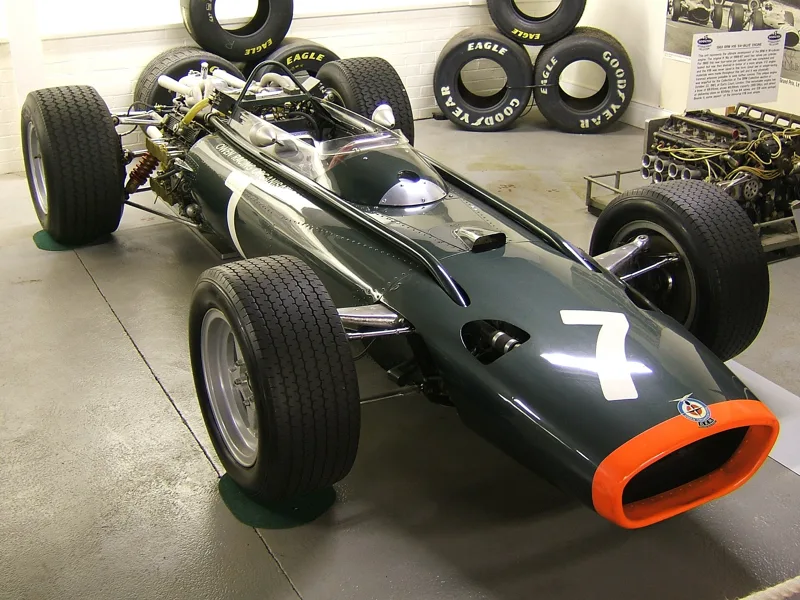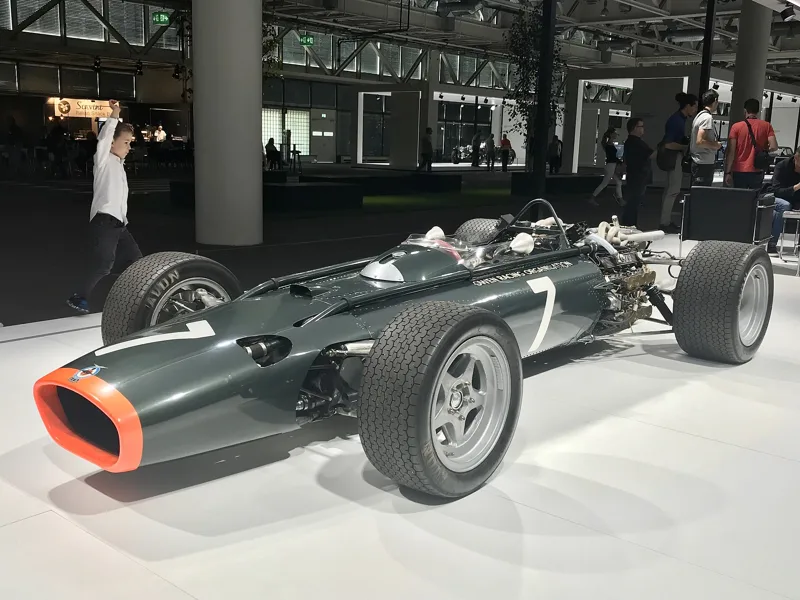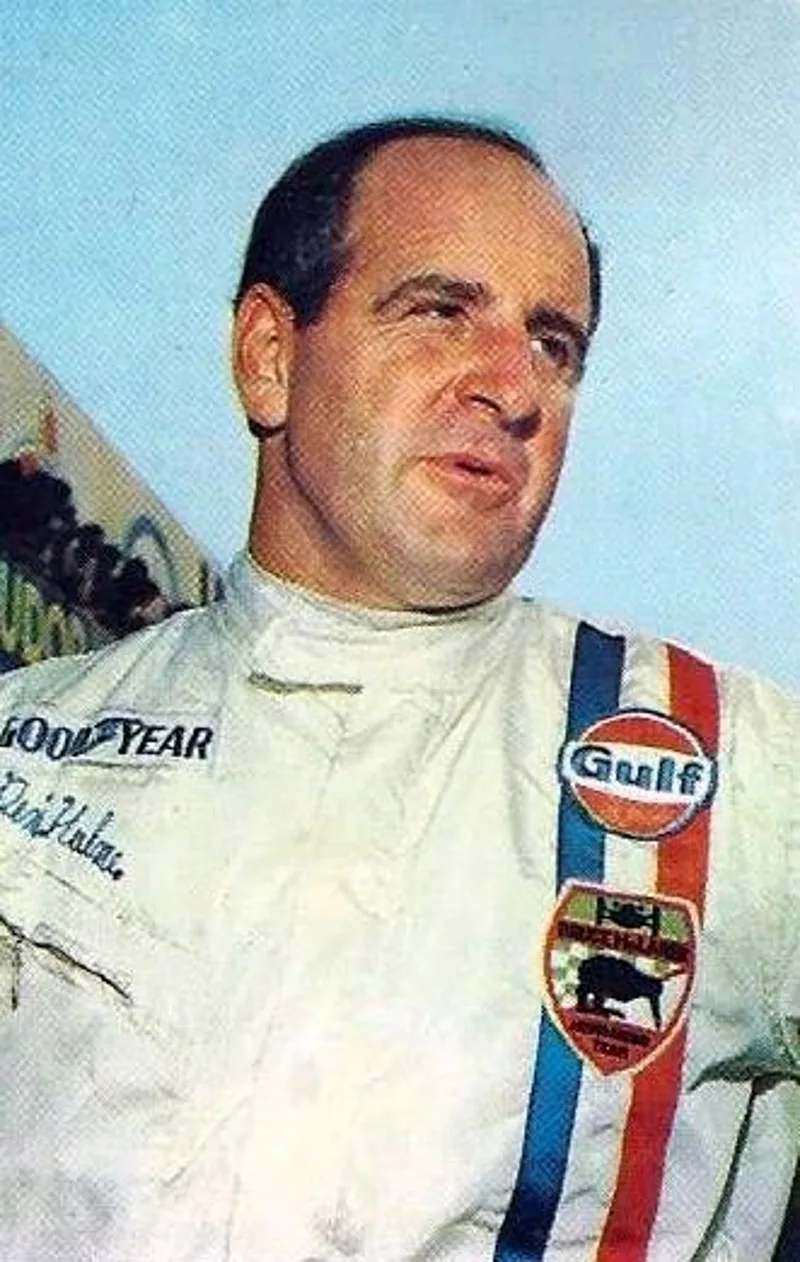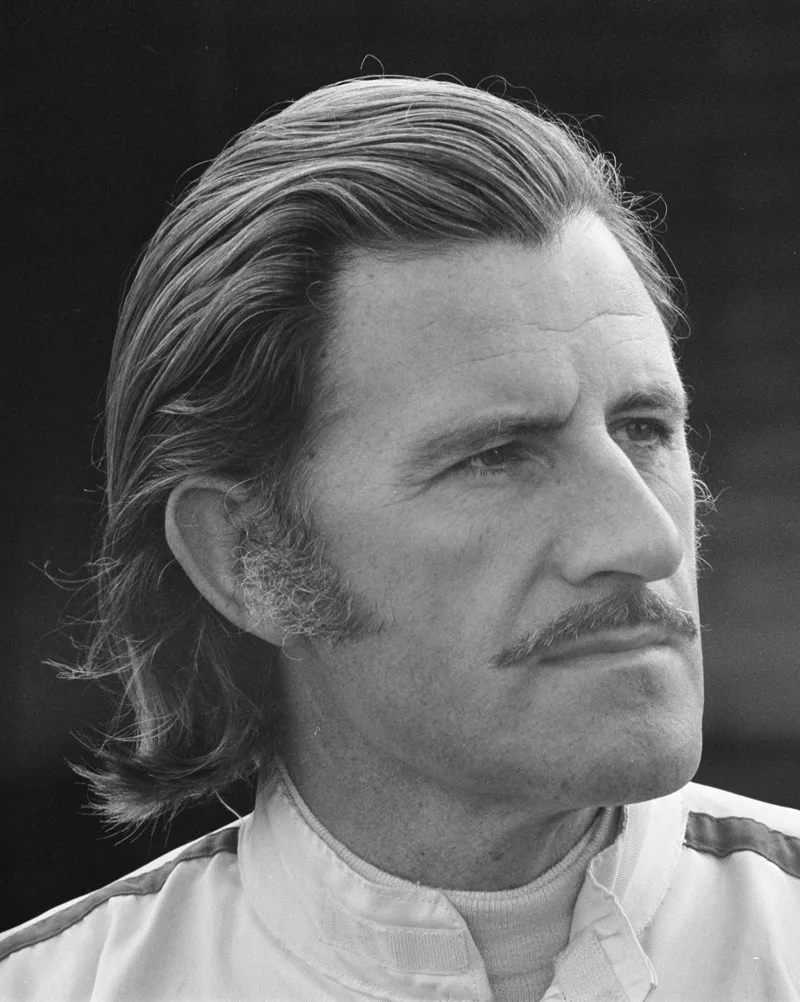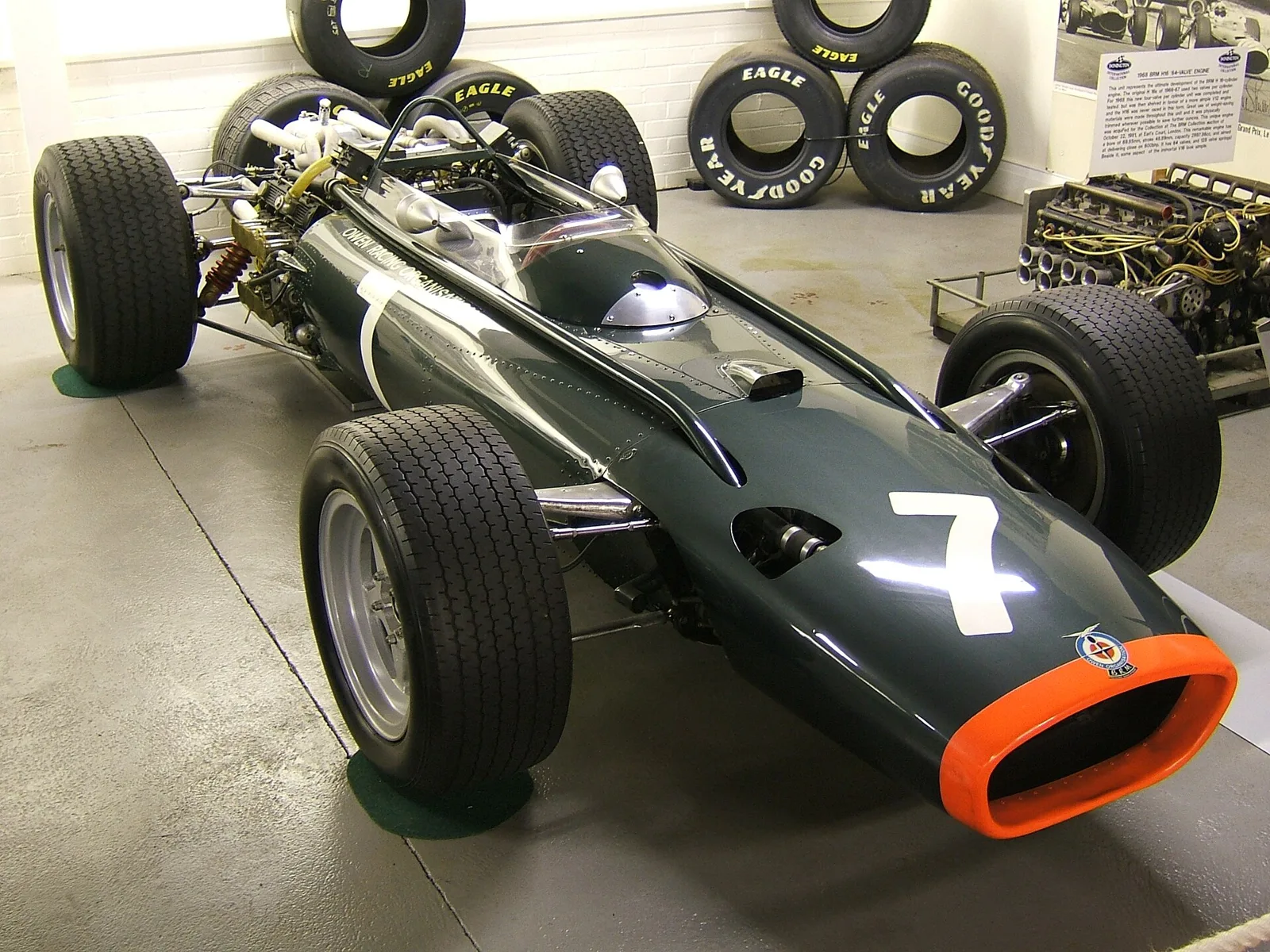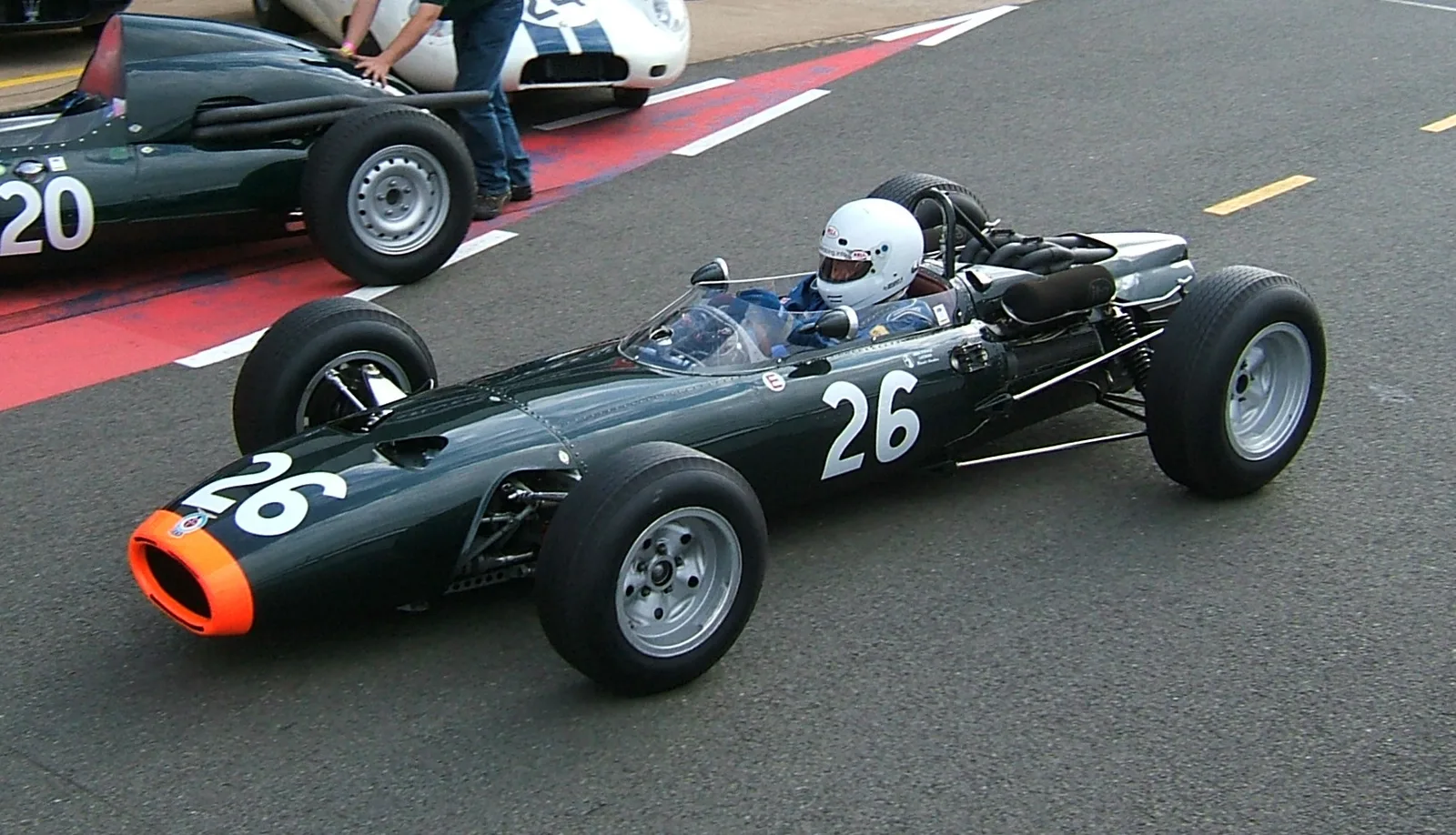
Tony Rudd's 1964 monocoque won six world championship races for Graham Hill and Jackie Stewart and remains the most successful car in BRM's history.
Designed by Tony Rudd for 1964, the BRM P261 combined a monocoque chassis with a fuel-injected V8. It won six world championship races for Graham Hill and Jackie Stewart and gave BRM second place in both championships in 1964 and 1965.
The BRM P261 was a monocoque Formula One car that British Racing Motors built at Bourne, Lincolnshire, for 1964. Tony Rudd designed it, and it later delivered six world championship race wins to Graham Hill and Jackie Stewart. By races won and points scored it remains the most productive car in BRM's history, and it brought the team second place in both championships in 1964 and 1965.
What was the BRM P261?
The P261 grew out of the one-off P61 prototype that Rudd had completed in 1963, carrying over much of that car's philosophy. The model stayed in competition for years, with variants still entered in Grands Prix as late as 1968. Six chassis were produced, and all six are still with us, although the first and the last were written off during their careers and rebuilt at the factory.
Chassis numbering continued from the earlier machine. The first P261 received the number 2612, extending the P61 sequence and signalling that this was a refinement rather than a fresh design.
A monocoque that carried BRM to its best run of results and gave Graham Hill and Jackie Stewart six world championship wins.
How did the P261 come to be a monocoque?
Colin Chapman's Lotus 25 of 1962 set the new benchmark, and most Formula One constructors scrambled to produce their own monocoques. BRM had already worked with stressed-skin construction on its P25, which gave Rudd a head start, and the P261 became the first BRM chassis built entirely on that principle.
The P61 used a tubular subframe to support its rear engine mounts. Rudd removed that subframe by extending the side pontoons rearward past the driver's seat and bolting the engine between them. Rubber fuel cells sat inside the pontoons, a simple and light arrangement.
Exhaust routing caused early difficulties. The high-exhaust version of BRM's V8 was not finished in time for 1964, so the pontoons had to be cut open to accept the older low-exhaust engine. The high-exhaust unit debuted at the 1964 Italian Grand Prix in chassis 2616. Chassis 2617, which Stewart drove as his regular car in 1965, and 2616 were the only two P261s built without exhaust slots.
The slots on earlier cars were plated over instead of being removed, so they could be reopened when outside exhausts were needed. That happened during the 1967 Tasman championship.
What engine did the P261 use?
The engine was a fuel-injected V8 with two valves per cylinder and four camshafts, and its internals barely changed from the unit Peter Berthon had designed for the P578. Graham Hill had won the 1962 world title in that car. The V8 was oversquare, with a bore and stroke of 68.5 x 50.8 mm, and BRM abandoned a four-valve experiment in favour of the proven layout.
Engineers moved the inlet trumpets so that air entered at the outer edges of the car, where it was cooler and denser. The exhausts left through the cylinder vee, and a near-circular gearbox cover closed off the back. A curved cover hid the engine between the pontoons, and heat built up under it, so a hole was cut in its top, which became one of the car's most recognisable features.
The 1965 unit produced 210 bhp (157 kW) when turning 11,000 rpm, and at Monza it climbed to 220 bhp (164 kW), reached at 11,750 rpm. Its Formula One capacity was 1,498 cc. For the early 1966 Tasman races it grew to 1,916 cc, and when the World Championship limit rose to 3.0 litres that year, the 1.9-litre engine was used there too. It was later taken to 2.0 litres, and for the 1967 trip to the Antipodes it reached 2,136 cc.
How were the suspension and brakes arranged?
Each corner carried a fully independent double wishbone, and at the front the coil springs and dampers were kept inside the monocoque. That kept the nose clean and streamlined around the nose-cone. At the rear the dampers moved outboard to clear the cam covers of a 32-valve engine that was later shelved, but the geometry stayed.
Outboard Dunlop discs provided the braking. The arrangement was typical of the period, and the car's clean nose showed that aerodynamic thinking was beginning to reach the design of Formula One cars.
How did the P261 begin its racing life in 1964?
The car first raced at the non-championship Daily Mirror Trophy at Snetterton on 14 March 1964. Just a single example had been completed, and it was entered for Graham Hill, who qualified second behind Jim Clark before retiring after an accident on lap seven. At Goodwood the car showed real pace, and Hill took the fastest lap, only to be denied the win when a rotor arm failed two laps before the finish.
Monaco brought the car its best early result. Hill qualified third and Richie Ginther eighth, yet the two P261s crossed the line first and second, and Hill also set the fastest lap. It was the second of Hill's five Monaco victories. Stewart's 1966 win there gave the P261 three Monaco victories in all. Runner-up finishes in France, Britain and Germany followed, but reliability faltered once the high-exhaust engine arrived in Italy.
At Monza, Hill's clutch seized as he waited for the flag, and the rest of the field passed him while he sat still. He recovered to win in the United States, though he finished outside the points in Mexico after colliding with Lorenzo Bandini. BRM ended the year second in the Constructors' Championship, and Hill was second in the Drivers' table.
How did the P261 perform in 1965?
Jackie Stewart arrived at BRM for 1965 and impressed immediately at the Race of Champions, where his P261 placed second on aggregate after two heats. He later won the International Trophy, and by the start of the championship the car's reliability had improved considerably.
Of the twenty Grand Prix starts the P261 made that year, only four ended without a points finish. Hill won at Monaco and in the United States again, while Stewart took a tight Italian Grand Prix, his first world championship victory in his first season of Formula One. BRM again finished second among the constructors, and Hill and Stewart took second and third in the drivers' standings.
| Season | P261 World Championship wins | Team placings |
|---|---|---|
| 1964 | 2 (Hill, in Monaco and the USA) | BRM second in Constructors'; Hill second in Drivers' |
| 1965 | 3 (Hill at Monaco and the USA; Stewart in Italy) | BRM second in Constructors'; Hill second, Stewart third in Drivers' |
| 1966 | 1 (Stewart at Monaco) | Car replaced by the P83 for the final three races |
How did the P261 dominate the Tasman Series?
Once the 1965 season ended, BRM prepared two chassis with 1.9-litre engines for the trip to the Antipodes. Hill and Stewart drove them, with Richard Attwood as a substitute. The BRMs carried a displacement disadvantage of more than half a litre against the older Climax-engined cars, and they still dominated the series.
Stewart won four of the eight races, Hill won two, and Attwood took one. The series opened with a New Zealand Grand Prix in which Stewart and Hill finished first and second. Hill missed the remaining New Zealand rounds, and Attwood stepped in with a win and a second place from three starts. Hill returned for the Australian events and added a second victory. Stewart took the title, with Hill second overall. The results showed that the monocoque could compete with older machinery in another formula, even while it carried a capacity handicap.
Why did the P261 give way to the P83 in 1966?
The 3-litre rule change had left many teams short of a ready engine, and BRM was one of them. In Europe, only Brabham, Ferrari and Cooper possessed genuine 3-litre engines for 1966. BRM was obliged to start the season with an enlarged version of its older V8, and the team's H16 was still under development. The two-year-old P261 therefore carried the early races, and Stewart won the season-opening Monaco Grand Prix in it. Once the Brabham BT19 found its form, the P261 looked outclassed.
The H16-engined P83 took over for the final three races of 1966. Other teams ran P261s too. Team Chamaco Collect entered the American Bob Bondurant in five races and the South African Vic Wilson in one. Bernard White renamed his outfit Bernard White Racing and fielded a P261 for Innes Ireland in the closing two rounds of 1966, and Ireland failed to finish either.
What happened to the P261 after 1966?
For the 1967 Tasman Series BRM supported the private Reg Parnell Racing team, which prepared two P261s for Stewart and Attwood. With a 2.1-litre engine Stewart won the New Zealand Grand Prix again, and Attwood had taken four consecutive podiums before Courage and Irwin took over his seat for the Australian rounds. Irwin took third at Longford, and Stewart ended equal second in the overall series table.
Parnell kept a 2.1-litre P261 running for Irwin and Courage in the 1967 Formula One season, while Bernard White put a second car in the hands of David Hobbs for the British and Canadian rounds. Stewart finished third at the French Grand Prix in his P261, but the Bourne works squad now depended on the P83. Pedro Rodriguez took a P261 back to the Tasman for 1968 and finished second at Longford, though by then the design was badly outdated. Stewart's Parnell win had shown that a privately prepared P261 could still win races while the works team turned to newer machinery.
Chassis 2615 received the new BRM V12 that replaced the H16 for a handful of non-championship races, and its best result was third at the Grand Prix de Madrid. Privateers kept racing P261s into 1969. Ian Mitchell's car appeared in British Formula 5000 races, and Tony Dean drove one in the Madrid Grand Prix, where he finished second on a lap count. Peter Gethin broke down on lap 40 in the same race.
Why does the P261 still matter?
The P261 gave BRM its strongest run of results in the 1960s, and it remains the team's most successful car by races won and points scored. Its record also shows how one design, refined over several seasons, could carry a team through a period of rule change. Its six world championship wins came with two drivers who would shape the decade, and its second-place finishes in both championships marked the closest the team came to the title.
The car has also lived on in simulation. A detailed and drivable recreation of the 1.5-litre version was released in 2004 as a free modification for the Grand Prix Legends simulation, and a 1966 version with the 2-litre engine followed in 2007. With six chassis preserved, the P261 remains within reach of enthusiasts and historians.