A flat-12 Alfa design whose radiators were removed before its debut, and a fan-assisted variant that won at Anderstorp before being withdrawn.
The Brabham BT46 was a 1978 Formula One machine from Gordon Murray's drawing board for the Brabham squad, with a flat-12 Alfa Romeo engine. Its flat heat exchangers were removed before the race debut, and the fan-assisted BT46B won the Swedish Grand Prix before being withdrawn. The standard car gave Brabham third place in the constructors' championship.
The Brabham BT46 was Gordon Murray's bold 1978 design for the Brabham team, a Formula One car that began life with flat heat exchangers set into its bodywork instead of radiators. Those were removed before its race debut, yet the car went on to win a race in a version that used a large fan to create downforce. Its story mixes engineering ambition with rule-making politics.
What made the BT46 so radical?
Its signature feature was flat plate heat exchangers set flush into the bodywork in place of conventional radiators. This allowed a slim, low frontal area and offset the weight of the big engine and fuel, but the cooling system could not cope, and the radiators returned to the nose before the car raced.
Gordon Murray began the design in mid-1977, aiming to compensate for the bulk of the engine and fuel and to take a large step forward in safety. The predecessor, the BT45, had been overweight at 625 kg and as wide as the regulations permitted. It became competitive as development went on, but it never won a race. The chassis was an aluminium monocoque shaped like a trapezoid in section, a feature of many Murray cars from the 1970s, and it carried built-in pneumatic jacks for quick tyre changes in practice.
Consultant engineer David Cox worked out that the heat exchangers offered only about 30% of the cooling surface the car needed. By then the car had already overheated, and Cox pointed out what he believed were fundamental errors in the concept. The team replaced the heat exchangers with conventional radiators in the nose, similar to those on the BT45, which compromised the aerodynamics and moved weight to the front.
Radiators built into the bodywork, a fan that sucked the car to the road, and a win at Anderstorp before the rules closed the loophole.
How did the Alfa Romeo engine shape the design?
The 2995 cc flat-12 gave about 520 bhp at 12,000 rpm, roughly 50 bhp more than the Cosworth DFV used by most rivals. It was also wider and about 40 kg heavier, with higher fuel and oil consumption, and that width made it hard to fit the wide venturi tunnels that strong ground effect needed.
The engine was sportscar-derived, with fuel injection, electronic ignition and a magnesium alloy block. Its four gear-driven valves per cylinder and its peak torque of 324 lb-ft (439 N-m) were impressive, but the power came at the cost of size and weight. Dimensions also varied noticeably between units, which made the engine a difficult package to work with. The car used a lighter version of the six-speed gearbox from the BT45B, with a casing cast by Alfa and Hewland gears inside.
Murray realised early in 1978 that Lotus had grasped how to use ground effect through its tunnels. He wanted a V12 from Alfa for 1979, which Alfa then produced. In the meantime he looked for another way to reduce the pressure beneath the car.
Ground effect was the other great idea of the period. Peter Wright and Colin Chapman had found that shaping the underside of a car could speed up the air passing beneath it, lowering the pressure there and pressing the tyres harder onto the track. Ground effect offered grip without the drag penalty of conventional wings, and the Type 78 had shown the concept in 1977.
In 1978 Lotus developed the concept further, building broad tunnels beneath the car. As soon as the black and gold Type 79s appeared at Zolder, Mario Andretti and Ronnie Peterson were comfortably quicker than the opposition.
Why was the fan car so controversial?
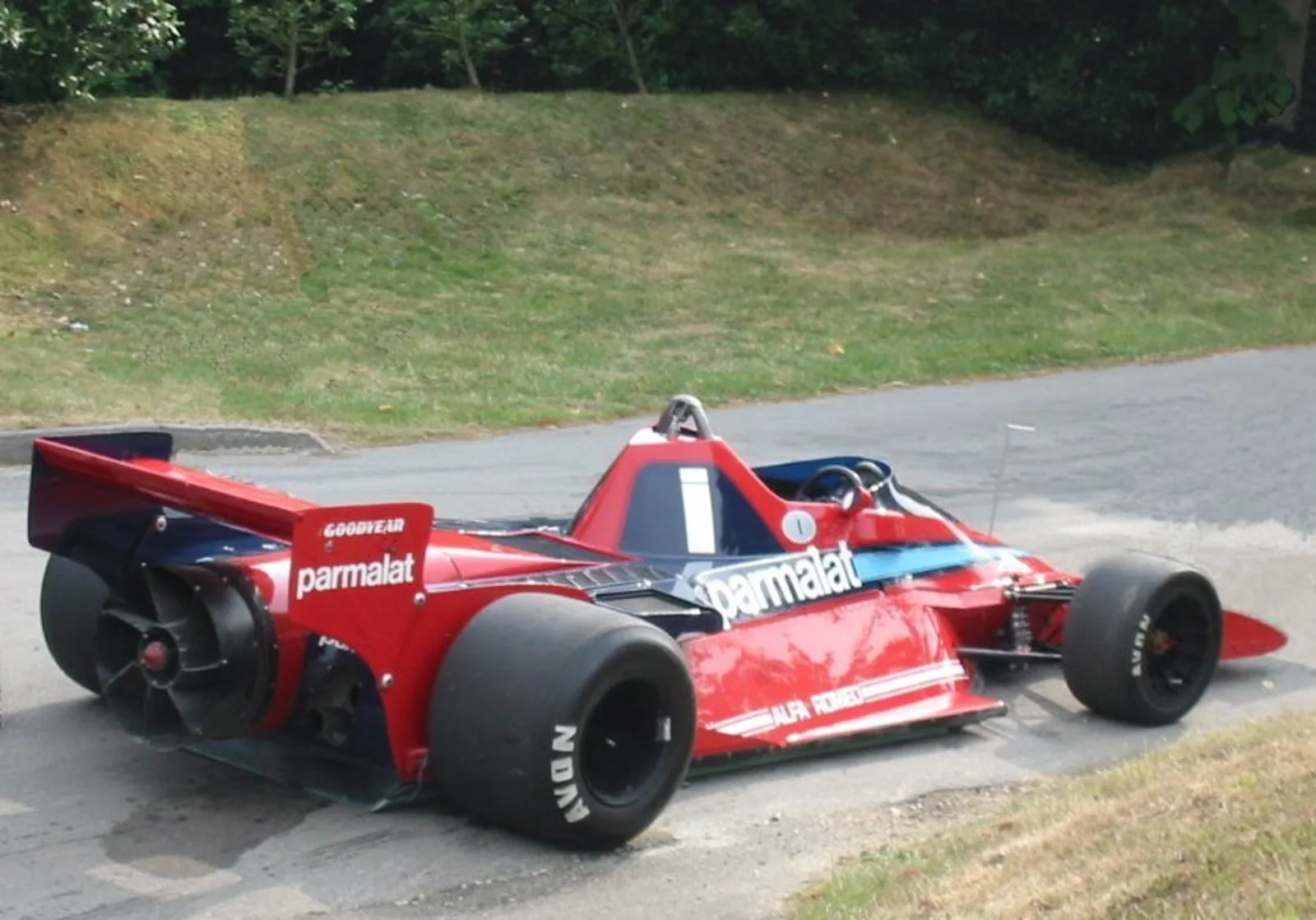
The BT46B used a large fan at the rear, driven from the engine through a set of clutches, to draw air from beneath the car and create downforce. Brabham said the fan was for cooling, but rivals saw an aerodynamic device, and the car was withdrawn after a single race.
Murray's idea drew on the Chaparral 2J, a 1970 Can-Am sportscar whose fans were driven by a dedicated two-stroke engine. It also owed something to the Tyrrell 008, which had a small fan that cooled its radiators while giving a modest amount of downforce. The BT46B was modified in secret, using two converted chassis, BT46/4 and BT46/6. The engine bay was sealed, sliding skirts closed the gap to the ground, and the fan also drew air through a horizontal radiator over the engine. Brabham had already used small electric fans on its BT45C cars at the South American races earlier in 1978, so the team had some experience with the idea.
Brabham argued that cooling was the primary purpose, and the claim had some support, because the original BT46 had real cooling problems. The rules banned movable aerodynamic devices, so the team's case rested on that point. Lauda found the car changed its character in the corners, sticking as if it ran on rails and exposing him to high lateral loads. He later described it as unpleasant to drive, because the lateral loads and the reliance on aerodynamics left less room for driver skill.
What happened at Anderstorp in 1978?
The two fan cars took to the grid at Anderstorp in Sweden on 17 June 1978, driven by Lauda and John Watson. They qualified second and third behind Mario Andretti. Blipping the throttle showed the car sinking onto its springs as downforce rose, and a dustbin lid covered the fan when it was not running.
Watson spun out on lap nineteen. After Didier Pironi spilled oil on the circuit and both main front-runners had retired, Lauda had a clear run. Andretti retired with a broken valve after Lauda passed him around the outside of a corner, and Lauda won comfortably from Riccardo Patrese's Arrows.
Lotus began a fan version of its own 79 almost at once. Rival team heads, led by Colin Chapman, threatened to pull their support from Ecclestone unless the BT46B was withdrawn. Ecclestone's biographer recorded that pressure in detail. Ecclestone negotiated three more races before a voluntary withdrawal, but the Commission Sportive Internationale stepped in first and banned fan cars. The Swedish win was allowed to stand because the car had been legal when it raced.
Andretti compared the car to a vacuum cleaner that threw muck at the drivers behind it. He was the championship leader at the time, which made his retirement from the race all the more costly. Murray disputed that, saying the fan exit speed was only 55 mph, so nothing could have been spat out the back.
How did the standard BT46 race in 1978?
The standard BT46 made its bow at the season's third race, in South Africa on 4 March 1978, with radiators in the nose. It was immediately competitive, although reliability was suspect. Lauda won the Italian Grand Prix in the car, and the team's points earned third place in the constructors' championship. The nose-radiator cars were the mainstay of that season, so their steady scoring mattered as much as the occasional win.
Lauda's Italian win followed a penalty of one minute for Mario Andretti and Gilles Villeneuve, who had jumped the restart. The restart came after Ronnie Peterson's crash at the first start proved fatal. The BT46 made its last championship appearance at the 1979 opening round, when Nelson Piquet's race ended on lap one in a multi-car accident. Lauda had qualified the older car, because the new BT48 was proving troublesome.
Murray later suggested that Ecclestone was using the affair to strengthen his hand in the Formula One Constructors' Association, which he had run since 1972. Ecclestone went on to chair the wider commercial side of the sport, a role he held from 1987 until 2017, and the episode is often cited as an early example of that ambition.
The fan car also tells a wider story about the sport. Murray's answer to Lotus's tunnels was an extreme one, and the rule makers reacted quickly. The loophole was closed for 1979, and the teams that followed were left to develop tunnels and skirts within the rules. The fan car was therefore both a technical breakthrough and an early lesson in how quickly the regulations could catch up with a clever idea.
The case also shows how much pressure Lauda was under. He had to adapt his driving so that the car stuck to the road without sliding, and he judged that every driver of the coming ground-effect era would face the same heavy loads and be left exhausted by the end of a race.
The variants that never raced
Murray also designed the BT47 for 1979, with a Chaparral-style box at the rear and twin variable geometry fans to maximise ground effect. The idea was to take the fan concept further than the BT46B had gone. The car was never built, because the FIA closed the loophole for 1979.
The BT46C moved its radiators behind the front wheels, using units from a Volkswagen Golf in a region of positive pressure. Removing the radiators from the front wing left a clean wing and moved the centre of gravity further back, which was the point of the exercise. It ran only in practice at the 1978 Austrian Grand Prix, where the drivers said it lacked revs and straight-line pace. It never raced.
A BT46 returned to the fan configuration for the 1979 Gunnar Nilsson Trophy at Donington Park, a fundraiser for the Gunnar Nilsson Cancer Fund. It was run as a time trial, with the fastest single lap winning, and since FIA sanction was absent, the rules on the car's legality did not apply. Nelson Piquet drove it and finished fourth of the five cars. The result depended on one fast lap rather than on a race, and the proceeds were the point of the event.
Key specifications
| Item | Detail |
|---|---|
| Engine | 2995 cc Alfa Romeo flat-12, fuel injection, electronic ignition |
| Power | About 520 bhp at 12,000 rpm |
| Torque | 324 lb-ft (439 N-m) peak |
| Weight penalty | About 40 kg more than a Cosworth DFV |
| Chassis | Aluminium alloy monocoque, trapezoidal cross-section |
| Gearbox | Revised, lighter six-speed with Hewland gears |
| Debut | South African Grand Prix, 4 March 1978 |
| Fan car win | Swedish Grand Prix, 17 June 1978, Lauda |
| Standard car win | Italian Grand Prix 1978, Lauda |
| Constructors' result | Third in the 1978 championship |