Twenty-one races, the debut of Haas and a final-round finish in Abu Dhabi that gave Nico Rosberg his only drivers' championship.
Nico Rosberg won the 2016 drivers' title in Abu Dhabi, five points ahead of teammate Lewis Hamilton. Mercedes defended the constructors' championship with 765 points, and Haas F1 Team made its debut as the first American team since 1986.
The 2016 FIA Formula One World Championship was the 70th season of the sport's motor racing, and it was the longest season to that point, with twenty-one Grands Prix. Nico Rosberg won his only drivers' title in the final race in Abu Dhabi, five points ahead of his Mercedes teammate Lewis Hamilton. Mercedes defended its constructors' championship with a record 765 points.
The season was a close and sometimes bitter contest between two teammates. Hamilton won more races than Rosberg, but Rosberg's consistency across the year gave him the title by a narrow margin. The result ended the championship with the champion stepping away from the sport within days.
What happened across the 2016 season?
Rosberg won his only title with nine wins and seven other podiums, beating Hamilton by five points. He followed his father, who had been champion in 1982, to become the second son of a champion to take the title, a feat previously achieved by Damon Hill in 1996. He announced his retirement shortly after the title was secured.
The season opened with a Mercedes one-two in Australia, with Rosberg winning from Hamilton and Vettel finishing third. Fernando Alonso crashed heavily at high speed on lap sixteen, and the race was red-flagged because of the debris. Haas scored points in its first race, with Romain Grosjean finishing sixth.
Hamilton had been second in Australia, and in Bahrain he took pole before finishing third behind Rosberg and Raikkonen. That result showed how quickly the lead could move between the two Mercedes drivers, even in a season when one car was clearly the class of the field.
Rosberg then won Bahrain and China, his second and third consecutive victories. In Russia he won again with his first grand slam, while Hamilton finished second after starting tenth. Those early results gave Rosberg a platform, although Hamilton was quickly back in contention.
Red Bull made a driver change before Spain. Verstappen was moved up to Red Bull and Kvyat returned to Toro Rosso, a decision that Red Bull explained as a way to relieve pressure on Kvyat after criticism of his role in a first-lap accident in Russia.
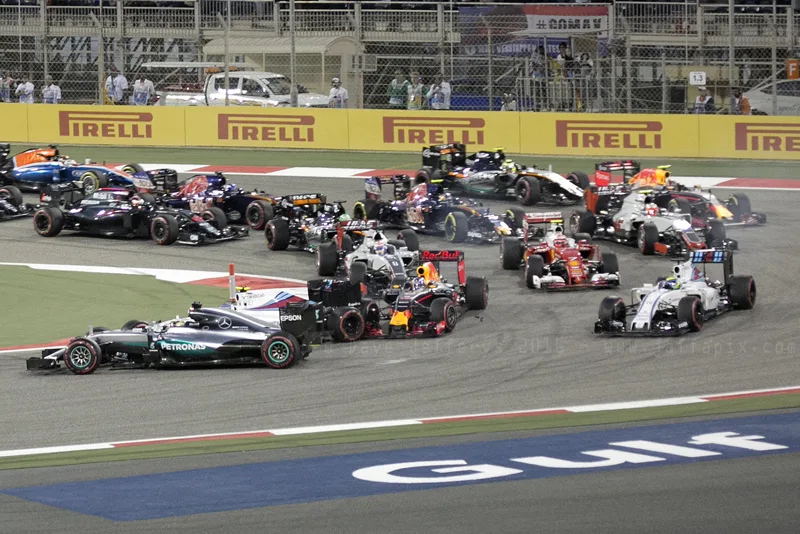
The European rounds turned the battle into a true duel. Verstappen became the youngest race winner in Spain, while Hamilton and Rosberg collided at the start, which handed the lead to Ricciardo. Hamilton then won Monaco, his first win of the season, after the race started behind the safety car, and he won Canada after losing the lead at the start.
Rosberg won at Baku for his second grand slam of the season. Hamilton then won Austria, where the two Mercedes drivers made contact on the final lap, and a stewards' inquiry found Rosberg had caused an avoidable collision. Rosberg received a ten-second penalty, though the result was not affected.
Britain followed a similar pattern. Hamilton established an early lead, and Rosberg was penalised for a radio call after a gearbox fault, which demoted him to third behind Verstappen. Hamilton then won in Hungary to take the championship lead, and he added the German Grand Prix from the start to extend it. In Hungary, Jenson Button was also penalised for unauthorised assistance after reporting a brake problem, which was later traced to a faulty sensor.
A season-long Mercedes duel ended with five points between teammates in Abu Dhabi.
Which teams and drivers changed for 2016?
Haas F1 Team joined the grid, formed by NASCAR team owner Gene Haas. It was the first American team to compete since the Haas Lola team in 1986, and it used Ferrari power units with a chassis developed by Dallara, which had last been in Formula One as HRT's chassis maker in 2010.
Renault returned as a full works team after it bought Lotus from Genii Capital, and it was the first time Renault had been a full factory team in over six years. Red Bull ended its partnership with Renault after nine years, and the Renault engines were rebadged as TAG Heuer for Red Bull.
Scuderia Toro Rosso returned to Ferrari power units, while Marussia applied to change its name to Manor Racing MRT and switched to Mercedes power. Sauber was bought by Longbow Finance before the Hungarian Grand Prix, and the team founder, Peter Sauber, retired.
The driver line-ups changed substantially. Romain Grosjean left Lotus for Haas, and Jolyon Palmer, the 2014 GP2 champion, made his race debut for Renault in Melbourne. Pastor Maldonado's sponsors could not meet their contract, so Kevin Magnussen replaced him at Renault.
Manor signed two rookies, Pascal Wehrlein and Rio Haryanto, and Haryanto became the first Indonesian driver to race in the championship. He lost his seat after the German Grand Prix when his sponsors could not meet their obligations, and Esteban Ocon made his debut for MRT at the Belgian Grand Prix.
Manor's management also changed. The resignation of team principal John Booth and sporting director Graeme Lowdon followed the team's rebuilding around its new drivers and power unit, and the team had to keep its cars on the grid through sponsor support.
Fernando Alonso was ruled out of the Bahrain Grand Prix after suffering broken ribs and a pneumothorax in Australia, and Stoffel Vandoorne made his Formula One debut in his place. Daniil Kvyat and Max Verstappen also swapped seats before the Spanish Grand Prix, with Verstappen promoted to Red Bull.
What rule changes shaped the 2016 season?
Cars had to carry a separate wastegate for exhaust gases to increase noise after criticism of the 2014 engines. The FIA also raised the number of tokens available for power unit development from fifteen to thirty-two, the same figure as 2014, so that Renault and Honda could catch up.
The FIA and Formula One Management gained wider authority over the rules and over the sport's governance. Drivers were allowed alternative helmet designs for one race weekend per season, a change that had been prohibited before.
The sporting rules changed in several places. The elimination-style qualifying format was introduced at the opening round, then scrapped after two races, and the 2006 to 2015 system returned at the Chinese Grand Prix. Pre-season tests were cut from three to two, and the maximum number of events rose from twenty to twenty-one.
Pirelli added a fifth dry compound, the ultrasoft, which was limited to street circuits. Three dry compounds were brought to each race, and drivers chose ten sets from those three compounds, with the softest tyre given to teams that reached the third qualifying session.
Track limits and the safety procedures were tightened. Drivers had to stay between the white lines except where driver error was the cause, and the Virtual Safety Car was extended to practice sessions. Drivers could also use the DRS as soon as a Virtual Safety Car period ended, rather than waiting two laps.
Radio rules were a source of controversy. The FIA restricted pit-to-car messages through the first half of the year, then relaxed the restriction from the German Grand Prix so that it applied only to the formation lap, after penalties at Britain and Hungary had sparked debate.
Which races shaped the title fight?
The title fight swung between the two Mercedes drivers. Rosberg reduced Hamilton's lead to two points in Italy, and then he reclaimed the lead with a win in Singapore. Hamilton hit back in the United States, Mexico and Brazil, but Rosberg's consistency kept him close enough to win the title in Abu Dhabi.
Rosberg's Singapore win showed how a single race could change the picture. Hamilton finished third after struggling with mechanical issues and driving errors, and Rosberg held on to first place to turn a two-point deficit into an eight-point lead.
Hamilton's four straight wins at the end of the year were a strong response to a difficult mid-season, and they put him in control of the final round. Mercedes also scored 1-2 finishes in the United States, Mexico and Brazil, which showed the depth of the team even while its drivers fought each other. Rosberg's earlier wins in Singapore and Japan had kept the pressure on, and the final standings reflected the close margin.
| Grand Prix | Winner | Note |
|---|---|---|
| Australia | Nico Rosberg | Alonso crash; race red-flagged |
| Bahrain | Nico Rosberg | Second consecutive win |
| China | Nico Rosberg | Third consecutive win |
| Russia | Nico Rosberg | First grand slam |
| Spain | Max Verstappen | Youngest race winner |
| Monaco | Lewis Hamilton | First win of the season |
| Canada | Lewis Hamilton | Won after losing the lead at the start |
| Europe (Baku) | Nico Rosberg | Second grand slam |
| Austria | Lewis Hamilton | Contact with Rosberg |
| Britain | Lewis Hamilton | Rosberg demoted to third |
| Hungary | Lewis Hamilton | Took the championship lead |
| Germany | Lewis Hamilton | Beat Rosberg off the line |
| Belgium | Nico Rosberg | Led from start to finish |
| Italy | Nico Rosberg | Cut Hamilton's lead to two points |
| Singapore | Nico Rosberg | Reclaimed the championship lead |
| Malaysia | Daniel Ricciardo | First win since 2014 |
| Japan | Nico Rosberg | From pole |
| United States | Lewis Hamilton | Mercedes one-two |
| Mexico | Lewis Hamilton | Mercedes one-two |
| Brazil | Lewis Hamilton | Third win in as many races |
| Abu Dhabi | Lewis Hamilton | Rosberg second and champion |
Who won the 2016 Drivers' Championship?
Nico Rosberg won the 2016 drivers' title, finishing five points ahead of Lewis Hamilton in the final standings. It was his only championship, and he became the second son of a champion to win the title, following his father in 1982.
The margin was small, and it came down to the final race. Rosberg led by twelve points going into Abu Dhabi, so he needed only third place if Hamilton won, and he finished second. Hamilton led the race from pole and won it, while Rosberg finished second, which was enough for the title. Rosberg announced his retirement from the sport five days after winning the championship, ending a rivalry that had defined the season.
What the 2016 season left behind
The season was the last full year for Jenson Button, the 2009 champion, who made only one more Grand Prix appearance at the 2017 Monaco Grand Prix. The 2016 season marked the close of an era for Button in Formula One.
Haas's arrival was an important entry for the sport. It was the first new team to score points in its debut season since Toyota in 2002, and the result suggested that a well-supported new entry could compete quickly. Ferrari's third place in the constructors' table showed a team that had made progress but was still far from the top.
Mercedes' record 765 points, and Red Bull's second place with a gap of 297 points, showed the scale of the team's advantage. Ferrari finished third, seventy points behind Red Bull, which underlined how far the Italian team still had to climb to challenge the leaders.