A Ford-engined project carried by a Lola name it never owned, a Hart engine stopgap and a closure once the sponsor pulled out.
Haas Lola was a Formula One team founded by Carl Haas in 1984 that competed in the 1985 and 1986 seasons. Its planned Ford turbo engines were delayed and its sponsor withdrew, so it closed by the end of October 1986. The cars were designed by a Haas-owned company, not by Lola.
Team Haas (USA) Ltd., known as Haas Lola, was an American Formula One team that raced in 1985 and 1986 and then closed. Carl Haas founded it in 1984, and although it competed under the Lola name, the British firm Lola Cars played no part in the design or construction of its cars.
Why did the team carry the Lola name?
Carl Haas was the official importer of Lola Cars International into the United States, and he wanted to link his team with the better-known Lola brand. The team was entered as Lola for that reason, even though it had no connection with the design of the cars.
The team was also commonly called Beatrice Haas after its major sponsor. Lola earned the team's points towards the Constructors' Championship as its designated constructor, and the cars carried the acronym THL for Team Haas Lola.
The cars were in fact designed and built by FORCE, a company owned by Haas. Teddy Mayer, the former McLaren owner, bought a disused factory at Colnbrook in England to house it, and the team's cars were built in the same building.
A team that wore a famous name it did not own, built cars in a factory it had bought, and ended when its sponsor walked away.
How did the backing from Beatrice and Ford come together?
In autumn 1984 Carl Haas agreed a sponsorship deal with Beatrice Foods, a US consumer products conglomerate, for the Formula One entry. Beatrice was already the title sponsor of Haas's CART IndyCar team, and the team dropped Budweiser at the urging of Beatrice's chief executive, Jim Dutt.
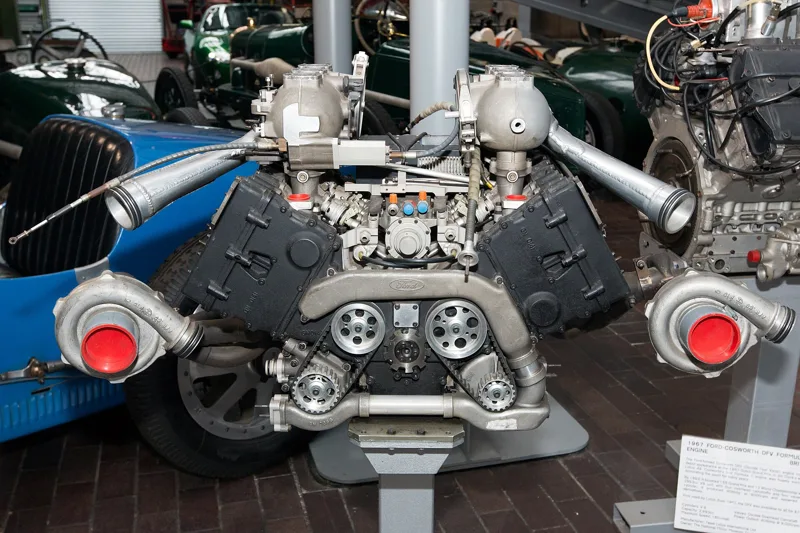
Ford was developing a turbocharged V6 called the TEC to replace the Cosworth DFV, and it agreed to supply engines for three seasons. The deal was only settled at the 1984 British Grand Prix, after the engine designer Keith Duckworth had spent four months trying to build a four-cylinder unit before settling on a V6. Cosworth's work on the engine was filmed for Channel 4's Equinox series, which broadcast it in 1986. The 1980 world champion Alan Jones came out of retirement to drive the first car, having last raced in Formula One at Long Beach in 1983.
Neil Oatley, a former Williams engineer, led the FORCE design team, and the team's early years brought together designers who would later shape the sport. Neil Oatley led the work, and the group also included engineers who moved on to other championship-winning squads. Ross Brawn, who would later run his own team, was the lead aerodynamicist, and Adrian Newey also passed through the team in its early years.
What happened in the 1985 season?
The first car, the THL1, was designed by Oatley and was not ready until the twelfth round, the Italian Grand Prix. The Ford engines were also late, so the team used Hart 415T turbocharged four-cylinder engines in the meantime, and Goodyear supplied the tyres.
The team's arrival in 1985 was a matter of timing as much as design. The cars were not ready until late in the year, and the sponsor's support depended on results that the first months could not provide.
At Monza Jones qualified twenty-fifth out of 26 cars before the Hart engine failed after six laps. The team then missed the Belgian Grand Prix because it had not been on the original entry list, and the race had been rescheduled after the track surface broke up.
Jones later said that South Africa was not simply a matter of illness. Ecclestone described pressure from activists such as Jesse Jackson on Beatrice in the United States, including threats of strike action by African American workers in the company's businesses, and that pressure shaped the decision not to race.
At the European Grand Prix at Brands Hatch Jones qualified twenty-second and retired after 13 laps with radiator damage. In South Africa he qualified eighteenth out of 21 but did not take the start, and the official reason was illness.
Jones later described a meeting with Bernie Ecclestone on the night before that race. He said Ecclestone suggested he feign illness because of pressure from activists in the United States, and that only Jones and the team management knew of the plan.
At the final race in Australia Jones, the home favourite, qualified nineteenth and recovered from a stall on the grid to climb to sixth. He retired after 20 laps with electrical problems, which ended the team's first season.
What happened in the 1986 season?
Adrian Newey had worked at Fittipaldi in 1980 and was brought in to help design the THL2, a car built around the Ford engines. Patrick Tambay, who had won two Grands Prix for Ferrari in 1982 and 1983, joined Jones as the second driver.
Cosworth's Ford engines were delayed, so the team began the season with the previous year's car and the Hart engine. Tambay qualified thirteenth for the Brazilian Grand Prix, but both cars retired, and Tambay finished the Spanish Grand Prix as the last of eight cars to cross the line.
The first THL2 was completed for Jones in time for the San Marino race, but Tambay had a serious accident at Monaco when his car flipped over the barrier. Eddie Cheever stood in for Tambay at Detroit after the team had difficulty obtaining a superlicence for Michael Andretti.
The German Grand Prix became the first race in which both cars finished. Tambay was eighth and Jones ninth, both laps down, and Tambay later took seventh at the Hungarian Grand Prix after qualifying sixth.
Tambay had been a Ferrari winner, and his experience helped the team in the mid-season races that suited the car. The Hungaroring, which had first been used in 1986, rewarded handling and acceleration more than outright power, and the Haas Lola cars suited that layout.
The breakthrough came in Austria. Mechanical problems hit several top teams, and Jones finished fourth and Tambay fifth, both two laps behind the winner, which earned points. Jones added a sixth at Monza on the team's first anniversary in Formula One.
A management change at Beatrice in the autumn of 1985 led the sponsor to reduce its support for 1986, and the money dwindled as the year went on. Jones ended the season with four points, twelfth in the Drivers' Championship, while Tambay had two points and finished fifteenth.
| Entry | 1986 points | Championship position |
|---|---|---|
| Alan Jones | Four | Twelfth |
| Patrick Tambay | Two | Fifteenth |
| Lola (designated constructor) | Six | Eighth |
Why did the team close?
Carl Haas tried to find funding for 1987 after Beatrice opted not to return. The team still had a deal for Ford engines, but without sponsorship it could not continue, and he closed the team by the end of October 1986.
The FORCE base was sold to Bernie Ecclestone, then owner of the Brabham team. The team was dismantled, Haas and Mayer returned to the United States, and Oatley moved on to design cars for McLaren. Jones and Tambay both left Formula One when their contracts ended.
The Ford turbo units found a new home with Benetton, which ran them in 1987 and became the works outfit that Ford leaned on for the next several years. Lola had its own plans for 1987, building the Ford-Cosworth powered LC87 for the new Larrousse and Calmels team.
Those cars came from Lola's own factory, the first Lola-built machines in the sport since the 1975 Embassy Hill chassis, and they marked the first time the Lola badge had been on a car designed by the company itself since then.
What became of the factory?
The former FORCE factory was kept by Ecclestone and used by Alfa Romeo to build several racing cars. It was then sold to March Engineering in 1989, where it built Ralt and March IndyCars for a number of years.