The FIA judged the race safe. Rights groups, British MPs, sponsors and some drivers disagreed, and the weekend became one of the sport's most argued-over races.
The 2012 Bahrain Grand Prix returned to the calendar after the 2011 race was cancelled because of unrest. The FIA decided on 13 April 2012 that the race would go ahead, despite protests and criticism from human rights groups and some British politicians.
The 2012 Bahrain Grand Prix was held in the middle of a political crisis, and the decision to run it was contested from start to finish. The FIA concluded that the country was secure, while critics said the race would endorse the government's policies. The Independent later called it one of the most controversial races in the history of the sport.
Why was the race cancelled in 2011 and then restored?
The 2011 Bahrain Grand Prix was cancelled on 21 February 2011 because of civil unrest, at the request of Crown Prince Salman and the Bahrain Motor Federation. An attempt to reinstate it for October 2011 failed, but the FIA later restored Bahrain to the 2012 calendar.
The first provisional calendar put the race in November, to give the country time to stabilise. A second calendar moved it forward to 22 April, and the final calendar published in December 2011 confirmed that date.
Pre-season testing for 2012 began in February and brought the question back to the front of the sport. Several teams had voiced worries about the country back at the 2011 Japanese Grand Prix.
A race that went ahead while protests continued, and that the sport still argues about.
Who called for the race to be boycotted?
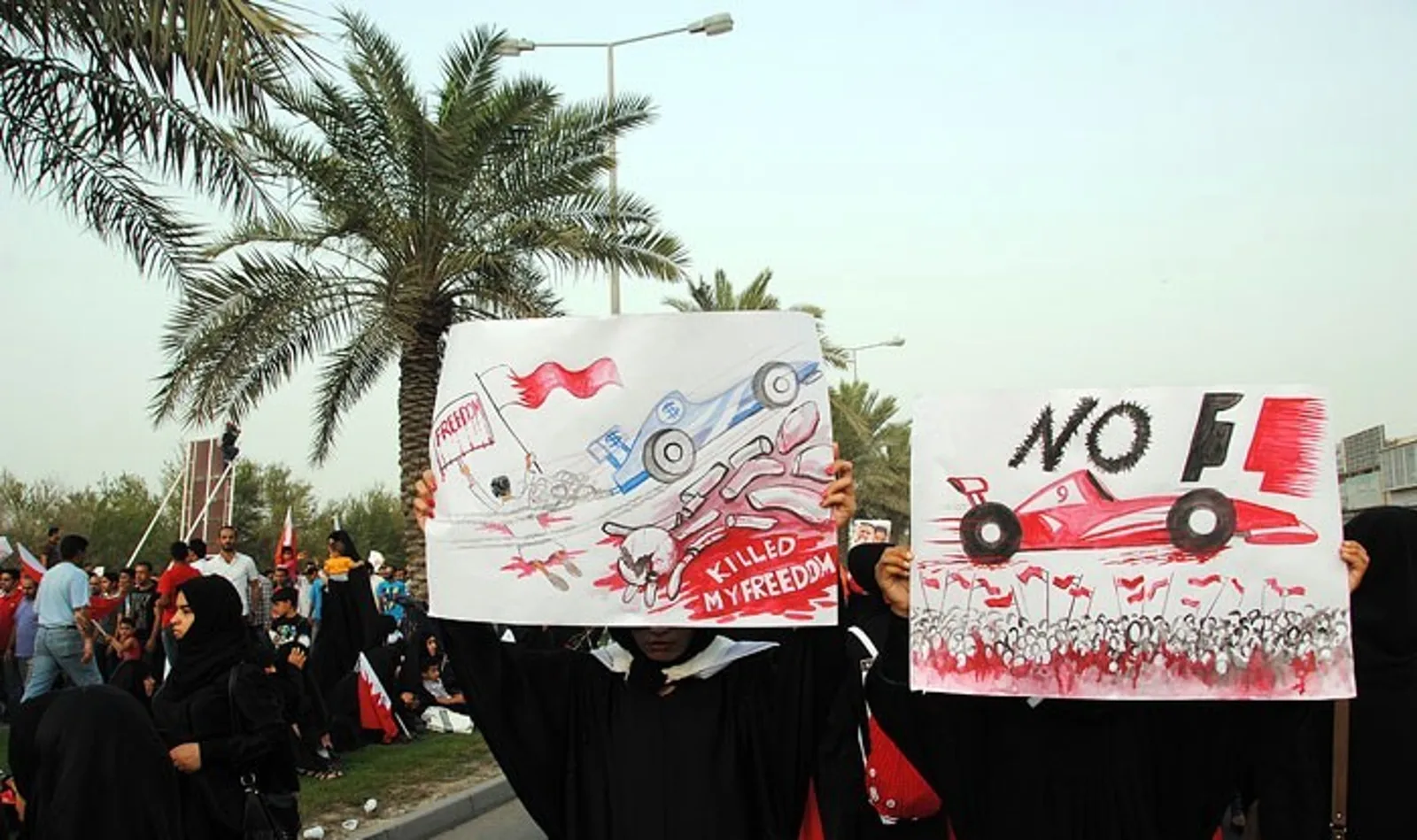
The Bahrain Centre for Human Rights asked teams to stay away, claiming the government was using the event to look stable. Human rights groups repeated that call in January 2012, and some politicians and activists joined them.
Damon Hill, the 1996 world champion, initially felt that a return to Bahrain was defensible once he had seen the country for himself. Two weeks later he changed his stance, warning that the race could create more problems than it solved and urging the sport not to take sides.
Jackie Stewart backed the race, arguing that cancelling it could do more damage to the sport than holding it. Bernie Ecclestone kept to his position that the race would go ahead, and Sebastian Vettel and Michael Schumacher both supported it.
What did the February 14 Youth Coalition threaten?
In February 2012 the February 14 Youth Coalition, a protest group, sent Bernie Ecclestone a letter. It promised to do everything in its power to ensure the race failed, and it added that it could not guarantee the safety of teams, drivers or spectators if the race went ahead.
Ecclestone was unconcerned. He said he did not think the protesters needed to resort to violence, and he expressed confidence that the organisers would not answer opposition with force.
Ecclestone announced on 28 March 2012 that the race was going ahead. Protesters returned four days later, and police broke up gatherings in Abu Saiba and Tubli.
Campaigners also used Twitter to push for cancellation. By early April the movement had shifted its attention onto the race itself.
Was the government using the race to show stability?
Circuit chairman Zayed al-Zayani said the race was in the interests of everyone involved and would bring economic benefits to the region. He described Bahrain as the home of motorsport in the Middle East and dismissed critics as armchair observers and scaremongering extremists.
Al-Zayani said he did not understand why the race had been made into a political issue. Activists rejected his account and said the government wanted to tell the outside world that everything had returned to normal.
Ecclestone later admitted he had no power to force teams to race in Bahrain if they did not want to. He said that any team that failed to race would breach the Concorde Agreement and could face a financial penalty.
What did the teams say about going to Bahrain?
A Guardian report quoted an unnamed team principal who was uncomfortable about going, and who said the only way to stage the race without incident was a complete military lockdown. Several teams shared similar reservations about the race going ahead.
The Foreign and Commonwealth Office had not issued travel restrictions for Bahrain two weeks before the race, and the insurers that cover the teams had raised no objections to travel there.
Reports also claimed that teams held two flights home from Shanghai, one direct and one routed through Bahrain, in case the race was called off. Ecclestone played these down and said that none of the twelve teams had raised reservations with him.
How did the teams prepare for arrival in Bahrain?
Teams hired local security experts and planned special routes from Manama to the circuit, which is about 40 kilometres (24.9 mi) away. The first team members reached Bahrain on 17 April, although reports said sixty Shi'ite protest leaders had already been detained.
News agency AFP reported that its journalists and photographers were blocked from entering Bahrain, and that several foreign journalists had their visas delayed. Camera staff had to wear high-visibility markings at all times, so they could be identified and kept away from events away from the circuit.
Riot police and armoured vehicles lined the road from Manama to the circuit. Journalists who did have approval to enter used social media to get around press censorship.
Key dates in the dispute
| Date | Event |
|---|---|
| 21 February 2011 | The 2011 race is cancelled because of civil unrest |
| December 2011 | The final 2012 calendar confirms the race for 22 April |
| February 2012 | The February 14 Youth Coalition threatens to disrupt the race |
| 28 March 2012 | Ecclestone confirms the event will go ahead |
| 13 April 2012 | The FIA says the race will go ahead as planned |
| 17 April 2012 | The first team members arrive in Bahrain |
| 18 April 2012 | Force India mechanics are caught in a petrol bomb incident, and MRS Racing withdraws from the Porsche Supercup round |
| 19 April 2012 | Shell, Vodafone and UBS say they will not use the race for clients |
What did the FIA and its advisers say about security?
A report commissioned by Lotus F1 predicted that protests over the race would be limited to peaceful demonstrations. John Yates, a former senior officer of the London Metropolitan Police who advised the Bahrain Ministry of the Interior, called the protests unlawful and said they were being misrepresented in the media.
Yates later admitted that nobody could guarantee anyone's safety during the race meeting. He also said security forces might be forced to use live ammunition in the event of an incident.
Nabeel Rajab, president of the Bahrain Centre for Human Rights, said nobody in the Formula One community would be hurt and that the protests were aimed at the politics of the race, not at the sport.
On 13 April the FIA released a statement saying it was satisfied with the situation in Bahrain, and that the race would go ahead as planned. Teams met Ecclestone in Shanghai and declared themselves happy with the decision. Members of the Formula One Teams Association said they could not cancel a Grand Prix, and Button and Webber called for unity and for the FIA to make the most informed decision possible.
Why did the decision draw criticism from rights groups?
Amnesty International said the situation was no better than it had been in 2011. The Times reported that teams had moved staff members who objected to competing in Bahrain out of their positions, and McLaren and Mercedes declared their support for the race.
Opposition also came from politicians. Several British MPs, including Jeremy Corbyn, called for the race to be cancelled, saying it would be used by the Bahraini government as an endorsement of its suppression of dissent. Labour asked Britain's Jenson Button, Lewis Hamilton and Paul di Resta to stay away from the event.
Ed Miliband and Yvette Cooper went further and openly demanded cancellation. In a letter to the chief executives of Red Bull and News Corporation, Douglas Alexander urged teams, media and sponsors to boycott the event.
The White House criticised violence from both sides without naming the race. Several sponsors, including Royal Dutch Shell, Vodafone and UBS, said they would not use the race to entertain clients, and corporate hospitality agencies reported a downturn of up to eighty percent.
How did the FIA's neutrality rules come into play?
At the 2006 Turkish Grand Prix, the winner Felipe Massa was presented with his trophy by a figure described as the president of a state recognised only by Turkey. The government of Cyprus complained, and the FIA fined the organisers five million dollars for breaching its political neutrality.
The FIA Statutes state that the federation must refrain from political discrimination. FIA president Jean Todt said the federation was interested in sport and not politics, and an FIA spokesman called political neutrality fundamental and not open to compromise. Todt also avoided a direct question about the Bahrain campaign, which had been promoted under the slogan UNIF1ED.
Keith Collantine called the campaign political in nature, and Ted Kravitz reported that team bosses thought the slogan was a mistake, because Formula One is not supposed to be used for political aims. Journalists also argued that the slogan failed to present the country as united.
How did the drivers respond?
Sebastian Vettel said Bahrain was no more dangerous than Brazil, while Button, Michael Schumacher and Romain Grosjean declined to comment either way. Rubens Barrichello disagreed with the comparison and said there was no real parallel between the two countries.
Robert Fisk, writing in The Independent, attacked the drivers' neutral stance. He called Vettel clueless and accused Button and Hamilton of double standards, arguing that sportspeople could no longer keep a distance from moral questions. Hill, for his part, had cautioned against indifference to the situation.
Pedro de la Rosa, chairman of the Grand Prix Drivers' Association, said he was not concerned about safety. Xevi Pujolar, the race engineer to Pastor Maldonado, posted a photo on Twitter saying that all was normal outside.
Button had been through a frightening episode at the 2010 Brazilian Grand Prix, when armed gunmen tried to hold up his road car after he left the circuit. That experience was often cited by those who compared the two countries.
What happened to the Force India mechanics?
A hire car carrying Force India mechanics was caught up in a petrol bomb incident on 18 April. They were travelling in an unmarked vehicle when a makeshift barricade stopped them, and a petrol bomb exploded close by.
Nobody was injured and the car was not damaged, but security forces fired tear gas nearby and the staff were briefly affected. Former McLaren mechanic and journalist Marc Priestley reported the incident on Twitter.
One team member flew out of the country the next day, and a second left several hours later. Nico Hulkenberg said staff should not have to fear for their safety, calling the episode wrong.
Why is the 2012 race still remembered as controversial?
The race is remembered because it went ahead while protests and violence continued, and while sponsors and teams were still uneasy about being there. The debate over whether it should have run has never really been settled.
The row also tested the FIA's own rules. Its statutes commit the federation to political neutrality, and critics argued that the race and its slogan had put that principle under strain.