Sebastian Vettel led from pole to win at Sakhir, Kimi Raikkonen climbed from eleventh to second and Romain Grosjean took his first podium, in a race whose staging drew wide criticism.
Sebastian Vettel won the 2012 Bahrain Grand Prix for Red Bull at Sakhir on 22 April 2012, starting from pole. Kimi Raikkonen was second for Lotus after starting eleventh, and Romain Grosjean took third. It was round four of the season.
Sebastian Vettel won the 2012 Bahrain Grand Prix at the Bahrain International Circuit in Sakhir on 22 April 2012, starting from pole and leading for most of the 57 laps. Kimi Raikkonen climbed from eleventh to second, and Romain Grosjean took his first Formula One podium in third. The race returned to the calendar after the 2011 event was cancelled, and its staging was described as controversial by several news outlets.
Who won the 2012 Bahrain Grand Prix?
Vettel won for Red Bull, his 17th Grand Prix victory and his 22nd overall in the sport. It was also the first win of 2012 for both the driver and the team. Raikkonen finished second after starting eleventh, and Grosjean took third, the best result of his career.
Raikkonen was on a better tyre strategy than the cars ahead of him, and he passed Grosjean for second roughly halfway through the race. Vettel was pressed hard in the later laps, and he used the full power of his engine down the main straight to defend against the Lotus.
It was Raikkonen's first rostrum since 2009, when he was still with Ferrari. Grosjean's third place completed a strong afternoon for Lotus, which had the two cars on the podium.
Pole, a 17th win for Vettel and a first podium for Grosjean, all in a race that was never free of argument.
Why was the race so controversial?
The race had not taken place in 2011, when it was cancelled because of anti-government protests in Bahrain. Its return in 2012 was widely debated, and several news organisations described the decision to hold the race during protests and violence as controversial.
Several broadcasters and news agencies, among them Al Jazeera English and CNN, described the decision that way. The Independent went further and called the race one of the most contentious in the sport's past. The race was still held, and the debate about it continued after the chequered flag.
Teams arrived with no data on the Pirelli tyres at Sakhir. The 2011 race had been cancelled, so the tyres introduced that season had never been run there, and the revised 2012 compounds had only been used in cool or wet conditions so far.
What did the tyres and rules mean before the race?
Teams were given the medium and soft tyres, identical to the choice in China. Pirelli's motorsport director, Paul Hembery, predicted high tyre degradation, and sand on the surface was expected to cause graining.
Mark Webber had predicted that the teams who understood tyre behaviour first would be the most successful, and Nico Rosberg, who had won in China a week earlier, agreed that tyre understanding would be central to the championship. The Drag Reduction System had been introduced in 2011, but it had never been used in a race at Sakhir before.
Officials placed the DRS detection point 108 metres from the apex of Turn 14, with the activation point 270 metres after the final corner. The resulting zone was 820 metres (0.51 mi) long and sat on the start-finish straight, where overtaking into the first corner complex was possible.
Pastor Maldonado of Williams took a five-place drop on the grid after a gearbox swap. Under the rules a gearbox must run for five consecutive events before an unscheduled change is free, and Maldonado became the fourth driver of the season to take a gearbox penalty, after Sergio Perez, Kimi Raikkonen and Lewis Hamilton.
Bottas took over Senna's car for the first session, which was his third of fifteen scheduled outings.
How did practice unfold at Sakhir?
Lewis Hamilton was fastest in the first practice session, with a time of 1:33.572, while Vettel was three-tenths behind in second. Force India did not run in the second session because of security concerns, and Rosberg led the field by the end of it.
The first session began with installation laps, and the majority of drivers used the harder prime tyres. Ferrari and Lotus tested new aerodynamic configurations on their front and rear wings. The surface was visibly sandy because the circuit had not been used for two years, and Hulkenberg was the first to set a time, roughly twenty minutes in.
Narain Karthikeyan set 1:41.710 almost straight away in the second session, while Rosberg was ahead as the final ten minutes began, with 1:32.816, four-tenths faster than Webber. Vettel finished third, and Hamilton was fourth. Bruno Senna, back in his car after Bottas had driven it in the first session, ended the session 18th.
The last session ran on Saturday morning, three hours ahead of qualifying. Paul di Resta set 1:41.356 ten minutes in. Rosberg topped the session at 1:33.254, with Vettel next and Webber following him. Hamilton was fourth. Force India's two drivers had completed forty-three laps between them in the hour.
How did qualifying go?
Vettel took pole, his first since the 2011 Brazilian Grand Prix, with a time of 1:32.422. Hamilton was second, and half a second covered the top five. Qualifying started at 14:00 local time on a track measured at 43 degrees Celsius (109 Fahrenheit).
The format used three knockout periods. Q1 lasted 20 minutes and eliminated the seven slowest cars, Q2 lasted 15 minutes and removed the next seven, and Q3 was ten minutes long to set the top ten. Drivers who reached Q3 had to start the race on the tyres they used for their fastest lap, and a 107 per cent rule applied in Q1.
In the first period Sergio Perez set the pace, and he was the fastest man in Q1. The two HRT drivers were inside the 107 per cent time, but four seconds off Perez's pace. Jean-Eric Vergne spent most of the period near the cut-off, and he was eliminated for the third consecutive race.
Schumacher lost time to a DRS flap fault in his rear wing and went out in Q1. Heikki Kovalainen's late lap put him through to Q2 for Caterham, which had reached the second session in dry conditions only once before. Timo Glock was also out, but Charles Pic outqualified him for the first time.
In the second session Romain Grosjean eliminated Kimi Raikkonen with his final lap, and Felipe Massa missed Q3 for the fourth race in a row. Kamui Kobayashi was out after a faster lap from teammate Perez had put Perez into Q3. Bruno Senna made a mistake at turn 13 and finished 15th.
Alonso and di Resta set no timed lap in the final period. Both had used all their soft tyres and chose not to start a flying lap, so they qualified ninth and tenth on sighting laps alone. Vettel's pole time was 1:32.422.
Mark Webber locked a front wheel at turn 10 on his first timed lap, dragging it across the surface and losing time. Jenson Button was fourth, Nico Rosberg fifth, Daniel Ricciardo sixth, Grosjean seventh and Perez eighth. Maldonado's penalty put him 22nd, but Schumacher's own gearbox penalty moved Maldonado up to 21st.
How did the race develop?
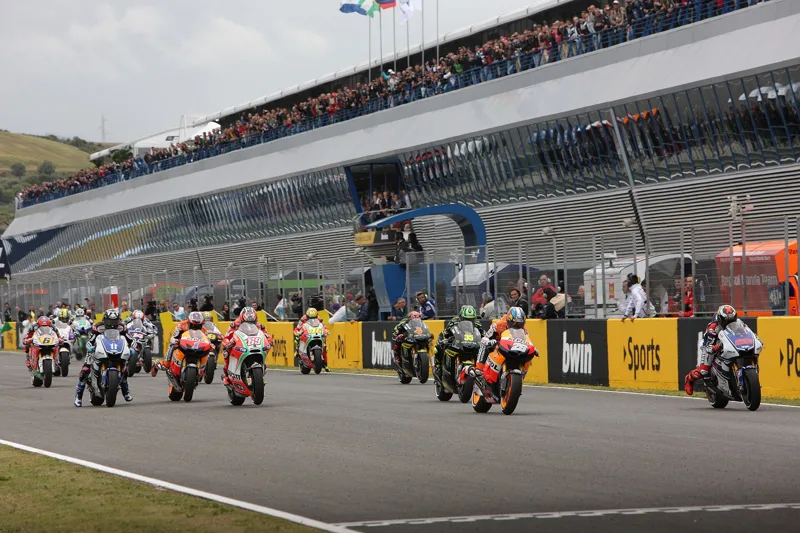
The race started at 12:00 UTC, or 15:00 local time, under warm and cloudy conditions. The air was 27 degrees Celsius (81 Fahrenheit) and the track 32 degrees (90 Fahrenheit). Most drivers started on the soft yellow-banded tyre, and Vettel led into the first corner from pole.
Grosjean used DRS to pass Webber for third on lap four, and on lap seven he passed Hamilton with the same tool. Webber had no KERS on the first lap, so he could not challenge Hamilton early. Maldonado was passed by Vergne, but he grabbed the slipstream and retook the place while Vergne still had his wing open.
Rosberg forced Hamilton wide and off the track before turn four on lap eight, and the stewards chose to review it after the race instead of mid-race. Hamilton shook his head as he waited in the pits, and his left rear wheel then stuck during his stop, leaving him stationary for a long time.
By lap 15 every car had made at least one stop. Vettel led, with the two Lotus cars behind him, then Webber and the Button-led McLarens. Michael Schumacher was 13th and still clawing back into the points.
Di Resta led after Vettel's stop, the first time since the 2009 Belgian race that a Force India led a lap. On lap 23 Rosberg forced Alonso wide and off the track in the same spot before turn four, and Alonso was vocal about it on the radio. The stewards again opted to review it after the race.
Maldonado retired on lap 25 after a left rear puncture sent him into a 360-degree spin, and Hamilton's left rear problem repeated itself in his second stop. Raikkonen was within the DRS zone of Vettel on lap 33 and attempted an overtake on lap 36, but he switched to the outside under braking and missed the move.
Vettel was told to push to pass, and he used the full rev limit down the main straight to keep Raikkonen behind. He had been shifting below that limit earlier to save fuel. Hamilton, meanwhile, set the fastest lap of the race at that point from 10th position on lap 39.
Rosberg's exhaust broke, and Jenson Button had an engine noise that forced him to retire with two laps to go. Bruno Senna also retired with three laps remaining, which made it a double retirement for Williams.
How did the race finish?
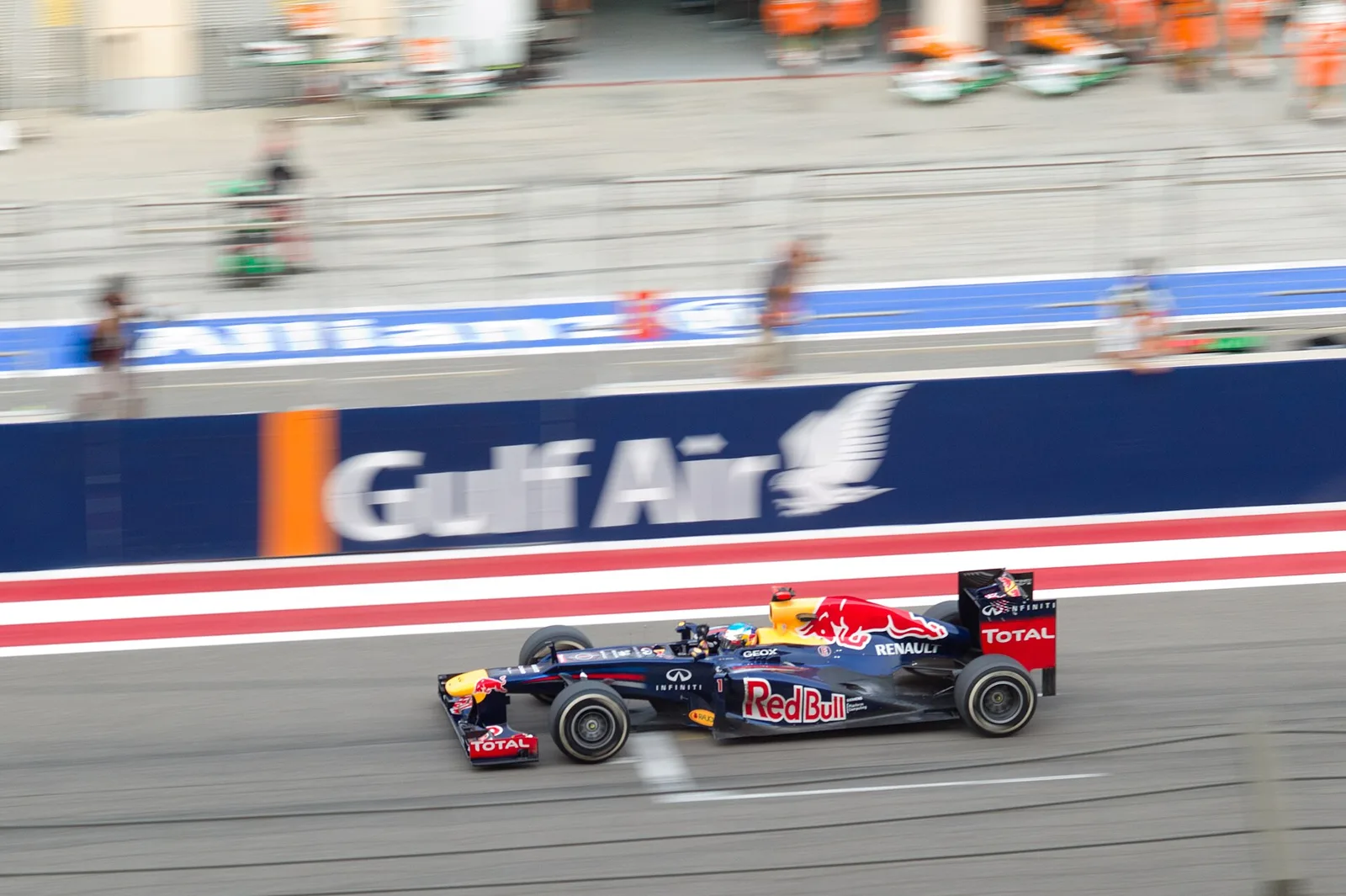
Vettel crossed the line first to claim his 17th victory, starting from pole. Raikkonen was second, Grosjean third, and Webber fourth for the fourth consecutive race. Vettel stopped at the pit exit after the flag, most likely because his fuel was low.
Rosberg finished about 55 seconds behind after a broken exhaust, and he was fortunate to avoid a penalty for dangerous driving. Di Resta matched his best Formula One result, sixth, and held off Alonso by less than 0.3 seconds. Hamilton finished eighth after losing around 15 seconds in pit stop time, and Felipe Massa scored his first points of the year in ninth.
Michael Schumacher took the final point in tenth after starting 22nd. Both Sauber and Toro Rosso lacked race pace, and Caterham had the best result of the three bottom teams.
| Finish | Driver | Team | Grid | Note |
|---|---|---|---|---|
| 1 | Sebastian Vettel | Red Bull | 1 | Pole; 17th Grand Prix win |
| 2 | Kimi Raikkonen | Lotus | eleventh | First podium since 2009 Italian race with Ferrari |
| 3 | Romain Grosjean | Lotus | 7 | First podium of his career |
| 4 | Mark Webber | Red Bull | 3 | Fourth for the fourth consecutive race |
| 6 | Paul di Resta | Force India | 10 | Matched his best result |
| 10 | Michael Schumacher | Mercedes | 22 | Final point after a gearbox penalty |
What did the result change in the title race?
Vettel took the Drivers' Championship lead from Hamilton, who was second, four points behind. Webber was third, one point behind Hamilton, and Button fourth, five points behind. Alonso stood fifth.
Red Bull led the Constructors' Championship, with McLaren nine points behind. Lotus moved up to third after its first podium of the year, while Ferrari fell to fourth and Mercedes stayed fifth. Four rounds had now produced four separate leaders and four separate winners.