A rain-hit finale at Interlagos gave Jenson Button his last Formula One victory, while Sebastian Vettel secured the championship from sixth place.
Button took the chequered flag for McLaren at Sao Paulo, the final round of the 2012 season, and it was his final Formula One victory. Vettel finished sixth, enough to take the championship, while Fernando Alonso was second for Ferrari.
Jenson Button won the 2012 Brazilian Grand Prix for McLaren at the Autodromo Jose Carlos Pace on 25 November 2012, the twentieth and final round of the season. Sebastian Vettel clinched his third successive world title by finishing sixth, while Fernando Alonso took second and came closest to the championship. The race was rain-affected and unpredictable, and it has been remembered as one of the great finales.
Who won the 2012 Brazilian Grand Prix?
Jenson Button won for McLaren, taking the 15th and last victory of his Formula One career. It was also McLaren's last Grand Prix win until Daniel Ricciardo triumphed at the 2021 Italian Grand Prix. The race was run in rain and was widely praised as a thriller.
Fernando Alonso finished second for Ferrari, and he had held the provisional championship lead at a late stage before Vettel moved up the order. Vettel's sixth place gave him a three-point cushion over Alonso, which was enough to take the title. The race also marked the 306th and final start of Michael Schumacher's career. Michael Schumacher, who had announced his second retirement, scored the final points of his career by finishing seventh.
Button congratulated his team on the result and said that ending the season on a high was a good sign for 2013. It was the last victory of his career.
A rain-hit finale in which Button closed his career with a win and Vettel took the title from sixth place.
Why did Vettel's title depend on sixth place?
Vettel needed to defend a 13-point advantage over Alonso going into the race. That meant Alonso had to finish at least third even if Vettel failed to score, while a fourth-place finish was enough for Vettel even if Alonso won. Vettel was therefore the clear favourite before the lights went out.
The arithmetic kept the pressure on Vettel throughout the afternoon, because a poor start or a collision could still have cost him the title. Once the rain began the standings became a secondary concern, and the drivers focused on survival and track position. Vettel's eventual sixth place was the one he needed.
How did practice set up the weekend?
During free practice on Friday and Saturday, Lewis Hamilton and McLaren set the pace, with Vettel and his Red Bull teammate Mark Webber close behind. Hamilton topped the timesheets in both Friday sessions, while Jenson Button was quickest in the third session on Saturday morning.
Alonso struggled in the opening free practice session, behind Vettel by a margin roughly double that of earlier rounds. He was faster than the German on the harder compound in the second session, and Ferrari looked stronger on long runs, with Felipe Massa setting the most consistently fast times, 0.1 seconds ahead of Hamilton.
The heat was a concern for every team. Tyre degradation was a worry in the paddock, and Hamilton said he felt as though he was sliding around the track while the tyres were melting.
What happened in qualifying?
Qualifying on Saturday was run in difficult conditions. The first part started on a damp track, so the drivers used intermediate tyres, while by the second part the track was almost dry and slick tyres were used. Romain Grosjean collided with the slower HRT of Pedro de la Rosa in the first part and lost his front wing.
Grosjean nursed the car back to the pit lane but could not change his tyres, and that left him 18th on the grid. Michael Schumacher had a poor final qualifying session of his career, taking 14th place and almost half a second down on his teammate Nico Rosberg. He admitted afterwards that he may have compromised his set-up too much for an expected wet race.
The McLarens were the fastest cars all weekend and took the front row. Lewis Hamilton secured his last pole position with the team, and the title contenders struggled, with Vettel fourth and Alonso eighth. The weighbridge cost Pastor Maldonado dearly, as a ten-place penalty dropped him from sixth to 16th after he missed his call to the scales.
De la Rosa also took a five-place grid penalty for replacing his gearbox, which made the grid harder to predict.
How did the race start?
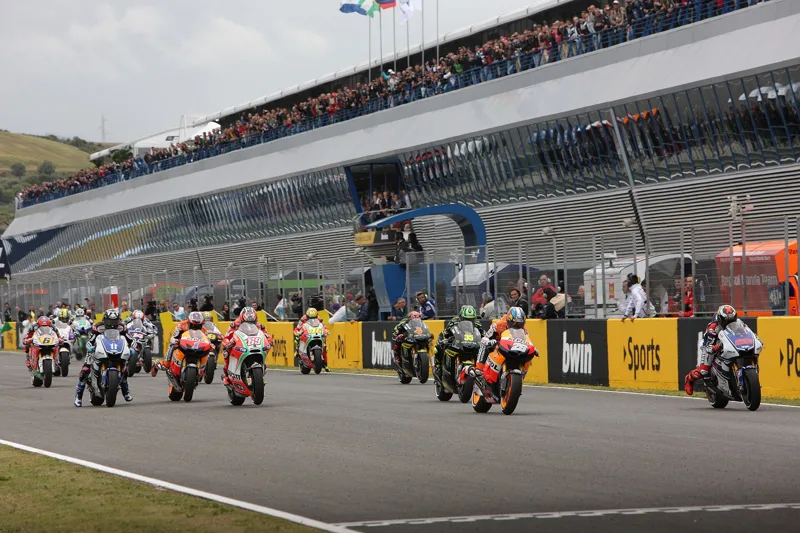
There was light rain about ten minutes before the start, but every team opted to start on slick tyres. Vettel got away poorly and dropped to seventh, while Alonso moved up into fifth. After the start both title contenders were in the top seven.
Vettel tangled with Bruno Senna at turn 4, which spun Vettel and sent Senna into the back of Sergio Perez. Vettel damaged his left sidepod but carried on, and he was running 22nd after the incident. Massa helped his teammate by letting Alonso past Mark Webber on lap two into the Senna-S, which gave the Spaniard the third place he needed.
Alonso lost that place to Nico Hulkenberg on lap four after running wide. Pastor Pastor Maldonado's race ended on lap two, when a loss of control over the kerb at turn 3 sent him into the tyre barrier on the exit. The race was still wide open.
How did the rain change the race?
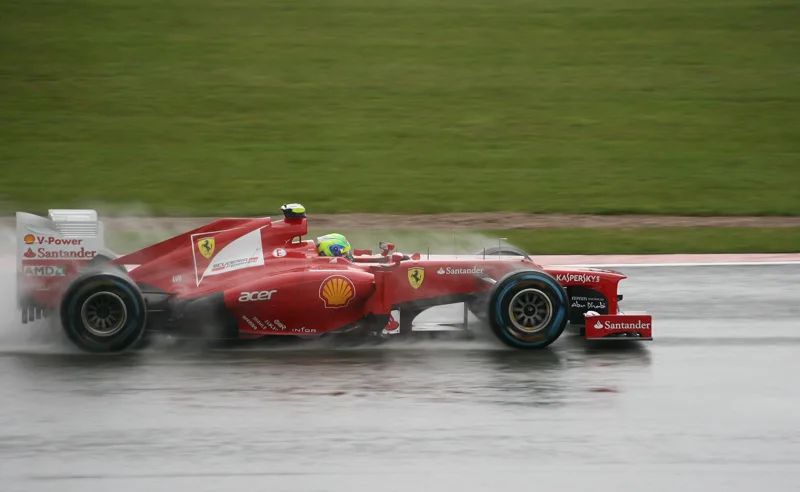
Showers arrived over the following laps, and the first runners switched to intermediates. The two title contenders were among them, while Button and Hulkenberg stayed out on slicks. That decision proved to be the right one, because the rain eased soon afterwards and cars on intermediates were forced to pit again for slicks.
Hulkenberg overtook Button for the lead at the end of lap 18, with the official time difference at the line recorded as 0.000. The German had been running a strong race.
Almost a minute separated the leaders from the rest when debris prompted a safety car on lap 23. Alonso and Vettel were running in fourth and fifth. At the restart on lap 29, Kamui Kobayashi took fifth from Vettel, and the damage on the Red Bull slowed him considerably in dry conditions, so Massa passed him shortly afterwards.
At the front Hamilton took second from his teammate and passed Hulkenberg when the German half-spun. Hulkenberg then pursued the McLaren but slid into him on lap 54. That left Hamilton out of the race with left front suspension damage, and Button inherited the lead.
How did Vettel secure the title?
Vettel was among the first to switch to intermediates once the rain returned. His radio had failed, so the team was not ready for him, and a long delay followed. Ferrari timed Massa's stop well, which let Alonso take second position from him.
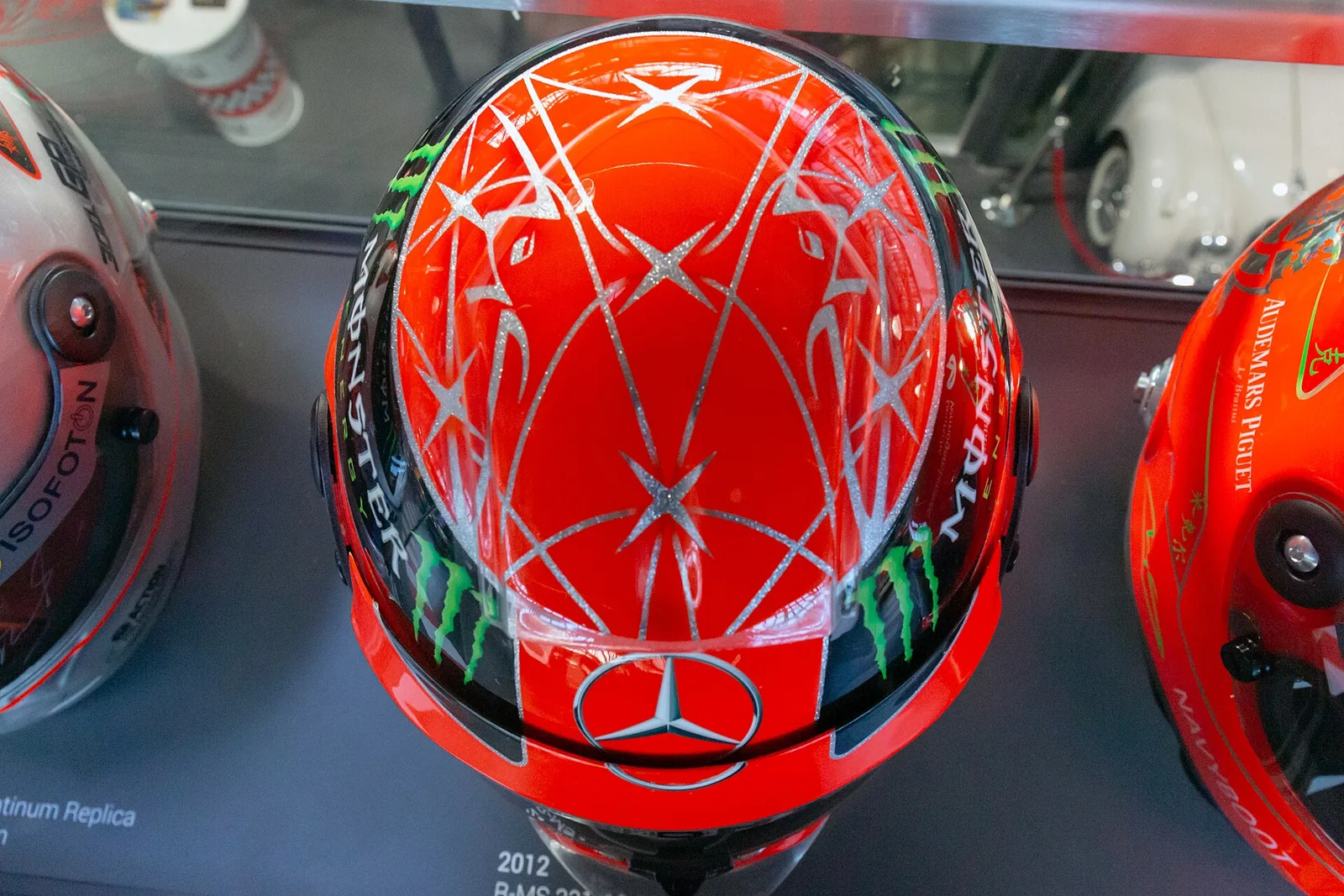
Vettel eventually took sixth place from Michael Schumacher, and that position proved sufficient to retain the title even with Alonso finishing second. Schumacher's seventh place was also the last points he would score in Formula One. Schumacher gave up sixth to Vettel on purpose, so that Vettel could extend his small points advantage over Alonso in the championship.
Raikkonen had an eventful afternoon as well. He almost crashed into Vettel after the start, and later he tried an escape road that turned out to be a dead end. He said afterwards that the way had been open 11 years earlier, when he made the same manoeuvre at the 2001 Brazilian Grand Prix.
Di Resta crashed on the start-finish straight near the end, which brought out a final safety car. Vitaly Petrov took 11th for Caterham, which meant his team overtook Marussia in the Constructors' Championship.
How was the race received?
The race received widespread acclaim, and The Guardian described it as a roller coaster. Three-time world champions Niki Lauda and Nelson Piquet said they had never witnessed anything similar. The German magazine Der Spiegel called it spectacular and historic because of the record number of 147 successful overtaking manoeuvres during the race.
Reuters said the Brazilian weather had produced a thriller that would stand the test of time against the sport's great races. Vettel himself described it as his toughest race ever, and the race has since been remembered for its drama rather than its order.
At age 25, Vettel became the youngest triple world champion in the sport's history. He was six years younger than Ayrton Senna had been when Senna won his title in the 1991 season. Christian Horner praised his driver's fight back into the championship and said that he had never given up.
Adrian Newey's decision to change the engine mapping on Vettel's car after reviewing photographs of the damage also drew praise. Newey saw a serious crease in the exhaust, a sign that it could soon fail and set the bodywork alight, so the team cooled it down even though that cost performance.
What did the drivers say afterwards?
Alonso expressed pride in his team and called the 2012 season the best of his career. He said the championship had been lost in races where the team had been unlucky, rather than in Brazil itself, and that the team would try again next year.
Button said that the victory was the perfect way to end the season, and that the ups and downs of the year would make 2013 more promising. He would never win another race in Formula One,.
Michael Schumacher reflected on his three years at Mercedes and said the mission to end successfully had not worked this time. He added that he was happy to finish and move on to a different life. Eddie Jordan believed that Alonso would have deserved the title more, while the BBC's Jaime Alguersuari argued that Vettel deserved the title, having had everything to lose going into the final race.
What followed the race?
Three days after the race Ferrari said it was considering an appeal over video footage that appeared to show Vettel overtaking Jean-Eric Vergne under yellow flags. If the allegation had been proven, the FIA could have added 20 seconds to Vettel's finishing time, which would have dropped him to eighth and handed the title to Alonso.
Two days later Ferrari decided not to appeal after receiving information from the FIA that Vettel's move on Vergne had happened under green flags. Formula One chief executive Bernie Ecclestone had called Ferrari's allegations a shame and a joke.
Marussia's director of engineering later accused driver Charles Pic of letting Vitaly Petrov pass him, because Pic had already signed for Caterham. No action was taken. In August 2018 Christian Horner also revealed that Vettel believed Mark Webber had pushed him towards the wall at the first turn, and that the Multi 21 affair at the 2013 Malaysian Grand Prix was Vettel's response.
| Position | Driver | Team | Note |
|---|---|---|---|
| 1st | Jenson Button | McLaren | 15th and last win; McLaren's last win until 2021 |
| 2nd | Fernando Alonso | Ferrari | Runner-up in race and championship |
| 6th | Sebastian Vettel | Red Bull | Sixth place was enough for the third title |
| 7th | Michael Schumacher | Mercedes | Final points of his career, in his 306th and final race |
| 11th | Vitaly Petrov | Caterham | Moved Caterham ahead of Marussia in the Constructors' Championship |