Webber took pole at the Nurburgring, but Hamilton's McLaren won from second and Vettel's record championship lead took a hit.
The 2011 German Grand Prix was the tenth round of the Formula One season, held on 24 July 2011 at the Nurburgring. Lewis Hamilton won the 60-lap race for McLaren from second on the grid, ahead of Fernando Alonso and Mark Webber, who had started from pole.
Lewis Hamilton won the 2011 German Grand Prix from second on the grid, holding off Fernando Alonso and Mark Webber at the Nurburgring. Sebastian Vettel finished fourth, ending an eleven-race run of podium finishes. The result also moved Hamilton up to third in the drivers' standings.
What was the championship picture before the race?
Vettel led the drivers' championship by 80 points, which was then the largest lead on record. Webber was second, 12 points ahead of Alonso, while Hamilton and Jenson Button were both on 109 points.
Red Bull had 328 points in the constructors' table, 110 ahead of McLaren. Ferrari were third on 164 points, 54 behind McLaren, and Mercedes sat 103 points further back, just ahead of Renault for the first time that season.
Hamilton was placed fourth on countback because he had one more second place than Button, which left the two McLaren drivers level on points.
Before the race, every team and driver was still in contention for the championship. Many of them would not be after the German weekend, which made the result more important than the usual points haul.
A lap only five-hundredths slower than pole gave Hamilton the front row, then the win.
What did the practice sessions show?
After Friday's two sessions, Hamilton summed up his prospects bleakly. He said his team could not challenge Red Bull and Ferrari for pole, and he ended up only marginally off the pole time.
In the first practice session Alonso was fastest, ahead of Webber and Vettel, which suggested Ferrari would match Red Bull in qualifying. Hamilton was fifth, while Button was 11th after running without KERS in both Friday sessions.
Late in the first session Sebastien Buemi lost control, went sideways onto the gravel and was out for the second session with a fuel pressure fault.
Webber led Alonso in the second session, which also featured an unusual number of lock-ups and off-track moments. Schumacher left the track at turn seven and waved to his home crowd, while Timo Glock slid on wet grass at the foot of a hill and only narrowly avoided ending up stuck on the kerb.
Who made the front row, and why was Alonso not on it?
Webber took pole with a lap that beat Alonso by four-tenths of a second, with Vettel sandwiched between them. Alonso then went faster but could not improve, and he stayed third. Hamilton's late lap, only five-hundredths slower than Webber's, pushed Alonso down to fourth.
Vettel's third place was the first time since Monza the previous year that he had not qualified on the front row. He was 0.137 seconds behind Webber on the grid.
Kobayashi was the biggest surprise among the early casualties, and his Sauber qualified 18th after he could set only a slow first-period time. Karun Chandhok replaced Jarno Trulli at Lotus, and he was 21st before a penalty moved him to 20th. Heikki Kovalainen had beaten him by eight-tenths of a second in the same session.
Buemi was excluded from qualifying for a fuel irregularity, which dropped him to 24th. Four of the six German drivers in the field qualified in the top ten at their home race.
Massa, fifth, was six-tenths behind his teammate Alonso. Button was disappointed after qualifying seventh, 1.2 seconds behind Hamilton, and blamed a lack of grip and understeer. Di Resta later said he had suffered grip problems in qualifying too.
What did the start line change mean for the weekend?
The start line had been moved 240 metres (790 ft) closer to the first corner for the weekend. That roughly halved the distance to Turn 1, so the start mattered less to the drivers than it had before.
Pirelli brought the white-banded medium prime and the yellow-banded soft option.
There were six German drivers at the race, and Schumacher, who had won on this track five times, was among them. Four of the six qualified in the top ten, which gave the home crowd plenty to cheer.
How did the race open?
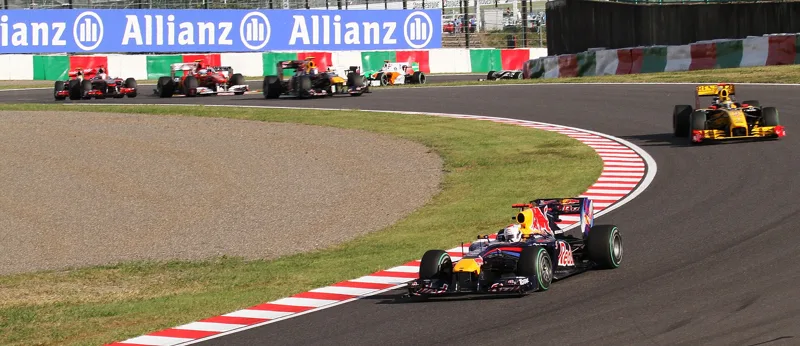
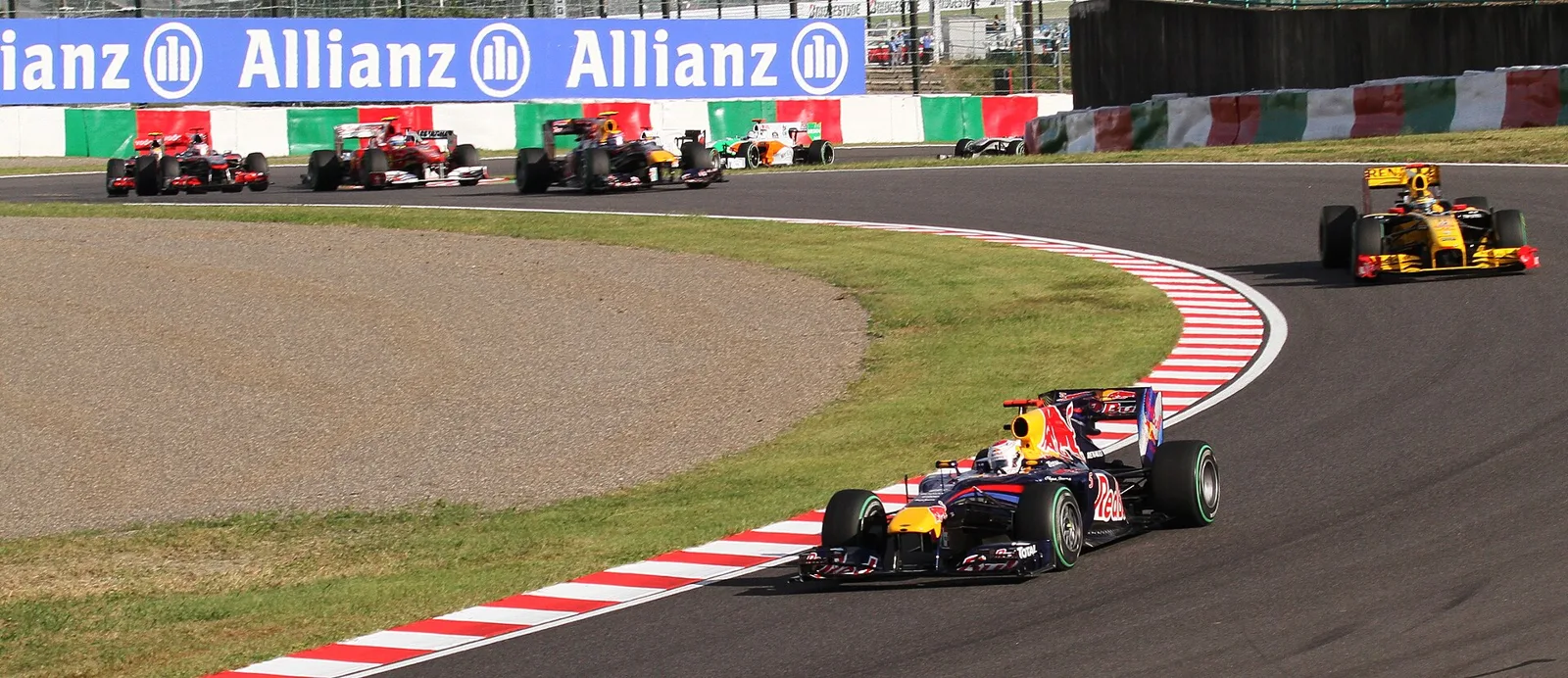
Webber made a slow start from pole, bogging down at low revs, and Hamilton took the lead. Alonso beat Vettel into the first corner, with the two Ferraris flanking the Red Bull.
Massa had another good start but slipped behind Rosberg into sixth. Button had a poor start and dropped from seventh to tenth on the first lap, while Schumacher moved from tenth to eighth, and Sutil ran seventh after a good start.
Heidfeld and di Resta made contact and fell to the back of the field. Heidfeld had been handed a drive-through for an avoidable collision with di Resta, though he never served it.
What happened in the middle laps?
Alonso ran wide at turn two on lap four and got a wheel onto the wet grass, which let Vettel up to third for a short time. Alonso repassed him soon afterwards, and Barrichello's engine failed on lap 16.
Heidfeld was squeezed off the track by Buemi at the chicane and crashed out. Buemi took a five-place grid drop for the Hungarian race that followed.
Massa passed Rosberg for fifth after his Ferrari engineer, Rob Smedley, told him the move was needed for his strategy. Button suffered a hydraulics failure, and two laps later Liuzzi retired with an electrical failure, the fourth and final retirement of the race.
Vettel spun at turn ten and dropped eleven seconds behind the third-placed Alonso. Di Resta fought back through the field to finish 13th.
How did the pit stops decide the lead?
Webber pitted first to try for an undercut and came out behind Sutil, but he worked his way past Vettel. When Hamilton and Alonso pitted at the same time, Massa took the lead ahead of Webber, Hamilton and Alonso, while Vettel dropped to ninth.
After those stops Webber had undercut Hamilton into the lead, which was the first time he had led a race that season, with Alonso third. Schumacher later spun at the same corner where Vettel had gone off, and fell behind Sutil and Petrov.
Hamilton got the better of the second round of stops in cold conditions, where the mechanical grip of his McLaren helped. Alonso then came out in the lead, but his tyres had not reached operating temperature, and Hamilton made an easy pass at turn two.
How did Hamilton finish the race?
Hamilton pitted for medium tyres, came out in front of Alonso and Webber, and pulled away to take the win. Anyone on a three-stop plan switched to the primes in the final ten laps, since the medium compound cost 1.5 seconds a lap.
The fight for fourth between Massa and Vettel was settled in the pits on the next-to-last lap. Massa's slower stop cost him, and Vettel got in front after being unable to pass on track.
After the flag Alonso halted his Ferrari on the circuit and rode back to parc ferme on the sidepod of Webber's Red Bull.
Final order at the Nurburgring
| Position | Driver | Note |
|---|---|---|
| First | Lewis Hamilton | McLaren, started second |
| Second | Fernando Alonso | Ferrari |
| Third | Mark Webber | Red Bull, started from pole |
| Fourth | Sebastian Vettel | Red Bull, eleven-race podium run ended |
| Fifth | Felipe Massa | Ferrari, passed Rosberg for the place |
| Sixth | Adrian Sutil | Force India, two-stop strategy |
| Seventh | Nico Rosberg | Mercedes |
| Eighth | Michael Schumacher | Mercedes |
| Ninth | Kamui Kobayashi | Sauber, started from 17th on the grid |
| Tenth | Vitaly Petrov | Renault, ahead of Sergio Perez |
What did the result do to the championship?
Webber cut Vettel's lead in the drivers' championship to 77 points. Hamilton moved into third, five points behind Webber and four points ahead of Alonso.
Red Bull extended their constructors' lead over McLaren to 112 points. Ferrari were third in the constructors' table, a further 51 points behind McLaren.
For Vettel, the race ended a long run of podium finishes, which had given him a clear cushion before the weekend. The title fight stayed open well into the season, and Hamilton's win was the first big statement in it.