A collision and a punctured tyre left Button 21st in Montreal, then a race that ran over four hours gave him the win.
Montreal's 2011 Canadian Grand Prix went to McLaren's Jenson Button, who started seventh at Circuit Gilles Villeneuve on 12 June. A puncture after contact with Alonso left him 21st, but he recovered to win. The race lasted over four hours and set the record as the longest in Formula One history.
Jenson Button won the 2011 Canadian Grand Prix from seventh on the grid, and he did it after a collision left him 21st and last. The race ran through standing water, a rain storm and a stoppage of over two hours. It set the record as the longest race in Formula One history, running for over four hours.
Where did the 2011 Canadian Grand Prix fit into the season?
Montreal was the seventh round of the 2011 Formula One World Championship and the 48th Canadian Grand Prix. Vettel arrived as the leader on 143 points, and Red Bull had won five of the six races before it. Button was fourth on 76 points, so a win in Montreal would move him sharply up the table.
Hamilton was second on 85 points, Webber third on 79 and Alonso fifth on 69. In the constructors' table, Red Bull led with 222 points from McLaren on 161 and Ferrari on 93, while Renault and Mercedes, on 50 and 40 points, were battling for fourth.
Hamilton had won the Chinese Grand Prix that season, the only race Red Bull had not taken in the first six rounds. The high-speed, low-downforce layout of Montreal gave the rest of the field a chance to break that run of results.
For Button, fourth in the table was a position to leave behind quickly. Most of the season was still to run, and one strong result could change how the title race looked from the back of the leading group.
Button went from 21st to first, in a race that ran for more than four hours.
Why did Virgin Racing split from Wirth Research?
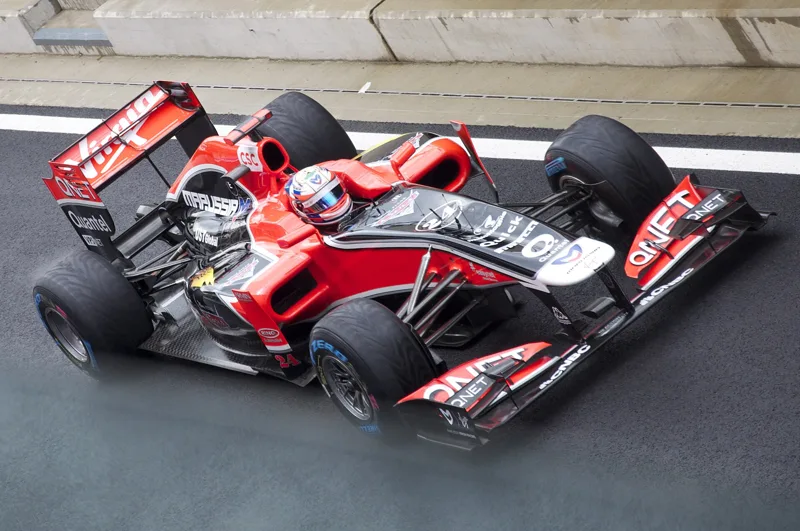
Virgin Racing ended its partnership with Wirth Research just before the race, after a design approach that had not worked. Wirth had designed the cars with computational fluid dynamics alone, skipping the wind tunnel that rivals used to cut costs. Virgin had not qualified higher than 20th all season.
Virgin's chief executive, Andy Webb, said the split would give the team more control over its own future. Wirth kept developing the car until the end of 2011, while Virgin built its own technical department under Pat Symonds, the former Renault engineering director.
Webb had aims of challenging for a podium at the inaugural Russian Grand Prix, a race still to come. That target looked a long way off for a team whose cars were at the back of the grid in Montreal.
A wind tunnel lets engineers test models in controlled airflow, and most teams relied on one to refine their aerodynamics. Wirth's decision to work without one was a bet on simulation alone, and in Montreal that bet had not yet paid off on the grid.
What did the teams change for the low-downforce circuit?
McLaren and Ferrari changed their brake ducts for better cooling in Montreal. Red Bull brought a front wing set for lower downforce, and Renault and Williams fitted rear wings designed for low-downforce circuits. Ferrari and Mercedes also revised their rear suspension layouts.
Those changes reflected the circuit's character, and teams that got the balance right had the best chance of a strong result in the corners. Montreal's high speeds and low downforce pushed teams to cut drag and trim the cars, while the braking zones made cooling a priority for every team on the grid.
Which tyres and DRS zones did the teams have?
Pirelli brought soft primes with a yellow band and super-soft options with a red band, alongside intermediate and full wet tyres for the rain. The drag reduction system had two activation zones, one between turns 11 and 13 and one on the start-finish straight.
Those rules and tyres shaped the first lap. With standing water on the track, the wet compounds were the only sensible choice at the start, and the dry options waited until the surface had dried enough to use them.
Practice, Perez's withdrawal and Sutil's broken suspension
Three practice sessions came before the race, two of 90 minutes on Friday and one of an hour on Saturday. Rosberg was fastest in the first session, which was suspended after Vettel crashed heavily into the Wall of Champions on the last corner. The timing sheets from that session were the first clear sign of where the cars stood.
Sergio Perez withdrew with concussion from his crash at the previous race, and Pedro de la Rosa, who had raced for Sauber in 2010, took his place. Alonso was fastest in the second session, and Sutil's Force India broke its suspension at turn 7 during the same session.
Webber's KERS failure kept him out of the third session, which Vettel topped on the Saturday morning. De la Rosa crashed in the final minute, which brought out a red flag and cut the session short.
How did qualifying set the grid?
Vettel took pole in 1 minute 13.014 seconds, his sixth of the season and his first at Montreal. Alonso lined up second and Massa third, which gave Ferrari their best qualifying performance of the season. Webber could not use his KERS and qualified fourth, four-tenths behind Vettel.
Hamilton and Button qualified fifth and seventh, and McLaren blamed the slow pace on too much downforce for the high-speed circuit. The Mercedes drivers were sixth and eighth, and Heidfeld and Petrov completed the top ten. Di Resta was 11th, ahead of Maldonado and Kobayashi.
The 107% rule applied in the first part of qualifying. Alguersuari qualified 18th, complaining of grip and brake balance, and he started from the pit lane after changing his set-up for the wet. Lotus, HRT and Virgin were at the back of the grid.
Jerome d'Ambrosio missed the 107% time, but the stewards let him race. They accepted that he had been using a new chassis after an accident in Friday practice.
How did the race begin in standing water?
The race started behind the safety car because standing water, spray and poor visibility made a normal start unsafe. Every car ran full wet tyres, and there was no formation lap. Hamilton and Webber collided at the first corner, sending both down the order.
The race was due to start at 13:00 local time, with the air at 17-19 C (63-66 F) and the track at 18-20 C (64-68 F). The safety car came in after five laps, and the cars were allowed to overtake. The field had bunched up behind it, so every move from then on was a hard-fought one.
Vettel kept the lead as Alonso attacked, and Alonso, who had started second, stayed close to him. Button, meanwhile, Button lost places to Schumacher and Hamilton after running wide. Kobayashi gained three places off the grid on the first lap.
Hamilton then tried an overtake on Button on the pit straight. The two collided, and Hamilton hit the pit wall. That retirement brought out a safety car at the end of lap eight, and Button was later given a drive-through for speeding behind it.
Why was the race stopped for more than two hours?
Rain grew steadily heavier, and the race was suspended on lap 26. Torrential rain kept the cars off track for over two hours before the restart behind the safety car. The field resumed in the order it held when the race stopped.
Button had changed to intermediate tyres before the safety car period. A rain storm on lap 19 then forced drivers on intermediates back onto full wets. Alonso and the Mercedes had pitted for intermediates earlier, so the field was split across tyre choices.
After a long run behind the safety car, the circuit began to dry enough for intermediate tyres again. Schumacher led several cars into the pits to change, and D'Ambrosio pitted from his full wets.
The stoppage froze the order on track, and the restart returned every driver to the position he had held before the rain. Those positions would change again only through pit stops and passes.
How did Button climb from last place to win?
Button dropped to 21st after a punctured tyre, which followed his collision with Alonso on lap 37. He was 14th by lap 44 and passed Webber and Schumacher for second on lap 65. On the final lap, he caught Vettel, who ran wide at turn six, and took the lead.
The collision came as Button tried to pass Alonso, and the Ferrari spun and beached on a curb. Button continued from 21st with a punctured tyre, working back through the field one place at a time.
By lap 37 only Vettel and Karthikeyan had yet to change tyres, so the rest of the field had all made their stops. Button's fastest lap of the race came on lap 69, when he set 1:16.956 while closing on Vettel for the lead. Vettel's margin had been 0.9 seconds on the final lap, and a slip at turn six let Button through.
His fightback was built on passes rather than luck. He moved past cars one at a time, and the moves that counted most came in the final third of the race, when the leaders were slowing and the lead was shrinking.
The midfield battles that shaped the finish
Heidfeld's front wing detached on lap 56 after contact with Kobayashi, and the debris brought out another safety car. Heidfeld ran down an escape road at turn 3 after losing his wing.
Di Resta damaged his front wing while trying to overtake Heidfeld, and the pit stop and drive-through penalty dropped him to last. Schumacher passed Heidfeld for fourth and set the fastest lap of the race at that point.
Webber passed Schumacher using DRS on lap 64, then cut the chicane and gave the place back to avoid a penalty. Button passed Webber after Webber cut the chicane again, and Schumacher on the same lap. Massa passed Kobayashi on the finish line for sixth, while Petrov held on to fifth.
Those battles mattered because the points were tight behind the leaders, and a single pass could decide a result. Every place the midfield drivers took or lost was a place that other teams could not easily win back.
What was the final order and what did the win change?
Button crossed the line first, with Vettel second, Webber third, Schumacher fourth, Petrov fifth and Massa sixth. The win was Button's first of the 2011 season, and it moved him into second place in the drivers' standings, sixty points behind Vettel.
| Finish | Driver | Team | Grid |
|---|---|---|---|
| First | Jenson Button | McLaren | Seventh |
| Second | Sebastian Vettel | Red Bull Racing | Pole |
| Third | Mark Webber | Red Bull Racing | Fourth |
| Fourth | Michael Schumacher | Mercedes | Eighth |
Hamilton's retirement dropped him to fourth in the drivers' table, while Webber remained third. Red Bull extended their constructors' lead over McLaren to 65 points, and Ferrari were a further 85 points behind McLaren. For Button, the win turned a season that had not gone his way into a title race he could still influence.