Pole, a margin of twenty-two seconds and a Russian podium: the Melbourne opener came after Bahrain was cancelled and Pirelli returned as sole tyre supplier.
Melbourne's 2011 Australian Grand Prix went to Red Bull's Sebastian Vettel, who started from pole at Albert Park on 27 March. Hamilton finished second for McLaren, and Renault's Vitaly Petrov took third, the first podium for a Russian driver. The race opened the season after Bahrain was cancelled.
Sebastian Vettel won the 2011 Australian Grand Prix at Albert Park by twenty-two seconds from Lewis Hamilton. It was the season opener, because the Bahrain round had been cancelled over civil unrest. Pirelli returned as sole tyre supplier, and Vitaly Petrov took the only podium finish of his career.
Why was Melbourne the season opener in 2011?
The Bahrain Grand Prix was cancelled because of civil unrest, which moved the Australian race from second on the calendar to the first race of the season. It stood as the 76th edition of the Australian Grand Prix, a series whose roots lie in the 100 Miles Road Race of 1928.
Friday practice ran in conditions unlike any the teams had seen in winter testing. The Pirelli tyres had a much narrower working window than the Bridgestones used in 2010, and the cold track made the early running a learning exercise for everyone.
Temperatures stayed consistently below 20 C (68 F), and showers arrived late in the afternoon. Teams struggled to find the performance band of the tyres, and the support races changed the rubber on the track as the day went on.
Heading into the race, Vettel had won three of the last four Grands Prix, and his new Red Bull RB7 looked in good form. The race came two weeks after the Tohoku earthquake and tsunami, and several teams paid tribute to the disaster on their cars.
Vettel led from pole and never let Hamilton back into the fight, while a Russian driver took his only podium.
How did the DRS rules change for the Melbourne circuit?
The FIA changed the drag reduction system rules on the Thursday before the race. The markings first covered only the final 600 metres of the main straight, but the zone was later extended to the whole 867 metres of the front straight. The distance between the detection and activation lines was also increased.
The longer distance gave drivers more time to be aware that their DRS system was active.
Practice, blistered tyres and Hispania's problems
Red Bull led the first practice session. Webber was three tenths clear of reigning champion Sebastian Vettel and nearly a second up on Fernando Alonso. Vettel had a blistered front tyre, which first raised concern about the Pirelli tyres before it was shown to be a phenomenon seen during winter testing.
Karun Chandhok crashed on his installation lap at the exit of turn three, and the team blamed driver error. Massa, Petrov and Rosberg also ran wide at the same corner.
McLaren followed Red Bull in the second session, and Jenson Button sat a tenth clear of Hamilton, Alonso and Vettel. McLaren had claimed in the off-season that they were a second behind their rivals, so the timesheet was a surprise. Intermittent showers led race control to declare the circuit wet, but no driver used wet or intermediate tyres because a dry line was quickly established.
Hispania did not run in the first session, spending most of the day building both cars in the pit garage, and Narain Karthikeyan did not take to the circuit at all. Vitantonio Liuzzi left the garage only three minutes before the end of the second session. Both cars took to the circuit for the third session. Liuzzi's car lost all drive on its installation lap, and Karthikeyan was some fourteen seconds slower than Vettel.
Hispania's 2011 front wing failed a mandatory crash test, so the team ran the 2010 wing. That part had not been designed alongside their new aerodynamic package, and the car ran below its peak efficiency for the weekend.
Which drivers changed for the weekend?
Daniel Ricciardo ran in place of Jaime Alguersuari at Scuderia Toro Rosso, Karun Chandhok took Jarno Trulli's seat at Team Lotus, and Nico Hulkenberg drove for Force India in place of Paul di Resta. The swaps came in the first practice session.
How did qualifying set the grid in Melbourne?
Vettel set a time in the final session that proved unbeatable, almost a second quicker than Lewis Hamilton. Webber held second for much of that session before Button and Hamilton split the Red Bulls, and Alonso qualified fifth behind the McLarens, with Vitaly Petrov sixth for Renault.
The first session was less certain. Hispania's limited running left both cars well outside the 107% benchmark, and the stewards refused their request to race after they cited exceptional circumstances. Lotus also went out in the first session, which surprised the team, who had expected to be closer to the midfield.
Virgin feared Timo Glock would miss the race, as his best time sat just two tenths of a second inside 107%, but both Virgins qualified. Nick Heidfeld was the other first-session elimination, after a KERS problem and traffic on his final lap.
In the second session, Barrichello spun and qualified seventeenth. Sergio Perez struggled with a hydraulics problem that cost him track time, and Michael Schumacher missed the cut to the third session by one hundredth of a second. Adrian Sutil was left sixteenth after he activated his DRS and KERS together, which pitched him into a spin.
Did Red Bull run a start-only KERS system?
Speculation before the race suggested that Red Bull ran a start-only KERS device, which would have helped their drivers at the start at the expense of using it for the rest of the race. Telemetry showed that Vettel did not touch his KERS button during his qualifying laps, and that seemed to support the theory.
Team principal Christian Horner revealed after the race that neither car had been fitted with KERS during qualifying or the race. The team had kept the decision quiet to mislead its rivals.
The start and the opening lap
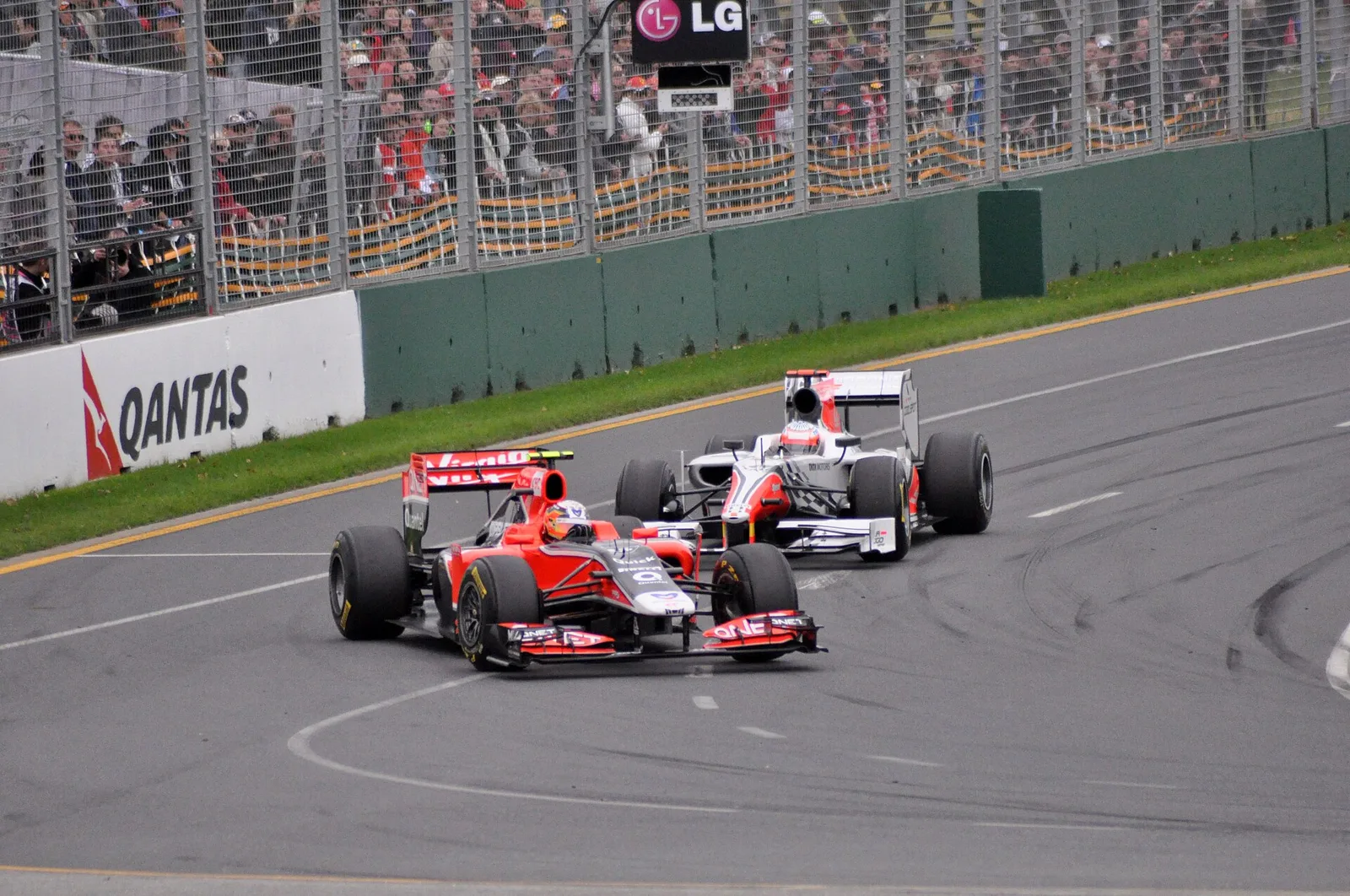
Vettel made the best start from pole, and he was unchallenged into the first corner, while the McLarens of Hamilton and Button started slowly from second and fourth on the dirty side of the grid. Hamilton's KERS button let him keep second from Webber into the first corner.
Button could not defend his position, as Alonso and Petrov came past him. Petrov took fourth, Alonso was pushed onto the grass and dropped back, and Button slipped to sixth behind Felipe Massa.
In the middle of the pack, Schumacher and Alguersuari collided, and both had to pit for repairs. Schumacher needed a new tyre after a puncture and Alguersuari a new front wing. Barrichello went onto the gravel in an attempt to avoid the incident and dropped to last.
How did Vettel pull away from Hamilton?
After one lap Vettel led Hamilton by 2.4 seconds, and by the end of lap two the gap had grown to 3.2 seconds. Hamilton then matched Vettel's fast laps and kept the gap at around three seconds, while Webber stayed right behind him.
Button spent many laps trying to pass Massa. He finally went around the outside at the Turn 11 chicane on lap 11, but he cut the chicane to complete the move and was given a drive-through penalty. He said on the radio that he felt he had the position, but the penalty stood.
Massa lost momentum, and the recovering Alonso passed him in the sister Ferrari, which made Button's position worse. Giving the place back would have meant letting both Ferraris past, so Button had to race on with a penalty and a track position that had not improved.
Pit stops, two-stop plans and the late stoppers
Vettel, Hamilton and Petrov ran two-stop strategies, while Alonso and Webber made a third stop each, and their second stops came much earlier than everyone else's, which began to show the shape of the race. Sergio Perez defied expectations with a single stop in his Sauber,.
Button was also on a two-stop strategy, and he had worked back into the points by the halfway point despite his drive-through penalty. Vettel made his stop and rejoined fourth behind Button, who had yet to serve his penalty and make his tyre stop.
Hamilton pitted two laps after Vettel and rejoined nearly seven seconds behind him, a disadvantage he could not recover from. Webber, Petrov, Alonso and Massa followed, and Webber rejoined on hard tyres, unlike the others.
Which drivers retired in the first half of the race?
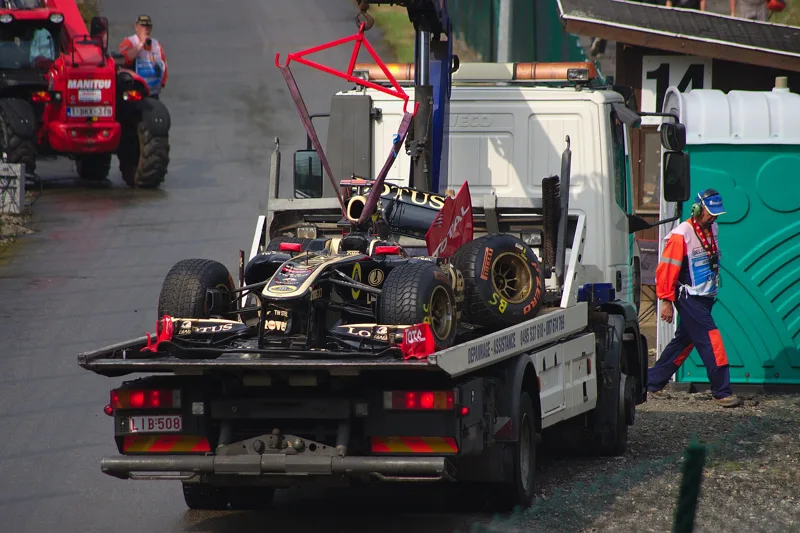
Pastor Maldonado was the first retirement, pulling over with a fault that the team later linked to the transmission. Michael Schumacher, damaged in contact with Alguersuari, followed several laps later, and Heikki Kovalainen's Lotus also retired with a water leak on the same lap. The Mercedes team judged it better to retire Schumacher than to risk further damage.
Nico Rosberg joined them after Barrichello attempted a pass up the inside into turn three. The contact damaged the side pod of Rosberg's car and sent Barrichello spinning. Rosberg's car gave off blue smoke for half a lap before he parked it safely, so the safety car was not needed.
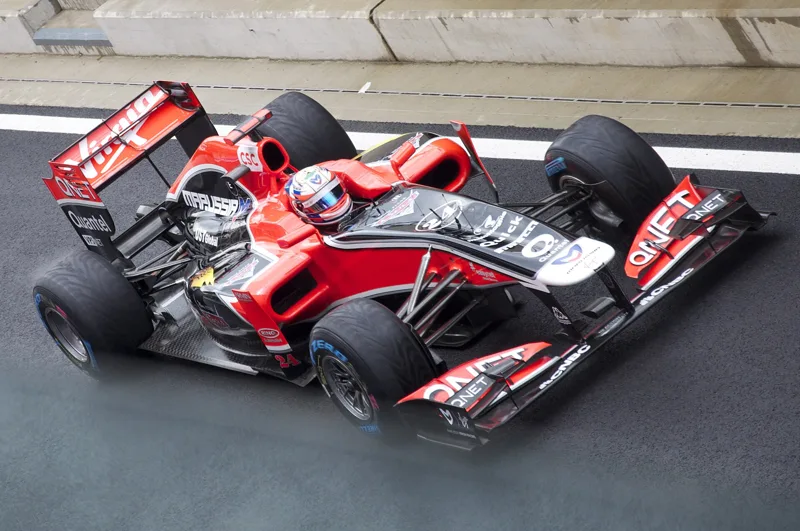
Timo Glock left the pits with a front wheel incorrectly fitted and drove a lap at walking pace. He went back to the garage to fix the wheel and rejoined later, but he had completed less than 90% of the winner's distance and was not classified. Barrichello later retired his Williams with a problem similar to Maldonado's, leaving the team without points.
How the closing laps settled the podium
Hamilton ran wide at the first corner, and the moment damaged his undertray. That was enough to stop him challenging Vettel. He stayed in second place as Webber and Alonso closed on Petrov.
Vettel crossed the line twenty-two seconds ahead of Hamilton, his third straight Grand Prix win, a run last managed by Button in mid-2009. Alonso closed fast on Petrov in the closing laps, yet Petrov kept him off long enough to take third.
That third place was the only podium finish of Petrov's career, and the first for a Russian national. Webber equalled his best result at Albert Park with fifth, while Button finished sixth ahead of Perez in seventh and Kobayashi in eighth.
Felipe Massa crossed the line ninth, almost ninety seconds behind Vettel. Sebastien Buemi claimed the final championship point in tenth, one lap down, and the points came to an end there.
What did the opener mean for Pirelli and the field?
| Finish | Driver | Team | Grid |
|---|---|---|---|
| First | Sebastian Vettel | Red Bull Racing | Pole |
| Second | Lewis Hamilton | McLaren | Second |
| Third | Vitaly Petrov | Renault | Sixth |
| Fourth | Fernando Alonso | Ferrari | Fifth |
| Fifth | Mark Webber | Red Bull Racing | Third |
| Sixth | Jenson Button | McLaren | Fourth |
Pirelli returned to Formula One as sole tyre supplier in 2011, its first race in that role since 1991. It was also Pirelli's first win as a tyre supplier since the 1991 Canadian Grand Prix, and the tyres had allowed several different pit strategies.
Neither Mercedes was classified, and that was the only race until the 2016 Spanish Grand Prix in which both cars failed to finish in the results. It was also the Grand Prix debut of Sergio Perez, who drove for Sauber.