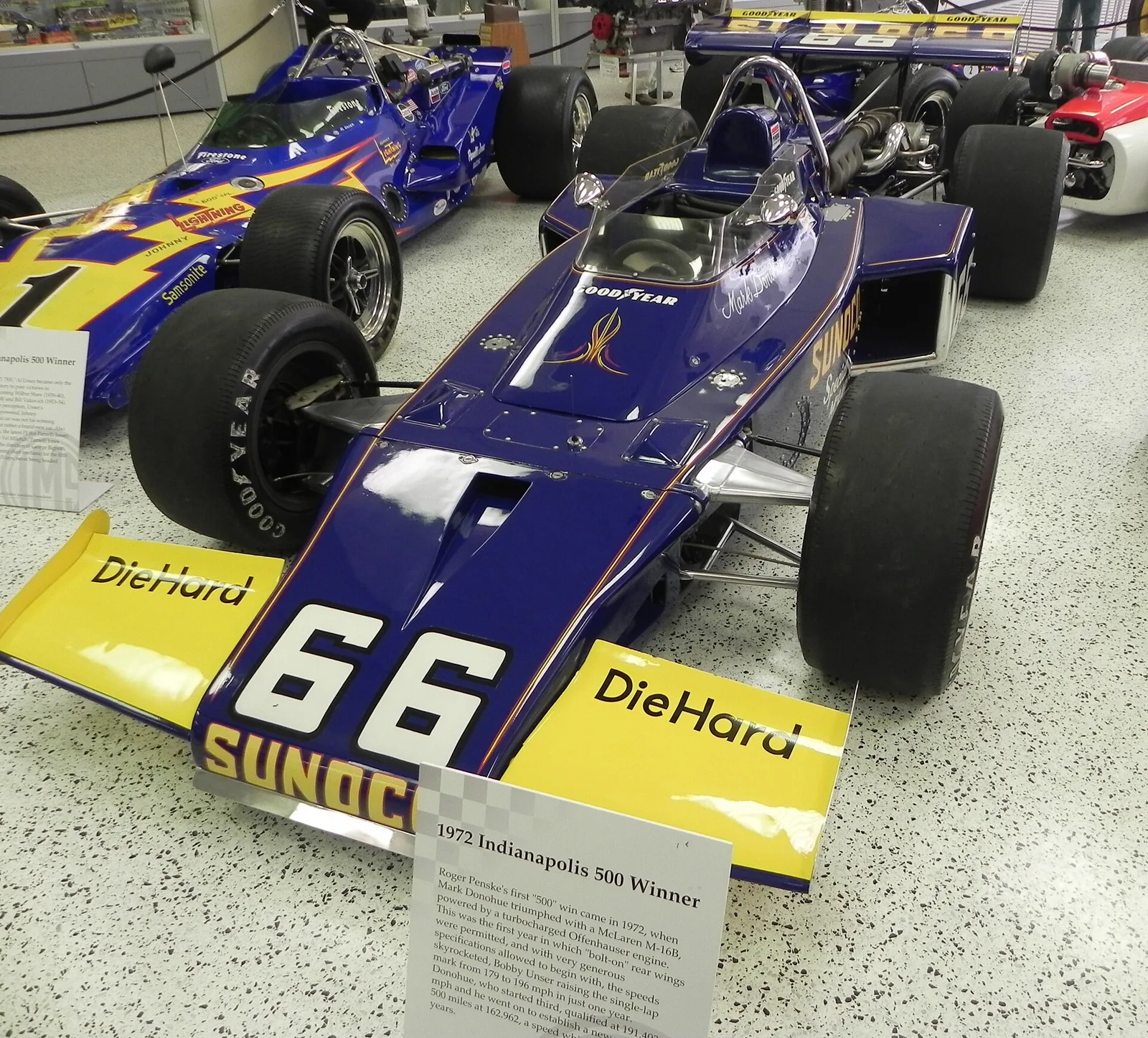
Mark Donohue won a race of record speeds and a disqualification after bolt-on wings lifted qualifying speeds above 190 mph.
Mark Donohue won the 1972 Indianapolis 500 on Saturday 27 May 1972 in a McLaren, leading only the final 13 laps after Jerry Grant was disqualified. Bolt-on wings were allowed for the first time, and Bobby Unser took pole at 195.940 mph.
The 1972 Indianapolis 500 was the 56th running of the race, held on Saturday 27 May 1972 at the Indianapolis Motor Speedway. Mark Donohue won it, leading only the final 13 laps, and it was the first race in which bolt-on wings were allowed. Speeds rose sharply that year, and the pole went to Bobby Unser at 195.940 mph.
Who won the 1972 Indianapolis 500?
Donohue won the race in a McLaren, the first Indianapolis victory for that chassis, and it marked the first of what is now twenty Indianapolis 500 wins for Roger Penske. Donohue inherited the lead on lap 188, when Jerry Grant's car was in the wrong pit stall, and he held it for the final 13 laps.
Gary Bettenhausen had led 138 of the first 175 laps before his car lost ignition on lap 175 and he finished 14th. Donohue's race average was 162.962 mph, a record that stood until 1984.
Bolt-on wings lifted the speeds at Indianapolis, and a late disqualification decided who finished second.
Bolt-on wings and the speed surge
USAC allowed bolt-on wings for the first time in 1972. Wings had previously been required to be integral parts of the bodywork, and the change raised downforce sharply, which pushed lap speeds up across the field during practice.
During a Goodyear tyre test in March, Bobby Unser reportedly lapped at 190.8 mph, the first driver to go over that speed unofficially. Practice then produced a string of records, including Jim Malloy's 181.415 mph, the first official-looking lap over 180 mph.
By the end of the first week, eleven drivers had practised over 180 mph. Gary Bettenhausen became the first driver of the month to top 190 mph, and Unser blistered the track at 194.721 mph on 10 May. Three drivers had passed 190 mph in practice by the Pole Day weekend.
What happened on Pole Day?
Pole Day had been scheduled for Saturday 13 May, but rain kept the track closed for most of the day. Only three cars got onto the track, and A. J. Foyt suffered an engine failure in turn two soon after setting off.
Qualifying moved to Sunday 14 May. Bill Vukovich II posted the first official lap over 180 mph, at 185.797 mph, but he spun on his second lap. Joe Leonard qualified at 185.223 mph, and Mario Andretti reached 187.617 mph.
Bobby Unser then took to the track and set the new one-lap record of 196.036 mph on his second lap. His four-lap average of 195.940 mph became the first official qualifying average over 190 mph at the Speedway, and it beat the previous year's record by more than 17 mph.
Twelve cars completed runs on Pole Day, and six were still waiting in line when the track closed at the 6 o'clock gun. Unser was the first to clear 190 mph officially, and the pole round was pushed into the following weekend.
Why was Jim Malloy's crash so serious?
Malloy slid wide out of turn three on the morning of 14 May and struck the outside wall of the north short chute. His injuries included fractures to the arms and legs, and burns, and he was in critical condition.
Four days later Malloy died of his injuries. The crash came at a time when the cars were running faster than their safety features were designed for, and the crash added to concern about the speeds.
How did the field fill on the later days?
Third Day on Saturday 20 May saw the front row settled. Mark Donohue put his car on the front row at 191.408 mph, and Peter Revson moved to second at 192.885 mph, while Unser held pole. The same three drivers had filled the front row in consecutive years for the first time since 1940 and 1941.
A. J. Foyt qualified at 188.996 mph, and Two-time defending winner Al Unser also made the field. Jerry Grant was the fastest Third Day qualifier at 189.294 mph, and by the end of the day the field stood at 27 cars.
Bump Day on Sunday 21 May was a hard day for several drivers. Gordon Johncock, who had blown five engines during the month, finally put a car in at 188.511 mph, the fastest speed of the day, and he qualified 26th.
Walther's run completed the field at 33 cars. Wally Dallenbach then sat on the bubble at 178.423 mph before Cale Yarborough bumped him by half a second at 178.864 mph, leaving Yarborough on the bubble himself.
Dallenbach made one last attempt in a backup car, but it began to smoke on the third lap and he had to wave off the run. All 33 cars in the field were faster than the pole car of the previous year.
What was the beer engine stunt?
Jim Hurtubise wheeled his front-engined Mallard roadster to the qualifying line shortly before the 6 o'clock deadline. The car carried sponsorship from Gohr Distributing, a Buffalo-area wholesaler promoting Miller High Life. Hurtubise had already qualified and said he might put someone else in the car.
He queued the car late on purpose, so it never reached the front of the line. When the engine cover was lifted, there was no engine, only a plastic-lined trough of ice and chilled bottles that he shared with the pit crews and officials.
The stunt was popular with the crowd but drew anger from some officials, and it was the first of several clashes between Hurtubise and USAC. The episode led to rules that require cars to pass a cursory inspection before reaching the qualifying line.
The Electro-PACER light system
The Electro-PACER Light system was installed around the track for the 1972 race to enforce the caution periods. At the time the pace car was not used under yellow, and the field did not pack up behind it.
The system used eight message panels set at equal intervals around the track, each showing a number from 1 to 9 for the gap to the car ahead, with small lights for fractions. Drivers were told to keep the same number at every board, and officials could issue penalties that included a one-lap penalty for repeated abuse.
The PACER system ran at Indianapolis from 1972 to 1978. Drivers found loopholes and it was hard to police, and the drivers themselves lobbied for the pack-up rule, which was adopted in 1979.
The 1972 race also added a minimum of four pit stops with fuel hookup, up from two in 1965 to 1967 and three in 1968 to 1971. Tyre changes were still optional, but rising speeds made them more common.
The race as it unfolded
Jim Nabors sang Back Home Again in Indiana before the race, which was the first time he had performed it. Tony Hulman then ordered the engines fired, and the field pulled away for two pace laps.
A. J. Foyt's car stalled on the grid and was still pushing away when the starter waved the pace car off and dropped the green flag early. Salt Walther dropped out with a parts failure right at the start, and the start was ragged.
Bobby Unser grabbed the lead in turn one and led the first 30 laps, with Mark Donohue and Jerry Grant close behind. On lap 31 Unser's ignition rotor broke, and Gary Bettenhausen inherited the lead.
Foyt's turbocharger failed, and he dropped out after several slow pit stops. Peter Revson, who had started second, was also out early, and Johnny Rutherford retired after starting eighth.
Mike Mosley took the lead on lap 54, but two laps later he lost a wheel in turn four and hit the outside wall. The impact ruptured the tank, and fire engulfed the car as it slid along the main straight. Mosley got out and tried to put out the flames, suffering burns but no serious injuries.
Wally Dallenbach had fires in the pits on lap 81 and again on lap 151. At the halfway point 13 cars were already out, and Bettenhausen was still leading.
Jim Hurtubise ran out of fuel after 94 laps. When the safety truck towed him back, it went through the infield and the garage gate rather than around the track, and he was disqualified for leaving the racing surface.
By the 400-mile mark eighteen cars had retired. Lee Kunzman lost a wheel in turn two on lap 147, which brought out a yellow on the leader's lap.
Why was Jerry Grant penalised?
Grant had taken the lead when Bettenhausen's car stopped, and then a bad tyre forced a stop on lap 188. He overshot his own pit stall and stopped in Bobby Unser's pit box, where his crew serviced the tyre and, in the confusion, Unser's crew refuelled Grant's car from Unser's pit tank.
The details were never fully explained, and historians still debate them. Grant later said the mistake was unintentional and he maintained his innocence. The next morning USAC disqualified him from that point on, which erased his final 12 laps and moved Al Unser Sr. up to second.
Each car was limited to 250 gallons of methanol in its pit-side tank, which was not counted in the race-start fuel. Grant's penalty left him 12th in the official order.
How did Donohue take the win?
Mark Donohue took the lead on lap 188 and led the final 13 laps to score his first Indianapolis victory. He became the first driver to win in a McLaren at Indianapolis, and the win also marked Roger Penske's first.
Under the rules of the time the remainder of the field could keep racing for about five minutes after the checkered flag. During that time Sam Posey stopped for fuel and finished fifth, while Mario Andretti ran out of fuel and fell from fifth to eighth.
Donohue's race average of 162.962 mph set a new record that lasted until 1984, and only Joe Dawson and Graham Hill had led fewer laps in a winning car in the race's history up to that point.
Other firsts in 1972
Vanguard Racing, with Leonard W. Miller involved, was the first team owned by African Americans to enter a car at Indianapolis. John Mahler, who is white, drove the car and retired after 99 laps when a piston failed.
The 1972 race was also the last to feature an all-American lineup for some time, because Mario Andretti, who was born in Istria, was a naturalised American citizen.
How was the race broadcast?
The IMS Radio Network carried the race live on more than 1,200 affiliates, with shortwave transmissions to Japan, Vietnam, the Arctic and Antarctica. The estimated audience was 100 million listeners worldwide. Sid Collins celebrated his 25th year as chief announcer.
Governor Edgar Whitcomb gave him the Distinguished Hoosier Award, and Mayor Dick Lugar declared 27 May 1972 Sid Collins Day.
On ABC, the race was broadcast on a same-day tape delay in prime time. Chris Schenkel hosted the two and a half hour programme, and Jim McKay and Jackie Stewart were the booth announcers.
Key figures for 1972
| Measure | Detail |
|---|---|
| Date | Saturday 27 May 1972 |
| Winner | Mark Donohue, who led the final 13 laps |
| Pole | Bobby Unser, 195.940 mph four-lap average |
| Race average | 162.962 mph, a record until 1984 |
| Bettenhausen laps led | 138 |
| Jerry Grant | Disqualified from lap 188, 12th in the final order |
| Front row | Unser, Revson and Donohue |